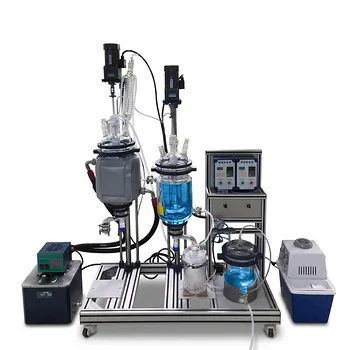
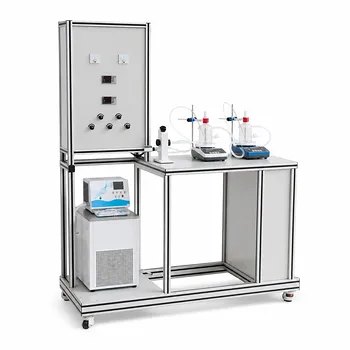
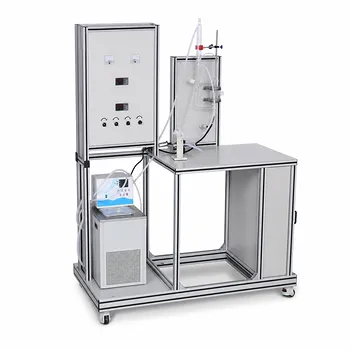
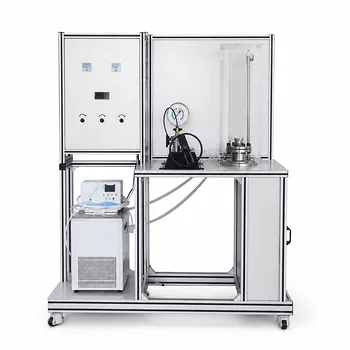
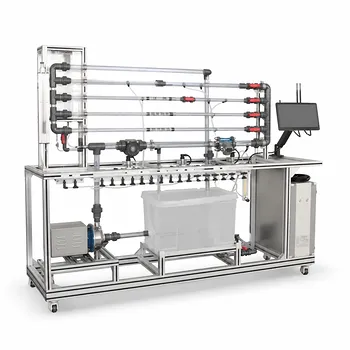
The equilibrium constant (K) is not just a silent spectator—it is the concrete, measurable limit that dictates whether your pilot‑plant reaction will succeed. In practical terms, K quantifies the maximum possible conversion of reactants into products at a given temperature. That single number directly shapes reactor size, residence time, and the separation train you must build. Because pilot plants give you precise control over temperature, they let you verify theoretical K values, explore thermal effects on yield, and optimize energy consumption long before you commit to a full-scale design.
The real power of K in a pilot plant is that it transforms a thermodynamic abstraction into an operational lever. By experimentally mapping how K changes with temperature, you set the boundary conditions for every other unit operation and create a fact‑based path from bench‑scale chemistry to industrial reality.
The Role of K in Reactor Design and Operation
A pilot plant exists to shrink the unknown. The equilibrium constant spells out what your reactor can deliver before you ever worry about mixing, mass transfer, or catalyst deactivation.
Sizing Reactors and Setting Residence Times
A large K means the reaction strongly favors products. With a known K, you can calculate the equilibrium conversion for a given feed composition and use that to set the reactor volume.
If K is small, the thermodynamic ceiling is low. You then know immediately that a simple single‑pass reactor will never hit a high yield, forcing you to consider recycle loops, reactive distillation, or continuous product removal. The pilot plant lets you test these strategies with the physical constraints of real hardware.
Planning Downstream Separation
The equilibrium composition directly determines the load on your downstream separation units. A reaction that leaves a high concentration of unconverted reactant demands a larger separation effort and higher energy input.
By measuring K under different conditions, you can assess whether shifting the equilibrium with temperature or pressure can reduce separation cost. This early‑stage insight prevents over‑design of distillation columns or extraction systems when scaling up.
Temperature as a Control Lever in Pilot Plants
Because K is temperature‑dependent, the pilot plant’s ability to hold and step temperature turns into a strategic advantage. You are no longer guessing how a 10‑degree change will affect your reactor; you can see it directly.
Verifying Thermodynamic Predictions Through Experiment
Textbook K values assume ideal solutions and simple activity coefficients. In a real bioprocess or chemical pilot plant, salts, solvents, and high substrate concentrations create non‑ideal behavior.
By running the reaction at several controlled temperatures and measuring steady‑state concentrations with inline gas chromatography or spectroscopy, you calculate experimental K values. This closes the gap between theory and reality, giving you confidence in the numbers you will feed into a commercial design.
Applying the van’t Hoff Equation to Optimize Energy
The van’t Hoff equation links the change in K with temperature to the reaction’s enthalpy. For an exothermic reaction, K drops as you raise temperature—pushing harder to speed up kinetics can actually lower the thermodynamic ceiling.
A pilot plant lets you find the optimal temperature where the reaction rate is high enough without sacrificing too much equilibrium conversion. You can also back‑calculate the enthalpy change from your experimental K‑versus‑T data, verifying the thermal duty required for scale‑up.
Distinguishing Thermodynamic Limits from Kinetic Reality
One of the sharpest distinctions a pilot plant teaches is the difference between what is possible (thermodynamics) and what actually happens (kinetics). K lives entirely on the thermodynamic side, and understanding it prevents you from chasing a yield that nature simply will not allow.
Using Gibbs Free Energy to Set Conversion Benchmarks
The equilibrium constant is directly related to the change in Gibbs free energy: ΔG° = –RT ln K. By computing ΔG° from the free energies of reactants and products (including solvation effects), you can predict K before a single experiment.
With that number in hand, you establish a theoretical maximum for conversion. When your pilot‑plant data fall short, you immediately know the gap is due to mass transfer, enzyme deactivation, or slow kinetics—not thermodynamics. This distinction guides where you invest your improvement effort.
Identifying when Kinetics, Not Equilibrium, Governs Yield
Some reactions reach equilibrium in seconds; others creep toward it for hours. A pilot plant equipped with real‑time sensors shows you the time course of concentrations. If the final conversion matches the K‑predicted value, the reactor is equilibrium‑limited.
If it does not, the process is kinetically controlled. You then shift focus to catalyst formulation, enzyme loading, or mixing intensity—knowing that pushing temperature might actually lower K and make things worse.
Understanding the Trade-offs
Treating K as a design target comes with real physical and economic costs. The pilot plant forces you to confront them honestly.
The Cost of Pushing Equilibrium Too Far
Shifting equilibrium by operating at extreme temperatures or pressures often demands expensive materials of construction and higher utility bills. In bioprocess pilot plants, high temperatures can irreversibly denature enzymes or kill cells, even if the thermodynamics still favor product formation.
Common Pitfalls in Pilot-Scale Equilibrium Studies
A frequent error is assuming the system has reached equilibrium when it is still changing slowly. Another is neglecting the effect of pressure on K for gas‑phase reactions, or ignoring activity coefficients in concentrated solutions. Without proper calibration and steady‑state verification, the K you calculate is not a true thermodynamic constant—it is an artifact that will mislead your scale‑up.
Making the Right Choice for Your Goal
Apply these insights based on what your pilot‑plant campaign needs to achieve.
- If your primary focus is confirming scale‑up feasibility: Measure K under your expected industrial conditions. If the equilibrium conversion is too low at a tolerable temperature, fundamental redesign is necessary before scaling.
- If your primary focus is energy optimization: Use temperature‑dependent K data to find the point where conversion and heating cost balance. An endothermic reaction may justify hot operation, while an exothermic one might benefit from intercooling or cold‑feed staging.
- If your primary focus is teaching or research: Let students compute K from free‑energy predictions, then experimentally verify it with the pilot‑plant data. The discrepancy teaches more about non‑ideality and mass‑transfer limits than any simulation alone.
Use K as the thermodynamic compass it is—let it define the possible, so you can engineer the actual.
Summary Table:
| Aspect | Practical Significance in Pilot Plants | Operational Impact |
|---|---|---|
| Reactor Sizing | Defines the thermodynamic ceiling of maximum conversion | Sets residence times and determines recycle loop needs |
| Downstream Separation | Determines the concentration of unconverted reactants | Optimizes separation energy and distillation column sizing |
| Temperature Tuning | Maps K-vs-T behavior using the van't Hoff equation | Balances reaction kinetics against equilibrium yields |
| Kinetics vs. Thermo | Distinguishes thermodynamic limits from rate limitations | Directs engineering focus (catalyst loading vs. temperature shifts) |
Bridge the Gap from Theory to Industrial Reality with LABPARK
Accurately mapping thermodynamic limits requires precise, reliable equipment. LABPARK provides premium Educational and Vocational Unit Operations Pilot Plants in chemical engineering, bioprocess & biotech, and environmental & water treatment. Engineered specifically for universities, research institutes, and enterprises, our pilot plants help you seamlessly verify theoretical K values, optimize thermal energy consumption, and scale up processes with confidence.
Ready to elevate your research and training capabilities? Contact our technical experts today to find the perfect pilot plant configuration for your facility.
Related Products
- Potassium Salt Thermal Dissolution and Crystallization Separation Educational Unit Operations Pilot Plant
- Multi Functional Catalytic Reaction and Reactor Evaluation Educational Unit Operations Pilot Plant
- Ternary Liquid-Liquid Equilibrium Educational Pilot Plant
- Binary System Vapor Liquid Equilibrium Data Determination Educational Unit Operations Pilot Plant
- Educational Unit Operations Pilot Plant for Intraparticle Diffusion Effective Factor Measurement
People Also Ask
- What are the benefits of integrating online PAT tools like ATR-FTIR into crystallization unit operations pilot plants?
- How do crystallization pilot plants improve student learning? Shift from manual observation to process control.
- Why is precise temperature control critical in crystallization pilot plants? Key to Scale-Up Success
- Control Crystallization Pilot Plant Secondary Nucleation: 4 Key Adjustments
- What key factors should be considered when configuring a crystallization unit operations pilot plant?