Comprehensive Educational Solutions for Food Engineering Unit Operations
In the realm of food engineering and chemical process education, understanding unit operations such as drying and evaporation is foundational. These processes are critical in the production of food powders, concentrates, and dehydrated products. LABPARK's Educational Food Engineering Pilot Plants are meticulously designed to provide students and researchers with hands-on experience that mirrors industrial reality, bridging the gap between theoretical concepts and practical application. Our pilot plants are not merely demonstration tools; they are fully functional, instrumented systems that empower learners to conduct meaningful experiments, analyze data, and develop a deep intuition for process design and optimization.
The Role of Pilot Plants in Modern Food Engineering Education
Traditional classroom instruction often fails to convey the dynamic complexities of food processing. Pilot plants fill this void by allowing students to manipulate process variables, observe real-time responses, and confront the uncertainties of actual operation. With LABPARK's systems, learners can explore the interplay between temperature, humidity, airflow, residence time, and material properties—insights that are impossible to gain from textbooks alone. This experiential approach enhances critical thinking, problem-solving skills, and prepares students for the multifaceted challenges of the food industry.
Multi-Functional Drying: Bridging Theory and Practice
The Multi-Functional Drying Educational Unit Operations Pilot Plant is a cornerstone of our educational lineup. It uniquely integrates three prevalent industrial drying technologies—tunnel drying, fluidized bed drying, and spray drying—within a single unit. This versatility enables institutions to offer a broad curriculum without requiring multiple separate setups, maximizing lab space and budget efficiency.
Tunnel Drying: In this mode, wet solid material is placed on trays within a heated air tunnel. Air flows over or through the material, gradually removing moisture. Students can study the falling rate period, constant rate period, and the influence of air velocity and temperature on drying rate. Data logging of weight loss over time yields classical drying curves, essential for understanding the diffusion of moisture and thermal degradation of food components.
Fluidized Bed Drying: Here, air is blown through a porous distributor plate, suspending solid particles in an upward gas stream. This fluidization enhances heat and mass transfer, resulting in rapid and uniform drying. Advanced experiments involve determining the minimum fluidization velocity, bed expansion, and the effect of particle size distribution on drying kinetics. The unit includes transparent sections for visual observation, allowing students to witness the fluidization phenomenon firsthand.
Spray Drying: A liquid feed (solution, emulsion, or suspension) is atomized into fine droplets and introduced into a hot drying chamber. Instantaneous evaporation creates dry powder particles. This process is vital in the production of milk powder, coffee, and encapsulated flavors. Our pilot plant features a pneumatic atomization nozzle and a cyclone separator for product recovery. Students can investigate feed rate, inlet air temperature, and atomization pressure to optimize yield and product quality.
Throughout these operations, the integrated data acquisition system monitors and records parameters like temperature, relative humidity, airflow, and pressure, facilitating comprehensive psychrometric analysis and the construction of drying rate curves.
Rising and Falling Film Evaporation: Advanced Heat Transfer Studies
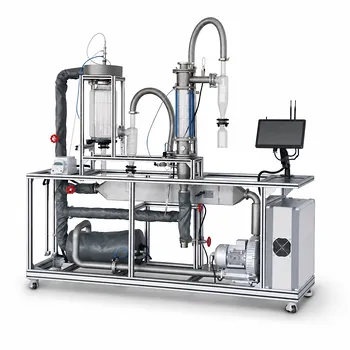
Evaporation is a key unit operation for concentrating liquid foods such as juices, dairy products, and extracts. The Rising and Falling Film Evaporation Educational Unit Operations Pilot Plant offers a unique dual-mode design, enabling students to compare two dominant evaporator configurations side by side.
Rising Film Evaporation: The liquid feed enters the bottom of a vertical tube, heated externally by steam. As the liquid rises, vapor bubbles form, inducing a two-phase flow that wets the tube walls and significantly boosts the heat transfer coefficient. This mode is effective for low-viscosity liquids and demonstrates the principle of thermal siphoning.
Falling Film Evaporation: Here, the liquid is distributed as a thin film flowing downward by gravity inside the tube wall, while heating medium surrounds the tube. This configuration ensures very high heat transfer coefficients, short residence time, and is ideal for heat-sensitive products because boiling occurs outside the film. Students can examine flow regime mapping, wetting rates, and the influence of feed rate on heat transfer performance.
The plant is equipped with industrial-grade instrumentation, including flow meters, temperature sensors, pressure gauges, and a vacuum system for low-temperature evaporation—reducing thermal damage to food constituents. The data logging software allows real-time visualization of temperature profiles, enabling students to calculate overall heat transfer coefficients and energy efficiency metrics such as steam economy. Comparative studies between the two modes provide a deep understanding of how flow dynamics affect evaporation performance, a critical insight for process selection in the food industry.
Convective Drying and Heat Transfer Coefficient Determination
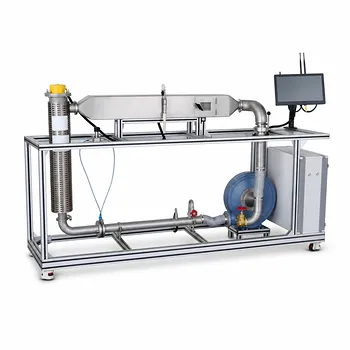
The Circulating Wind Tunnel Drying and Convective Heat Transfer Coefficient Determination Educational Pilot Plant is specifically designed for in-depth analysis of convective drying—a fundamental process in food dehydration. The unit consists of a closed-loop wind tunnel with a test section where a single wet sample (such as a fruit slice or hydrogel) is suspended. Air, conditioned to precise temperature and humidity, flows over the sample, while a precision balance continuously records mass loss.
Key educational outcomes include:
- Determination of the drying curve (moisture content vs. time) and drying rate curve.
- Evaluation of the critical moisture content marking the transition from constant rate to falling rate period.
- Calculation of the convective heat transfer coefficient from experimental data using the analogy between heat and mass transfer (e.g., Lewis relation).
- Study of the effects of air velocity, temperature, and relative humidity on drying kinetics.
- Development of mass transfer coefficients based on the driving force (humidity ratio difference).
Psychrometric principles are woven throughout the experiment. Students learn to use psychrometric charts or equations to determine air states, and gain hands-on experience with humidity sensors. The data acquisition system facilitates automatic recording and processing, allowing for rigorous error analysis and report generation.
Customization and Integration with Your Curriculum
LABPARK understands that every educational institution has unique pedagogical goals and physical constraints. That's why all our pilot plants are fully customizable. From the frame material and sensor selection to the integration of specific control strategies (PLC, DCS, or manual), we tailor each system to align with your syllabus. Whether you need additional ports for sample withdrawal, enhanced safety features for undergraduate labs, or the ability to run multi-phase research projects, our engineering team collaborates with you from initial design to final commissioning.
Every LABPARK pilot plant can be customized to include additional features such as:
- Explosion-proof construction for solvent-based products.
- Hygienic design with CIP (clean-in-place) capabilities for food-grade compliance.
- Extended data acquisition with wireless sensors and cloud connectivity for remote learning.
- Pre-programmed experiments with step-by-step guides for novice users.
Such flexibility ensures that the equipment remains relevant as course content evolves.
Educational Benefits Beyond Operation
Beyond mastering unit operations, our pilot plants cultivate essential soft skills: teamwork in experimental design, data interpretation, and troubleshooting. Students learn to calibrate sensors, validate measurements, and assess the reliability of their results—skills directly transferable to quality assurance and R&D roles. The open architecture of our systems encourages creative experimentation, allowing advanced students to test novel drying methods or integrate by-product recovery mechanisms.
Professional Support and Services from LABPARK
With decades of experience in designing unit operations pilot plants for universities and research institutes worldwide, LABPARK is your trusted partner in educational hardware. We offer comprehensive services beyond equipment delivery:
- On-site installation and calibration by our field engineers.
- Detailed operation manuals and standard operating procedures (SOPs).
- Training workshops for faculty and laboratory technicians.
- Ongoing technical support and maintenance contracts.
- Assistance with developing laboratory manuals and experimental protocols.
Our commitment to quality ensures that each pilot plant is built with robust industrial-grade components, guaranteeing durability and reliability under continuous use. Safety interlocks, emergency stops, and clear labeling are standard features, meeting international laboratory safety standards.
Take the Next Step in Elevating Your Laboratory
Empower your students with the tools they need to excel in food engineering. LABPARK's Educational Food Engineering Pilot Plants transform abstract equations into tangible experiences, fostering the next generation of food scientists and process engineers. If you are looking to enrich your curriculum with state-of-the-art drying and evaporation technology, we invite you to discuss your needs with our specialists. Contact us today via our inquiry form [link to #ContactForm] to schedule a consultation, request a detailed proposal, or arrange a virtual demonstration. Let us help you create a learning environment that inspires innovation and mastery. Your journey towards a more engaging and effective engineering education starts here.