The $1,000 Per Hour Experiment
A new polymeric membrane sits in a laboratory. In a pure-gas test, it shows breathtaking selectivity for CO₂ over nitrogen. The research paper is published. The spin-off company secures funding.
Three years later, the pilot plant fails. The membrane, exposed to real flue gas saturated with water vapor and trace sulfur dioxide, plasticizes within weeks. Its selectivity collapses. The economic model, built on that perfect lab data, turns to fiction.
This story repeats itself across the carbon capture industry. The graveyard of failed scale-ups is filled with materials that were perfect in theory.
The root cause is not bad science. It is a missing bridge. A membrane separation pilot plant is that bridge—an instrument that translates pristine material physics into messy industrial truth.
Why Pure-Gas Tests Lie
A membrane is not a static filter. It is a dynamic, thermodynamic interface that changes shape, swells, and ages when it touches real gas.
The Illusion of Simplicity
In a pure CO₂ test, the driving force is clean. The molecule dissolves, diffuses, and desorbs. The numbers look beautiful.
But flue gas is not pure. It is a dilute, chaotic cocktail. Carbon capture from a coal boiler means dealing with a stream that is only 10-20% CO₂. The rest is nitrogen, oxygen, water, and acid gases. Each component interacts with the polymer matrix differently.
When you test with a CO₂/N₂ mixture, you immediately see competitive sorption. Nitrogen molecules occupy space. They slow down CO₂. The selectivity drops—sometimes by 30% or more. This is not a flaw in the membrane; it is reality.
The Silent Saboteur
The most dangerous component is usually water.
Water vapor induces plasticization in glassy polymers. The polymer chains, once rigid and selective, become mobile. They lose their ability to discriminate between gas molecules. A membrane that started with a CO₂/N₂ selectivity of 50 can drift down to 15. You cannot see this coming from a dry gas experiment.
A pilot plant lets you introduce steam into the feed stream systematically. You document the decline. You learn what happens not just over hours, but over months.
The Levers That No Model Predicts
Theoretical models treat a membrane as an isothermal, isobaric black box. A pilot plant reveals the gradients inside.
The Pressure Drop Penalty
To push gas through a dense membrane, you need high pressure—often 5 to 15 bar gauge. This pressure creates a driving force for permeation. But it also creates an axial pressure drop along the module's fiber length.
The feed pressure at the inlet is high. Near the outlet, it has dropped significantly. The driving force becomes uneven. The last quarter of your membrane module does far less work than the first quarter.
This is invisible in a textbook. On a pilot skid, you measure it with differential pressure transducers. You see the energy cost:
- Higher flow = higher flux, but also higher pressure drop.
- Tighter packing = more membrane area, but a steeper pressure gradient.
- The trade-off becomes a quantifiable engineering decision.
Concentration Polarization
Near the membrane surface, a boundary layer forms. The rejected species—say, nitrogen—accumulates. The CO₂ concentration right at the surface is lower than in the bulk stream. The driving force suffers.
This effect scales non-linearly with module size. A small laboratory coupon barely feels it. An industrial-scale module suffers a serious efficiency penalty. The only way to measure the polarization modulus is through a pilot plant with controlled hydrodynamics and precise compositional analysis at both permeate and retentate ports.
The Economics of the Stage Cut
Here is where the pilot plant transforms an operator into a systems thinker.
The stage cut is the ratio of permeate flow to feed flow. Turn it up, and you pull more CO₂ through: high recovery. Turn it down, and you get a more concentrated permeate: high purity.
You cannot have both.
The Single-Stage Trap
In a single-stage system, the math is cruel. If your feed is 15% CO₂, and you want 95% capture, your permeate purity will suffer as the driving force diminishes toward the exit. Pilot plant data precisely maps this curve. More often than not, it shows that a single-stage design is economically non-viable for high-purity targets.
The Redemption of Recycling
A multi-stage pilot plant changes the equation entirely. You take the retentate from a first stage and send it to a second. You take the second stage’s permeate—which still has some CO₂—and recycle it back to the feed compressor.
You witness the mass balance closing. The yield rises without sacrificing purity. Students and engineers learn this by adjusting valves and watching real-time gas chromatograph readings. They feel the surge pressure in the recycle line. They hear the compressor load change. This is embodied learning about process integration that no simulation can deliver.
Why Piloting is an Act of Humility
No one scales up a new membrane chemistry directly to a $100 million demonstration plant. The intermediate step is a pilot plant that runs for 2,000 to 5,000 hours. Why? Because you are not just testing separation; you are testing material endurance.
Consider the practical failures a pilot catches:
- Trace Acid Gas Attack: Your flue gas simulation includes 50 ppm of SO₂. Over three months, the membrane's active layer chemically degrades. The permeance drops, and the selectivity crashes. You have just saved your company from ordering 2,000 modules with a fatal material incompatibility.
- Plasticization Drift: A glassy polymer works by freezing chain mobility. High CO₂ concentrations in the feed cause swelling. The pressure you apply tries to collapse the free volume. There is a hysteresis battle. A pilot plant tracks this drift in real-time, showing you the stable operating window that differs radically from the pure-gas prediction.
- Fouling Kinetics: Aerosols, compressor oil carryover, fine particulates—they accumulate on the membrane face. Your feed spacer design matters. Your pre-treatment philosophy matters. You watch the transmembrane pressure rise over a 2-week run and realize that your membrane is robust, but your upstream knock-out drum design is not.
The pilot plant is a truth machine. It is an instrument of intellectual honesty.
Choosing What Your Plant Must Prove
Not all pilot campaigns are the same. The question you ask determines the configuration.
Scenario A: Fundamental Research
Your goal is to extract solubility and diffusivity coefficients for a novel mixed-matrix membrane. You design an experiment that varies one parameter at a time:
- Constant temperature, sweeping pressure from 5 to 20 bar.
- Constant pressure, changing temperature from 25°C to 55°C.
- Introducing a single impurity at a known concentration.
You fit the permeance and selectivity data to the solution-diffusion model. You reverse-engineer the transport parameters. The output is not an engineering design; it is a peer-reviewed paper with mechanistic certainty.
Scenario B: Material Screening
An R&D group has ten candidate hollow fiber modules. They all claim high CO₂/N₂ selectivity. You subject all ten to the same brutal protocol:
- 15% CO₂, 5% O₂, 80% N₂, saturated with water vapor.
- Feed at 10 bar, 40°C.
- Run continuously for 1,000 hours.
You rank them not by their initial flux, but by the stability of their selectivity over time. By hour 800, eight candidates have failed. Two are left standing. You have just made a multi-million-dollar material selection decision with confidence.
Scenario C: Education
You bring a class of chemical engineering students to the skid. You ask them to run the plant first with a 70% CO₂ feed, mimicking a purification stream, then with a 12% CO₂ feed, mimicking a power plant flue gas.
They calculate the membrane area required. For the same capture rate, the low-concentration feed demands over five times the area. They compute the compressor energy. The lesson lands with physical force: dilution is the fundamental economic enemy of CCS.
This is not memorization. It is muscle memory.
What a Pilot Plant Actually Looks Like
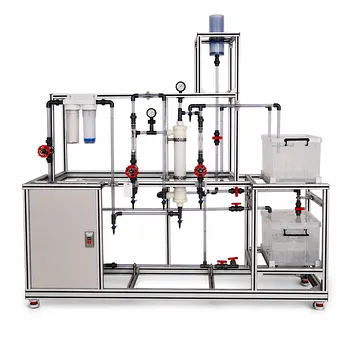
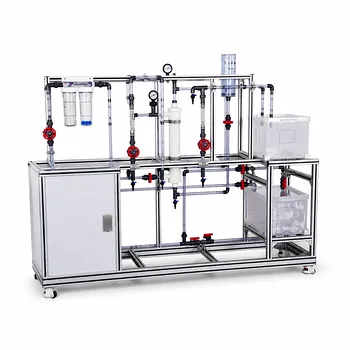
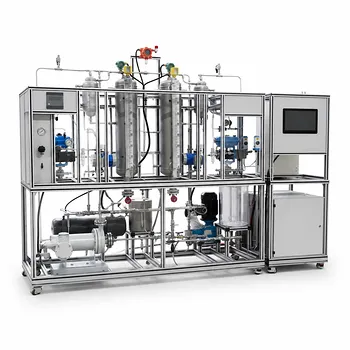
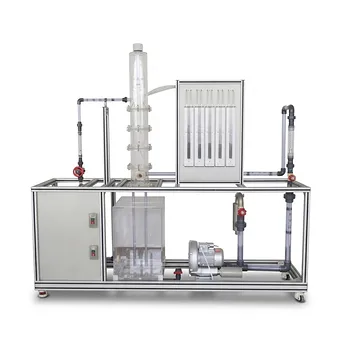
The physical system comprises interconnected modules that mirror an industrial plant in miniature:
| Subsystem | Function | What You Control & Measure |
|---|---|---|
| Gas Blending Station | Mixes CO₂, N₂, and impurity bottles with mass flow controllers. | Precise feed composition (±0.1% accuracy). |
| Pre-treatment & Humidification | Heats the stream to operating temperature and introduces controlled steam. | Dew point or relative humidity sensor to set plasticizing conditions. |
| Membrane Housing & Module | Houses polymeric, ceramic, or hollow-fiber test coupons or mini-modules. | Differential pressure transducers at inlet, outlet, and permeate sides. |
| Back-Pressure Regulation | Maintains feed and retentate pressure independently via PID-controlled valves. | Feed pressure, retentate pressure, stage-to-stage pressure drop. |
| Online Analysis | GC or dedicated IR/paramagnetic sensors on feed, permeate, and retentate lines. | Real-time CO₂ concentration, permeate purity, and instantaneous selectivity. |
| Permeate Flow Measurement | High-precision mass flow meter or wet test meter on the low-pressure side. | Permeate flux (GPU) calculation and stage cut determination. |
Every component is an instrument, not just a piece of hardware. The data pipeline from sensor to SCADA screen turns invisible physical phenomena into visible trends.
The Engineering Romance of the Solution-Diffusion Model
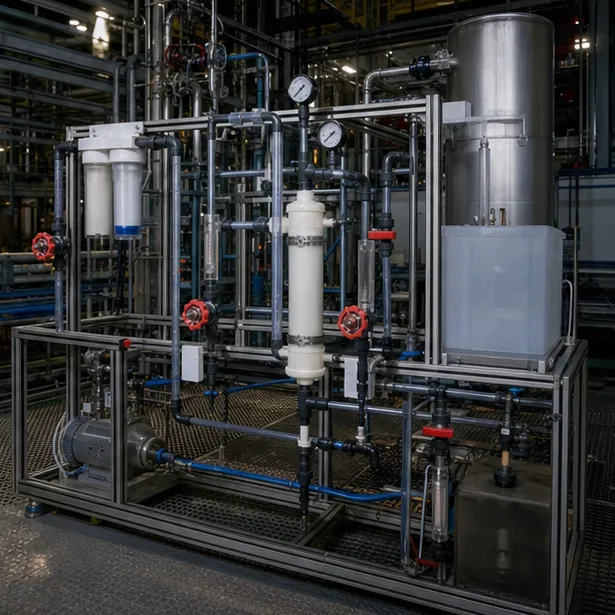
There is something beautiful about making an abstract model tangible.
Gas transport through a dense membrane follows three steps: sorption into the upstream face, diffusion through the polymer matrix driven by a concentration gradient, and desorption from the downstream face.
In a classroom, these are differential equations. In a pilot plant, you feel them. You see that increasing the pressure differential increases the permeation flux. You see that the selectivity is not a constant; it is a ratio of permeabilities that shifts with temperature.
You run experiments that separate the thermodynamic component (solubility) from the kinetic component (diffusivity). You come to understand, in your bones, why glassy polymers are diffusion-selective and rubbery polymers are solubility-selective.
This is the heart of the educational value. The pilot plant does not just teach you how to operate a unit operation. It teaches you how to think like a physical chemist confronting an industrial problem.
Bridging the Gap to a Real Career
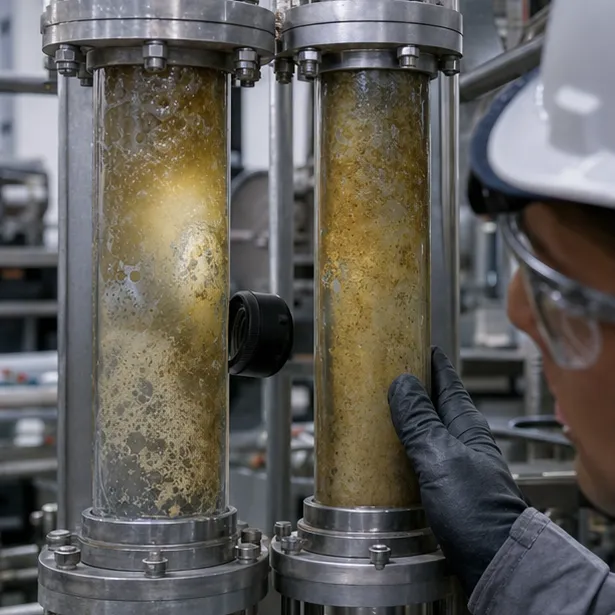
For an enterprise, the ROI of a pilot plant is risk mitigation. For a university or research institute, the ROI is human capital.
A graduate who has operated a membrane skid—who has wrestled with a stuck back-pressure regulator, who has diagnosed a GC baseline shift, who has calculated a mass balance closure error and hunted down the leak—is employable on day one.
They understand that a P&ID is not just a drawing; it is a map of causality. They know that a control valve's hysteresis can ruin an experiment if not recognized. They have developed a sense, almost an intuition, for the time constants of a separation process.
This practical wisdom is exactly what companies building the next generation of carbon capture plants desperately need.
Making the Choice
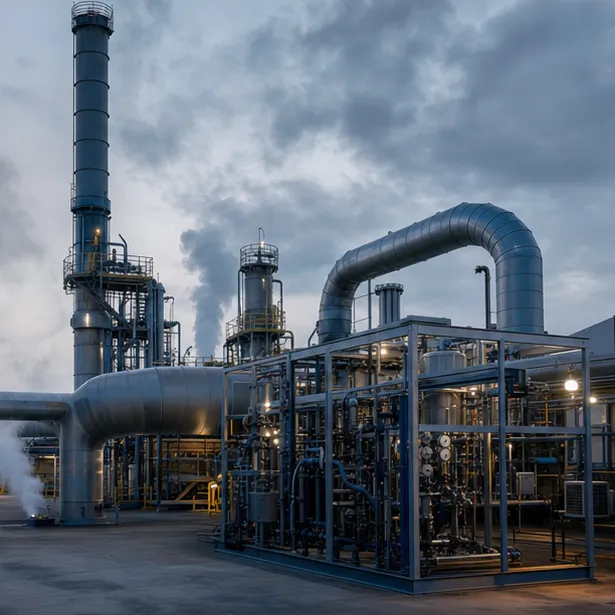
Selecting a pilot plant is a strategic decision. It should match your goal precisely.
The right system is not an appliance. It is a research instrument designed for exploration. Modularity is key. You need to reconfigure the flow path, swap membrane cells, add analytical instruments, and introduce new impurity streams as your study evolves.
Whether your lab focuses on bioprocess gas separation, natural gas sweetening, or post-combustion carbon capture, the facility must offer industrial-grade robustness with laboratory-scale precision.
Contact Our Experts to discuss how a purpose-built membrane separation pilot plant can become the most honest and valuable instrument in your laboratory portfolio.
Related Products
- Ultrafiltration Membrane Separation Educational Pilot Plant
- Multifunctional Membrane Separation Educational Pilot Plant with Ultrafiltration, Nanofiltration, Reverse Osmosis
- Multi-Functional Membrane Separation Educational Pilot Plant for Unit Operations Lab
- Hollow Fiber Ultrafiltration Membrane Separation Educational Pilot Plant
- Multi Functional Membrane Crystallization Educational Unit Operations Pilot Plant