She had the number every researcher dreams of. A flawless CO₂/N₂ selectivity, measured on a pristine polymer film in a stainless‑steel permeation cell. The academic paper wrote itself. Then came the pilot run—where a trace of water vapor and 20 parts per million of SO₂ reduced that selectivity by nearly half in less than a week.
This is the ideal‑selectivity trap. A single‑gas laboratory measurement gives you the membrane’s intention. A pilot plant gives you its behavior. For engineers working on carbon capture, the distance between those two facts determines whether a technology becomes a climate solution or another filing cabinet full of clever materials that couldn’t scale.
The Gap Between a Cell and a Capture Plant
A palm‑sized membrane coupon in a temperature‑controlled cell sees a world that does not exist. It breathes pure gases. It avoids pressure spikes. It never meets the aerosol particles, heavy metals, or unglamorous condensables that ride along in real flue gas.
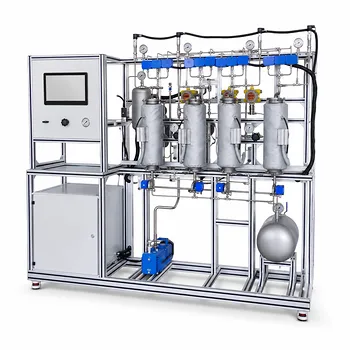
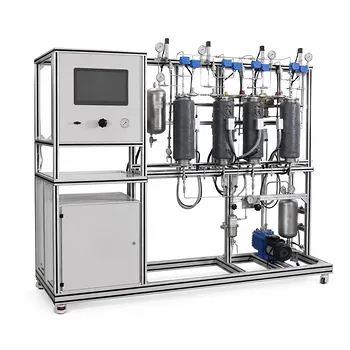
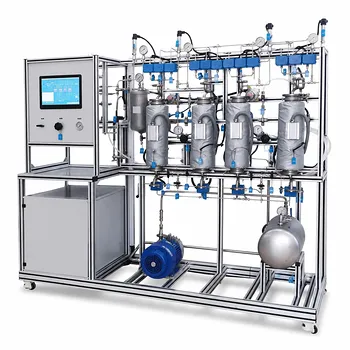
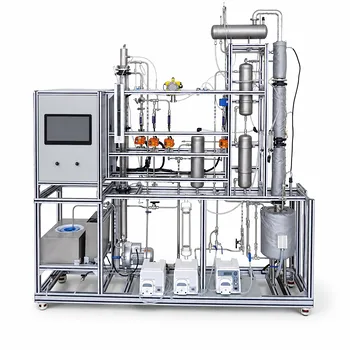
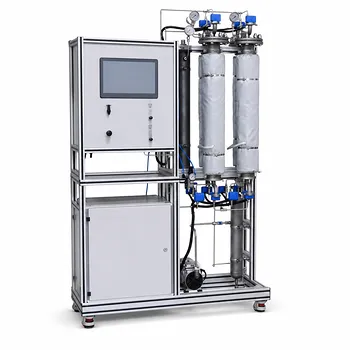
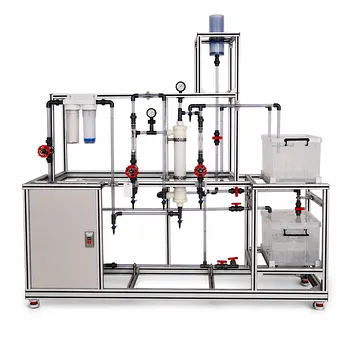
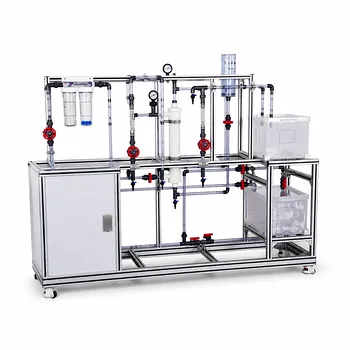
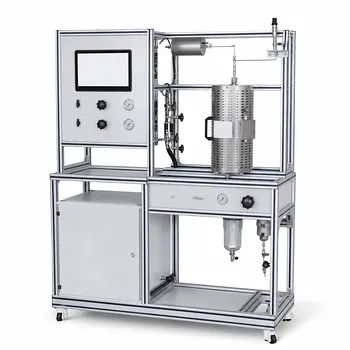
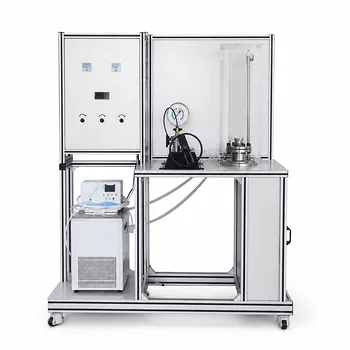
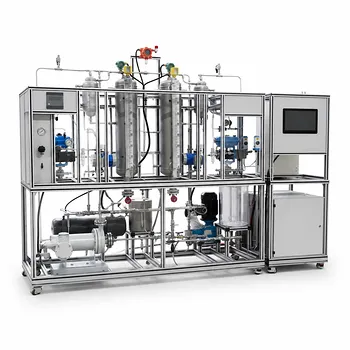
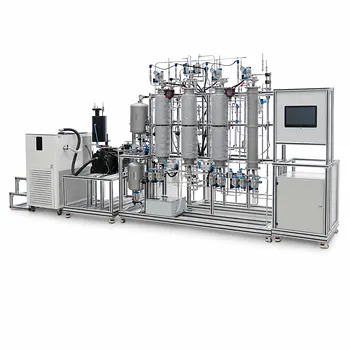
The pilot plant closes that reality gap. It is not just a bigger holder for a membrane. It is a compressed, instrumented version of the future—a place where molecular transport theory collides with the hydraulic, thermal, and chemical stresses of an industrial stack.
Why Blended Streams Tell a Different Story
Real flue gas is never a neat binary mixture. A pilot plant equipped with mass flow controllers creates precise, repeatable blends: CO₂ and N₂ in ratios that mimic coal‑fired exhaust, doped with controlled amounts of water vapor, SO₂, or hydrocarbons.
These minor components are not spectators. Water can plasticize a glassy polymer, swelling the matrix and letting nitrogen slip through. SO₂ can compete for sorption sites. In a lab cell you guess; in a pilot plant you watch it happen on a gas chromatograph, minute by minute.
The Solution–Diffusion Mechanism Under Process Stress
Gas transport through polymeric membranes follows the solution–diffusion mechanism. Molecules dissolve into the polymer and then diffuse across it. This sounds clean in a textbook. In a pilot plant, you learn that a 20 °C temperature rise may boost diffusion but simultaneously reduce solubility, shifting permeability in ways no room‑temperature measurement can predict.
You also confront the hidden variable of compaction. As feed pressure rises, the selective layer grows denser, permanently crimping permeability. A pilot plant lets you map this irreversible decay against the gains in purity—trade‑offs you simply cannot quantify on a single‑gas rig.
The Two Numbers That Decide a Membrane’s Fate
A membrane’s commercial worth rests on permeability—how fast a gas moves through—and selectivity, the ratio of permeabilities between the target gas and everything else. The research community loves to report these numbers at 25 °C and 1 bar. A pilot plant tests whether that selectivity of 80 holds when a third component joins the feed and the pressure ratio hits 15.
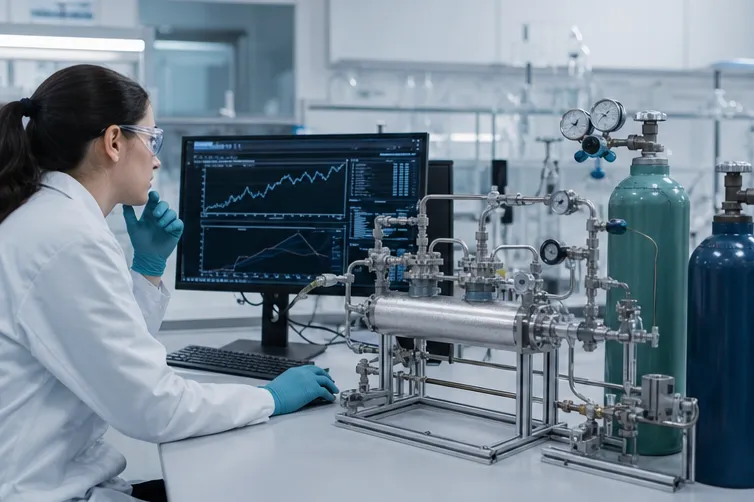
With an online gas chromatograph sampling both permeate and retentate, the pilot plant turns mass balance into process‑grade accuracy. It shows you the effective selectivity in service, not the intrinsic selectivity in isolation. Often, the difference is humbling.
Fouling: The Slow Dismantling of Your Economic Model
Fouling is the silent killer of membrane economics. It arrives as a thin film of condensed hydrocarbons, as a vapor that plasticizes, as a particle that blocks. In the laboratory, membranes die of old age; in the field, they die of poisoning.
A pilot plant runs multi‑day experiments with challenge streams that contain these agents. The resulting decline curves are not pretty, but they are honest. They give you a realistic replacement interval. Without this data, any cost model is built on a fouling‑free fantasy—an optimistic spreadsheet that collapses the moment the real plant starts up.
The Optimism Woven into Every Pilot Curve
Even pilot data, for all its realism, carries a psychological bias. A pilot campaign lasts weeks or months; an industrial module must work for years. Accelerated aging tests can suggest how a polymer degrades, but they rarely capture the full synergy of thermal cycling, vibration, and unpredictable contaminant spikes. Researchers tend to treat the resulting lifetimes as a fixed forecast. Wise engineers treat them as an upper bound—and then add a generous safety factor.
This is the Morgan Housel insight: we crave precise numbers, but the world delivers messy probabilities. A pilot plant reduces uncertainty, but it does not eliminate it. The membrane that survives 500 hours may not survive 50,000. Acknowledge that gap, and your scale‑up plan grows sturdier.
The Translation of Physics into Economics
A membrane that delivers 99 % purity in a pilot plant can still fail economically if the feed compression consumes more energy than an amine scrubber. This is the second trap: confusing technical elegance with cost advantage.
A pilot plant, instrumented for mass and energy balance, lets you calculate the specific energy demand per ton of CO₂ captured. It reveals that a moderate‑selectivity, fouling‑resistant membrane often produces cheaper capture than an ultra‑selective material that needs constant protection. You see these truths only if you analyze the data through an economic lens, not just a materials‑science one.
Making the Right Choice for Your Mission
The same pilot‑plant hardware serves different masters beautifully, provided you know what to measure. Align your experimental design with your ultimate goal.
- If you are optimizing material performance: Map how permeability and selectivity respond to incremental changes in feed pressure and temperature, locating the stable operating window.
- If you are developing a carbon capture process: Simulate a stream containing representative impurities and run long‑duration trials to quantify fouling rates and cleaning protocol effectiveness.
- If you are educating future engineers: Use the pilot plant to physically demonstrate how stage cut, pressure ratio, and module geometry link the solution‑diffusion model to real purity and recovery outcomes.
- If you are de‑risking a scale‑up decision: Run a full industrial module under design conditions and anchor a techno‑economic model with the data, comparing your membrane route head‑to‑head with pressure swing adsorption or absorption.
| Research Focus | Key Parameters Tracked | Practical Outcome |
|---|---|---|
| Material Performance | Permeability, selectivity, pressure, temperature | Stable operating window mapping |
| Process Development | Impurity effects, fouling rates, cleaning cycles | Long‑term durability baseline |
| Education & Training | Stage cut, pressure ratio, module geometry | Theory validation (solution–diffusion) |
| Industrial Scale‑Up | Module testing under field‑simulated conditions | Techno‑economic risk reduction |
A Purpose‑Built Instrument for a Necessary Truth
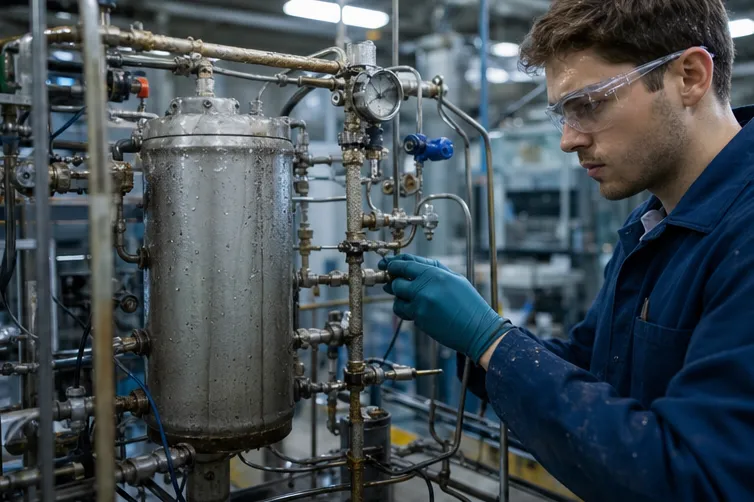
A membrane pilot plant is your compressed, accelerated version of the future. It translates the language of polymer physics into the language of operational budgets and capture costs. It takes a material’s elegant promise and stress‑tests it until only the durable facts remain.
For universities, research institutes, and enterprises working on carbon capture, having access to a system that blends gases, controls pressure, and tracks degradation over time is no longer a luxury. It is the difference between publishing another paper and delivering a process that works.
LABPARK designs and delivers such systems—Educational and Vocational Unit Operations Pilot Plants that bring industrial‑grade rigor to chemical engineering and environmental laboratories. Their platforms enable you to study polymeric gas separation with the same analytical depth you would demand in a commercial plant, while remaining accessible enough for hands‑on training and curriculum development.
The gap between a promising membrane and a reliable carbon capture process is measurable—and conquerable—with the right experimental tool. Contact Our Experts
Related Products
- Carbon Dioxide Adsorption and Capture Educational Unit Operations Pilot Plant
- Bench Scale Carbon Dioxide Capture Educational Unit Operations Pilot Plant
- Carbon Dioxide Capture and Utilization Educational Pilot Plant for Unit Operations
- Carbon Dioxide Absorption and Desorption Educational Pilot Plant for Carbon Capture Studies
- Low Concentration Carbon Dioxide Capture Pressure Swing Adsorption Educational Pilot Plant
Related Articles
- The Machine That Teaches Green Chemistry by Making Pressure Visible
- The Invisible Thread: How Supercritical CO₂ Weaves a Future Without Water
- The Invisible Constraint: How First-Principles dCO₂ Modeling Turns Your Pilot Plant into a Predictive Engine
- The Physics of Safety: Why Supercritical CO2 Turns a Pilot Plant into a Classroom Without a Poison Cabinet
- The Solvent That Disappears: Supercritical CO₂ and the New Logic of Pilot Plant Operations