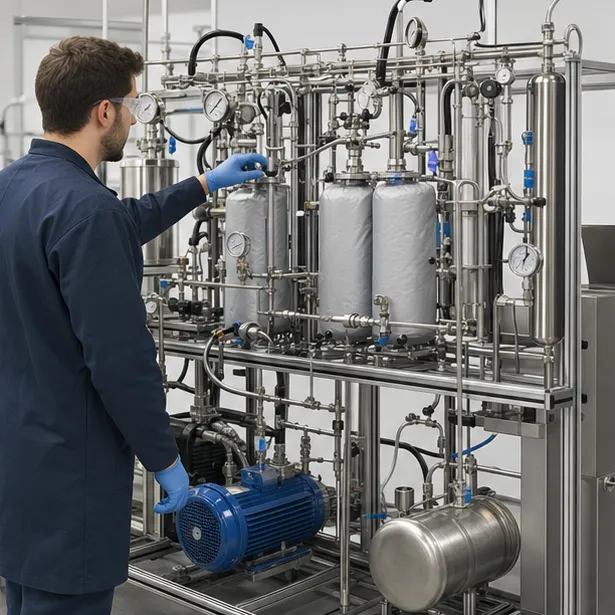
The Graduate Student’s Bargain
Every chemical engineering student learns about the trade-off eventually. You want a clean extract, so you choose a solvent. You want speed, so you heat the system—and degrade half the molecules you were trying to capture. You want purity, so you add a distillation step that consumes more energy than the rest of the process combined.
This bargain is so familiar it becomes invisible. We assume a pilot plant must be a scaled-down version of an industrial Faustian pact: yield versus purity, safety versus performance, speed versus selectivity.
Supercritical fluid extraction (SFE) with carbon dioxide breaks that assumption. It rewrites the bargain entirely. And in doing so, it changes what a pilot plant can teach.
The Critical Point Is a State of Mind
When CO₂ is pushed past 31 °C and 7.38 MPa, it enters a thermodynamic gray zone. Not liquid. Not gas. Something that has the density of a liquid but the diffusivity and viscosity of a gas.
Most people read those numbers and see a phase diagram. A few—the ones who will redesign entire separation trains—see a philosophical shift.
A solvent that dissolves like a liquid but flows like a gas solves a cascade of downstream problems before they even appear. The very physics of the supercritical state eliminates boundary-layer resistance, thermal degradation, and solvent residue in a single stroke.
The Three Burdens That Disappear
1. Toxicity Leaves the Building
Traditional extraction methods carry an unspoken cost: the solvent itself. Dichloromethane, hexane, and their relatives don’t just dissolve target compounds—they create regulatory liabilities, ventilation requirements, and disposal streams that haunt a plant for years.
CO₂ is non-toxic and non-flammable. More importantly, it removes itself. Depressurize to ambient conditions and the solvent simply gasifies, leaving behind an extract that needs no further cleanup. No cancer warnings on the lab door. No solvent-recovery distillation columns consuming steam. This single property can slash volatile organic compound emissions by 60–80% compared to conventional methods.
2. The Mass Transfer Bottleneck Unblocks
Liquid solvents suffer from sluggish diffusion. The solute must cross a stagnant boundary layer that throttles the speed of every extraction. Supercritical CO₂, with its gas-like diffusivity and near-zero surface tension, shrinks that boundary layer to a whisper. Equilibrium that took hours arrives in minutes.
In a teaching pilot plant, that temporality matters. A student can run three experiments in an afternoon instead of one per week. The learning loop tightens. Hypotheses get tested while the mental model is still fresh.
3. Thermal Fragility Stops Being an Excuse
Ask anyone who has tried to extract delicate bioactives—vitamins, antibiotics, essential oils—with hot solvents. You spend more energy protecting the molecule from the process than running the process itself.
CO₂ becomes supercritical at 31.1 °C. The extraction happens near room temperature. Heat-sensitive compounds emerge intact, their bioactivity preserved, their flavor profiles undamaged. This changes the catalogue of what a pilot plant can credibly handle.
What You Can Control, and What That Teaches
The real pedagogical gift of a supercritical system is how it makes thermodynamics tactile.
- Pressure. Crank it up and the density rises. Heavier, more polar molecules suddenly become soluble. Dial it back and the selectivity tightens.
- Temperature. In the supercritical region, temperature changes alter both vapor pressure and density in complex ways. Students see the trade-offs in real time, not in a textbook.
- Co-solvent ratio. Add a few percent ethanol and the polarity of the entire system shifts. Suddenly the unit operation is no longer a fixed recipe but a landscape to explore.
Selectivity becomes an operating parameter, not a fixed property of the solvent. That lesson alone justifies the presence of an SFE pilot unit in any chemical engineering curriculum. It turns phase behavior from an abstraction into something you can touch.
The Honest Trade-offs
No physical process is a free lunch, and supercritical CO₂ comes with its own constraints worth confronting directly.
High-Pressure Equipment Is Not Trivial
Operating above 7.38 MPa demands robust vessels, precision pressure control, and safety interlocks. The capital investment is higher than for an atmospheric glass rig. But for high-value extracts and educational environments, the safety record of CO₂ versus flammable or carcinogenic solvents frequently tips the decision.
Polar Molecules Will Not Cooperate (Without Help)
Pure CO₂ is non-polar. Ionic compounds and highly polar species resist dissolution. Adding modifiers like ethanol extends the solvent range but also reintroduces some of the separation complexity the system aimed to eliminate. Solubility screening is not optional—it’s the entrance ticket.
Compression Requires Energy
Bringing CO₂ to its supercritical state consumes power. In practice, however, the energy penalty is often overcome by three factors: the elimination of solvent recovery distillation, the avoidance of waste treatment, and the dramatic reduction in batch cycle times.
Who Benefits Most? A Decision Matrix
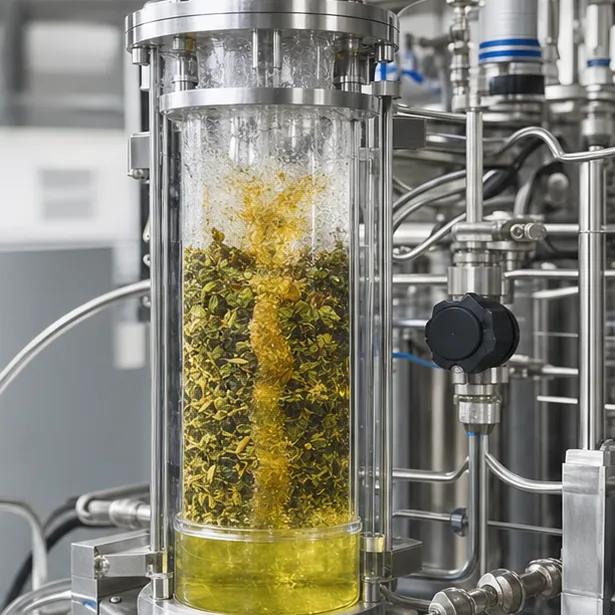
The technology is not universally optimal. It is brilliantly suited to specific goals.
| If your primary focus is… | Then SFE with CO₂ delivers… |
|---|---|
| Green chemistry and regulatory compliance | Zero hazardous air pollutants, zero solvent waste streams, vastly simplified permitting and operator safety |
| Thermally fragile, high-value compounds | Near-ambient extraction that preserves bioactivity, flavor, and molecular integrity |
| Rapid process development and hands-on education | Immediate, visible response of selectivity to operating variables—a living phase-equilibrium laboratory |
| Simplifying downstream purification | Self-removing solvent that collapses an entire separation step, leaving pure product and recyclable CO₂ |
The Operational Summary
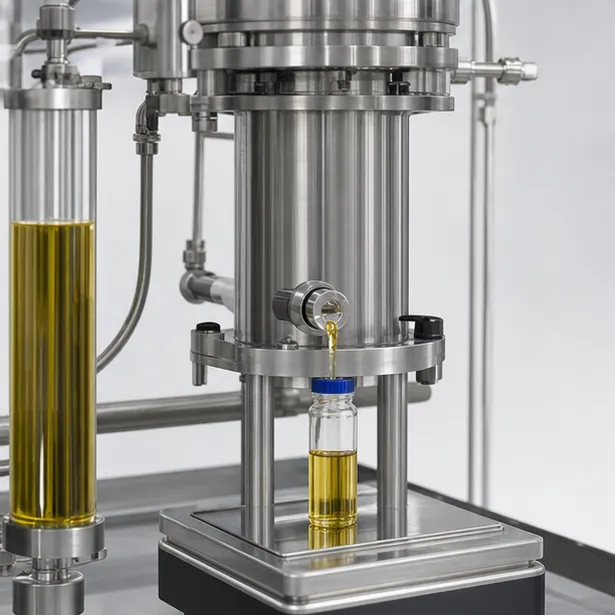
| Operational Advantage | Physical Basis | What It Means in Practice |
|---|---|---|
| Zero Toxic Residues | CO₂ gasifies at ambient pressure | No solvent disposal, no VOC emissions, no carryover into product |
| High-Speed Mass Transfer | Gas-like diffusivity and low viscosity | Extractions in minutes, not hours; faster experimentation cycles |
| Mild Thermal Profile | Critical temperature of 31.1 °C | Bioactive compounds survive intact; thermal degradation eliminated |
| Tunable Selectivity | Pressure, temperature, and co-solvent ratio adjust solvent strength | Selectivity becomes a controllable variable, not a fixed constraint |
| Simple Solvent Recovery | CO₂ depressurizes, leaves product, and is recompressed | Entire distillation train rendered unnecessary; closed-loop operation |
Building the Plant That Teaches
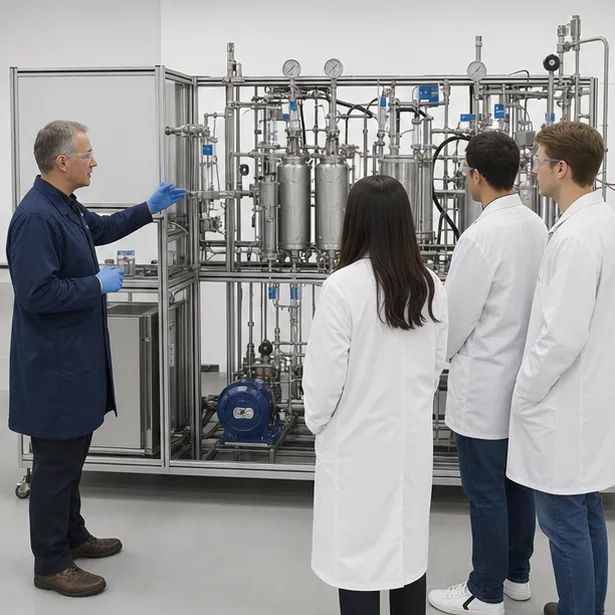
A pilot plant is not just a smaller factory. It is an instrument for understanding. The best pilot units make the underlying physical phenomena visible—pressure gauges that reveal mass transfer, temperature profiles that trace separation, a sight glass that shows phase behavior in real time.
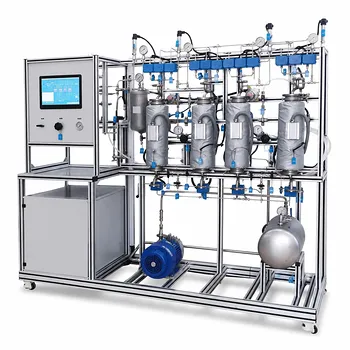
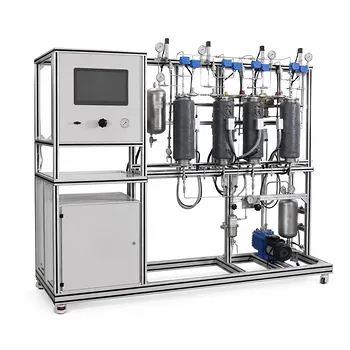
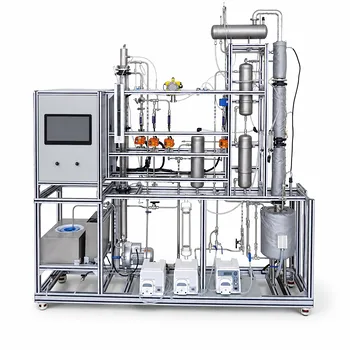
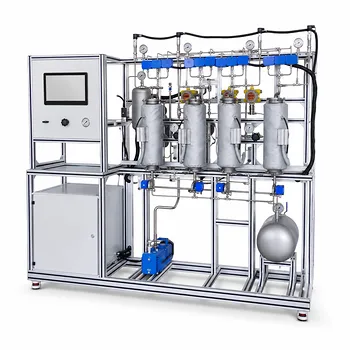
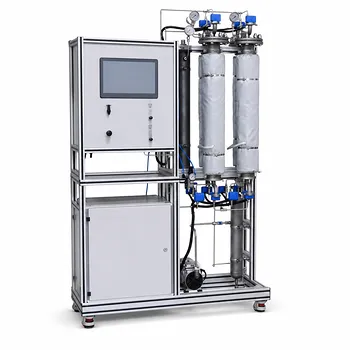
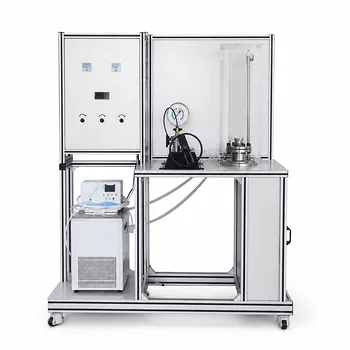
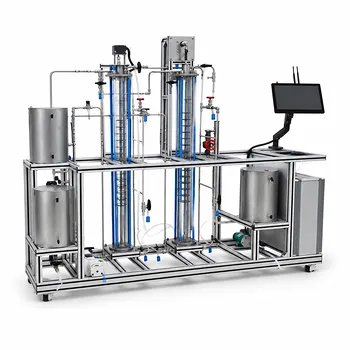
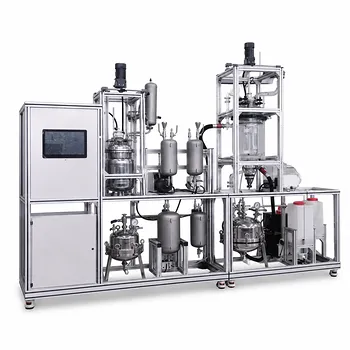
This is where LABPARK’s Educational and Vocational Unit Operations Pilot Plants enter the picture. Designed for universities, research institutes, and enterprises working in chemical engineering, bioprocess, and environmental engineering, these systems turn supercritical fluid extraction from a textbook chapter into a hands-on reality. They give students and researchers direct control over the variables that define extraction selectivity, yield, and safety. In doing so, they compress not just extraction times but the entire learning curve.
A well-configured SFE pilot plant does not merely extract. It teaches the logic of green separation, the discipline of high-pressure processing, and the quiet art of letting a solvent disappear when it is no longer needed.
When the solvent vanishes, what remains is pure understanding. Contact Our Experts
Related Products
- Carbon Dioxide Capture and Utilization Educational Pilot Plant for Unit Operations
- Bench Scale Carbon Dioxide Capture Educational Unit Operations Pilot Plant
- Carbon Dioxide Absorption and Desorption Educational Pilot Plant for Carbon Capture Studies
- Carbon Dioxide Adsorption and Capture Educational Unit Operations Pilot Plant
- Supercritical High-Gravity Flash Evaporation Educational Unit Operations Pilot Plant
Related Articles
- The Ideal-Selectivity Trap: How Pilot Plants Expose the Real Story of Membrane CO₂ Capture
- The Machine That Teaches Green Chemistry by Making Pressure Visible
- The Invisible Thread: How Supercritical CO₂ Weaves a Future Without Water
- The Invisible Constraint: How First-Principles dCO₂ Modeling Turns Your Pilot Plant into a Predictive Engine
- The Physics of Safety: Why Supercritical CO2 Turns a Pilot Plant into a Classroom Without a Poison Cabinet