Educational Chemical Engineering Pilot Plants
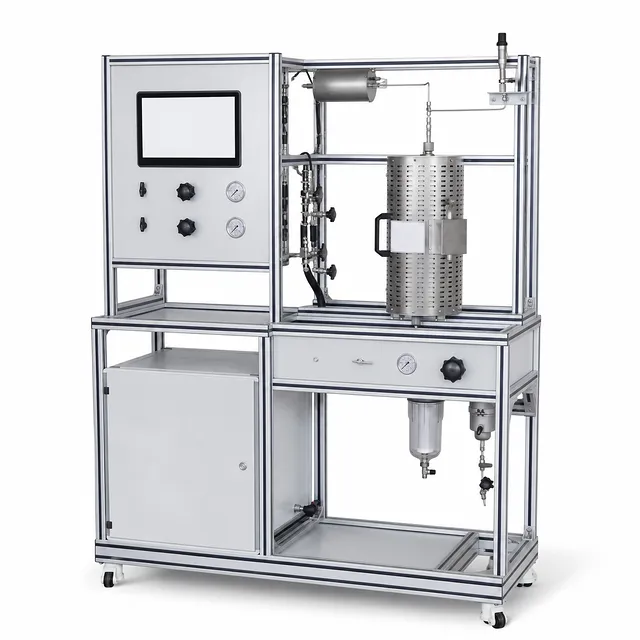
Carbon Dioxide Hydrogenation Methanol Synthesis Educational Unit Operations Pilot Plant
Item Number : LPK-TBJ
Price varies based on specs and customizations
- Reactor Type
- Fixed-bed tubular reactor, 316L stainless steel
- Maximum Operating Pressure
- 3.0 MPa
- Maximum Operating Temperature
- 500°C

Shipping:
Contact us to get shipping details Enjoy On-time Dispatch Guarantee.
Why Choose Us
Easy ordering process, quality products, and dedicated support for your business success.
Introduction
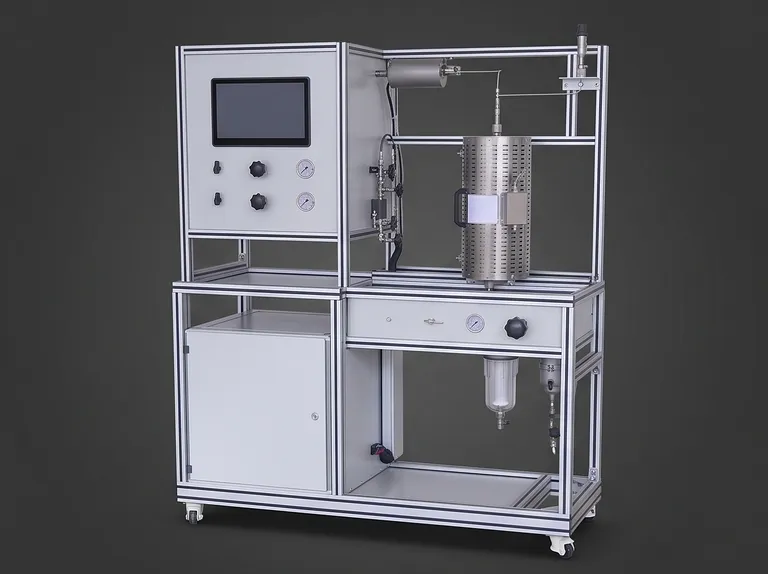
The Carbon Dioxide Hydrogenation Methanol Synthesis Educational Unit Operations Pilot Plant is an advanced, pilot-scale laboratory system designed for engineering students and academic researchers. It provides hands-on training on the catalytic hydrogenation of carbon dioxide ($CO_2$) and hydrogen ($H_2$) to synthesize green methanol, reflecting the real-world industrial push toward carbon capture, utilization, and storage (CCUS) technologies. This integrated system allows students to safely study high-pressure, high-temperature gas-phase catalytic reactions and analyze the factors influencing catalytic activity and process efficiency.
To ensure this training unit fits seamlessly into your existing lab infrastructure and curriculum, both the hardware architecture and software interfaces can be customized to meet your institution's specific educational requirements.
Key Features and Educational Value
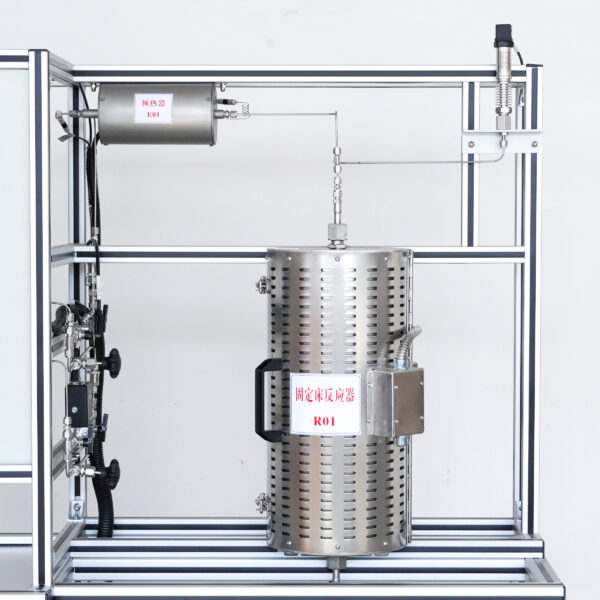
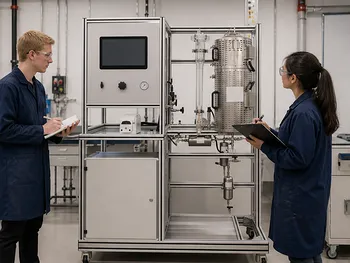
- Realistic Engineering Simulation: Uses a fixed-bed tubular reactor constructed from 316L stainless steel, capable of handling operating pressures up to 3 MPa and temperatures up to 500°C to simulate industrial synthesis pathways.
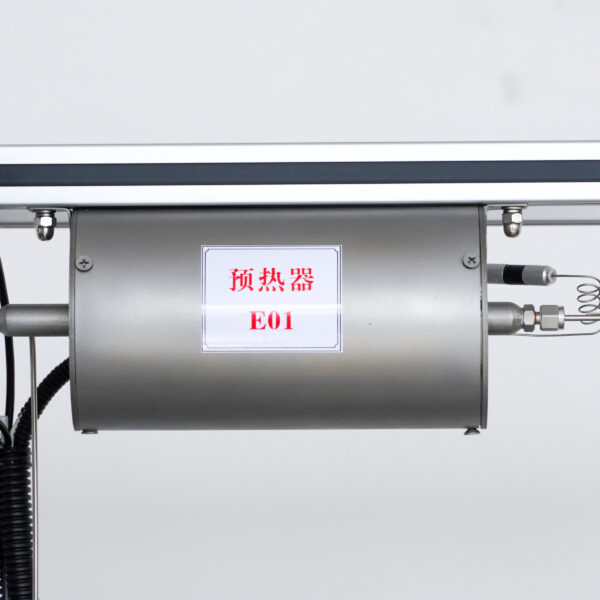
- Thermal Management Study: Equipped with a three-stage electric heating furnace with a split-shell design. This enables safe, physical observation of the heating zones and teaches students how to manage and profile reaction temperatures.
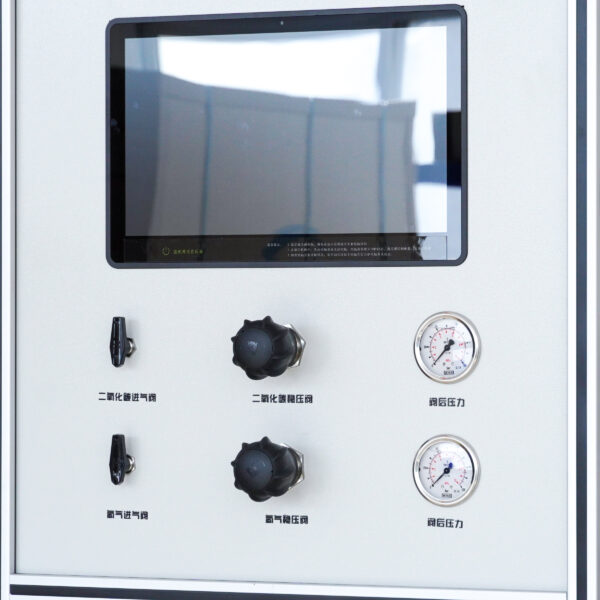
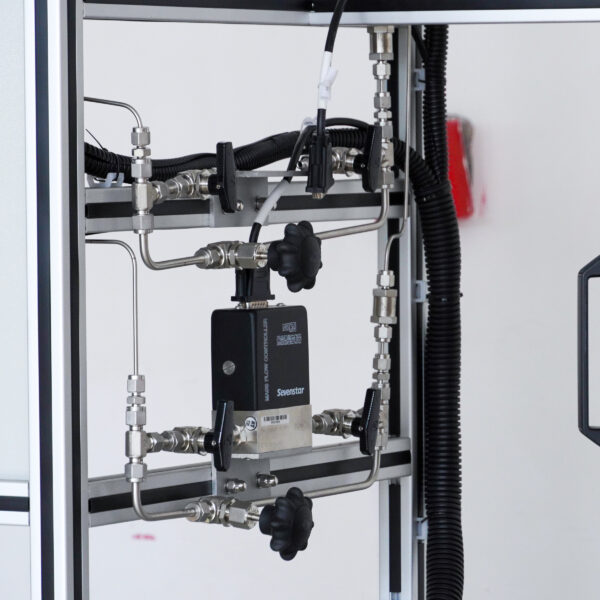
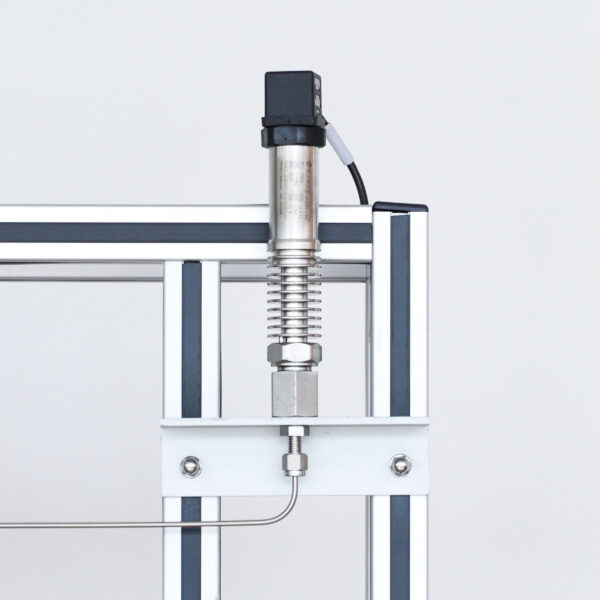
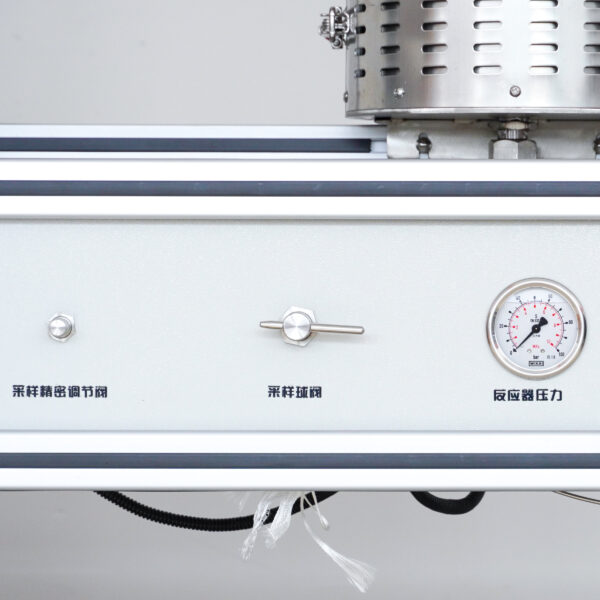
- Modern Instrumentation: Features dual mass flow controllers, inline thermocouples, and pressure transmitters that feed process data directly to an integrated 15.6-inch touchscreen terminal.
- Constructed for Shared Lab Spaces: The system is built on a robust aluminum alloy frame with heavy-duty castors, offering easy mobility and efficient storage in multi-use academic laboratories.
Detail & Parts
Technical Specifications
| Feature / Component | Specification |
|---|---|
| Reactor Type | Fixed-bed tubular reactor, 316L stainless steel |
| Catalyst Compatibility | Copper-based catalyst (pre-loaded, customizable upon request) |
| Maximum Operating Pressure | 3.0 MPa |
| Maximum Operating Temperature | 500°C |
| Heating System | Three-stage electric furnace with a hinged, split-outer shell |
| Flow Control | Dual high-precision mass flow meters for reactant gases |
| Human-Machine Interface | 15.6-inch touchscreen terminal with real-time data acquisition |
| Frame & Mobility | Corrosion-resistant aluminum alloy frame with locking casters |
| Dimensions | 1480 mm × 580 mm × 1800 mm |
Curriculum Integration and Experimental Modules
This educational pilot plant bridges theoretical chemical engineering principles and physical plant operations. It is designed to align with core courses in Chemical Engineering, Environmental Engineering, and Sustainable Energy Systems.
Instructors can directly link laboratory exercises to foundational concepts found in classic textbooks such as Unit Operations of Chemical Engineering, Transport Processes and Unit Operations, and Chemical Engineering Design. By working with this pilot-scale unit, students gain practical insight into heterogeneous catalytic reaction kinetics, mass transport resistance, thermodynamics, and pressure drop through packed beds.
| Experimental Module | Key Pedagogical Focus | Textbook Association & Core Concepts |
|---|---|---|
| Catalyst Evaluation & Kinetics | Study of conversion rate, selectivity, and space velocity during carbon dioxide hydrogenation. | Unit Operations of Chemical Engineering • Heterogeneous reaction kinetics • Catalytic fixed-bed reactors |
| Reactant Flow Dynamics | Investigating the pressure drop across packed catalyst beds under different gas velocities. | Transport Processes and Unit Operations • Flow of fluids through packed beds • Pressure drop calculations |
| Thermal Profile Tuning | Analyzing heat transfer coefficients and heat management using three-stage control. | Transport Processes and Unit Operations • Heat transfer in reactively heated tubes • Thermal conductivity of packed solids |
| Process Control & Automation | Setting up closed-loop feedback systems for temperature, pressure, and flow rates. | Chemical Engineering Design • Piping and Instrumentation Diagrams (P&ID) • Process safety and pressure relief loops |
Customization Options
We recognize that different universities have unique laboratory layouts, utility configurations, and syllabus designs. To accommodate these differences, we offer flexible customization options. Both hardware elements (such as reactor dimensions, gas inlet lines, and sensor configurations) and software features (such as data logging export options and control interfaces) can be modified to match your department's specific teaching goals and space limits.
About LABPARK
LABPARK is a global manufacturer of educational pilot plants and laboratory equipment, with over 20 years of experience serving the higher education sector. We specialize in developing robust training platforms across six main disciplines: Chemistry, Chemical Engineering, Biotechnology, Food Engineering, Pharmaceutical Technology, and Environmental Engineering. Our units are engineered to safely translate complex industrial processes into structured, pedagogical experiences.
Driven by a commitment to academic excellence, LABPARK holds 209 technical patents and has established collaborative partnerships with over 289 universities worldwide. Our operations are supported by a 49,000-square-meter production and R&D facility, ensuring that every system we deliver is built to rigorous industrial standards and prepared to support the next generation of engineers.
Trusted by Industry Leaders
REQUEST A QUOTE
Our professional team will reply to you within one business day. Please feel free to contact us!
Related Products

Carbon Dioxide Hydrogen Methanol Synthesis Educational Unit Operations Pilot Plant
Hands-on educational pilot plant for methanol synthesis from carbon dioxide and hydrogen. Enables practical study of high-pressure catalysis, unit operations, and process control. Features real-time data acquisition, safety systems, and customizable experiment modules for undergraduate and graduate chemical engineering laboratories.

Methane Cracking Educational Unit Operations Pilot Plant
This bench-scale methane cracking educational pilot plant provides hands-on catalytic conversion training with a 1000°C furnace, seven mass flow controllers, and real-time automation for safe, curriculum-aligned experiments. Designed for university teaching of unit operations and reaction engineering.
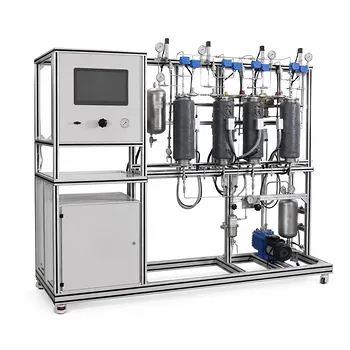
Bench Scale Carbon Dioxide Capture Educational Unit Operations Pilot Plant
This bench-scale educational pilot plant simulates industrial CO₂ separation using a multi-tower adsorption system for hands-on engineering training. Students achieve ≥90% CO₂ purity while studying pressure swing adsorption, desorption kinetics, and process control in gas purification experiments.

Methanol Synthesis and Catalyst Performance Evaluation Educational Unit Operations Pilot Plant
Bench-scale methanol synthesis and catalyst evaluation educational pilot plant for chemical engineering labs to study catalytic kinetics, high-pressure operations, process control, and unit operations under realistic conditions with industrial safety features, precision gas delivery, data acquisition, and intelligent monitoring.
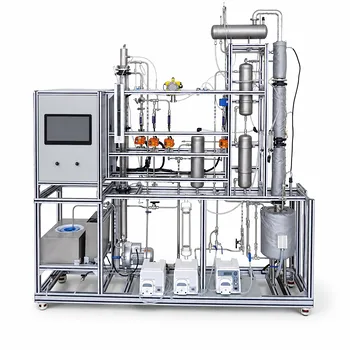
Carbon Dioxide Absorption and Desorption Educational Pilot Plant for Carbon Capture Studies
Explore carbon dioxide absorption and desorption with this educational pilot plant. Transparent columns visualize mass transfer; electric heating simulates industrial solvent regeneration; touchscreen interface enables data monitoring. Ideal for chemical engineering, bridging theory and practice.
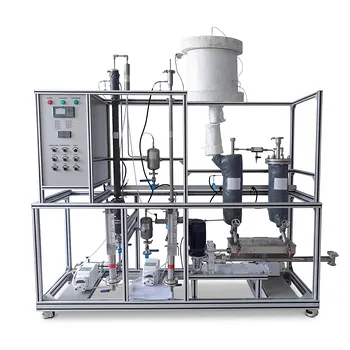
Steam Methane Reforming Hydrogen Production and Purification Educational Pilot Plant
This bench-scale educational pilot plant combines steam methane reforming with hydrogen purification, offering safe, hands-on unit operations training for university engineering laboratories. Its customizable design and high-precision monitoring enable real-time study of catalysis, phase separation, and process dynamics.

Multi-Reactor Educational Pilot Plant for Reaction Engineering Unit Operations
Integrated bench-scale educational pilot plant for chemical engineering teaching featuring fixed bed fluidized bed and stirred tank reactors with web-based digital twin controls and safety interlocks for hands-on unit operations and reaction engineering comparative studies in one compact system.

100L Continuous Loop Hydrogenation Educational Unit Operations Pilot Plant
This 100L continuous loop hydrogenation pilot plant is designed for chemical engineering education, featuring 316 stainless steel construction, advanced gas-liquid mass transfer components, explosion-proof safety systems, and a 15.6-inch touchscreen with 5G connectivity, cloud data logging, bridging theory and industry.

Multi-Functional Special Distillation Educational Pilot Plant
Versatile multi-functional special distillation pilot plant for chemical engineering education. Supports continuous, vacuum, azeotropic, reactive, extractive distillation. Transparent glass columns enable real-time visual observation of hydrodynamics and separation processes.

Fixed-Bed Chemical Reaction and Gas Dust Tar Removal Unit Operations Pilot Plant
Integrated educational pilot plant for studying catalytic gas-solid reactions and downstream gas purification. Features dual fixed-bed reactor, three-stage heating, and touchscreen control for hands-on engineering training. Ideal for chemical and environmental engineering curricula.
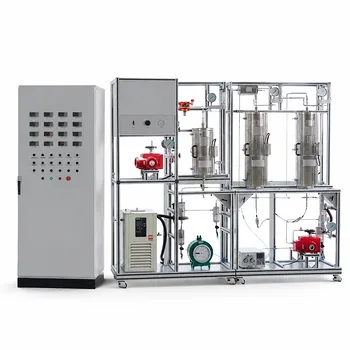
Crude Benzene Hydrogenation Educational Unit Operations Pilot Plant
Advanced pilot plant for higher education, enabling hands-on study of crude benzene hydrogenation and gas-liquid catalytic reactions. Triple-stage reactor system with precision flow and temperature control, AI-driven PID, remote monitoring, and comprehensive safety interlocks. Customizable for curriculum integration.

Natural Product Extraction Unit Operations Training Pilot Plant
Integrated natural product extraction pilot plant for chemical engineering training bridges theory and industrial practice with modular extraction and evaporation/concentration units, hybrid touchscreen and manual control, realistic process simulation, and self-contained softened water and vacuum utilities.
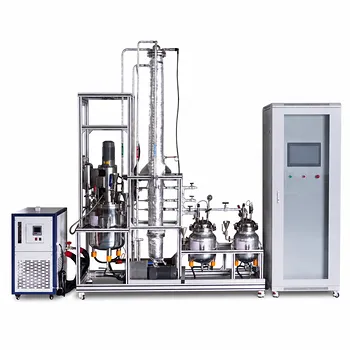
Carbon Material Thermal Pretreatment Multiphase Separation Educational Pilot Plant
Educational pilot plant for carbon material thermal pretreatment and multiphase separation. Features jacketed agitated reactor, separation column, and modern controls for hands-on unit operations training in heat transfer, fluid flow, and process safety with industrial-grade materials and wireless data acquisition.

Micro-Scale Gas-Solid Catalytic Reaction Educational Pilot Plant
Explore heterogeneous catalysis with this micro-scale gas-solid catalytic reaction educational pilot plant. Designed for university labs, it enables hands-on study of reaction kinetics and transport phenomena in a benchtop packed bed reactor with high-precision flow control and touchscreen automation.

Green Anhydrous Ethanol Refining Practical Training Pilot Plant
Advanced integrated pilot plant for university labs demonstrating extractive distillation to produce high-purity absolute ethanol from crude feedstock, featuring multi-column continuous operation, closed-loop solvent recycling, and customizable controls for hands-on engineering education, ideal for chemical engineering training and research.

Electrolytic Hydrogen Production Educational Unit Operations Pilot Plant
Bench-scale electrolytic hydrogen production pilot plant designed for university engineering labs. Provides hands-on training in water electrolysis, gas-liquid separation, and process safety. Fully customizable system with digital PID control, corrosion-resistant components, and hydrogen gas detector. Ideal for chemical engineering curricula.

Continuous Batch Extractive Distillation Educational Pilot Plant
Versatile pilot plant for continuous, batch, and extractive distillation training. High-borosilicate glass column for visualizing hydraulics, 15.6-inch touchscreen with data logging, precise reflux ratio control 1-99, and durable corrosion-resistant frame. Ideal for chemical engineering education and process research.

Bio-fermentation Ethanol Production Practical Training Unit Operations Pilot Plant
Bio-fermentation ethanol production pilot plant for hands-on training in unit operations: fermentation, solid-liquid filtration, membrane separation, and distillation. Bridges theory with industrial practice using industrial-grade components, customizable for university labs. Hybrid automated and manual control for comprehensive learning.

Electrolyte Distillation Purification and Formulation Educational Pilot Plant
Integrated bench-to-pilot scale educational pilot plant for electrolyte distillation, purification, and formulation with borosilicate glass construction, PLC automation, touchscreen HMI, and advanced industrial safety features for hands-on chemical process training, ideal for chemical engineering and materials science curricula.

Multi Functional Catalytic Reaction and Reactor Evaluation Educational Unit Operations Pilot Plant
Bench-scale educational pilot plant for catalytic reaction and reactor evaluation, integrating fixed bed, fluidized bed, and stirred tank reactors. Students compare reactor designs, evaluate catalysts, and study reaction kinetics and hydrodynamics. Perfect for unit operations labs in chemical engineering curricula.
Related Articles
The Machine That Teaches Green Chemistry by Making Pressure Visible
How supercritical CO₂ pilot plants turn the safer-solvent principle into a hands-on, trade-off-driven lesson in chemical engineering—and why memorizing green chemistry isn’t enough.
The Invisible Thread: How Supercritical CO₂ Weaves a Future Without Water
Explore the high-pressure physics and critical unit operations behind waterless dyeing. A deep dive into why supercritical CO₂ pilot plants are the non-negotiable bridge to sustainable textile manufacturing.
The Physics of Safety: Why Supercritical CO2 Turns a Pilot Plant into a Classroom Without a Poison Cabinet
Supercritical CO₂ extraction eliminates toxic solvents, zeroes out hazardous waste, and operates near room temperature — making it the ultimate teaching tool for process safety and green chemistry.
The Solvent That Disappears: Supercritical CO₂ and the New Logic of Pilot Plant Operations
Supercritical CO₂ extraction doesn’t just replace toxic solvents—it fundamentally reshapes mass transfer, preservation, and teachable moments in chemical engineering pilot plants. Here’s how that changes what an education-focused pilot unit can deliver.
The Ideal-Selectivity Trap: How Pilot Plants Expose the Real Story of Membrane CO₂ Capture
A lab cell measures a membrane’s ideal selectivity; only a pilot plant reveals how it behaves under real flue gas stress, impurities, and economics. Uncover the truth before scaling up.
The Invisible Constraint: How First-Principles dCO₂ Modeling Turns Your Pilot Plant into a Predictive Engine
Learn how a first-principles dCO2 mass transfer model de-risks bioprocess scale-up. Validate with pilot plant data to predict manufacturing CO2 profiles, size spargers, and design control loops—eliminating costly full-scale trials.
The Lever and the Leverage: Why a Pilot Plant Creates Engineers Who Build, Not Just Calculate
Catalytic reforming isn't a recipe; it's a war of trade-offs. Here’s how a pilot plant transforms abstract catalysis theory into the visceral, systems-thinking intuition that defines a great chemical engineer.