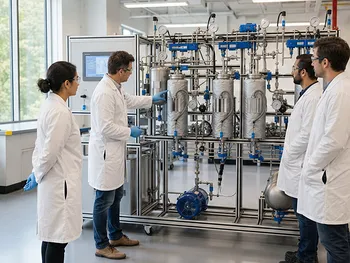
Our vocational pharmaceutical engineering pilot plants provide realistic, hands-on training for aspiring pharmaceutical professionals. The category includes the Aspirin API Synthesis Unit Operations Training Pilot Plant, which covers batch reaction, recrystallization, and distillation, and the Natural Product Extraction Unit Operations Training Pilot Plant, focusing on modular extraction and concentration processes. These plants simulate real industrial operations with dual-control systems and transparent vessels for enhanced learning.
Toggle Categories
Get Instant Support
Choose your preferred way to connect with our team
-
Get Free Quote Fill out form for detailed pricing
-
Send Email Detailed inquiry support
-
WhatsApp Quick mobile chat
Response Time
Within 8 hours on working days, 24 hours on holidays
Vocational Pharmaceutical Engineering Pilot Plants
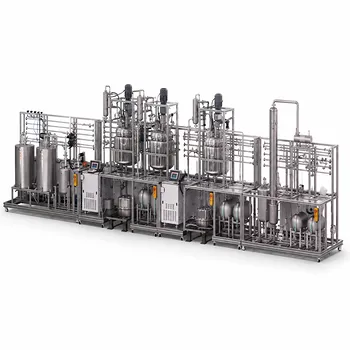
Aspirin API Synthesis Unit Operations Training Pilot Plant
Item Number: LPK-ISPM

Natural Product Extraction Unit Operations Training Pilot Plant
Item Number: LPK-IGNE
Advanced Vocational Pharmaceutical Engineering Pilot Plants for Hands-On Training
In the rapidly evolving pharmaceutical industry, the demand for skilled professionals who can seamlessly transition from academic theory to industrial practice has never been higher. Vocational training in pharmaceutical engineering bridges this critical gap, equipping students and trainees with the practical competencies needed to operate, optimize, and troubleshoot complex manufacturing processes. LABPARK’s Vocational Pharmaceutical Engineering Pilot Plants are meticulously designed to deliver an immersive, safe, and highly effective educational experience. These pilot plants replicate key unit operations found in active pharmaceutical ingredient (API) synthesis and natural product extraction, enabling learners to gain hands-on familiarity with the equipment and processes that define modern pharmaceutical production.
Authentic Industrial Unit Operations in a Compact Educational Format
Pharmaceutical manufacturing encompasses a diverse range of unit operations, each requiring precise control and deep understanding. LABPARK’s pilot plants distill these operations into manageable, transparent, and fully functional training modules. The two flagship systems—the Aspirin API Synthesis Unit Operations Training Pilot Plant and the Natural Product Extraction Unit Operations Training Pilot Plant—provide comprehensive coverage of essential processes such as batch chemical reaction, crystallization, solid-liquid separation, distillation, liquid-liquid extraction, and evaporation/concentration. By working with real chemical materials (where appropriate) or safe simulants, students observe phenomena like heat transfer, mass transfer, and phase changes in real time, reinforcing theoretical principles taught in the classroom.
Aspirin API Synthesis Unit Operations Training Pilot Plant: A Deep Dive
The Aspirin API Synthesis plant is a benchmark educational tool for teaching the end-to-end production of a widely recognized pharmaceutical compound. This integrated pilot plant features three core modules:
-
Batch Reaction Module: A jacketed glass reactor equipped with a mechanical stirrer, temperature probe, and condenser allows students to perform the acetylation of salicylic acid under controlled conditions. The transparent vessel offers unparalleled visibility of reaction dynamics, color changes, and mixing behavior. Dual-control capability—via a local manual panel and a touchscreen HMI with PID loops—introduces learners to both traditional knob-based operation and modern automated process control.
-
Recrystallization Module: Following reaction, the crude aspirin must be purified. This module includes a heated dissolution vessel and a cooling crystallizer where students observe nucleation and crystal growth. Parameters like cooling rate and agitation speed can be adjusted, teaching the impact on crystal size distribution and purity. An integrated filtration unit (Nutsche filter) enables solid-liquid separation, mimicking industrial isolation steps.
-
Packed Distillation Module: Solvent recovery and purification are demonstrated through a continuous packed distillation column. Students learn principles of vapor-liquid equilibrium, reflux ratio adjustment, and column efficiency. The column is fabricated from glass for full visual observation, and instrumentation (thermocouples, flow meters) allows collection of process data for material and energy balance calculations.
Safety is paramount in pharmaceutical training. The Aspirin plant incorporates multiple interlocks, emergency stop buttons, and containment features. All wetted parts are chemically resistant, and the system can operate under fume hoods or with local exhaust ventilation. Additionally, the plant simulates typical industrial utility requirements (heating, cooling, vacuum), teaching students how to integrate unit operations into a plant-wide utility network.
Natural Product Extraction Unit Operations Training Pilot Plant: Bridging Nature and Industry
The Natural Product Extraction plant addresses the growing interest in biopharmaceuticals and botanical drug substances. It focuses on solid-liquid extraction and concentration, key steps in obtaining active ingredients from plant materials. The system includes:
-
Modular Extraction Units: Configurable for Soxhlet, percolation, or maceration extraction, these modules allow comparison of different extraction techniques. Temperature-controlled heating mantles and solvent circulation systems enable students to optimize extraction efficiency. The use of transparent extractors makes the process highly educational, showing solvent penetration and solute dissolution in real time.
-
Evaporation/Concentration Module: A falling-film or rotary evaporator system operates under vacuum to remove solvent and concentrate the extract. Learners control vacuum level, heating temperature, and feed rate, gaining insight into the challenges of heat-sensitive compound handling. The module includes condensate recovery, emphasizing solvent recycling and waste minimization—a critical aspect of green pharmaceutical manufacturing.
-
Integrated Utilities and Control: This pilot plant is self-contained with a softened water loop and a vacuum pump, eliminating the need for external plant utilities. The hybrid control architecture combines a touchscreen PLC for automated sequences and manual valves/controllers, ensuring students understand both automation logic and fundamental process control.
Educational Advantages and Pedagogical Impact
LABPARK’s vocational pilot plants transform theoretical knowledge into tangible skills. Key educational benefits include:
- Visual Transparency: Borosilicate glass components throughout the plants demystify process internals. Students can watch bubble trays in a distillation column, crystal formation in a crystallizer, and phase separation in an extractor, which dramatically enhances comprehension of abstract concepts like mass transfer and fluid dynamics.
- Dual-Control Philosophy: The integration of manual and digital controls (HMI/PLC) caters to different learning levels. Beginners can operate valves and knobs to develop a tactile feel for process dynamics, while advanced students can implement PID tuning, data logging, and alarm management—skills directly transferable to GMP-regulated environments.
- Data Acquisition and Analysis: Both plants are instrumented with sensors for temperature, pressure, flow, and level, feeding real-time data to a centralized SCADA system. This enables students to perform mass and energy balances, yield calculations, and statistical process control exercises, reinforcing chemical engineering fundamentals.
- Safety Training: The pilot plants incorporate industrial safety practices such as pressure relief devices, containment systems, and hazard identification protocols. Students learn safe operating procedures, risk assessment, and emergency response in a controlled setting, building a safety-first mindset essential for the pharmaceutical sector.
- Scalable Complexity: The modular design allows instructors to start with simple batch operations and gradually introduce more complex continuous processes or integrated sequences. This flexibility supports a wide range of curricula, from vocational certificates to advanced degree programs.
Customization and Professional Services by LABPARK
At LABPARK, we understand that every educational institution has unique training objectives, laboratory constraints, and budget considerations. Our Vocational Pharmaceutical Engineering Pilot Plants are not off-the-shelf products; they are platforms that we tailor precisely to your needs. Our team of experienced chemical and mechanical engineers collaborates closely with you to:
- Customize Unit Operations: Need a specific type of reactor (e.g., continuous stirred-tank) or a different extraction method? We can integrate additional modules such as membrane separation, chromatography, or lyophilization.
- Adapt to Your Curriculum: We align the pilot plant’s instrumentation, control strategies, and experimental protocols with your course syllabi. Customized lab manuals and experiment guides can be developed to ensure seamless adoption.
- Scale and Layout Optimization: Whether you have a small bench-top space or a dedicated pilot plant hall, we design the system footprint to fit. Portable skids with casters, flexible utility connections, and modular frames allow reconfiguration as your program grows.
- Compliance and Documentation: For institutions seeking GLP or GMP training environments, we can provide full documentation packages, including IQ/OQ, material certificates, and standard operating procedures.
- Training and Support: Our service includes on-site installation, commissioning, and comprehensive training for faculty and technicians. Ongoing technical support ensures your plant remains a valuable asset for years.
Why Choose LABPARK?
With over a decade of experience in designing and manufacturing educational pilot plants, LABPARK has become a trusted partner for leading universities, research institutes, and industry training centers worldwide. Our commitment to quality is reflected in:
- Robust Construction: We use pharmaceutical-grade materials (316L stainless steel, PTFE, borosilicate glass) ensuring chemical compatibility and long service life.
- Innovative Design: Our plants incorporate the latest trends in Pharma 4.0, such as smart sensors and IoT connectivity, preparing students for the digitalized factories of the future.
- Proven Pedagogy: We work with academic advisors to ensure that each plant maximizes learning outcomes. From intuitive HMI graphics to detailed technical documentation, every detail is crafted with the educator in mind.
Take the Next Step in Pharmaceutical Education
Equip your students with the practical skills that industry demands. LABPARK’s Vocational Pharmaceutical Engineering Pilot Plants are more than just equipment—they are a bridge to successful careers in pharmaceutical manufacturing, process development, and quality control.
If you are ready to elevate your pharmaceutical engineering training program, we invite you to reach out to our team. Let us design a customized pilot plant solution that aligns with your educational goals and inspires the next generation of pharmaceutical professionals. Contact us today through our contact form to schedule a consultation, request a detailed quotation, or arrange a virtual demonstration. Together, we can shape the future of pharmaceutical education.
REQUEST A QUOTE
Our professional team will reply to you within one business day. Please feel free to contact us!
Related Articles
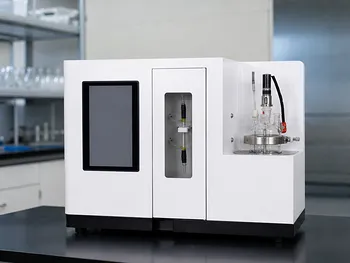
The 44% Error: Why Your Crystallization Pilot Plant is Lying About Yield
Ignoring water of hydration in crystal mass balances can inflate yield predictions by over 50%. A deep dive into the mass and energy balance coupling that separates an empirical observation from a predictable, scalable process.
Read more
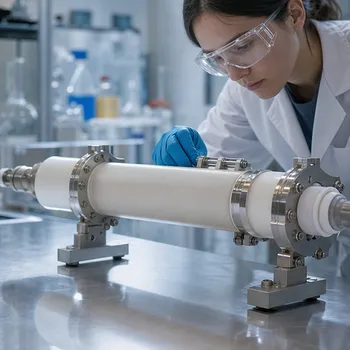
The Bridge Between a Material's Promise and a Carbon Capture Plant's Reality
A membrane pilot plant is not a scaled-down factory; it's a time machine for risk. Learn how hands-on testing exposes the hidden flaws—fouling, plasticization, and pressure penalties—that destroy the economics of CO₂ capture.
Read more
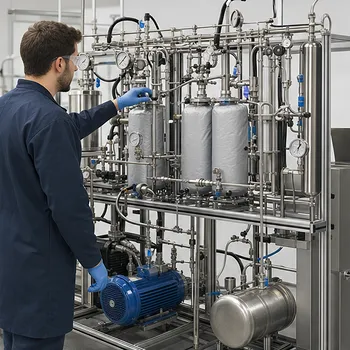
The Solvent That Disappears: Supercritical CO₂ and the New Logic of Pilot Plant Operations
Supercritical CO₂ extraction doesn’t just replace toxic solvents—it fundamentally reshapes mass transfer, preservation, and teachable moments in chemical engineering pilot plants. Here’s how that changes what an education-focused pilot unit can deliver.
Read more
The Physics of Safety: Why Supercritical CO2 Turns a Pilot Plant into a Classroom Without a Poison Cabinet
Supercritical CO₂ extraction eliminates toxic solvents, zeroes out hazardous waste, and operates near room temperature — making it the ultimate teaching tool for process safety and green chemistry.
Read more