The Beautiful Crystals That Broke the Excel Model
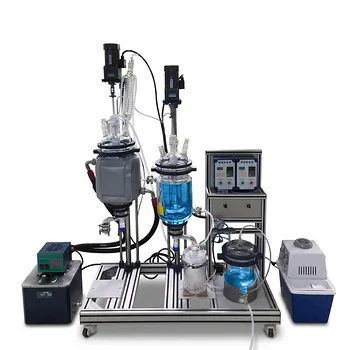
The student’s experiment looked flawless. A saturated copper sulfate solution cooled perfectly in the jacketed vessel. Needle-like blue crystals of CuSO₄·5H₂O formed as predicted. The filtration went smoothly. The product dried to a brilliant, consistent azure.
But the numbers didn’t add up.
The lab report predicted 100 grams of crystal. The balance read 156 grams. The student hadn’t made a weighing error. The yield was exactly what the raw flow rates suggested. The mistake was conceptual—an invisible one, hidden inside the crystal lattice itself. The student had calculated the yield for anhydrous CuSO₄, a grey-white powder that doesn’t exist in this particular thermodynamic reality.
This isn't a minor rounding error. Treating a hydrated crystal as if it’s anhydrous—using w_G = 1.0 instead of the true anhydrous fraction—is the single most persistent systematic error in pilot-plant mass balances.
The math is deceptively simple. The psychological trap, however, is deep.
The Conservation Laws Don’t Care About Your Observations
Crystallization is a purification method wrapped in a phase-change spectacle. You cool a solution. Solubility drops. The solute precipitates. You filter. You weigh.
The satisfaction of those glistening crystals is dangerous. It tricks the mind into believing the process is inherently simple—that you can skip the rigor.
But a pilot plant is a closed thermodynamic system, and two inviolable laws govern everything that happens inside it:
- Mass cannot be created or destroyed.
- Energy cannot be created or destroyed.
If your material balance doesn’t reconcile to the last gram, you haven't discovered a loophole in physics. You've missed a stream, misidentified a species, or ignored a phase.
A crystallization pilot plant’s true value isn’t making crystals. It’s making theoretical balances tangible—forcing the invisible assumptions about hydrates, evaporation, and heat of crystallization into the harsh, measurable light of the balance and the thermocouple.
The Foundation: A Universal Mass Balance
The total mass balance is universal and non-negotiable:
F = L + G + W
Where:
- F = Feed stream mass flow
- L = Mother liquor leaving
- G = Crystal product
- W = Solvent vaporized
For a simple cooling crystallizer with no evaporation, W = 0. The equation collapses to F = L + G. It feels intuitive. You put in a known mass, you pull out a liquid and a solid.
But intuition fails when you try to isolate G. You cannot calculate the crystal yield from just the total mass balance. You have exactly one equation and two unknowns (L and G, or L, G, and W).
This is where most educational experiments drift into guesswork.
The Solute Balance: Tracking the Invisible
The second equation is the solute balance, tracking only the dry, anhydrous substance:
F · w_F = L · w_L + G · w_G
The terms w_F and w_L are the mass fractions of anhydrous solute in the feed and mother liquor. These are straightforward. You measure concentration by refractometer, density, or analytical chemistry.
The term w_G is where the trap lies.
- For anhydrous crystals (e.g., NaCl, pure sucrose): w_G = 1.0.
- For a hydrated salt like CuSO₄·5H₂O: w_G = M_anhydrous / M_hydrate.
Here is the math that broke the student's spreadsheet:
- Molar mass of anhydrous CuSO₄: 159.6 g/mol.
- Molar mass of CuSO₄·5H₂O: 249.7 g/mol.
- w_G = 159.6 / 249.7 = 0.639.
Only 64% of that beautiful blue crystal is the solute you actually tracked in the feed. The other 36% is water—water that left the liquid phase, joined the crystal lattice, and silently vanished from your liquid-side mass balance.
Solving for Crystal Yield
Solve the two balances simultaneously, and you get the true production rate:
G = [F · (w_F − w_L) + W · w_L] / (w_G − w_L)
For pure cooling (W = 0), this becomes:
G = F · (w_F − w_L) / (w_G − w_L)
If you use w_G = 1.0 for a hydrate, your denominator is (1.0 - w_L). Using the correct w_G = 0.639, the denominator shrinks to (0.639 - w_L).
A smaller denominator yields a larger G. The model corrects itself to account for the water “stolen” by the hydrate. This isn’t magic. It’s the conservation of mass, respecting the integrity of the crystal structure.
The Heat Balance: Where Energy Meets Matter
Calculating Q (Cooling Duty)
The material balance gives you the yield. The heat balance gives you the price—the energy required to make the batch.
The first law for an open-system crystallizer with phase change:
F · c_pF · t₁ + Q = L · c_pL · t₂ + G · c_pG · t₂ + W · H
The term Q is the heat exchanged with the jacket or cooling coil. For cooling, Q is negative; you are removing energy.
The equation tracks sensible heat changes (F cooling from t₁ to t₂, L and G leaving at t₂) and the latent heat of any evaporation (W · H). The missing term—often omitted in textbook simplifications—is the heat of crystallization (q_cr).
Crystallization is exothermic. As ions snap into an ordered lattice, they release energy. If you don’t account for this, your cooling utility sizing will be undersized. The coolant won't just fight sensible heat; it will fight the molecular process of solidification itself.
The Vacuum Cooling Special Case
In a vacuum cooling crystallizer, there is no jacket. The feed enters hot, and the vacuum causes flash evaporation.
Here, Q ≈ 0. The energy to vaporize the solvent comes entirely from the sensible heat of the solution and the exothermic heat of crystallization.
The simplified balance becomes:
W · r_W = F · c_pF · (t₁ − t₂) + G · q_cr
Where r_W is the latent heat of vaporization and q_cr is the heat of crystallization (positive if exothermic).
This equation creates a coupled loop that mirrors reality:
- Guess a G based on solubility at t₂.
- Calculate W from the heat balance.
- Feed W back into the material balance to refine G.
- Iterate until G and W converge.
This isn’t an academic exercise. It’s the exact logic a control system uses in an industrial evaporative crystallizer. Mastering this loop on a pilot scale is the difference between a student who memorized a formula and an engineer who can troubleshoot a $5 million unit.
The Three Systematic Errors
1. The Hydrate Blind Spot
This is the 44% error we started with.
For Na₂SO₄·10H₂O, the anhydrous fraction is a mere 44%. A student using w_G = 1.0 will predict 100 kg of product. In reality, 227 kg of sparkling Glauber's salt will come out of the filter.
The error isn't just academic. In a pilot-plant design, it means incorrectly sizing pumps, filters, and dryers by more than a factor of two.
The Fix: Always determine w_G from the crystal structure or the supplier’s certificate. If your pilot plant is for education, make this the deliberate, graded step that separates a casual observation from an engineering calculation.
2. The Adiabatic Assumption
Assuming vacuum cooling is perfectly adiabatic (Q = 0) is an idealization.
Real pilot-plant vessels lose heat through insulation. A 50-liter glass vessel might lose 50-100 watts to the surroundings. Over a 3-hour batch, that’s half a kilowatt-hour of unaccounted energy.
The Result: You calculate a certain W (evaporation rate) based on the measured temperature drop. But some of that temperature drop came from ambient losses, not flash evaporation. Your calculated W is too high. When you feed that W back into the material balance, you overestimate the yield and underestimate the final liquor concentration.
The Fix: In a pilot plant, measure Q directly. Use the jacket flow rate and ΔT of the coolant water. Don’t assume; observe.
3. The Steady-State Mirage
For continuous crystallization, the equation F = L + G + W assumes steady state. The mass inside the crystallizer (hold-up) is constant over time.
But in a university lab, a “continuous” run might last 45 minutes. Is that enough to reach true equilibrium? Is the liquid composition in the vessel exactly equal to the exit stream composition?
If the vessel is still accumulating solute (the crystal bed is growing or the solution hasn't reached its saturation endpoint), your balance is missing a term: dM/dt, the rate of change of mass inventory.
The Fix: Wait. Sample the exit stream every 5 minutes. Plot concentration versus time. Only close the balance when the exit concentration plateaus. If you sample before that, you’re measuring a transient, not a state.
A Decision Guide for the Pilot Plant
| If your primary goal is… | Use this approach | Critical check |
|---|---|---|
| Cooling crystallization yield | G = F · (w_F − w_L) / (w_G − w_L) with W = 0 | Verify w_G for hydrate species |
| Vacuum cooling process | Iterate W · r_W = F · c_pF · (t₁−t₂) + G · q_cr and material balance | Measure actual vessel heat loss to validate Q≈0 |
| Sizing a cooling utility | Full heat balance including q_cr | Use measured c_p values, not textbook estimates |
| Hydrate product | Always set w_G = M_anhydrous / M_hydrate | This single correction eliminates the largest systematic error |
Engineering is Respecting What You Cannot See

The most important lesson a pilot plant teaches isn’t how to turn a valve or hit the target yield. It’s the habit of interrogating invisible assumptions.
The water inside a crystal. The heat loss through insulation. The accumulation inside a vessel that looks steady. These are the silent variables that destroy scale-up.
When you force yourself to close a mass and energy balance—when you hunt down that missing 2% for three hours—you’re not doing accounting. You’re learning to see a process from the inside. You’re learning that every gram unaccounted for is a mechanism you don’t yet understand.
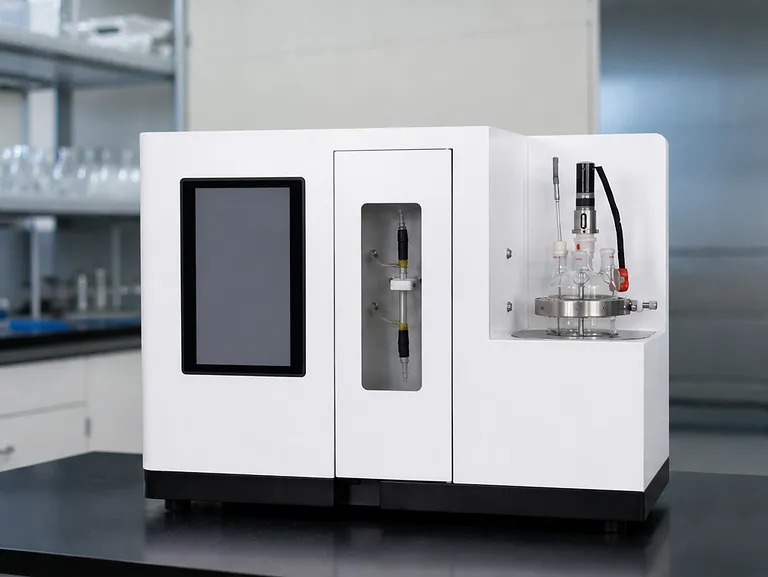
Bringing these chemical engineering theories to life demands a pilot plant system that lets you measure everything—live concentrations, precise jacket duty, and accurate evaporation rates. LABPARK provides Educational and Vocational Unit Operations Pilot Plants in chemical engineering, bioprocess, and environmental technology, built specifically for universities, research institutes, and enterprises. Our crystallization systems turn these mass and energy balances from textbook abstractions into practical, hands-on mastery.
Ready to upgrade your laboratory’s capabilities? Contact Our Experts to find the perfect pilot plant solution for your institution.
Related Products
- Multi Functional Membrane Crystallization Educational Unit Operations Pilot Plant
- Potassium Salt Thermal Dissolution and Crystallization Separation Educational Unit Operations Pilot Plant
- Multi-Functional Special Distillation Educational Pilot Plant
- Ethyl Acetate Synthesis Unit Operations Pilot Plant for Practical Training
- Multi-Modal Distillation Unit Operations Training Pilot Plant
Related Articles
- The Bridge Between a Material's Promise and a Carbon Capture Plant's Reality
- The Ideal-Selectivity Trap: How Pilot Plants Expose the Real Story of Membrane CO₂ Capture
- The Machine That Teaches Green Chemistry by Making Pressure Visible
- The Invisible Thread: How Supercritical CO₂ Weaves a Future Without Water