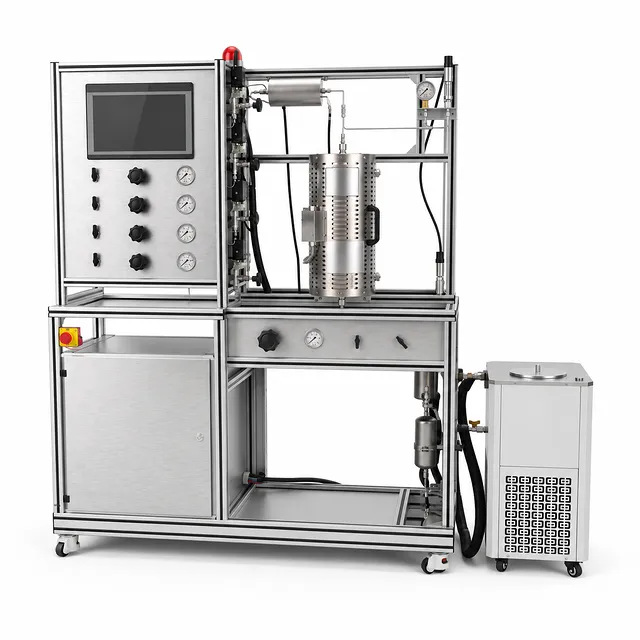
Educational Applied Chemistry Pilot Plants
Methanol Synthesis and Catalyst Performance Evaluation Educational Unit Operations Pilot Plant
Item Number : LPK-JCPJ
Price varies based on specs and customizations
- Max Pressure
- 10 MPa
- Max Temperature
- 1000°C
- Flow Control Accuracy
- ±1%

Shipping:
Contact us to get shipping details Enjoy On-time Dispatch Guarantee.
Why Choose Us
Easy ordering process, quality products, and dedicated support for your business success.
Introduction
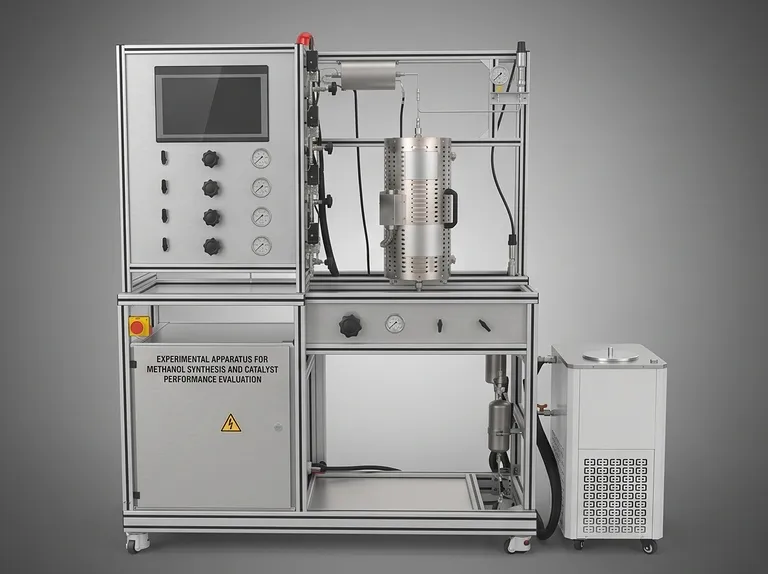
The Methanol Synthesis and Catalyst Performance Evaluation Educational Unit Operations Pilot Plant is a bench-scale, integrated teaching system designed specifically for chemical engineering and industrial chemistry laboratories. It allows undergraduate and graduate students to study catalytic reaction kinetics, high-pressure gas phase operations, and process control dynamics through the practical synthesis of methanol from syngas ($CO/CO_2$ and $H_2$). By operating under high-temperature and high-pressure conditions that mirror industrial-scale processes, this pilot plant provides students with realistic exposure to industrial safety protocols, mass and energy balances, and thermodynamic equilibria within a controlled educational setting.
Tailored Hardware and Software Configurations
To accommodate diverse laboratory layouts and specific institutional curricula, this pilot plant is designed with flexibility in mind. LABPARK offers customizable configurations across both hardware and software systems. Whether your course syllabus requires modifications to the reactor dimensions, feed gas configurations, piping layout, or specific data acquisition parameters in the control software, our engineering team can adapt the system to align with your university's teaching and research goals.
Key Educational Features and Engineering Practice Value
- Representative Industrial Operating Conditions: Equipped with a heavy-duty 316L stainless steel tubular reactor rated for pressures up to 10 MPa and temperatures up to 1000°C, allowing students to study real-world high-pressure catalytic reactions safely.
- Precision Gas Delivery and Mixing: Built-in high-accuracy thermal mass flow controllers for $CO$, $CO_2$, $H_2$, and $N_2$ (0–200 mL/min, $\pm1%$ accuracy) enable precise stoichiometry formulation, helping students evaluate how varying feed compositions impact catalyst activity.
- Intelligent Process Monitoring: A 15-inch industrial touchscreen interface provides real-time visualization of system variables, supporting comprehensive data logging, trend analysis, and remote data transmission for post-lab reports.
- Hands-on Unit Operations Practice: The open, modular layout allows students to gain practical experience with loading catalysts, sealing high-pressure fittings, monitoring thermal runaway, and managing downstream separation units.
- Multi-layered Safety Architecture: Features active overpressure relief valves, integrated gas leak detection pathways, automated temperature interlocks, and a robust structural frame with lockable casters to ensure student safety during operation.
Detail & Parts
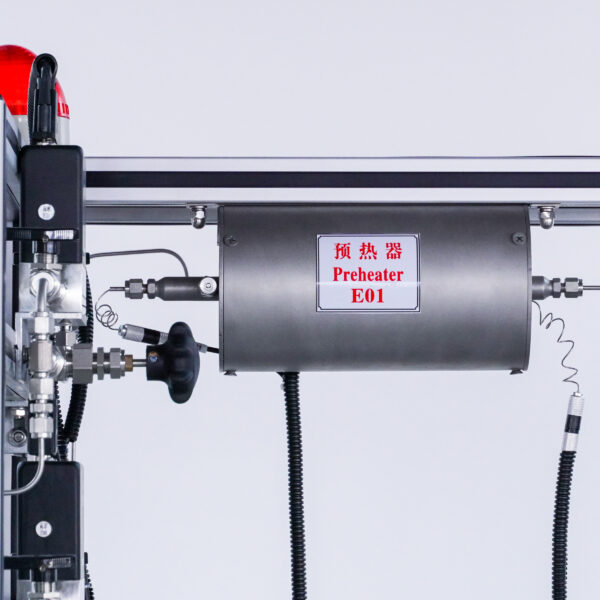
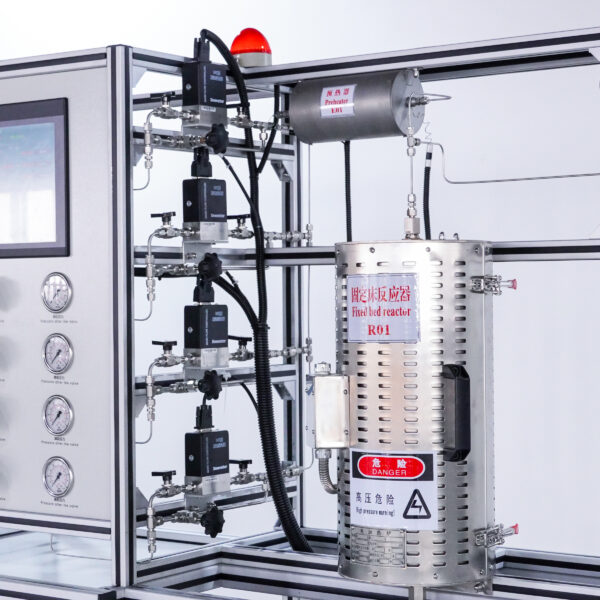
Technical Specifications and Curriculum Mapping
The following table outlines the system specifications and demonstrates how the educational modules of the pilot plant align with core academic concepts and widely used chemical engineering textbooks.
| Technical System / Experimental Module | Functional Specification & Parameters | Core Academic Concept & Associated Textbook |
|---|---|---|
| High-Pressure Reactor Vessel | 316L stainless steel construction; design pressure up to 10 MPa; max temperature of 1000°C; quick-disassembly mechanism. | Chemical Engineering Design • High-pressure vessel safety and wall thickness calculations • Materials selection for corrosive or high-temperature environments |
| Precision Feed Delivery Unit | Four-channel thermal mass flow controllers ($CO, CO_2, H_2, N_2$); accuracy of $\pm1%$; working pressure range matching reactor specifications. | Transport Processes and Unit Operations / Transport Processes and Separation Process Principles • Multi-component fluid dynamics • Packed bed pressure drop and gas flow modeling |
| Catalytic Synthesis & Evaluation Module | Real-time calculation of catalyst conversion rates, space-time yield, selectivity, and space velocity. | Elements of Chemical Reaction Engineering • Solid-catalyzed gas-phase reaction kinetics • Fixed-bed catalytic reactor design and modeling • Temperature profiles in exothermic reactions |
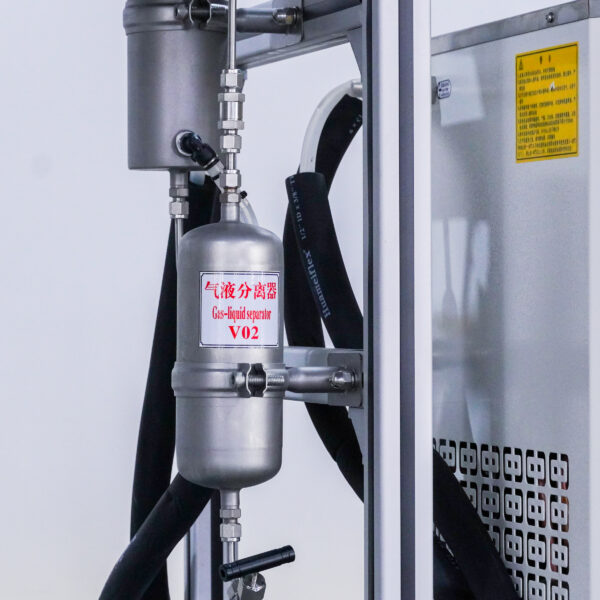
| Condensation and Separation Loop | High-efficiency gas-liquid separator; downstream chilled condenser; liquid collection vessel. | Unit Operations of Chemical Engineering • High-pressure vapor-liquid phase equilibrium (VLE) • Condensation heat transfer and heat exchanger performance |
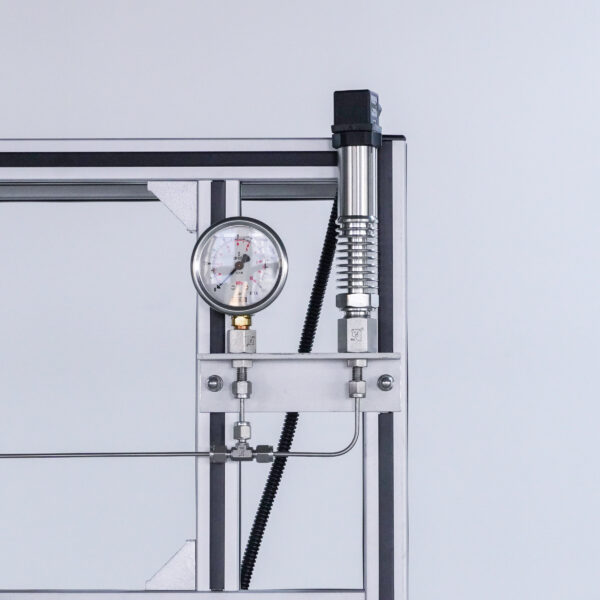
| Data Acquisition and Control Center | 15-inch PLC touchscreen system; automated temperature loops; data storage and export capabilities. | Process Dynamics and Control • Closed-loop temperature and pressure control systems • Sensor calibration and industrial instrumentation protocols |
Curriculum Integration and Academic Relevance
This educational unit operations pilot plant is designed to bridge the gap between abstract lecture theory and physical process engineering. By utilizing the same terminology, units, and dimensionless analysis methodologies found in standard textbooks like Unit Operations of Chemical Engineering and Elements of Chemical Reaction Engineering, instructors can easily integrate this equipment into existing laboratory courses.
Students can directly apply theoretical equations for packed-bed pressure drops, catalyst effectiveness factors, and heat transfer coefficients to the raw data generated by the pilot plant. This direct reinforcement strengthens their analytical skills and prepares them for professional roles in process design, plant operation, and reaction engineering.
Flexible Customization Services
To ensure the equipment fits seamlessly into your laboratory curriculum, LABPARK provides comprehensive custom engineering. Both the hardware layout (such as reactor volume, auxiliary sensor integration, and piping schematics) and the software control systems (including human-machine interface design and data export formats) can be modified. This customizable approach ensures the pilot plant meets your exact educational requirements and laboratory space constraints.
About LABPARK
LABPARK has spent over 20 years serving higher education, delivering specialized, integrated laboratory solutions across six major academic disciplines: chemistry, chemical engineering, biotechnology, food engineering, pharmaceutical engineering, and environmental engineering. Armed with 209 technical patents and a robust commitment to engineering education, LABPARK has successfully partnered with more than 289 universities and colleges globally to enhance practical, hands-on learning environments.
Our state-of-the-art production and research headquarters covers 49,000 square meters, allowing us to maintain rigorous quality control, execute comprehensive factory acceptance testing, and provide ongoing technical support to educational institutions worldwide.
Trusted by Industry Leaders
REQUEST A QUOTE
Our professional team will reply to you within one business day. Please feel free to contact us!
Related Products

Carbon Dioxide Hydrogen Methanol Synthesis Educational Unit Operations Pilot Plant
Hands-on educational pilot plant for methanol synthesis from carbon dioxide and hydrogen. Enables practical study of high-pressure catalysis, unit operations, and process control. Features real-time data acquisition, safety systems, and customizable experiment modules for undergraduate and graduate chemical engineering laboratories.
Carbon Dioxide Hydrogenation Methanol Synthesis Educational Unit Operations Pilot Plant
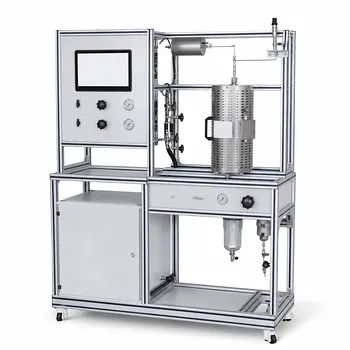
Pilot-scale educational system for carbon dioxide hydrogenation to methanol. Designed for unit operations teaching, it features a fixed-bed reactor, three-stage heating, dual mass flow controllers, and a 15.6-inch touchscreen with data acquisition. Perfect for chemical engineering and sustainable energy courses.
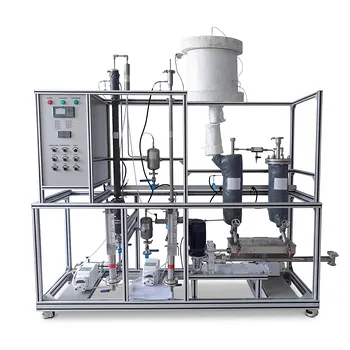
Steam Methane Reforming Hydrogen Production and Purification Educational Pilot Plant
This bench-scale educational pilot plant combines steam methane reforming with hydrogen purification, offering safe, hands-on unit operations training for university engineering laboratories. Its customizable design and high-precision monitoring enable real-time study of catalysis, phase separation, and process dynamics.

Methane Cracking Educational Unit Operations Pilot Plant
This bench-scale methane cracking educational pilot plant provides hands-on catalytic conversion training with a 1000°C furnace, seven mass flow controllers, and real-time automation for safe, curriculum-aligned experiments. Designed for university teaching of unit operations and reaction engineering.

Micro-Scale Gas-Solid Catalytic Reaction Educational Pilot Plant
Explore heterogeneous catalysis with this micro-scale gas-solid catalytic reaction educational pilot plant. Designed for university labs, it enables hands-on study of reaction kinetics and transport phenomena in a benchtop packed bed reactor with high-precision flow control and touchscreen automation.

Ethyl Acetate Synthesis Unit Operations Pilot Plant for Practical Training
Modular and customizable pilot plant for ethyl acetate synthesis practical training. Integrates esterification reaction, liquid-liquid extraction, neutralization, and sieve-plate distillation unit operations. Bridging theory and real-world industrial processes. Designed for university chemical engineering labs
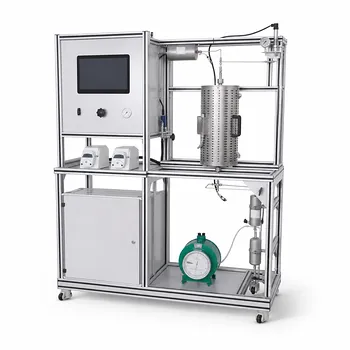
Ethylbenzene Dehydrogenation Educational Unit Operations Pilot Plant
Ethylbenzene dehydrogenation educational pilot plant replicates industrial styrene production, offering hands-on experience with fixed-bed reactors, catalyst activation, regeneration, automated process control. Designed for university chemical engineering labs, it enables study of gas-solid catalysis, catalyst deactivation, steam regeneration, and safety interlocks.

Fixed Bed Gas Solid Catalytic Reaction Educational Pilot Plant
Fixed-bed gas-solid catalytic reaction unit operations pilot plant for chemical engineering education. Features split-furnace, mass flow controllers, PID control, safety interlocks. Ideal for heterogeneous catalysis, reactor dynamics, catalyst evaluation studies. Fully customizable configurations for university laboratories and academic research.
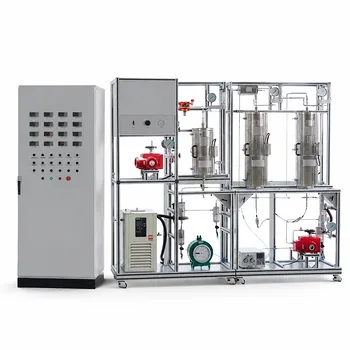
Crude Benzene Hydrogenation Educational Unit Operations Pilot Plant
Advanced pilot plant for higher education, enabling hands-on study of crude benzene hydrogenation and gas-liquid catalytic reactions. Triple-stage reactor system with precision flow and temperature control, AI-driven PID, remote monitoring, and comprehensive safety interlocks. Customizable for curriculum integration.
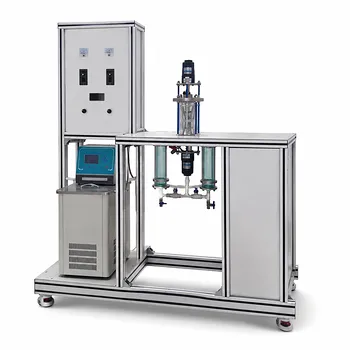
Liquid-Liquid Mass Transfer Coefficient Determination Educational Pilot Plant
This bench-scale educational pilot plant for liquid-liquid mass transfer coefficient determination offers precise control of phase boundary, temperature, and agitation, enabling hands-on study of transport phenomena and unit operations in chemical engineering labs for teaching.
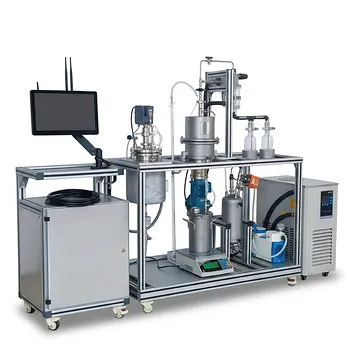
Supercritical High-Gravity Flash Evaporation Educational Unit Operations Pilot Plant
Bench-scale integrated teaching system for advanced separation and mass transfer, combining supercritical high-gravity flash evaporation with heating, chemical reaction, and material collection, featuring modular design, Stainless Steel 316L construction, transparent visualization, touchscreen control, and safety systems for chemical engineering education.

Continuous Batch Extractive Distillation Educational Pilot Plant
Versatile pilot plant for continuous, batch, and extractive distillation training. High-borosilicate glass column for visualizing hydraulics, 15.6-inch touchscreen with data logging, precise reflux ratio control 1-99, and durable corrosion-resistant frame. Ideal for chemical engineering education and process research.
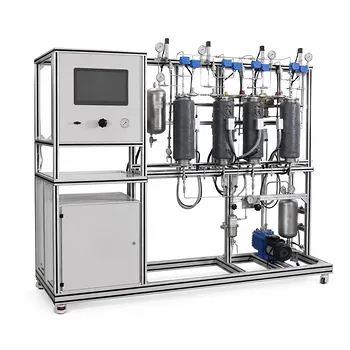
Bench Scale Carbon Dioxide Capture Educational Unit Operations Pilot Plant
This bench-scale educational pilot plant simulates industrial CO₂ separation using a multi-tower adsorption system for hands-on engineering training. Students achieve ≥90% CO₂ purity while studying pressure swing adsorption, desorption kinetics, and process control in gas purification experiments.

Green Anhydrous Ethanol Refining Practical Training Pilot Plant
Advanced integrated pilot plant for university labs demonstrating extractive distillation to produce high-purity absolute ethanol from crude feedstock, featuring multi-column continuous operation, closed-loop solvent recycling, and customizable controls for hands-on engineering education, ideal for chemical engineering training and research.

Multi-Functional Special Distillation Educational Pilot Plant
Versatile multi-functional special distillation pilot plant for chemical engineering education. Supports continuous, vacuum, azeotropic, reactive, extractive distillation. Transparent glass columns enable real-time visual observation of hydrodynamics and separation processes.

Fluidized Bed Gas Solid Catalytic Reaction Educational Pilot Plant
Our educational fluidized bed gas-solid catalytic reaction pilot plant is ideal for chemical engineering labs. Students study fluidization dynamics, catalyst evaluation, and process control hands-on. Features include a customizable reactor, touchscreen HMI, and safety interlocks for safe, curriculum-aligned experiments.

Bio-fermentation Ethanol Production Practical Training Unit Operations Pilot Plant
Bio-fermentation ethanol production pilot plant for hands-on training in unit operations: fermentation, solid-liquid filtration, membrane separation, and distillation. Bridges theory with industrial practice using industrial-grade components, customizable for university labs. Hybrid automated and manual control for comprehensive learning.

Multi Functional Catalytic Reaction and Reactor Evaluation Educational Unit Operations Pilot Plant
Bench-scale educational pilot plant for catalytic reaction and reactor evaluation, integrating fixed bed, fluidized bed, and stirred tank reactors. Students compare reactor designs, evaluate catalysts, and study reaction kinetics and hydrodynamics. Perfect for unit operations labs in chemical engineering curricula.

Fixed-Bed Chemical Reaction and Gas Dust Tar Removal Unit Operations Pilot Plant
Integrated educational pilot plant for studying catalytic gas-solid reactions and downstream gas purification. Features dual fixed-bed reactor, three-stage heating, and touchscreen control for hands-on engineering training. Ideal for chemical and environmental engineering curricula.

Multi-Reactor Educational Pilot Plant for Reaction Engineering Unit Operations
Integrated bench-scale educational pilot plant for chemical engineering teaching featuring fixed bed fluidized bed and stirred tank reactors with web-based digital twin controls and safety interlocks for hands-on unit operations and reaction engineering comparative studies in one compact system.
Related Articles
The Lever and the Leverage: Why a Pilot Plant Creates Engineers Who Build, Not Just Calculate
Catalytic reforming isn't a recipe; it's a war of trade-offs. Here’s how a pilot plant transforms abstract catalysis theory into the visceral, systems-thinking intuition that defines a great chemical engineer.
The 44% Error: Why Your Crystallization Pilot Plant is Lying About Yield
Ignoring water of hydration in crystal mass balances can inflate yield predictions by over 50%. A deep dive into the mass and energy balance coupling that separates an empirical observation from a predictable, scalable process.
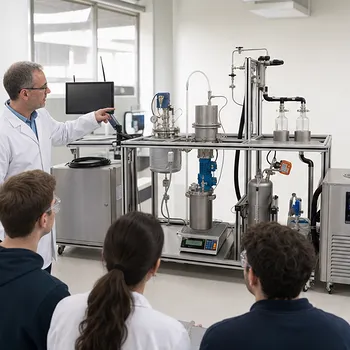
The Machine That Teaches Green Chemistry by Making Pressure Visible
How supercritical CO₂ pilot plants turn the safer-solvent principle into a hands-on, trade-off-driven lesson in chemical engineering—and why memorizing green chemistry isn’t enough.
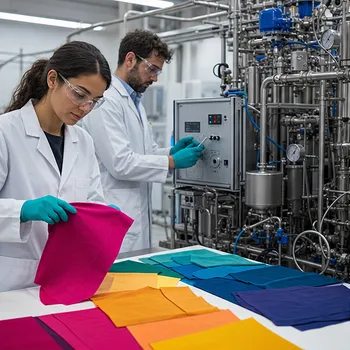
The Invisible Thread: How Supercritical CO₂ Weaves a Future Without Water
Explore the high-pressure physics and critical unit operations behind waterless dyeing. A deep dive into why supercritical CO₂ pilot plants are the non-negotiable bridge to sustainable textile manufacturing.