Blog The Single-Count Principle: How a Quiet VSEPR Rule Shapes the Molecules We Scrub, Absorb, and Teach
The Single-Count Principle: How a Quiet VSEPR Rule Shapes the Molecules We Scrub, Absorb, and Teach

The Single-Count Principle: How a Quiet VSEPR Rule Shapes the Molecules We Scrub, Absorb, and Teach

1 week ago

The Puzzle Inside the Absorption Column

A student stands in front of a packed absorption column, watching gas bubble through a liquid solvent. The instrument panel shows a sharp drop in CO₂ concentration from inlet to outlet. The engineering logic is clear. The molecular logic feels less clear. Why is this linear, symmetric molecule so reluctant to dissolve in water, while a similarly sized SO₂ molecule vanishes eagerly into the liquid phase?

The trainer, without turning from the panel, asks a single question: “What shape is CO₂?”

Linear, the student answers.

“And SO₂?”

Bent.

In that half-minute exchange, a whole branch of separation science collapses into a counting trick mastered decades earlier. The geometry of pollution, the design of scrubbers, the choice between physical washing and chemical scrubbing—all come down to how we count electron groups when there are double or triple bonds in play.

The VSEPR Shortcut: Counting Clouds, Not Bonds

Valence Shell Electron Pair Repulsion theory gives us a disarmingly simple box of rules to predict molecular shape. Yet the rule for multiple bonds is the one that unlocks most gas-phase environmental chemistry.

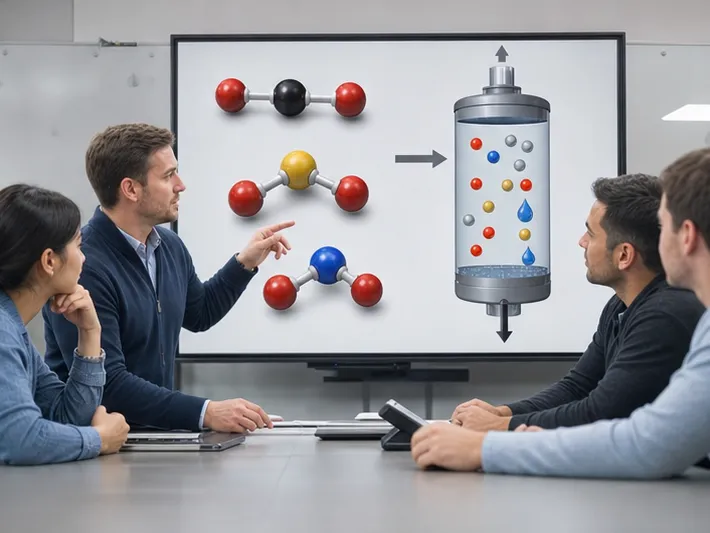
A double or triple bond counts as exactly one electron group.

Not two. Not three. One. All the electron density in that C=O or S=O or N≡N is confined between the same two nuclei. It behaves as a single repulsion centre. The π‑clouds aren’t flying around loose; they’re pinned in the internuclear region.

This means the steric number—the tool that determines geometry—treats a triple bond the same way it treats a single bond. For a central atom:

Steric number = (number of atoms bonded) + (number of lone pairs).

Bond order doesn’t appear in the equation. That’s the trick.

Why This Counting Trick Survives the Classroom

It tames the π‑electron chaos

Beneath VSEPR lies a quantum choreography of σ‑bonds and π‑bonds, in‑phase and out‑of‑phase combinations. For a student facing an absorption column for the first time, forcing them to dissect these contributions before they can draw a shape is a recipe for cognitive paralysis.

Grouping a multiple bond into one fat balloon of electron density slices through that paralysis. You draw a Lewis structure, count the X and E on your central atom, and the AXE notation hands you the geometry. No ab initio calculation. No panic.

It installs a deep intuition about polarity

In engineering training, shape isn’t a goal in itself. Shape is a proxy for dipole moment, solubility, boiling point, and partition coefficients. Once a trainee feels that a linear AX₂ molecule can never have a permanent dipole, and a bent AX₂E must have one, they don’t need to memorize scrubber behaviour—they predict it.

This is Morgan Housel’s territory: a simple, imperfect rule that sticks, compounding into better decisions over a career.

Engineering Shapes: From CO₂ to SO₂ and Beyond

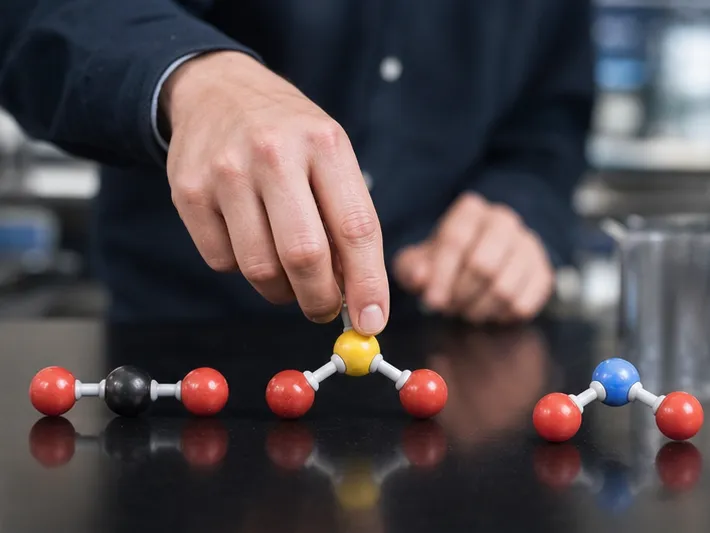
CO₂ – The Benchmark Linear molecule

Carbon dioxide, O=C=O, has two double bonds and no lone pairs on carbon. Treating each double bond as one electron group gives AX₂.

Result: Linear, 180°, zero permanent dipole.

That’s why CO₂ absorption into water is so poor. Without a dipole, solubility depends on weak van der Waals forces, or on chemical reaction with amines. Physical water wash alone barely touches it. In emission‑control design, this single geometry fact forces the engineer toward reactive absorption towers—a lesson that lands powerfully when a student sees clean gas exiting the column only when the amine solution is flowing.

SO₂ – The Bent Scrubber Target

Sulfur dioxide has two S=O double bonds and one lone pair on sulfur. That’s AX₂E.

Result: Bent, ≈119°, strong permanent dipole.

The dipole turns SO₂ into a polar molecule that dissolves robustly in water and reacts readily in wet scrubbers. The same counting rule—one group per double bond—tells you immediately why the absorption behaviour of SO₂ is the opposite of CO₂. Trainers don’t have to plead with students to remember it; the VSEPR picture makes it feel inevitable.

The Nitrogen Oxides: Straight Lines and Odd Angles

Nitrous oxide (N₂O) has a central nitrogen atom bonded to a terminal nitrogen with a triple bond and to oxygen with a double bond. Two bonding domains, no lone pairs: AX₂. Linear.

Nitrogen dioxide (NO₂) has two bonding domains and one lone electron, roughly AX₂E. Bent. The odd‑electron character leads to paramagnetism and dimerization to N₂O₄—bioprocess vent‑gas treatment has to account for the equilibrium, and again it begins with a simple electron‑group count.

The Hidden Price of a Beautiful Simplification

Counting a double bond as one group is a model, and all models lie—some usefully, others subtly.

A double bond’s electron cloud is physically fatter than a single bond’s. In formaldehyde (H₂C=O), the C=O double bond repels the C–H bonds more aggressively, squeezing the H–C–H angle from the ideal 120° to roughly 116°. That’s a real, measurable deviation.

In molecules with resonance—ozone, benzene derivatives—bond order isn’t even an integer. The “count multiple bonds as one” rule doesn’t break, but it becomes incomplete; you need to step beyond VSEPR.

For core process training, these errors are acceptable. A 5° angle difference rarely changes the qualitative dipole story, and the hand‑calculation speed gain is enormous. But advanced module leaders flag the limitation deliberately: first build confidence with the counting shortcut, then sharpen the model when dynamics simulations demand it.

Choosing the Right Lens for Your Training Goal

The depth to which you treat double bonds under VSEPR should match the engineering question you’re asking.

  • If you’re introducing absorption column concepts: Use the one‑group rule without hesitation. Let students build the fast mental link between Lewis structures, AXE notation, and scrubber solvent choices.
  • If you’re interpreting industrial gas‑phase data or simulating scrubber efficiencies: Start with the one‑group geometry, then calibrate. The larger repulsion of a π‑cloud can shift dipole moments; pair the simple picture with experimental calibration curves when you need quantitative precision.
  • If you’re bridging classroom theory to real‑world CO₂/SOₓ/NOₓ behaviour: Teach the counting rule first, then openly discuss its limits. This creates a practitioner who trusts a reliable shortcut but can recognize when the shortcut ends and a deeper computational tool must begin.

Bridging Theory and the Pilot Plant Floor
The Single-Count Principle: How a Quiet VSEPR Rule Shapes the Molecules We Scrub, Absorb, and Teach 1

The moment a molecule becomes a measurement

Knowledge of VSEPR shapes and dipoles is sterile until it collides with a real column, a real pressure drop, and a real gas detector. That collision is where engineering identity forms.

A student who has only drawn CO₂ on paper “knows” it’s linear. A student who watches a LABPARK absorption column show zero CO₂ removal with pure water, then sharp removal with an amine solution, has a visceral memory of that linear shape’s consequence. The two knowledge systems—theoretical geometry and unit‑operation reality—fuse.

Why pilot‑scale training units change the game

Desktop simulations are safe and fast. But they don’t smell, they don’t leak, and they don’t reward the student who correctly predicts polarity with a scrubber efficiency curve that rises exactly where VSEPR said the dipole was strong. Pilot‑scale units do.

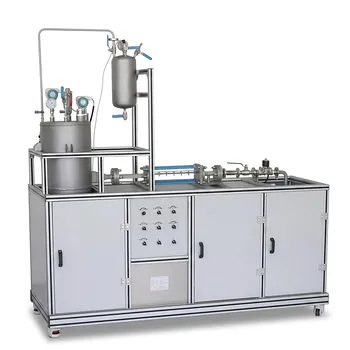
LABPARK’s educational and vocational unit operations pilot plants are built for this moment. In chemical engineering, bioprocess and biotech, and environmental and water treatment modules, these systems let trainees:

  • Run gas‑absorption experiments on CO₂ and SO₂ mixtures and directly observe polar‑nonpolar partitioning behaviour.
  • Test how wet scrubbing of NOₓ varies with dimerization equilibrium, linking odd‑electron molecular geometry to separation efficiency.
  • Generate their own breakthrough curves and see the shape of a molecule expressed as a mass‑transfer zone.

A mental model that scales

The VSEPR one‑group shortcut for multiple bonds started as a quiet electron‑counting rule. In the hands of an engineering educator, it becomes a decision‑making heuristic for scrubber design, solvent selection, and emission regulation compliance. In a LABPARK pilot plant, that mental model becomes a tangible pressure gauge reading, a conductivity spike, a colour change in the sump.

Each run fixes the rule more deeply than a lecture slide ever could.

The Geometry We Can’t See, Made Predictable
The Single-Count Principle: How a Quiet VSEPR Rule Shapes the Molecules We Scrub, Absorb, and Teach 2

Bond Type VSEPR Treatment Example (AXE) Molecular Shape Engineering Implication
Single Bond 1 Electron Group H₂O (AX₂E₂) Bent Solvent polarity; water treatment
Double Bond 1 Electron Group CO₂ (AX₂), SO₂ (AX₂E) Linear or Bent Gas absorption, emission‑control scrubber design
Triple Bond 1 Electron Group N₂O (AX₂) Linear Bioprocess vent‑gas treatment, NOₓ management

VSEPR’s treatment of multiple bonds is not a detail—it’s the central enabling fiction of gas‑phase environmental chemistry education. It collapses the complexity of π‑electron clouds into a count we can do on our fingers, turning a molecular structure into a unit operation decision. With the right training equipment, that count stops being a thought exercise and starts scaling toward industrial reality.

Contact Our Experts

Related Products

Related Articles

Related Products

Ion Exchange Water Purification Educational Pilot Plant for Engineering Unit Operations

Ion Exchange Water Purification Educational Pilot Plant for Engineering Unit Operations

This bench-scale ion exchange pilot plant trains engineering students in water purification. Dual transparent columns simulate industrial softening and demineralization. Students observe fluid dynamics, perform resin regeneration, and analyze breakthrough curves. The corrosion-resistant frame ensures durability in unit operations experiments.

Fluid Friction Resistance Determination Educational Unit Operations Pilot Plant

Fluid Friction Resistance Determination Educational Unit Operations Pilot Plant
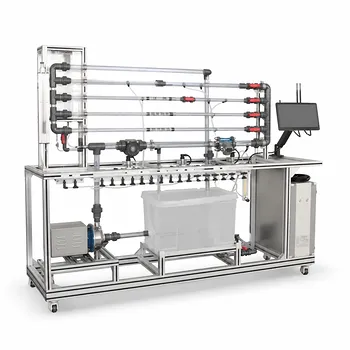
Engineered bench-scale system for university engineering labs. Provides hands-on fluid mechanics experience: quantitative energy loss analysis, flow regime observation, friction coefficient determination. Features four-point pressure measurement, transparent sections, industrial touchscreen PLC, 3D virtual simulation. Ideal for chemical, mechanical, civil engineering.

Multi-Functional Membrane Separation Educational Pilot Plant for Unit Operations Lab

Multi-Functional Membrane Separation Educational Pilot Plant for Unit Operations Lab

The Multi-functional Membrane Separation Educational Unit Operations Pilot Plant is an integrated bench-scale laboratory system designed for teaching undergraduate engineering education. It features Ultrafiltration, Nanofiltration, and Reverse Osmosis modules in a compact, mobile unit for practical hands-on learning.

Water Electrolysis Hydrogen Production and Storage Educational Pilot Plant

Water Electrolysis Hydrogen Production and Storage Educational Pilot Plant

Integrated pilot-scale training system for higher education engineering labs. Features AWE/PEM electrolysis, adjustable DC power, PLC controls, gas-liquid separation, and pressurized hydrogen storage. Hands-on learning in green hydrogen, process control, and safety, ideal for chemical and energy departments.

Electrochemical Water Treatment Educational Unit Operations Pilot Plant
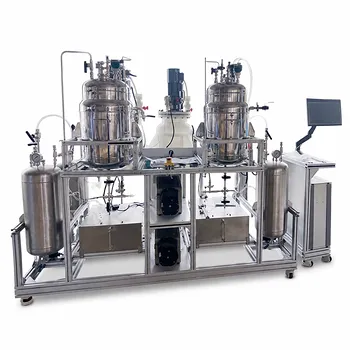
Electrochemical Water Treatment Educational Unit Operations Pilot Plant
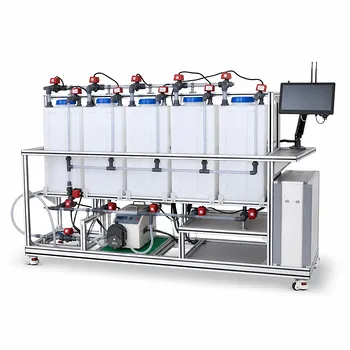
Enhance engineering education with this pilot-scale electrochemical water treatment plant. Designed for hands-on learning of efficient salt removal, electrolytic reactions, and real-time data acquisition. Features multi-mode control, corrosion-resistant PVC, low-voltage safety, and wireless connectivity for modern teaching labs.

Electrolytic Hydrogen Production Educational Unit Operations Pilot Plant

Electrolytic Hydrogen Production Educational Unit Operations Pilot Plant

Bench-scale electrolytic hydrogen production pilot plant designed for university engineering labs. Provides hands-on training in water electrolysis, gas-liquid separation, and process safety. Fully customizable system with digital PID control, corrosion-resistant components, and hydrogen gas detector. Ideal for chemical engineering curricula.

Rising and Falling Film Evaporation Educational Unit Operations Pilot Plant

Rising and Falling Film Evaporation Educational Unit Operations Pilot Plant

Hands-on educational pilot plant for studying rising and falling film evaporation, flow regimes, and heat transfer. Customizable for university labs with industrial instrumentation and data acquisition. Enables comparative evaluation of evaporation modes and energy efficiency.

Constant Pressure Filtration Educational Unit Operations Pilot Plant

Constant Pressure Filtration Educational Unit Operations Pilot Plant
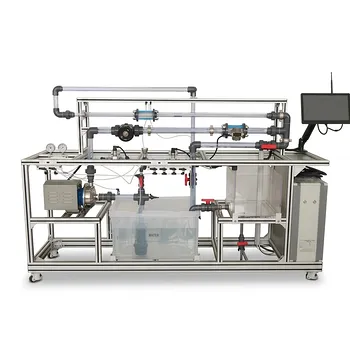
Hands-on educational pilot plant for constant pressure filtration. Classic plate and frame filter press allows students to study kinetics, determine specific cake resistance, perform cake washing and evaluate washing rates. Ideal for chemical engineering curriculum. Mobile, customizable, safety-compliant design.

Hot Filtration Educational Unit Operations Pilot Plant Laboratory System

Hot Filtration Educational Unit Operations Pilot Plant Laboratory System
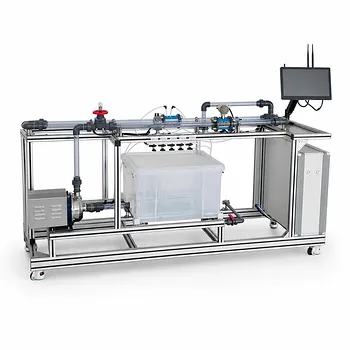
This integrated laboratory bench-scale hot filtration pilot plant enables students to study solid-liquid separation under thermal conditions, featuring a stainless steel vessel, removable heating jacket, and multi-layer filter plates for unit operations education, ideal for chemical engineering laboratory curriculum.

Multifunctional Membrane Separation Educational Pilot Plant with Ultrafiltration, Nanofiltration, Reverse Osmosis

Multifunctional Membrane Separation Educational Pilot Plant with Ultrafiltration, Nanofiltration, Reverse Osmosis

An integrated laboratory bench-scale membrane separation system for higher education engineering labs combining Ultrafiltration, Nanofiltration, and Reverse Osmosis processes. Features industrial PLC control with touch-screen HMI, transparent piping, and academic assessment software. Ideal for chemical and environmental engineering curricula.

Centrifugal Pump Performance and Orifice Flowmeter Calibration Educational Pilot Plant

Centrifugal Pump Performance and Orifice Flowmeter Calibration Educational Pilot Plant

This versatile educational pilot plant enables engineering students to conduct centrifugal pump performance tests, orifice flowmeter calibration, and fluid mechanics experiments using a transparent flow loop, industrial HMI, and 3D virtual simulation for a comprehensive hands-on learning experience.

Electrolyte Distillation Purification and Formulation Educational Pilot Plant

Electrolyte Distillation Purification and Formulation Educational Pilot Plant

Integrated bench-to-pilot scale educational pilot plant for electrolyte distillation, purification, and formulation with borosilicate glass construction, PLC automation, touchscreen HMI, and advanced industrial safety features for hands-on chemical process training, ideal for chemical engineering and materials science curricula.

Orifice and Venturi Flowmeter Calibration Educational Pilot Plant for Fluid Mechanics Laboratory

Orifice and Venturi Flowmeter Calibration Educational Pilot Plant for Fluid Mechanics Laboratory

Enhance fluid dynamics education with the Orifice and Venturi Flowmeter Calibration Educational Unit Operations Pilot Plant, featuring transparent orifice and Venturi meters, industrial sensors, touchscreen interface for real-time data analysis and automatic coefficient calculations in engineering student laboratories.

Centrifugal Pump Performance Determination Educational Unit Operations Pilot Plant
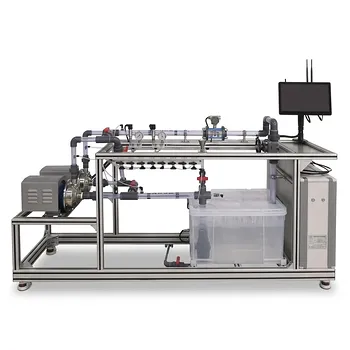
Centrifugal Pump Performance Determination Educational Unit Operations Pilot Plant
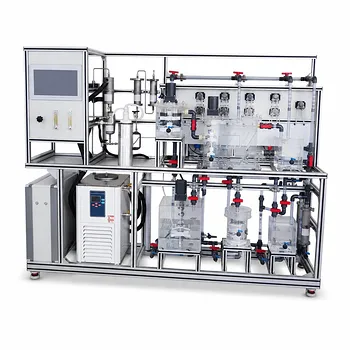
This lab system determines centrifugal pump performance curves for unit operations. Students configure dual pumps in series or parallel for hands-on learning. Includes industrial controls, clear piping, and data logging. Customizable for chemical, mechanical, and environmental engineering programs.

Thermal Desorption Exhaust Gas and Tail Water Treatment Educational Pilot Plant

Thermal Desorption Exhaust Gas and Tail Water Treatment Educational Pilot Plant

Bench-scale educational pilot plant for treating thermal desorption exhaust gas and tail water integrates condensation, Fenton oxidation, precipitation, filtration, and carbon adsorption. Ideal for chemical engineering and environmental labs, teaching unit operations, process control, and real-time data analysis.

General Purpose Cosmetics Production Unit Operations Training Pilot Plant

General Purpose Cosmetics Production Unit Operations Training Pilot Plant

Integrated pilot-scale cosmetics production training plant for chemical engineering education featuring utility supply emulsification blending and filtration modules with dual touchscreen manual control customizable mobile design ideal for practical hands-on unit operations and advanced process control learning.

Alkaline Membrane Water Electrolysis Educational Pilot Plant Unit Operations Training System

Alkaline Membrane Water Electrolysis Educational Pilot Plant Unit Operations Training System

Hands-on educational pilot plant for alkaline membrane water electrolysis hydrogen production, integrating unit operations training with industrial PLC control, real-time data logging, customizable design, durable 316L stainless steel construction, explosion-proof safety, and modern 5G connectivity for university laboratories.

Educational Rotary Disc Liquid-Liquid Extraction Pilot Plant

Educational Rotary Disc Liquid-Liquid Extraction Pilot Plant

A transparent rotary disc column for educational liquid-liquid extraction experiments. This pilot plant enables students to study mass transfer, droplet dynamics, and flooding behavior, bridging theory and practice in chemical engineering unit operations education. Features variable-speed agitation and PLC control.

Bernoulli Equation Demonstration Unit Operations Pilot Plant

Bernoulli Equation Demonstration Unit Operations Pilot Plant
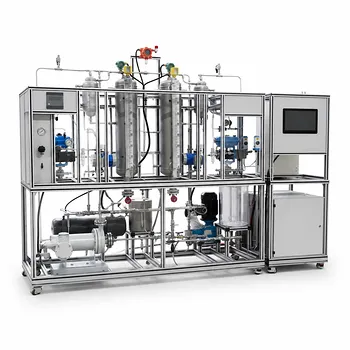
Laboratory pilot plant for Bernoulli's equation demonstration with transparent PVC pipes, 23 piezometer tubes for pressure measurement, and hands-on experiments. Designed for engineering education to study energy conservation, hydraulic grade line, and localized losses in fluid steady-flow systems.

Cavitation Phenomenon Demonstration and Analysis Educational Unit Operations Pilot Plant
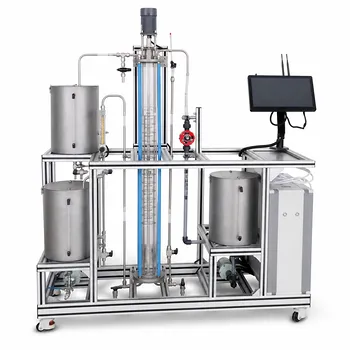
Cavitation Phenomenon Demonstration and Analysis Educational Unit Operations Pilot Plant
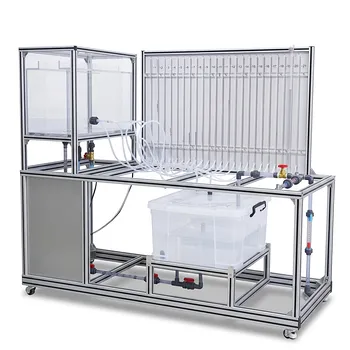
Advanced educational pilot plant for demonstrating and analyzing cavitation phenomena in fluid systems. Features a transparent acrylic Venturi test section, high-precision pressure and flow sensors, digital data acquisition, and integrated safety relief valves for engineering curricula.


Leave Your Message