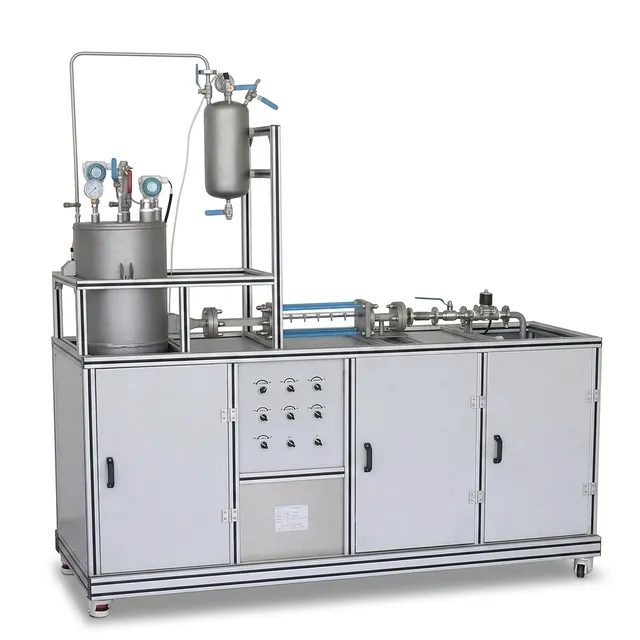
Educational Chemical Engineering Pilot Plants
Cavitation Phenomenon Demonstration and Analysis Educational Unit Operations Pilot Plant
Item Number : LPK-CATT
Price varies based on specs and customizations
- Cavitation Chamber Material
- High-grade acrylic
- Instrumentation
- Real-time digital displays for pressure and flow rate
- Test Section Geometry
- Convergent-divergent nozzle (Venturi)

Shipping:
Contact us to get shipping details Enjoy On-time Dispatch Guarantee.
Why Choose Us
Easy ordering process, quality products, and dedicated support for your business success.
Introduction
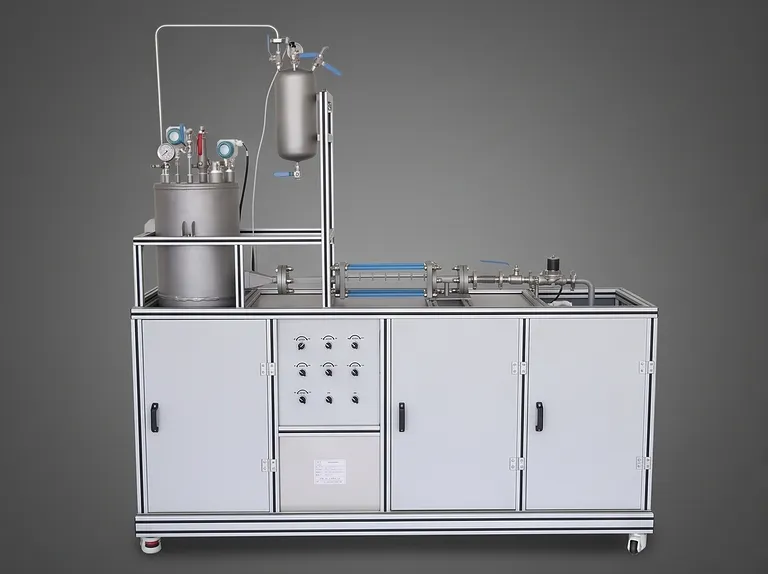
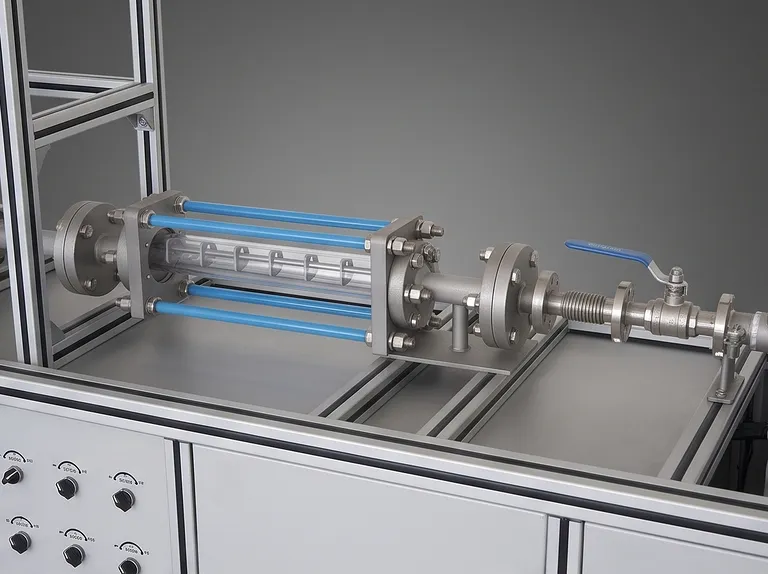
The Cavitation Phenomenon Demonstration and Analysis Educational Unit Operations Pilot Plant is an integrated laboratory teaching system designed for engineering departments to demonstrate and analyze the physical mechanisms of cavitation in fluid systems. By pressurizing an upstream water reservoir using a regulated compressed air supply, the system establishes controlled flow conditions through a specialized, highly transparent acrylic test section. This allows students to visually monitor the nucleation, growth, and rapid collapse of cavitation bubbles under variable localized pressure fields. Both the hardware components and the digital data acquisition software can be customized to align with specific laboratory curricula and space requirements.
Key Features and Pedagogical Advantages
- High-Visibility Flow Channel: The cavitation chamber is constructed from high-grade acrylic, providing an unobstructed view of two-phase flow phenomena and bubble dynamics.
- Industrial-Grade Data Acquisition: Equipped with high-precision pressure transmitters and flow sensors that deliver real-time data to digital displays, allowing students to map pressure profiles and verify theoretical equations.
- Robust and Ergonomic Construction: Built on a durable aluminum alloy profile frame with lockable casters, ensuring physical stability and ease of relocation within the laboratory.
- Comprehensive Safety Design: Features integrated safety relief valves on pressurized vessels and utilizes non-toxic fluids (water and air) to maintain a safe learning environment for undergraduate students.
Detail & Parts
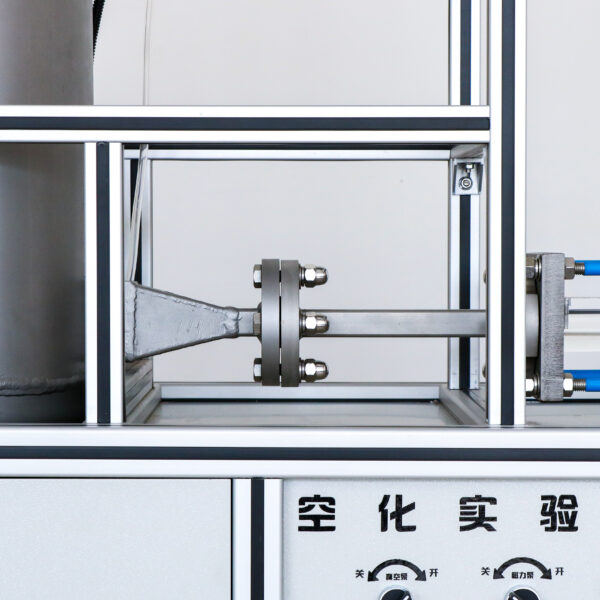
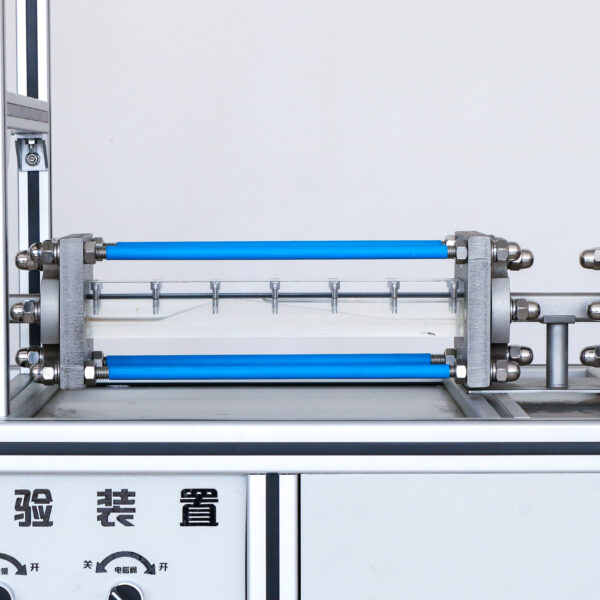
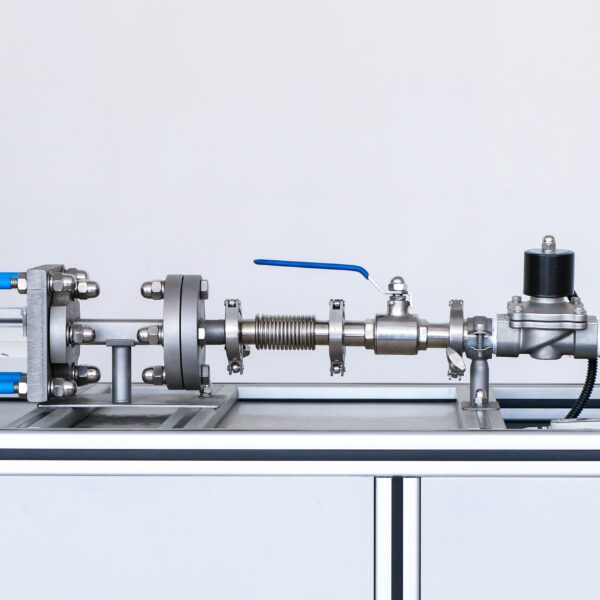
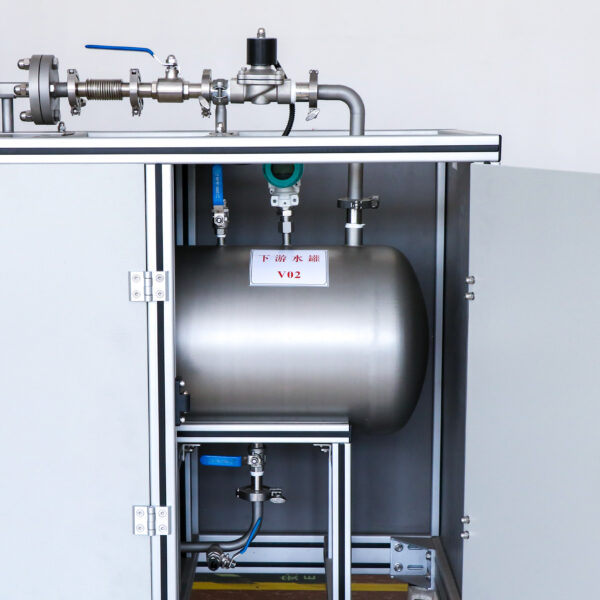
Technical Specifications and Laboratory Modules
| Experimental Module / Component | Technical Details & Functions | Academic Focus & Textbook Correlation |
|---|---|---|
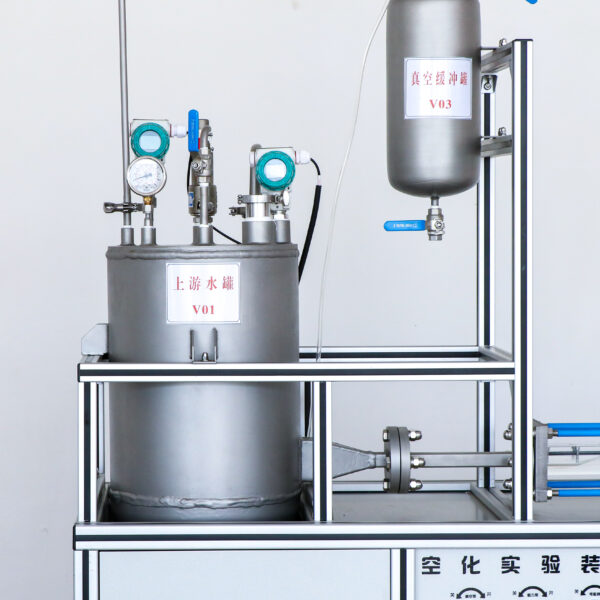
| Upstream Pressurized Vessel | Stainless steel construction, equipped with pressure gauges and relief valves; pressurized via external air source. | Fluid storage under pressure, energy balance in closed systems. |
| Cavitation Test Section | Precision-machined acrylic convergent-divergent nozzle (Venturi geometry) for localized velocity increase and pressure drop. | Bernoulli’s equation application, localized vapor pressure threshold determination. |
| Instrumentation & Control Panel | Real-time digital displays for inlet/outlet pressure, differential pressure, and fluid flow rate. | Calibration of sensors, process variable monitoring, data acquisition practices. |
| Cavitation Inception Study | Determination of the critical velocity and pressure at which vapor bubbles first appear. | Vapor pressure concepts, phase equilibrium, cavitation index calculations. |
| Cavitation Collapse & Noise Observation | Visual and acoustic observation of bubble collapse in the divergent section of the nozzle. | Shockwave generation, erosion mechanics, mechanical wear in hydraulic systems. |
Curriculum Alignment and Academic Integration
This pilot plant serves as an essential bridge between theoretical fluid mechanics and practical process engineering. It is designed for students enrolled in Chemical Engineering, Environmental Engineering, Food Engineering, and Mechanical Engineering programs.
The experimental runs directly support key concepts covered in standard core curricula and are designed to complement classic academic textbooks:
- Fluid Flow Phenomena and Transport Processes: The system demonstrates localized pressure drops, boundary layer behavior, and two-phase flow, directly correlating with the fluid mechanics chapters in Unit Operations of Chemical Engineering and Transport Processes and Unit Operations.
- System Design and Safety margins: By investigating the limits of fluid acceleration and localized boiling without heat input, students gain practical insight into Net Positive Suction Head (NPSH) requirements for pumps and control valve sizing, which are fundamental topics in Chemical Engineering Design.
- Energy Conservation Laws: Students apply the mechanical energy balance and Bernoulli's equation to predict where cavitation will occur, reinforcing theoretical calculations with empirical, real-time measurements.
Customization and Engineering Flexibility
To ensure that this equipment integrates into diverse teaching laboratories, LABPARK offers comprehensive customization options. The hardware can be modified regarding pipe diameters, sensor types, and pressure ranges to match specific pedagogical requirements. Additionally, the software interface can be adapted for various data logging systems, allowing instructors to align the digital experience with their university's existing computing infrastructure.
About LABPARK
LABPARK has dedicated over 20 years to supporting higher education by designing and manufacturing advanced teaching equipment for engineering laboratories. The company focuses on delivering educational solutions across six core domains: Chemistry, Chemical Engineering, Biotechnology, Food Engineering, Pharmaceutical Engineering, and Environmental Engineering.
With a commitment to engineering excellence and academic utility, LABPARK holds 209 technical patents and has established collaborative partnerships with over 289 universities worldwide. Our state-of-the-art research, development, and manufacturing facility spans 49,000 square meters, ensuring that every unit operations pilot plant is built to rigorous industrial standards for safety, durability, and educational value.
Trusted by Industry Leaders
REQUEST A QUOTE
Our professional team will reply to you within one business day. Please feel free to contact us!
Related Products
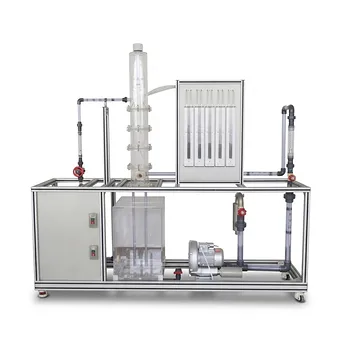
Plate Column Hydrodynamics Tray Demonstration Educational Pilot Plant
Advanced transparent educational pilot plant for chemical engineering labs demonstrates plate column hydrodynamics with industrial sieve bubble cap serrated valve trays for visual observation of gas-liquid contact pressure drop measurement and operational limit analysis including flooding weeping entrainment

Rising and Falling Film Evaporation Educational Unit Operations Pilot Plant
Hands-on educational pilot plant for studying rising and falling film evaporation, flow regimes, and heat transfer. Customizable for university labs with industrial instrumentation and data acquisition. Enables comparative evaluation of evaporation modes and energy efficiency.

High-Gravity Emulsification and Mass Transfer Educational Pilot Plant
This integrated educational pilot plant utilizes rotating packed bed technology to demonstrate high-gravity emulsification and mass transfer, providing engineering students with hands-on experience in process intensification and unit operations through a modular, customizable design with digital monitoring.
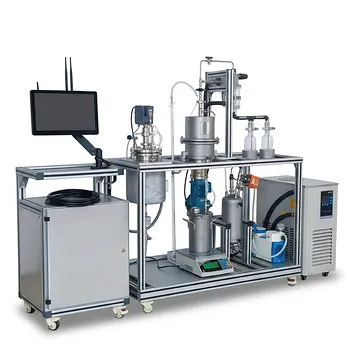
Supercritical High-Gravity Flash Evaporation Educational Unit Operations Pilot Plant
Bench-scale integrated teaching system for advanced separation and mass transfer, combining supercritical high-gravity flash evaporation with heating, chemical reaction, and material collection, featuring modular design, Stainless Steel 316L construction, transparent visualization, touchscreen control, and safety systems for chemical engineering education.
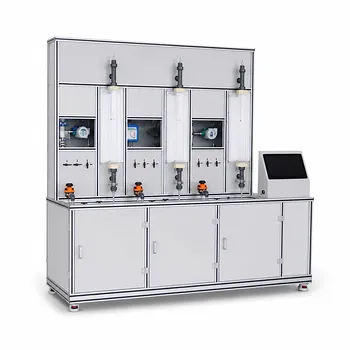
Two Phase Flow Pattern Velocity Resistance Measurement Educational Pilot Plant
Benchtop educational pilot plant for university labs studying gas-liquid two-phase flow patterns, velocity, and resistance across circular, square, and rectangular conduits. Features 15.6-inch touchscreen, 5G connectivity, differential pressure sensors, safe water-air operation. Supports chemical engineering curricula.

Multi Functional Catalytic Reaction and Reactor Evaluation Educational Unit Operations Pilot Plant
Bench-scale educational pilot plant for catalytic reaction and reactor evaluation, integrating fixed bed, fluidized bed, and stirred tank reactors. Students compare reactor designs, evaluate catalysts, and study reaction kinetics and hydrodynamics. Perfect for unit operations labs in chemical engineering curricula.
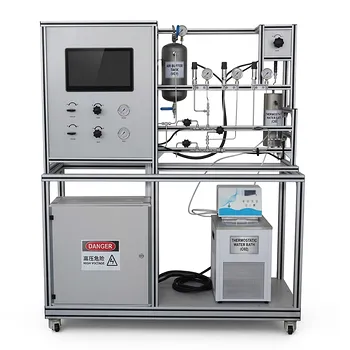
Throttling Effect Determination Educational Unit Operations Pilot Plant
Investigate the Joule-Thomson throttling effect with this educational unit operations pilot plant. Designed for engineering students, it enables hands-on comparative analysis of adiabatic gas expansion using precise process control, interactive digital interface, and eco-friendly operation, ensuring safe repeatable thermodynamic experiments.

Educational Unit Operations Pilot Plant for Intraparticle Diffusion Effective Factor Measurement
Designed for chemical engineering university labs, this pilot plant allows hands-on determination of catalyst particle intraparticle diffusion effective factors and gas-solid reaction kinetics using a fixed-bed tubular reactor with industrial touchscreen control, bridging theory and practical reactor design.

Fluidized Bed Gas Solid Catalytic Reaction Educational Pilot Plant
Our educational fluidized bed gas-solid catalytic reaction pilot plant is ideal for chemical engineering labs. Students study fluidization dynamics, catalyst evaluation, and process control hands-on. Features include a customizable reactor, touchscreen HMI, and safety interlocks for safe, curriculum-aligned experiments.

Constant Pressure Filtration Educational Unit Operations Pilot Plant
Hands-on educational pilot plant for constant pressure filtration. Classic plate and frame filter press allows students to study kinetics, determine specific cake resistance, perform cake washing and evaluate washing rates. Ideal for chemical engineering curriculum. Mobile, customizable, safety-compliant design.

Multi-Reactor Educational Pilot Plant for Reaction Engineering Unit Operations
Integrated bench-scale educational pilot plant for chemical engineering teaching featuring fixed bed fluidized bed and stirred tank reactors with web-based digital twin controls and safety interlocks for hands-on unit operations and reaction engineering comparative studies in one compact system.

Natural Product Extraction Unit Operations Training Pilot Plant
Integrated natural product extraction pilot plant for chemical engineering training bridges theory and industrial practice with modular extraction and evaporation/concentration units, hybrid touchscreen and manual control, realistic process simulation, and self-contained softened water and vacuum utilities.
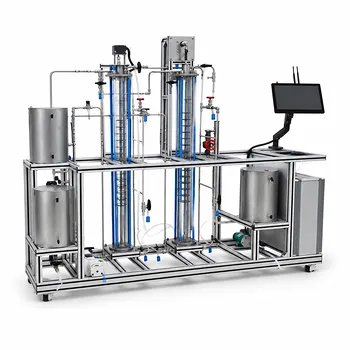
Comprehensive Liquid-Liquid Extraction Pilot Plant for Engineering Education
Comprehensive liquid-liquid extraction pilot plant for engineering education, integrating rotary and vibratory columns for hands-on observation of phase behavior, flooding limits, and mass transfer efficiency, enabling precise HTU and mass transfer coefficient calculations.

Micro-Scale Gas-Solid Catalytic Reaction Educational Pilot Plant
Explore heterogeneous catalysis with this micro-scale gas-solid catalytic reaction educational pilot plant. Designed for university labs, it enables hands-on study of reaction kinetics and transport phenomena in a benchtop packed bed reactor with high-precision flow control and touchscreen automation.
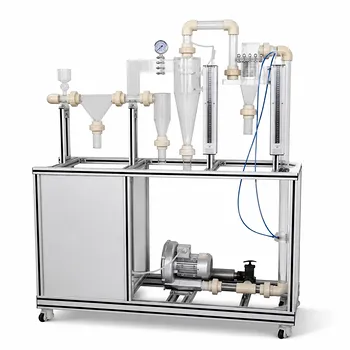
Gas-Solid Heterogeneous Separation Demonstration Educational Unit Operations Pilot Plant
Comprehensive visual transparent gas-solid separation pilot plant for chemical engineering labs. Demonstrates gravity settling inertial settling cyclone and bag filter technologies. Enables real-time analysis of fluid-particle mechanics pressure drop and collection efficiency. Ideal for undergraduate unit operations courses.
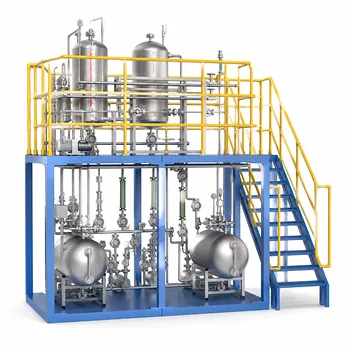
Fluid Transport and Piping Dynamics Practical Training Unit Operations Pilot Plant
This industrial-scale fluid transport and piping dynamics training pilot plant provides essential hands-on experience with pump operations, cavitation, piping resistance, flow metering, and process control. Customizable to fit specific academic engineering curricula.

Fixed-Bed Chemical Reaction and Gas Dust Tar Removal Unit Operations Pilot Plant
Integrated educational pilot plant for studying catalytic gas-solid reactions and downstream gas purification. Features dual fixed-bed reactor, three-stage heating, and touchscreen control for hands-on engineering training. Ideal for chemical and environmental engineering curricula.
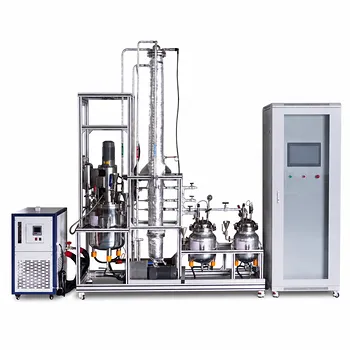
Carbon Material Thermal Pretreatment Multiphase Separation Educational Pilot Plant
Educational pilot plant for carbon material thermal pretreatment and multiphase separation. Features jacketed agitated reactor, separation column, and modern controls for hands-on unit operations training in heat transfer, fluid flow, and process safety with industrial-grade materials and wireless data acquisition.
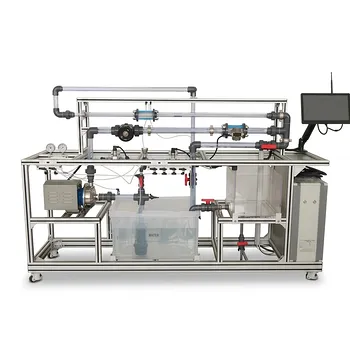
Centrifugal Pump Performance and Orifice Flowmeter Calibration Educational Pilot Plant
This versatile educational pilot plant enables engineering students to conduct centrifugal pump performance tests, orifice flowmeter calibration, and fluid mechanics experiments using a transparent flow loop, industrial HMI, and 3D virtual simulation for a comprehensive hands-on learning experience.
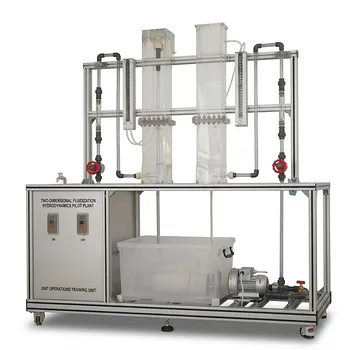
Two-Dimensional Fluidization Hydrodynamics Educational Pilot Plant for Unit Operations Training
Explore gas-solid and liquid-solid fluidization hydrodynamics with our transparent 2D educational pilot plant. Ideal for chemical engineering unit operations labs, it demonstrates fixed to fluidized bed regimes, measures pressure drop, and integrates QR-code digital learning for enhanced student training.
Related Articles
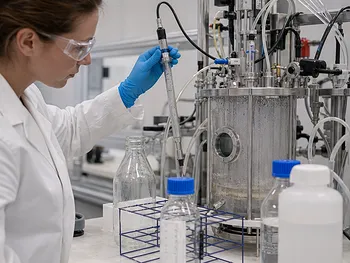
The Electric Ghost in Your Bioreactor: How Optical pH Sensors Are Ending a 50-Year Maintenance Ritual
Optical FRET-based pH and pCO₂ sensors eliminate ground-loop noise, slash response times to milliseconds, and survive repeated autoclaving—a step change for bioprocess pilot plants tired of nursing glass electrodes.
The Single-Count Principle: How a Quiet VSEPR Rule Shapes the Molecules We Scrub, Absorb, and Teach
Why do CO₂, SO₂, and NOₓ behave so differently in a wet scrubber? The answer hinges on a surprisingly simple VSEPR shortcut—treating every multiple bond as one electron group—that predicts shape, polarity, and separation strategies in environmental and bioprocess training.