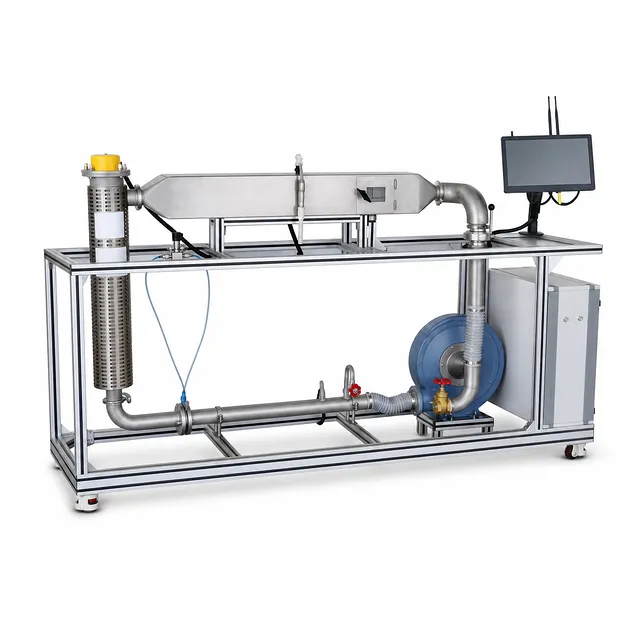
Educational Food Engineering Pilot Plants
Circulating Wind Tunnel Drying and Convective Heat Transfer Coefficient Determination Educational Pilot Plant
Item Number : LPK-XHFDGZ
Price varies based on specs and customizations
- Overall Dimensions
- ≤ 2200 mm × 580 mm × 1400 mm (L × W × H)
- Adjustable Variables
- Air velocity, heating power (temperature), and inlet humidity
- Measurement Parameters
- Dry-bulb temperature, wet-bulb temperature, air velocity, mass change

Shipping:
Contact us to get shipping details Enjoy On-time Dispatch Guarantee.
Why Choose Us
Easy ordering process, quality products, and dedicated support for your business success.
Introduction
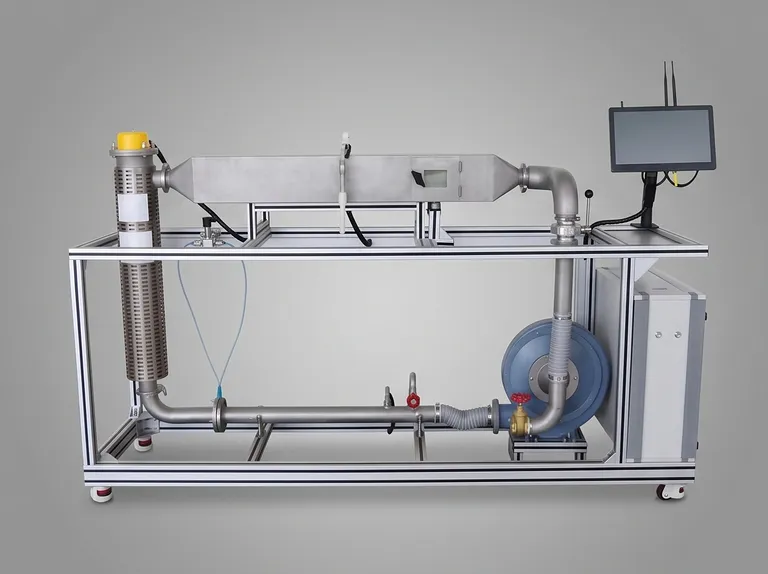
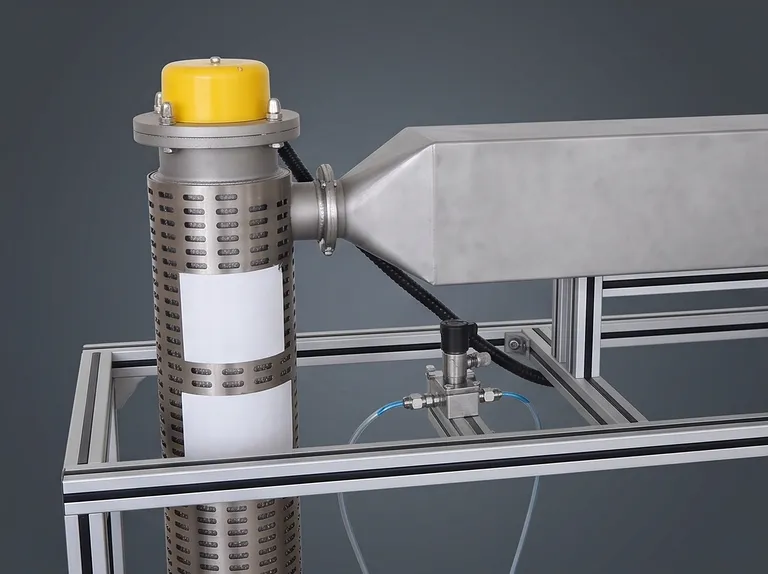
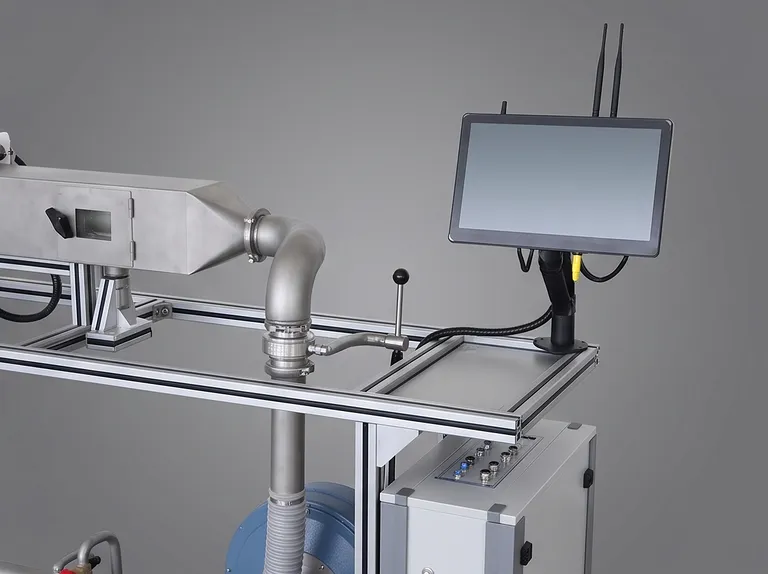
The Circulating Wind-Tunnel Drying and Convective Heat Transfer Coefficient Determination Educational Unit Operations Pilot Plant is an integrated laboratory system designed for engineering education in higher education institutions. This unit allows students to investigate the fundamental principles of convective drying, air-water vapor systems, and heat and mass transfer phenomena. By facilitating the empirical determination of drying curves, drying rate curves, and convective heat transfer coefficients under variable processing conditions, the pilot plant provides a bridge between theoretical classroom concepts and industrial process operations.
Customization and Flexibility
Recognizing the diverse educational requirements and space constraints of global universities, this educational unit is designed with flexibility in mind. We provide comprehensive customization services covering both hardware and software components. Whether adapting the structural layout, upgrading sensor configurations, or tailoring the software control interfaces and data acquisition protocols, the system can be modified to align with specific laboratory spaces, regional engineering standards, and institutional pedagogical objectives.
Key Pedagogical Features and Advantages
- Engineering Accreditation Alignment: Designed to support outcomes-based education, enabling students to perform real-time data acquisition and analysis, plotting essential drying curves and drying rate curves to meet modern engineering curriculum standards.
- Variable Process Control: Features adjustable airflow velocity, air temperature, and relative humidity, allowing students to systematically study how external boundary conditions influence drying kinetics.
- Constant-Pressure Cyclic Operation: Supports constant-pressure cyclic drying configurations, simulating realistic industrial drying loop behaviors.
- External Wet-Bulb Temperature Measurement: Employs an external measurement design for wet-bulb temperature, reducing physical interference with the main air stream and enhancing the stability of the thermodynamic measurements.
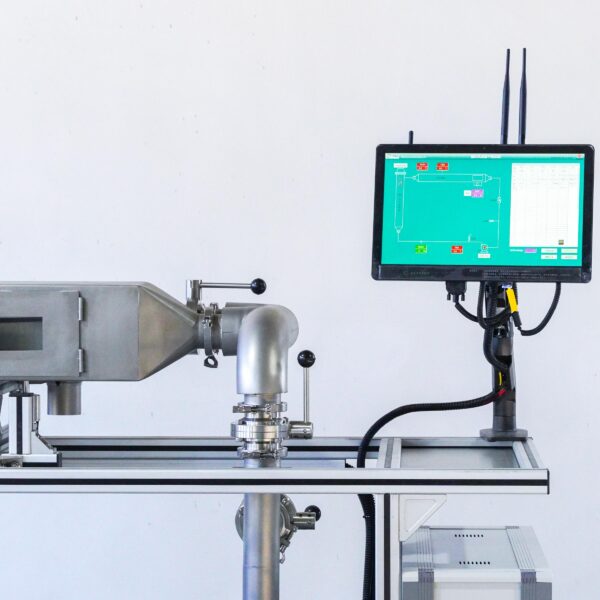
- Industrial-Grade Instrumentation: Equipped with an industrial all-in-one touchscreen PC for control and real-time data display, exposing students to human-machine interfaces (HMI) and supervisory control systems used in the industry.
- Robust and Mobile Construction: Built on a high-grade aluminum alloy framework equipped with lockable industrial casters, ensuring physical durability and ease of relocation within the laboratory.
Detail & Parts
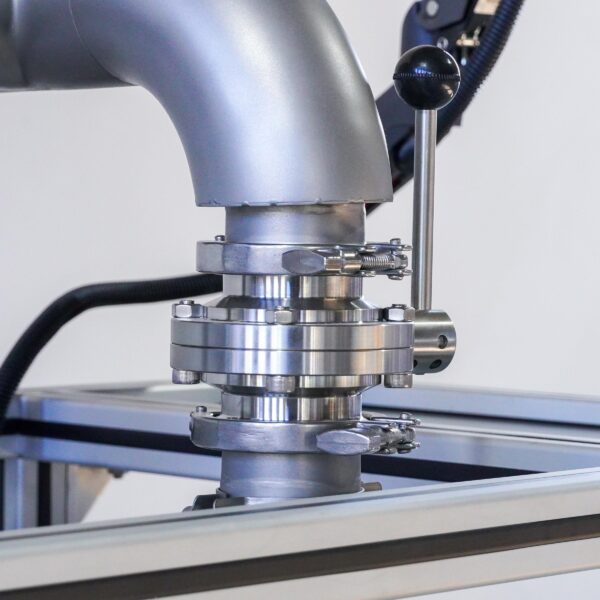
Technical Specifications
| Parameter | Specifications |
|---|---|
| Frame Material | High-strength industrial aluminum alloy with heavy-duty casters |
| Overall Dimensions | ≤ 2200 mm × 580 mm × 1400 mm (L × W × H) |
| Control Interface | Industrial all-in-one touchscreen computer |
| System Operations | Constant-pressure cyclic drying, convective wind-tunnel drying |
| Adjustable Variables | Air velocity, heating power (temperature), and inlet humidity |
| Measurement Parameters | Dry-bulb temperature, wet-bulb temperature, air velocity, mass change |
| Safety Features | Over-temperature protection, electrical leakage protection |
Experimental Modules and Learning Outcomes
| Experimental Module | Key Focus Areas | Learning Outcomes |
|---|---|---|
| Drying Kinetics Analysis | Drying curves ($X$ vs. $\tau$) and drying rate curves ($U$ vs. $X$) | Determine critical moisture content, constant-rate drying period, and falling-rate drying period. |
| Air-Water Vapor Thermodynamics | Wet-bulb and dry-bulb psychrometry | Understand the use of psychrometric principles to determine air humidity and enthalpy. |
| Convective Heat Transfer | Constant-rate drying stage heat transfer | Calculate the convective heat transfer coefficient ($h_c$) between the drying medium and the material surface. |
| Process Variables Influence | Parameter variation (velocity, temperature, humidity) | Analyze how changes in drying air properties affect the mass transfer rate and drying time. |
Academic and Textbook Alignment
This pilot plant is engineered to support core curricula in chemical engineering, food engineering, environmental technologies, and thermal process engineering. The operations performed on this unit correspond directly with the fundamental transport phenomena and unit operations detailed in standard academic literature.
By conducting experiments on this pilot plant, students can empirically validate the theoretical frameworks found in classic textbooks such as:
- Unit Operations of Chemical Engineering: Practical application of concepts including the constant-rate drying period, falling-rate drying period, equilibrium moisture content, and the design equations for batch and continuous dryers.
- Transport Processes and Unit Operations: Direct experimental modeling of simultaneous heat and mass transfer, boundary layer resistance, wet-bulb temperature dynamics, and convective mass transfer coefficients.
- Chemical Engineering Design: Experience in gathering pilot-scale drying rate data required for the scale-up, sizing, and optimization of industrial-scale drying equipment.
To accommodate specialized academic research or unique laboratory course syllabi, both the hardware setup and the corresponding software algorithms can be customized to model specific thermodynamic cycles or complex materials as requested by the department.
About LABPARK
LABPARK is a dedicated provider of educational equipment and engineering pilot plants, serving the higher education sector for over 20 years. We focus on delivering robust, high-quality laboratory solutions across six primary academic domains: Chemistry, Chemical Engineering, Biotechnology, Food Engineering, Pharmaceutical Engineering, and Environmental Engineering.
Supported by a manufacturing and research base spanning 49,000 square meters, our engineering and development team holds 209 technical patents. LABPARK has collaborated with more than 289 universities and colleges worldwide, helping academic departments build practical, safe, and modern laboratory environments that prepare the next generation of engineers for industry challenges.
Trusted by Industry Leaders
REQUEST A QUOTE
Our professional team will reply to you within one business day. Please feel free to contact us!
Related Products
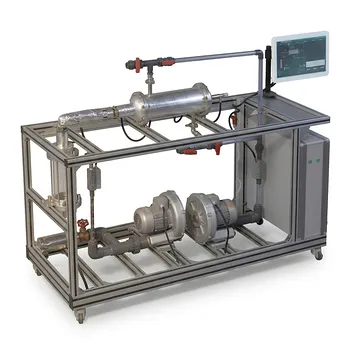
Shell and Tube Heat Exchanger Heat Transfer Coefficient Determination Educational Pilot Plant
LABPARK's shell and tube heat exchanger pilot plant enables students to investigate heat transfer coefficients, LMTD, co-current vs counter-current flow, bridging theory and industrial practice. Customizable for chemical, mechanical, environmental engineering curricula. Ideal for unit operations and process engineering labs.
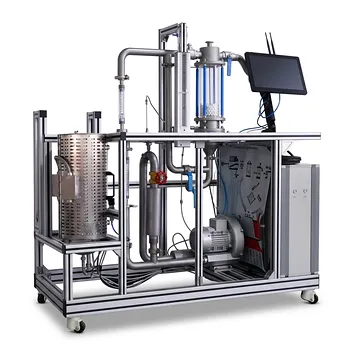
Solid Spherical Heat Transfer Coefficient Determination Educational Chemical Engineering Pilot Plant
This educational chemical engineering pilot plant enables students to determine convective heat transfer coefficients and observe transient thermal behavior of solid spheres under natural convection, forced convection, fixed beds, and fluidized bed regimes.
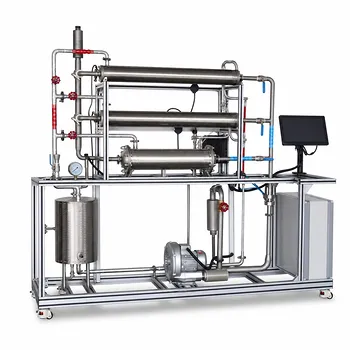
Comprehensive Heat Transfer Coefficient Determination Educational Unit Operations Pilot Plant
Advanced industrial-grade educational pilot plant for comprehensive heat transfer coefficient determination. Enables quantitative convective heat transfer analysis, evaluates double-pipe and shell-and-tube exchanger configurations, and includes digital data acquisition. Customizable for engineering curriculum. Ideal for engineering unit operations labs.

Multi-Functional Drying Educational Unit Operations Pilot Plant
Versatile multi-functional drying educational unit operations pilot plant integrating tunnel, fluidized bed, and spray drying. Enables hands-on study of drying curves, psychrometry, and gas-solid separation for chemical engineering curriculum in higher education labs.
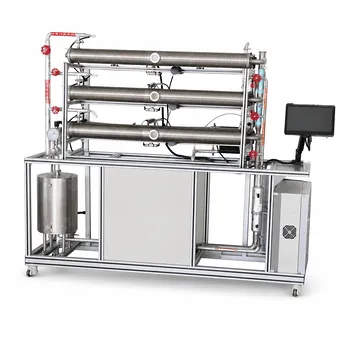
Three-Tube Heat Transfer Educational Pilot Plant for Unit Operations Training
Three-tube heat transfer pilot plant for studying convective heat transfer enhancement and condensation. Allows comparison of smooth, corrugated, turbulent tubes, verifying empirical correlations. Ideal for chemical engineering education with safety and closed-loop steam recovery.
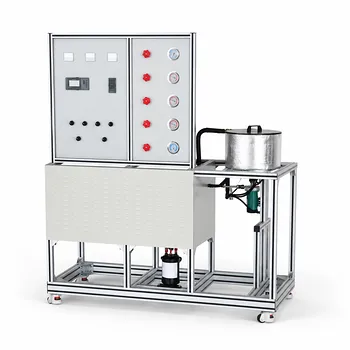
Educational Compression Refrigeration Performance Determination Unit Operations Pilot Plant
This educational pilot plant for compression refrigeration performance determination offers dual COP evaluation, regenerative cycle comparison, and calorimeter calibration. Customizable for curriculum integration, it features environmentally conscious design. Supports thermodynamic mapping on pressure-enthalpy diagrams and synchronous monitoring with centralized instrumentation.

Residence Time Distribution and Reactor Flow Characteristics Determination Educational Pilot Plant
This versatile educational pilot plant is designed for comprehensive study of residence time distribution and reactor flow characteristics, featuring multiple CSTRs in series, a tubular reactor, variable recycle loop, and automated real-time data acquisition, perfect for hands-on chemical engineering education.
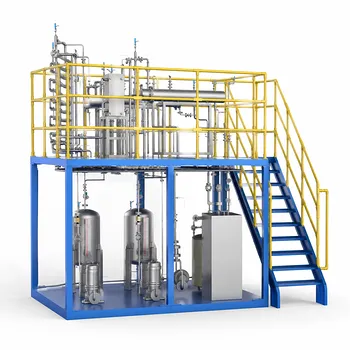
Comprehensive Multi-Modal Heat Transfer Unit Operations Pilot Plant for Engineering Training
Comprehensive multi-modal heat transfer unit operations pilot plant for engineering training. Features four heat exchanger types, multi-media switching, and three operating modes. Hands-on experience in safety, optimization, and process control. Industrial-grade design with real-time data acquisition for chemical engineering labs.
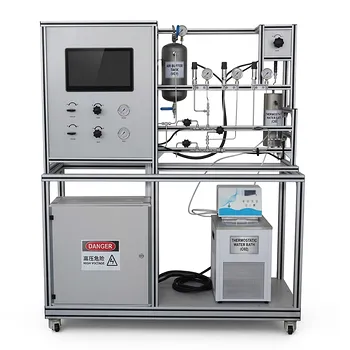
Throttling Effect Determination Educational Unit Operations Pilot Plant
Investigate the Joule-Thomson throttling effect with this educational unit operations pilot plant. Designed for engineering students, it enables hands-on comparative analysis of adiabatic gas expansion using precise process control, interactive digital interface, and eco-friendly operation, ensuring safe repeatable thermodynamic experiments.
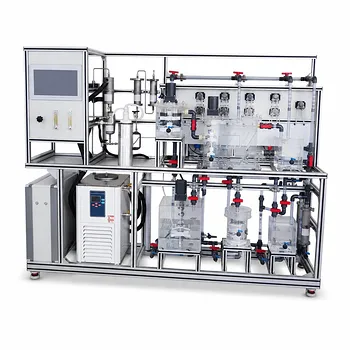
Thermal Desorption Exhaust Gas and Tail Water Treatment Educational Pilot Plant
Bench-scale educational pilot plant for treating thermal desorption exhaust gas and tail water integrates condensation, Fenton oxidation, precipitation, filtration, and carbon adsorption. Ideal for chemical engineering and environmental labs, teaching unit operations, process control, and real-time data analysis.
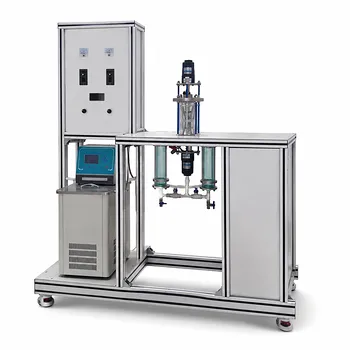
Liquid-Liquid Mass Transfer Coefficient Determination Educational Pilot Plant
This bench-scale educational pilot plant for liquid-liquid mass transfer coefficient determination offers precise control of phase boundary, temperature, and agitation, enabling hands-on study of transport phenomena and unit operations in chemical engineering labs for teaching.
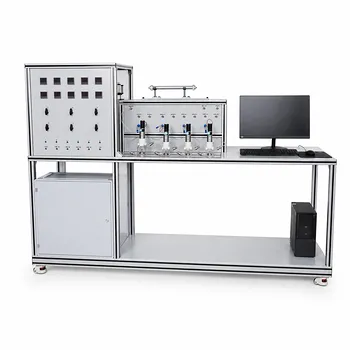
Gas Phase Mixing and Residence Time Distribution Determination Educational Unit Operations Pilot Plant
Integrated lab system for gas-phase mixing and RTD determination. Supports pulse and step tracer methods with dual CSTR and PFR reactors, industrial components, and PC data logging. Provides hands-on study of non-ideal flow and reactor behavior for university students.
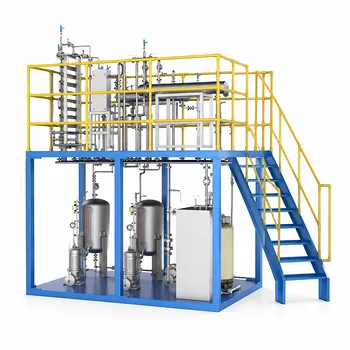
Dual Mode Heat Transfer Pilot Plant for Unit Operations Training
Engineering-scale dual-mode heat transfer pilot plant for hands-on unit operations training in chemical engineering. Features real and simulated modes, multiple heat exchanger types, comprehensive coefficient determination, and advanced process control with data acquisition for engineering students and researchers.

Absorption and Desorption Educational Unit Operations Pilot Plant
Dual packed column absorption and desorption pilot plant for chemical engineering education, offering real-time mass transfer coefficient measurement, durable mobile frame, industrial touch-screen interface, and customizable design for varied laboratory curricula, enabling hands-on study of gas absorption and stripping.
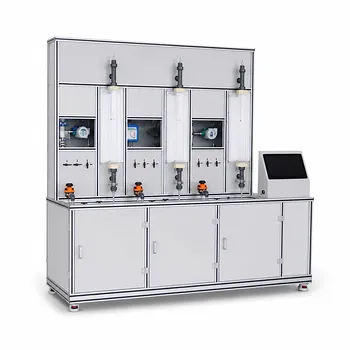
Two Phase Flow Pattern Velocity Resistance Measurement Educational Pilot Plant
Benchtop educational pilot plant for university labs studying gas-liquid two-phase flow patterns, velocity, and resistance across circular, square, and rectangular conduits. Features 15.6-inch touchscreen, 5G connectivity, differential pressure sensors, safe water-air operation. Supports chemical engineering curricula.
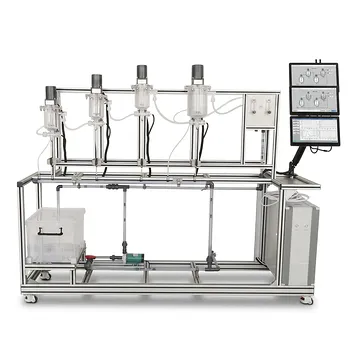
Multi-Stage Stirred Tanks in Series Residence Time Distribution and Mixing Performance Determination Educational Pilot Plant
Explore residence time distribution and mixing performance in series stirred tanks with this educational pilot plant. Real-time conductivity sensors, interactive 3D simulation, and industrial-grade PC for chemical engineering lab training. Customizable to curricula.

Constant Pressure Filtration Educational Unit Operations Pilot Plant
Hands-on educational pilot plant for constant pressure filtration. Classic plate and frame filter press allows students to study kinetics, determine specific cake resistance, perform cake washing and evaluate washing rates. Ideal for chemical engineering curriculum. Mobile, customizable, safety-compliant design.

Tubular Reactor Flow Characteristics Determination Educational Unit Operations Pilot Plant
Educational pilot plant for investigating tubular reactor flow characteristics and residence time distribution Features adjustable recycle for plug flow and backmixing studies industrial touchscreen interface and real-time data acquisition Ideal for chemical engineering unit operations laboratory training and education
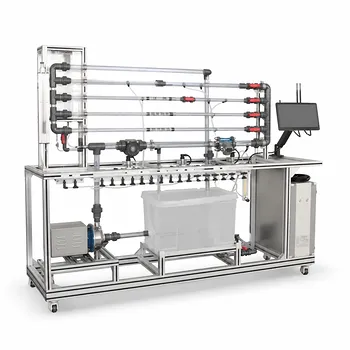
Fluid Friction Resistance Determination Educational Unit Operations Pilot Plant
Engineered bench-scale system for university engineering labs. Provides hands-on fluid mechanics experience: quantitative energy loss analysis, flow regime observation, friction coefficient determination. Features four-point pressure measurement, transparent sections, industrial touchscreen PLC, 3D virtual simulation. Ideal for chemical, mechanical, civil engineering.
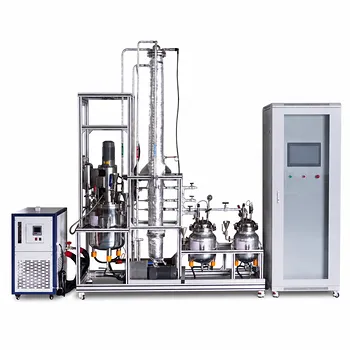
Carbon Material Thermal Pretreatment Multiphase Separation Educational Pilot Plant
Educational pilot plant for carbon material thermal pretreatment and multiphase separation. Features jacketed agitated reactor, separation column, and modern controls for hands-on unit operations training in heat transfer, fluid flow, and process safety with industrial-grade materials and wireless data acquisition.