Educational Chemical Engineering Pilot Plants
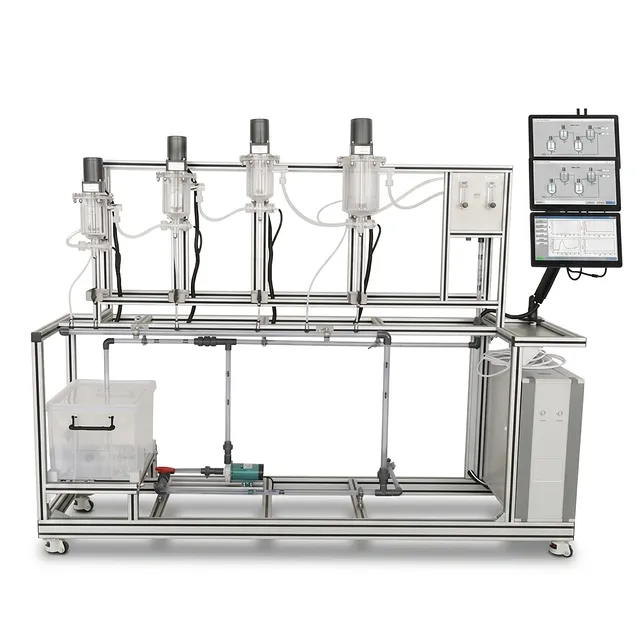
Multi-Stage Stirred Tanks in Series Residence Time Distribution and Mixing Performance Determination Educational Pilot Plant
Item Number : LPK-DFCL
Price varies based on specs and customizations
- Reactor Configuration
- 4 transparent stirred tanks in series
- Data Acquisition
- Industrial touch PC with real-time logging
- Tracer Measurement
- Pulse injection with online conductivity sensors

Shipping:
Contact us to get shipping details Enjoy On-time Dispatch Guarantee.
Why Choose Us
Easy ordering process, quality products, and dedicated support for your business success.
Introduction
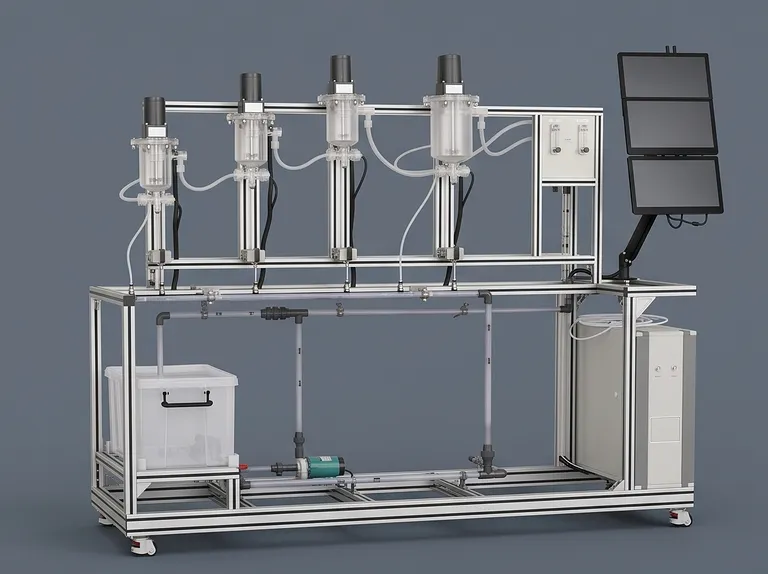
The Multi-Stage Stirred Tanks in Series Residence Time Distribution and Mixing Performance Determination Educational Unit Operations Pilot Plant is designed for chemical engineering and process-related university laboratories. This educational system allows students to visually and quantitatively analyze non-ideal flow behaviors, residence time distribution (RTD), and mixing characteristics in continuous stirred-tank reactors (CSTRs) operating in series. By bridging theoretical reactor design concepts with physical practice, the unit prepares students for real-world industrial process challenges. To accommodate varying curriculum requirements and laboratory layouts, this pilot plant features a flexible design where both the hardware components and the software interface can be fully customized to meet specific institutional needs.
Key Features and Educational Benefits
- Industrial-Grade Instrumentation: Equipped with an industrial all-in-one touch PC, exposing students to modern industrial control interfaces, data acquisition, and automated process monitoring.
- Real-Time Data Collection: Employs high-precision conductivity sensors at the outlet of each reactor to measure tracer concentration dynamically, enabling precise calculation of the RTD curve.
- Interactive 3D Virtual Simulation: A companion 3D virtual simulation platform allows students to preview and practice operations offline or online, supporting hybrid teaching models and self-paced learning.
- Comprehensive Assessment System: Built-in online testing tools enable educators to create customized question banks, generate exams, and track student performance automatically.
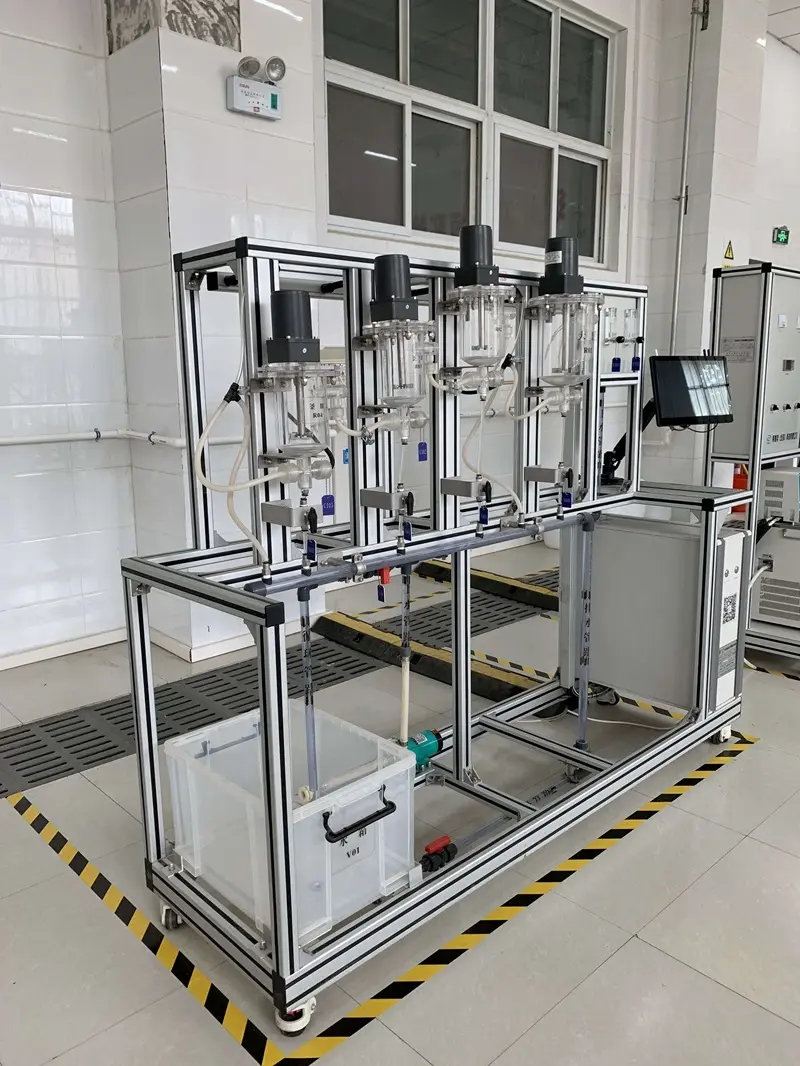
- Robust Engineering Design: Constructed on a durable, mobile aluminum profile frame, incorporating industrial-grade piping, pumps, and stirred reactors for long-term laboratory teaching use.
Technical Specifications and Experimental Capabilities
| System Component / Parameter | Technical Description | Related Academic & Textbook Concepts |
|---|---|---|
| Reactor Configuration | Four transparent stirred tank reactors (CSTRs) in series with variable-speed electric agitators. | Multiple CSTRs in series, fluid mixing, and backmixing behavior. |
| Tracer Injection System | Pulse tracer injection system with online, real-time conductivity sensors. | Pulse input method, tracer response technique, and concentration profiles. |
| Data Acquisition & UI | Industrial panel PC, real-time data logging, and automatic curve plotting software. | Residence Time Distribution (RTD) function, $E(t)$ curve calculation, and variance analysis. |
| Fluid Circulation | Corrosion-resistant circulation pump, precise rotameters, and integrated feed tank. | Volumetric flow rate, space velocity, and reactor space-time calculations. |
| 3D Virtual Platform | Interactive 3D modeling with guided procedures and grading synchronization. | Virtual laboratory practice, safety training, and pre-laboratory evaluation. |
Academic Integration and Curriculum Alignment
This educational pilot plant serves as a core experimental tool across multiple engineering disciplines, including Chemical Engineering, Environmental Engineering, Food Engineering, and Biotechnology. It is structured to align with foundational engineering concepts covered in major international textbooks, such as:
- Unit Operations of Chemical Engineering: Directly supports the study of mixing processes, agitation mechanisms, and the transport of fluids through process equipment.
- Transport Processes and Unit Operations: Connects to the principles of mass transfer, fluid dynamics, and non-ideal flow dynamics in continuous processing systems.
- Chemical Engineering Design: Illustrates the modeling of non-ideal reactors, determination of residence time distribution ($E$ and $F$ curves), evaluation of the tank-in-series model parameter ($N$), and the comparison of ideal Plug Flow Reactors (PFR) and Continuous Stirred Tank Reactors (CSTR).
By integrating this pilot plant into the laboratory curriculum, instructors can transition from textbook-based reactor design equations to hands-on experimental analysis. This reinforces the physical meaning of backmixing, reactor bypass, and dead zones.
To ensure seamless integration into your specific curriculum, both the hardware setup (including the number of reactors, sensor ranges, and piping materials) and the software environment (such as data analysis algorithms and user interface languages) can be customized to align with your academic standards.
About LABPARK
LABPARK has been dedicated to serving the higher education sector for over 20 years, focusing on delivering advanced laboratory equipment and engineering training solutions. The company specializes in six core academic fields: Chemistry, Chemical Engineering, Biotechnology, Food Engineering, Pharmaceutical Engineering, and Environmental Engineering.
Supported by a robust production and R&D base spanning 49,000 square meters, LABPARK holds 209 technical patents, reflecting a commitment to continuous educational innovation. To date, the company has established successful partnerships with more than 289 universities and colleges worldwide, helping educators cultivate the next generation of engineering talent.
Trusted by Industry Leaders
REQUEST A QUOTE
Our professional team will reply to you within one business day. Please feel free to contact us!
Related Products

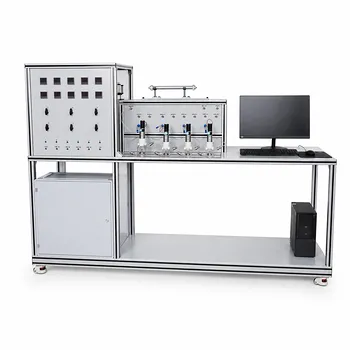
Residence Time Distribution and Reactor Flow Characteristics Determination Educational Pilot Plant
This versatile educational pilot plant is designed for comprehensive study of residence time distribution and reactor flow characteristics, featuring multiple CSTRs in series, a tubular reactor, variable recycle loop, and automated real-time data acquisition, perfect for hands-on chemical engineering education.
Gas Phase Mixing and Residence Time Distribution Determination Educational Unit Operations Pilot Plant
Integrated lab system for gas-phase mixing and RTD determination. Supports pulse and step tracer methods with dual CSTR and PFR reactors, industrial components, and PC data logging. Provides hands-on study of non-ideal flow and reactor behavior for university students.

Multi-Reactor Educational Pilot Plant for Reaction Engineering Unit Operations
Integrated bench-scale educational pilot plant for chemical engineering teaching featuring fixed bed fluidized bed and stirred tank reactors with web-based digital twin controls and safety interlocks for hands-on unit operations and reaction engineering comparative studies in one compact system.
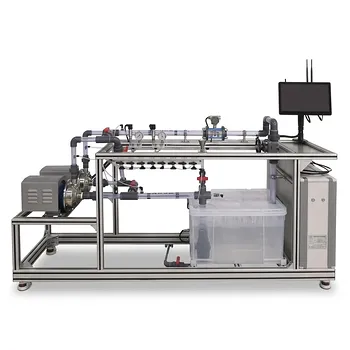
Centrifugal Pump Performance Determination Educational Unit Operations Pilot Plant
This lab system determines centrifugal pump performance curves for unit operations. Students configure dual pumps in series or parallel for hands-on learning. Includes industrial controls, clear piping, and data logging. Customizable for chemical, mechanical, and environmental engineering programs.
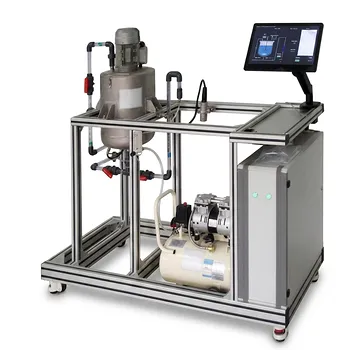
Agitation and Mixing Educational Unit Operations Pilot Plant
This bench-scale educational pilot plant enables investigation of agitation and mixing characteristics through real-time torque, speed, and conductivity measurements, supporting power number, Reynolds number, and scale-up experiments for chemical engineering students with customizable impellers and interactive control for practical education.

Multi Functional Catalytic Reaction and Reactor Evaluation Educational Unit Operations Pilot Plant
Bench-scale educational pilot plant for catalytic reaction and reactor evaluation, integrating fixed bed, fluidized bed, and stirred tank reactors. Students compare reactor designs, evaluate catalysts, and study reaction kinetics and hydrodynamics. Perfect for unit operations labs in chemical engineering curricula.

Multi-Functional Special Distillation Educational Pilot Plant
Versatile multi-functional special distillation pilot plant for chemical engineering education. Supports continuous, vacuum, azeotropic, reactive, extractive distillation. Transparent glass columns enable real-time visual observation of hydrodynamics and separation processes.
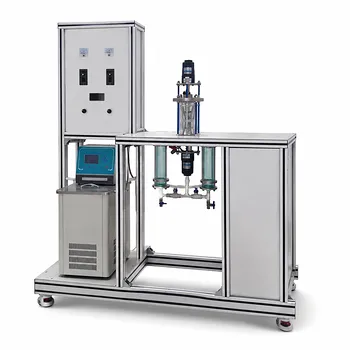
Liquid-Liquid Mass Transfer Coefficient Determination Educational Pilot Plant
This bench-scale educational pilot plant for liquid-liquid mass transfer coefficient determination offers precise control of phase boundary, temperature, and agitation, enabling hands-on study of transport phenomena and unit operations in chemical engineering labs for teaching.

Absorption and Desorption Educational Unit Operations Pilot Plant
Dual packed column absorption and desorption pilot plant for chemical engineering education, offering real-time mass transfer coefficient measurement, durable mobile frame, industrial touch-screen interface, and customizable design for varied laboratory curricula, enabling hands-on study of gas absorption and stripping.

Continuous Batch Extractive Distillation Educational Pilot Plant
Versatile pilot plant for continuous, batch, and extractive distillation training. High-borosilicate glass column for visualizing hydraulics, 15.6-inch touchscreen with data logging, precise reflux ratio control 1-99, and durable corrosion-resistant frame. Ideal for chemical engineering education and process research.

Multi-Functional Membrane Separation Educational Pilot Plant for Unit Operations Lab
The Multi-functional Membrane Separation Educational Unit Operations Pilot Plant is an integrated bench-scale laboratory system designed for teaching undergraduate engineering education. It features Ultrafiltration, Nanofiltration, and Reverse Osmosis modules in a compact, mobile unit for practical hands-on learning.

High-Gravity Emulsification and Mass Transfer Educational Pilot Plant
This integrated educational pilot plant utilizes rotating packed bed technology to demonstrate high-gravity emulsification and mass transfer, providing engineering students with hands-on experience in process intensification and unit operations through a modular, customizable design with digital monitoring.

Constant Pressure Filtration Educational Unit Operations Pilot Plant
Hands-on educational pilot plant for constant pressure filtration. Classic plate and frame filter press allows students to study kinetics, determine specific cake resistance, perform cake washing and evaluate washing rates. Ideal for chemical engineering curriculum. Mobile, customizable, safety-compliant design.
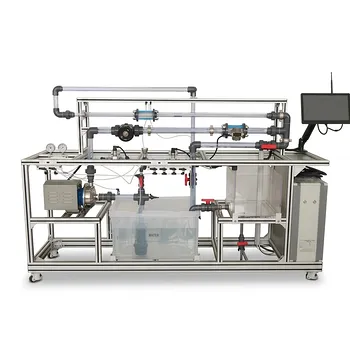
Centrifugal Pump Performance and Orifice Flowmeter Calibration Educational Pilot Plant
This versatile educational pilot plant enables engineering students to conduct centrifugal pump performance tests, orifice flowmeter calibration, and fluid mechanics experiments using a transparent flow loop, industrial HMI, and 3D virtual simulation for a comprehensive hands-on learning experience.
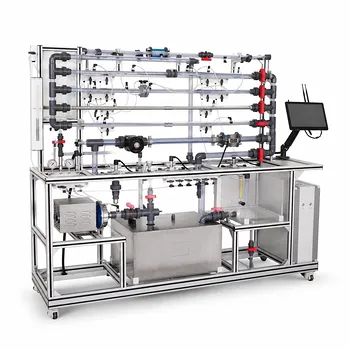
Comprehensive Fluid Mechanics Educational Unit Operations Pilot Plant
Hands-on fluid mechanics pilot plant for engineering education covering over 13 principles including pipe flow, minor losses, flowmeter calibration, and pump performance with industrial-grade components, smooth and rough piping, venturi and orifice flowmeters, and centrifugal pump testing and analysis.
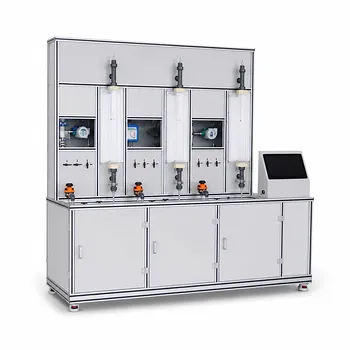
Two Phase Flow Pattern Velocity Resistance Measurement Educational Pilot Plant
Benchtop educational pilot plant for university labs studying gas-liquid two-phase flow patterns, velocity, and resistance across circular, square, and rectangular conduits. Features 15.6-inch touchscreen, 5G connectivity, differential pressure sensors, safe water-air operation. Supports chemical engineering curricula.

Educational Unit Operations Pilot Plant for Intraparticle Diffusion Effective Factor Measurement
Designed for chemical engineering university labs, this pilot plant allows hands-on determination of catalyst particle intraparticle diffusion effective factors and gas-solid reaction kinetics using a fixed-bed tubular reactor with industrial touchscreen control, bridging theory and practical reactor design.

Micro-Scale Gas-Solid Catalytic Reaction Educational Pilot Plant
Explore heterogeneous catalysis with this micro-scale gas-solid catalytic reaction educational pilot plant. Designed for university labs, it enables hands-on study of reaction kinetics and transport phenomena in a benchtop packed bed reactor with high-precision flow control and touchscreen automation.

Continuous Sieve-Plate Distillation Pilot Plant for Unit Operations Laboratory Education
Integrated pilot-scale teaching system for continuous sieve-plate distillation studies. Visual demonstration of tray hydraulics, flexible feed positions, and automatic reflux control for hands-on unit operations education in engineering labs. Designed for higher education engineering laboratories.
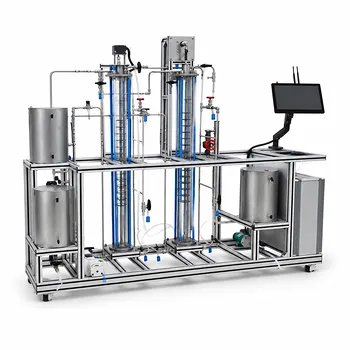
Comprehensive Liquid-Liquid Extraction Pilot Plant for Engineering Education
Comprehensive liquid-liquid extraction pilot plant for engineering education, integrating rotary and vibratory columns for hands-on observation of phase behavior, flooding limits, and mass transfer efficiency, enabling precise HTU and mass transfer coefficient calculations.
Related Articles
The Intuition You Can’t Simulate: Why the Best Bioprocess Education Still Lives on a Thin-Layer Plate
Before engineers trust a $500,000 bioreactor, they must trust their own hands. How thin-layer chromatography (TLC) builds the tacit knowledge that separates trained operators from true process engineers—and why LABPARK pilot plants preserve this irreplaceable skill.
The Invisible Variable That Sinks Bioreactors—and How Pilot Plants Train You to See It
Dissolved CO₂ accumulation silently impairs cell growth and product quality. First-principles modelling, validated on pilot-scale training plants, turns this hidden risk into a controllable process parameter.