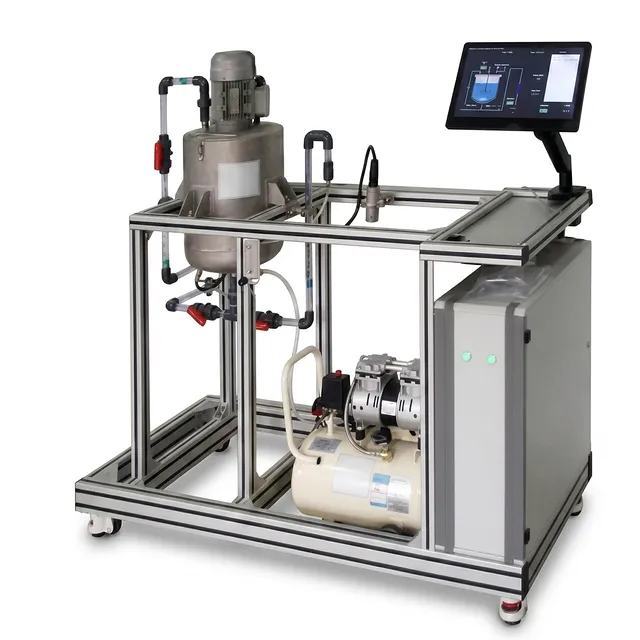
Educational Chemical Engineering Pilot Plants
Agitation and Mixing Educational Unit Operations Pilot Plant
Item Number : LPK-JBJ
Price varies based on specs and customizations
- Speed Range
- 0–1000 RPM
- Impeller Types
- Flat-Blade Turbine, Pitched-Blade Turbine, Anchor
- Instrumentation
- Torque/power transmitter, photoelectric speed sensor, conductivity probe, temperature sensor

Shipping:
Contact us to get shipping details Enjoy On-time Dispatch Guarantee.
Why Choose Us
Easy ordering process, quality products, and dedicated support for your business success.
Introduction
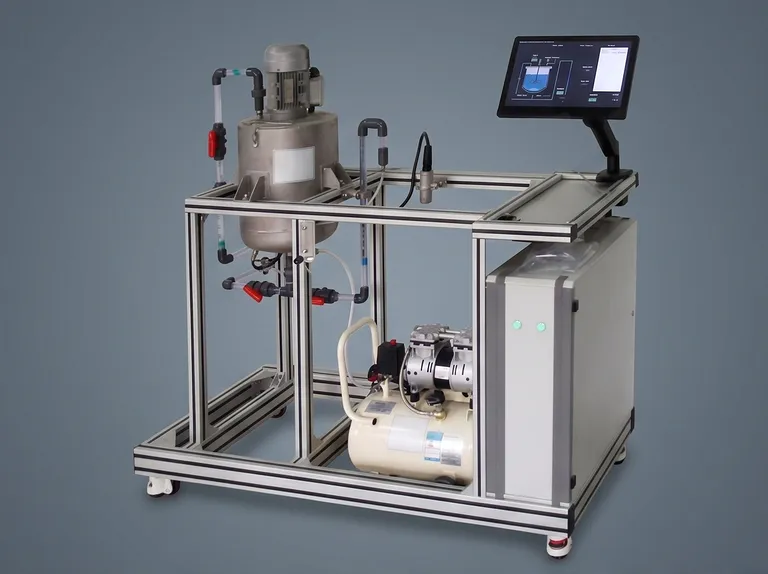
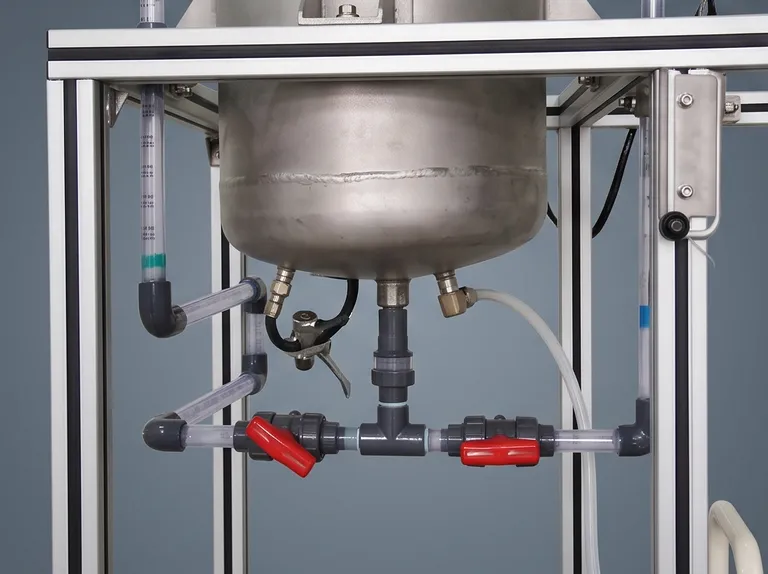
The Agitation and Mixing Characteristics Determination Educational Unit Operations Pilot Plant is an integrated, bench-scale teaching system engineered for university-level engineering laboratories. The pilot plant enables students to investigate the fundamental physical principles of fluid mixing, impeller dynamics, and power consumption within stirred vessels. By utilizing industrial-grade sensors and an intuitive digital interface, this system translates complex fluid dynamics theories into measurable, real-world engineering data.
To accommodate diverse laboratory layouts and pedagogical objectives, both the hardware and software components of this unit are customizable. Whether adapting the physical dimensions, incorporating specific impeller geometries, or modifying the data acquisition software, LABPARK can customize the system to meet your department's specific academic requirements.
Key Educational Functions and Advantages
- Empirical Power Characterization: Enables the experimental determination of the relationship between the Power Number ($N_p$) and the Reynolds Number ($Re$), allowing students to construct and analyze standard agitation power curves.
- Mixing Time Analysis: Features integrated conductivity measurement systems to study the blending process quantitatively, tracking how variables like rotational speed, fluid properties, and baffle configurations affect mixing time.
- Engineering-Grade Instrumentation: Equipped with precise sensors for real-time tracking of motor rotational speed ($n$), shaft power ($N$), fluid conductivity, and temperature, providing students with experience in industrial process monitoring.
- Interactive Digital Interface: A dedicated touchscreen control panel simplifies data monitoring, system control, and real-time visualization, enhancing student engagement and experimental efficiency.
- Industrial Realism: Promotes hands-on familiarity with pilot-scale equipment, process piping, and control architectures commonly encountered in industrial manufacturing plants.
Technical Specifications
| Parameter / Component | Specification |
|---|---|
| Agitation Vessel | Stainless steel construction equipped with removable baffles for flow pattern modification |
| Drive System | Variable speed motor with integrated control, speed range: 0–1000 RPM |
| Impeller Options | Standard configurations include Flat-Blade Turbine, Pitched-Blade Turbine, and Anchor types |
| Instrumentation | Real-time torque/power transmitter, photoelectric speed sensor, high-precision conductivity probe, and temperature sensor |
| Control & Acquisition | Integrated PLC with a color touchscreen HMI; data export capability via standard interface |
| Frame & Mobility | Corrosion-resistant aluminum alloy profile skid with heavy-duty locking casters |
Academic Fields and Curriculum Integration
This pilot plant serves as a practical link for students majoring in Chemical Engineering, Environmental Engineering, Food Engineering, and Biotechnology. By interacting with the physical system, students gain intuitive insights into the core transport phenomena and unit operations defined in major international engineering curricula.
The experimental modules align with key topics in standard academic reference materials:
- Fluid Mechanics and Mixing Theories: Directly maps to discussions on the agitation of liquids, flow patterns in stirred vessels, and power consumption found in Unit Operations of Chemical Engineering.
- Dimensional Analysis and Scale-Up: Corresponds to the principles of geometric similarity, Reynolds and Power number calculations, and scale-up criteria detailed in Transport Processes and Unit Operations.
- Process Equipment Design: Complements the design considerations for mixing vessels, agitator selection, and mechanical design principles presented in Chemical Engineering Design.
Experimental Modules & Academic Alignment
| Experimental Module | Measurable Parameters | Associated Academic Concepts | Reference Textbook Alignment |
|---|---|---|---|
| Agitator Power Determination | Speed ($n$), Power ($N$), Fluid density ($\rho$), Fluid viscosity ($\mu$) | Power Number ($N_p$), Reynolds Number ($Re$), dimensional analysis | Unit Operations of Chemical Engineering / Transport Processes and Unit Operations |
| Mixing Time & Efficiency | Conductivity vs. time, impeller speed, baffle configuration | Blending effectiveness, concentration homogenization, tracer dynamics | Unit Operations of Chemical Engineering |
| System Characterization & Scale-Up | Impeller geometry, vessel-to-impeller ratio, baffle effects | Scale-up criteria, power-per-unit-volume, flow vs. shear characteristics | Chemical Engineering Design / Transport Processes and Unit Operations |
Tailored Hardware and Software Customization
Understanding that every engineering department operates under distinct academic guidelines and spatial constraints, LABPARK provides comprehensive custom engineering. Our team can modify the physical hardware (including vessel capacities, jacketed configurations, and specialized impeller types) as well as the software architecture (including custom data analysis algorithms, user interface layouts, and network integration) to match your institutional requirements.
About LABPARK
LABPARK has dedicated over 20 years to serving higher education, focusing on developing state-of-the-art laboratory equipment across six core engineering and scientific fields: chemistry, chemical engineering, biology, food science, pharmacy, and environmental engineering. Our commitment to innovation is supported by 209 technical patents and a robust manufacturing infrastructure.
To date, LABPARK has established successful collaborations with more than 289 universities and colleges worldwide. Operating from a modern, 4.9-ten-thousand (49,000) square-meter R&D and manufacturing base, we ensure that every piece of educational equipment is manufactured to rigorous standards, providing reliable, safe, and academically aligned training tools for future engineers.
Trusted by Industry Leaders
REQUEST A QUOTE
Our professional team will reply to you within one business day. Please feel free to contact us!
Related Products

Multi-Reactor Educational Pilot Plant for Reaction Engineering Unit Operations
Integrated bench-scale educational pilot plant for chemical engineering teaching featuring fixed bed fluidized bed and stirred tank reactors with web-based digital twin controls and safety interlocks for hands-on unit operations and reaction engineering comparative studies in one compact system.
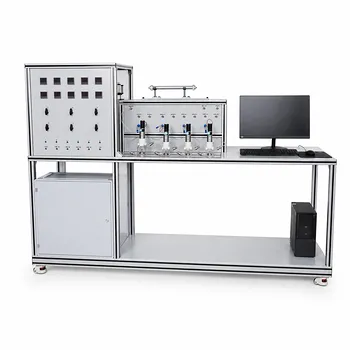
Gas Phase Mixing and Residence Time Distribution Determination Educational Unit Operations Pilot Plant
Integrated lab system for gas-phase mixing and RTD determination. Supports pulse and step tracer methods with dual CSTR and PFR reactors, industrial components, and PC data logging. Provides hands-on study of non-ideal flow and reactor behavior for university students.
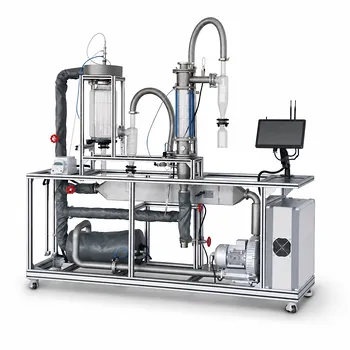
Multi-Functional Drying Educational Unit Operations Pilot Plant
Versatile multi-functional drying educational unit operations pilot plant integrating tunnel, fluidized bed, and spray drying. Enables hands-on study of drying curves, psychrometry, and gas-solid separation for chemical engineering curriculum in higher education labs.

Educational Unit Operations Pilot Plant for Intraparticle Diffusion Effective Factor Measurement
Designed for chemical engineering university labs, this pilot plant allows hands-on determination of catalyst particle intraparticle diffusion effective factors and gas-solid reaction kinetics using a fixed-bed tubular reactor with industrial touchscreen control, bridging theory and practical reactor design.
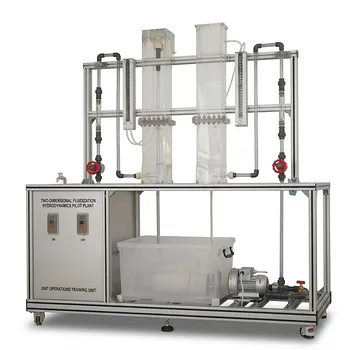
Two-Dimensional Fluidization Hydrodynamics Educational Pilot Plant for Unit Operations Training
Explore gas-solid and liquid-solid fluidization hydrodynamics with our transparent 2D educational pilot plant. Ideal for chemical engineering unit operations labs, it demonstrates fixed to fluidized bed regimes, measures pressure drop, and integrates QR-code digital learning for enhanced student training.

Solid Waste Pyrolysis and Refining Educational Pilot Plant for Unit Operations
This pilot plant for solid waste pyrolysis and refining integrates pyrolysis, separation, distillation, and catalytic hydrogenation into one educational unit. It provides visual process observation, smart data logging, and industrial safety for hands-on learning of engineering unit operations.

High-Gravity Emulsification and Mass Transfer Educational Pilot Plant
This integrated educational pilot plant utilizes rotating packed bed technology to demonstrate high-gravity emulsification and mass transfer, providing engineering students with hands-on experience in process intensification and unit operations through a modular, customizable design with digital monitoring.

Dual-Mode Rectification Pilot Plant for Practical Training Unit Operations
Industrial-scale dual-mode rectification pilot plant for chemical engineering practical training. Features real-material and simulated-material operation modes, sieve-plate column with sight glasses for visual observation of hydrodynamics, and customizable SCADA control for safe, hands-on learning of unit operations and mass transfer.
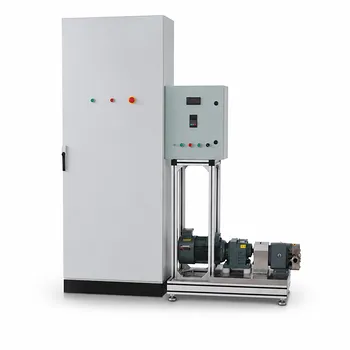
Quantitative Dosing and Liquid Flow Control Educational Unit Operations Pilot Plant
Explore industrial fluid transport and automated process control with this quantitative dosing and liquid flow control educational pilot plant, featuring local and remote control cabinets, variable speed metering pump, high-precision flow sensors, and PLC-based SCADA integration for engineering students.

Comprehensive Fluid Mechanics Educational Unit Operations Pilot Plant
Hands-on fluid mechanics pilot plant for engineering education covering over 13 principles including pipe flow, minor losses, flowmeter calibration, and pump performance with industrial-grade components, smooth and rough piping, venturi and orifice flowmeters, and centrifugal pump testing and analysis.

Multi Pump Fluid Transport Process Piping Unit Operations Training Pilot Plant
Industrial-scale multi-pump pilot plant for unit operations training in fluid transport and process piping, featuring real-material and semi-physical simulation modes, comprehensive pump and flowmeter calibration, and safety-enhanced two-tier platform, bridging academic theory and industrial practice for chemical engineering education.

Multi-Functional Special Distillation Educational Pilot Plant
Versatile multi-functional special distillation pilot plant for chemical engineering education. Supports continuous, vacuum, azeotropic, reactive, extractive distillation. Transparent glass columns enable real-time visual observation of hydrodynamics and separation processes.

Multimodal Absorption and Desorption Pilot Plant for Unit Operations Training
Multimodal absorption and desorption pilot plant for higher education labs. Bridges theory and industrial practice with transparent packed columns, three operational modes (real-material, simulated, semi-physical), and SCADA control. Students explore mass transfer, column hydraulics, and process control. Customizable.

Fixed-Bed Chemical Reaction and Gas Dust Tar Removal Unit Operations Pilot Plant
Integrated educational pilot plant for studying catalytic gas-solid reactions and downstream gas purification. Features dual fixed-bed reactor, three-stage heating, and touchscreen control for hands-on engineering training. Ideal for chemical and environmental engineering curricula.

Dual Mode Heat Transfer Pilot Plant for Unit Operations Training
Engineering-scale dual-mode heat transfer pilot plant for hands-on unit operations training in chemical engineering. Features real and simulated modes, multiple heat exchanger types, comprehensive coefficient determination, and advanced process control with data acquisition for engineering students and researchers.

Polymerization Granulation and Pellet Processing Educational Unit Operations Pilot Plant
Integrated pilot plant for teaching polymer processing from polymerization to pelletizing. Includes 30L reactor, hydrolyzer, extruder-granulator, vibration dryer, crusher, and sieve. Atmospheric pressure operation for safety, corrosion-resistant SS, customizable for chemical and polymer engineering education. Ideal for university labs.

Ethyl Acetate Synthesis Unit Operations Pilot Plant for Practical Training
Modular and customizable pilot plant for ethyl acetate synthesis practical training. Integrates esterification reaction, liquid-liquid extraction, neutralization, and sieve-plate distillation unit operations. Bridging theory and real-world industrial processes. Designed for university chemical engineering labs

Electrolytic Hydrogen Production Educational Unit Operations Pilot Plant
Bench-scale electrolytic hydrogen production pilot plant designed for university engineering labs. Provides hands-on training in water electrolysis, gas-liquid separation, and process safety. Fully customizable system with digital PID control, corrosion-resistant components, and hydrogen gas detector. Ideal for chemical engineering curricula.
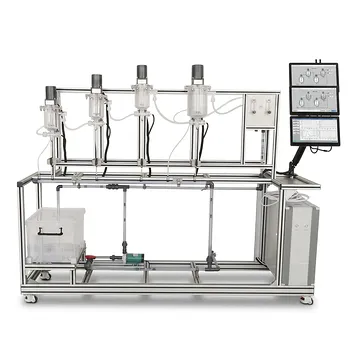
Multi-Stage Stirred Tanks in Series Residence Time Distribution and Mixing Performance Determination Educational Pilot Plant
Explore residence time distribution and mixing performance in series stirred tanks with this educational pilot plant. Real-time conductivity sensors, interactive 3D simulation, and industrial-grade PC for chemical engineering lab training. Customizable to curricula.

Natural Product Extraction Unit Operations Training Pilot Plant
Integrated natural product extraction pilot plant for chemical engineering training bridges theory and industrial practice with modular extraction and evaporation/concentration units, hybrid touchscreen and manual control, realistic process simulation, and self-contained softened water and vacuum utilities.