Vocational Chemical Engineering Pilot Plants
Dual Mode Heat Transfer Pilot Plant for Unit Operations Training
Item Number : LPK-SMTCR
Price varies based on specs and customizations
- Operation Modes
- Real-Material Mode and Simulated-Material Mode
- Exchanger Types
- Tubular/Shell-and-Tube, Plate, and other partition wall types (4 total)
- Control Interface
- Industrial computer with SCADA/configuration software

Shipping:
Contact us to get shipping details Enjoy On-time Dispatch Guarantee.
Why Choose Us
Easy ordering process, quality products, and dedicated support for your business success.
Introduction
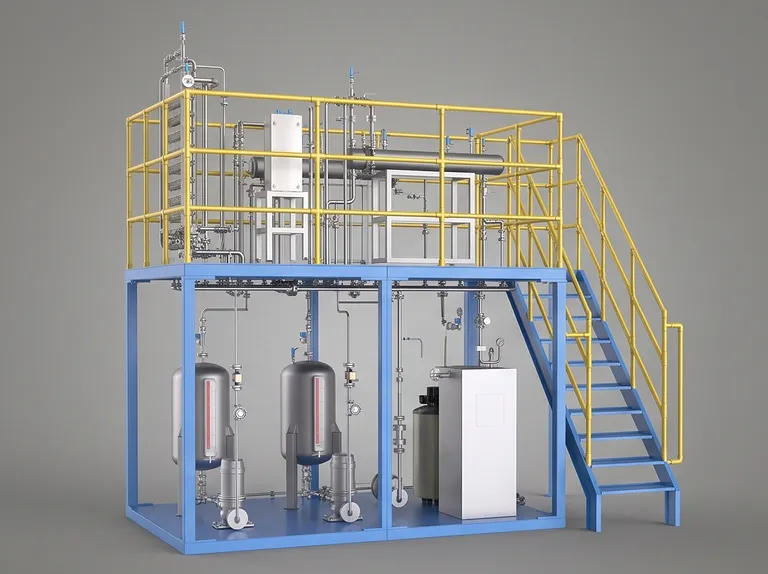
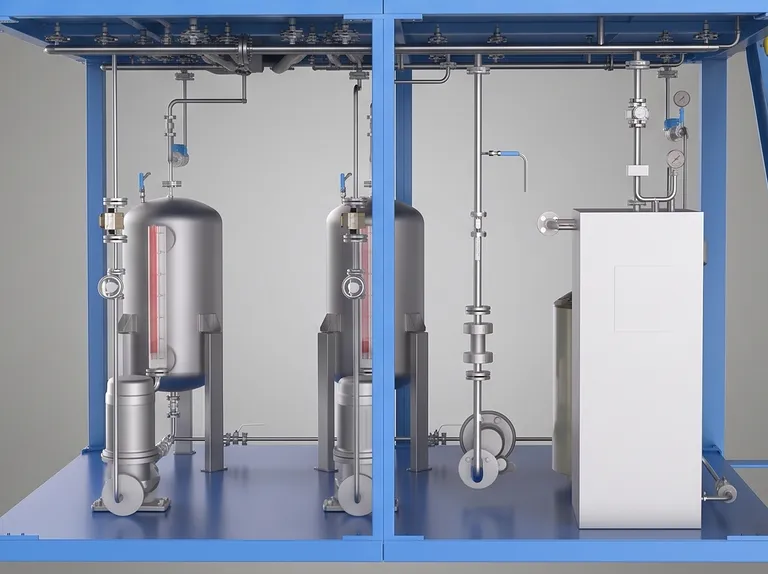
The Dual-Mode Comprehensive Heat Transfer Practical Training Unit Operations Pilot Plant is an engineering-scale laboratory system designed for higher education institutions to facilitate hands-on instruction in thermal engineering and chemical unit operations. This pilot plant provides undergraduate students and researchers with a practical platform to study heat transfer mechanisms, operate industrial-grade heat exchangers, and master process control systems. By bridging the gap between theoretical classroom concepts and real-world industrial operations, this unit prepares engineering students for practical career challenges.
Customization Options
To meet the specific requirements of different academic curricula and laboratory spaces, this pilot plant features a highly customizable design. Both hardware components (such as piping layout, material selection, sensor configurations, and physical dimensions) and software systems (including control interfaces, data acquisition modules, and simulation models) can be tailored to align with your institution's teaching objectives and facility constraints.
Key Teaching Functions and Advantages
- Dual-Mode Operation System: Features both "Real-Material" and "Simulated-Material" operation modes. The real-material mode controls physical components like pumps and heaters using real-time sensor data, while the simulated-material mode utilizes safe media (water or air) with mathematical models to safely train students on startup, shutdown, and fault-handling procedures.
- Multi-Type Heat Exchanger Analysis: Allows students to study the structure, working principles, and performance of four common types of wall-separated heat exchangers (including shell-and-tube and plate heat exchangers).
- Comprehensive Coefficient Determination: Facilitates hands-on calculation of overall heat transfer coefficients ($U$) under varying flow rates, temperatures, and fluid configurations (co-current and counter-current).
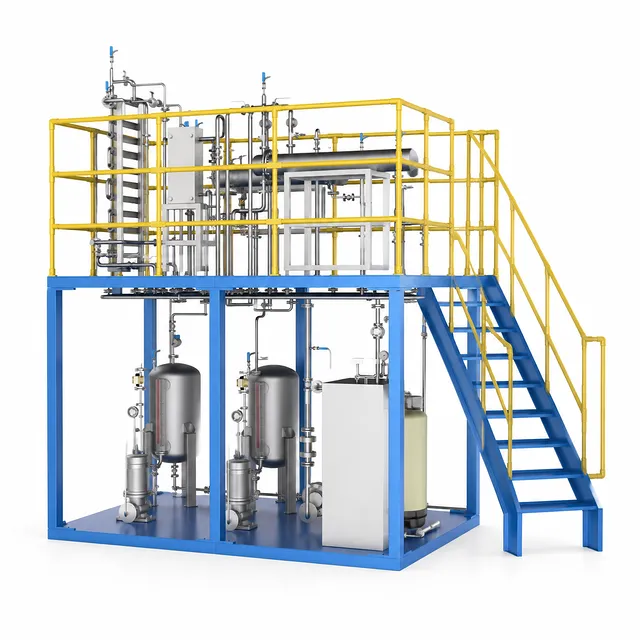
- Industrial-Scale Infrastructure: Built on a robust two-tier steel platform with safety handrails and access stairs, replicating the structural and operational environment of a real industrial chemical plant.
- Advanced Process Control & Data Acquisition: Equipped with industrial-grade sensors and a centralized control system that allows students to visualize process variables, analyze heat balances, and understand automated process loops.
Technical Specifications
| Specification | Details |
|---|---|
| System Footprint | Approx. 3930 mm × 2560 mm × 3900 mm (L × W × H) (Customizable to site requirements) |
| Structural Framework | Two-tier steel structure with powder-coated finish; 1.2 m safety handrails on Level 2; 3 mm checkered plate flooring; integrated safety inclined ladder |
| Exchanger Types | Tubular/Shell-and-Tube heat exchangers, Plate heat exchangers, and other partition wall types (4 types total) |
| Operation Modes | Real-Material Mode: Real-time sensor data acquisition and direct physical control of pumps and electric heaters. Simulated-Material Mode: Uses safe media (water/air) coupled with mathematical models to simulate process dynamics based on physical valve positions. |
| Control Interface | Industrial computer with SCADA/configuration software for real-time monitoring and process control |
| Customizability | Fully customizable hardware (piping, sensors, dimensions) and software (interfaces, simulation algorithms) |
Curriculum Integration and Textbook Alignment
This training plant is designed to align with international core engineering curricula in chemical engineering, environmental engineering, energy systems, and food engineering. By interacting with this physical and simulated system, students can directly correlate practical observations with the theoretical frameworks presented in classic academic textbooks.
The experimental modules correspond directly to key unit operations and transport phenomena covered in leading publications such as Unit Operations of Chemical Engineering, Transport Processes and Unit Operations, and Chemical Engineering Design.
| Experimental Module | Key Unit Operation / Knowledge Point | Corresponding Academic Concepts in Classic Textbooks |
|---|---|---|
| Heat Exchanger Characterization | Conduction and Convection in Pipes | Steady-state heat transfer through multi-layered walls, individual and overall heat transfer coefficients, fouling factors. |
| Co-current vs. Counter-current Operation | Logarithmic Mean Temperature Difference (LMTD) | LMTD correction factors, thermal efficiency comparison, heat exchanger effectiveness ($\epsilon$-NTU method). |
| Multi-Media Heat Switching | Process Design & Thermal Utilities | Energy balances, utility consumption calculations, switching mechanisms between different heating and cooling media. |
| Dual-Mode Process Control | Process Dynamics and Modeling | Sensor calibration, data acquisition, valve flow characteristics, transition from physical process behavior to simulated dynamic models. |
Through these integrated experiments, students develop a deeper understanding of transport phenomena, process design principles, and heat transfer equipment sizing, translating textbook formulas into practical engineering competencies.
Tailored Customization
In addition to the standard configurations, we emphasize that this pilot plant is fully adaptable to your academic laboratory. Both the hardware layout and the software control systems can be customized to match your specific teaching syllabus, space limitations, and research needs, ensuring seamless integration into your engineering department.
About LABPARK
LABPARK has been dedicated to serving higher education institutions for over 20 years, focusing on delivering advanced experimental and practical training solutions. We specialize in six major academic and industrial domains: chemistry, chemical engineering, biotechnology, food engineering, pharmaceutical engineering, and environmental engineering.
With a robust research and development foundation, LABPARK holds 209 technical patents and has established successful partnerships with more than 289 universities and colleges worldwide. Our operations are supported by a state-of-the-art production and R&D base covering 49,000 square meters, ensuring that all our equipment meets strict quality, safety, and pedagogical standards.
Trusted by Industry Leaders
REQUEST A QUOTE
Our professional team will reply to you within one business day. Please feel free to contact us!
Related Products

Dual-Mode Rectification Pilot Plant for Practical Training Unit Operations
Industrial-scale dual-mode rectification pilot plant for chemical engineering practical training. Features real-material and simulated-material operation modes, sieve-plate column with sight glasses for visual observation of hydrodynamics, and customizable SCADA control for safe, hands-on learning of unit operations and mass transfer.

Comprehensive Multi-Modal Heat Transfer Unit Operations Pilot Plant for Engineering Training
Comprehensive multi-modal heat transfer unit operations pilot plant for engineering training. Features four heat exchanger types, multi-media switching, and three operating modes. Hands-on experience in safety, optimization, and process control. Industrial-grade design with real-time data acquisition for chemical engineering labs.
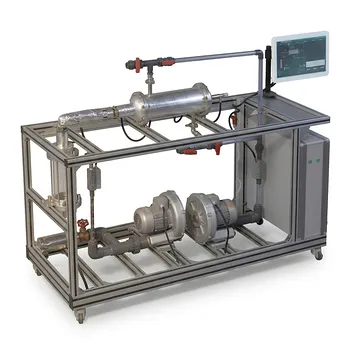
Shell and Tube Heat Exchanger Heat Transfer Coefficient Determination Educational Pilot Plant
LABPARK's shell and tube heat exchanger pilot plant enables students to investigate heat transfer coefficients, LMTD, co-current vs counter-current flow, bridging theory and industrial practice. Customizable for chemical, mechanical, environmental engineering curricula. Ideal for unit operations and process engineering labs.

Three-Tube Heat Transfer Educational Pilot Plant for Unit Operations Training
Three-tube heat transfer pilot plant for studying convective heat transfer enhancement and condensation. Allows comparison of smooth, corrugated, turbulent tubes, verifying empirical correlations. Ideal for chemical engineering education with safety and closed-loop steam recovery.

Dual-Mode Gas Absorption and Desorption Unit Operations Training Pilot Plant
Industrial-scale pilot plant for gas absorption and desorption training in chemical engineering. Features dual-mode operation with real and simulated materials, transparent columns for flow visualization, and customizable design. Supports independent or combined loops for hands-on unit operations experiments.
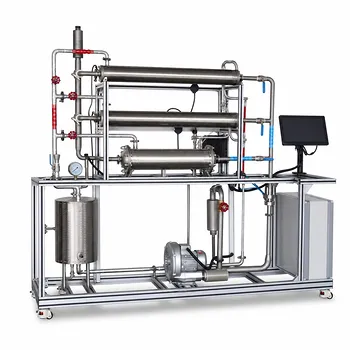
Comprehensive Heat Transfer Coefficient Determination Educational Unit Operations Pilot Plant
Advanced industrial-grade educational pilot plant for comprehensive heat transfer coefficient determination. Enables quantitative convective heat transfer analysis, evaluates double-pipe and shell-and-tube exchanger configurations, and includes digital data acquisition. Customizable for engineering curriculum. Ideal for engineering unit operations labs.
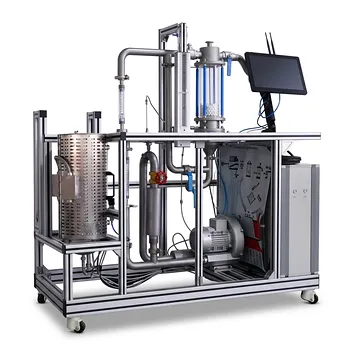
Solid Spherical Heat Transfer Coefficient Determination Educational Chemical Engineering Pilot Plant
This educational chemical engineering pilot plant enables students to determine convective heat transfer coefficients and observe transient thermal behavior of solid spheres under natural convection, forced convection, fixed beds, and fluidized bed regimes.
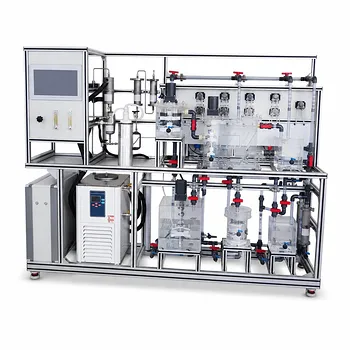
Thermal Desorption Exhaust Gas and Tail Water Treatment Educational Pilot Plant
Bench-scale educational pilot plant for treating thermal desorption exhaust gas and tail water integrates condensation, Fenton oxidation, precipitation, filtration, and carbon adsorption. Ideal for chemical engineering and environmental labs, teaching unit operations, process control, and real-time data analysis.

Absorption and Desorption Educational Unit Operations Pilot Plant
Dual packed column absorption and desorption pilot plant for chemical engineering education, offering real-time mass transfer coefficient measurement, durable mobile frame, industrial touch-screen interface, and customizable design for varied laboratory curricula, enabling hands-on study of gas absorption and stripping.

Multi-Modal Distillation Unit Operations Training Pilot Plant
Multi-modal distillation pilot plant for practical unit operations training in chemical engineering education. Features real, analog, and semi-physical simulation modes, industrial construction, customizable for university labs. Hands-on fractionation columns, SCADA control, safety systems. Includes sight glasses, sampling ports, closed-loop recycling.
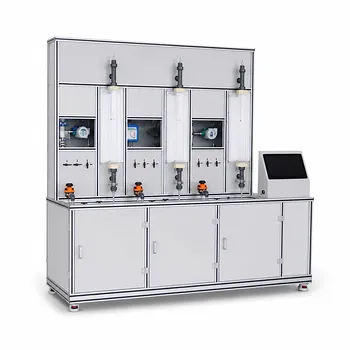
Two Phase Flow Pattern Velocity Resistance Measurement Educational Pilot Plant
Benchtop educational pilot plant for university labs studying gas-liquid two-phase flow patterns, velocity, and resistance across circular, square, and rectangular conduits. Features 15.6-inch touchscreen, 5G connectivity, differential pressure sensors, safe water-air operation. Supports chemical engineering curricula.
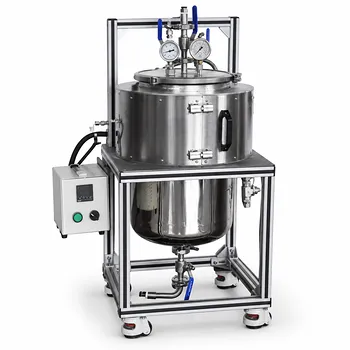
Hot Filtration Educational Unit Operations Pilot Plant Laboratory System
This integrated laboratory bench-scale hot filtration pilot plant enables students to study solid-liquid separation under thermal conditions, featuring a stainless steel vessel, removable heating jacket, and multi-layer filter plates for unit operations education, ideal for chemical engineering laboratory curriculum.

Multi-Functional Drying Educational Unit Operations Pilot Plant
Versatile multi-functional drying educational unit operations pilot plant integrating tunnel, fluidized bed, and spray drying. Enables hands-on study of drying curves, psychrometry, and gas-solid separation for chemical engineering curriculum in higher education labs.
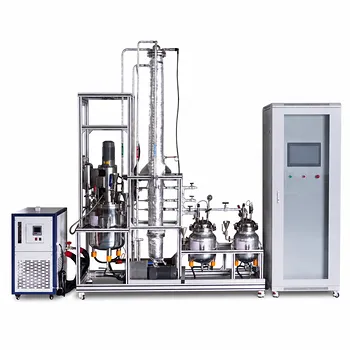
Carbon Material Thermal Pretreatment Multiphase Separation Educational Pilot Plant
Educational pilot plant for carbon material thermal pretreatment and multiphase separation. Features jacketed agitated reactor, separation column, and modern controls for hands-on unit operations training in heat transfer, fluid flow, and process safety with industrial-grade materials and wireless data acquisition.

Multi Functional Catalytic Reaction and Reactor Evaluation Educational Unit Operations Pilot Plant
Bench-scale educational pilot plant for catalytic reaction and reactor evaluation, integrating fixed bed, fluidized bed, and stirred tank reactors. Students compare reactor designs, evaluate catalysts, and study reaction kinetics and hydrodynamics. Perfect for unit operations labs in chemical engineering curricula.
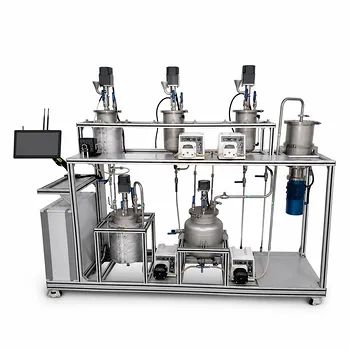
High-Gravity Emulsification and Mass Transfer Educational Pilot Plant
This integrated educational pilot plant utilizes rotating packed bed technology to demonstrate high-gravity emulsification and mass transfer, providing engineering students with hands-on experience in process intensification and unit operations through a modular, customizable design with digital monitoring.

Multi-Reactor Educational Pilot Plant for Reaction Engineering Unit Operations
Integrated bench-scale educational pilot plant for chemical engineering teaching featuring fixed bed fluidized bed and stirred tank reactors with web-based digital twin controls and safety interlocks for hands-on unit operations and reaction engineering comparative studies in one compact system.

Rising and Falling Film Evaporation Educational Unit Operations Pilot Plant
Hands-on educational pilot plant for studying rising and falling film evaporation, flow regimes, and heat transfer. Customizable for university labs with industrial instrumentation and data acquisition. Enables comparative evaluation of evaporation modes and energy efficiency.
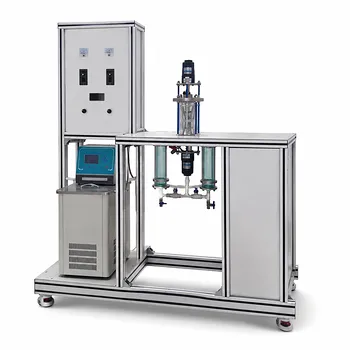
Liquid-Liquid Mass Transfer Coefficient Determination Educational Pilot Plant
This bench-scale educational pilot plant for liquid-liquid mass transfer coefficient determination offers precise control of phase boundary, temperature, and agitation, enabling hands-on study of transport phenomena and unit operations in chemical engineering labs for teaching.

Multi-Functional Special Distillation Educational Pilot Plant
Versatile multi-functional special distillation pilot plant for chemical engineering education. Supports continuous, vacuum, azeotropic, reactive, extractive distillation. Transparent glass columns enable real-time visual observation of hydrodynamics and separation processes.