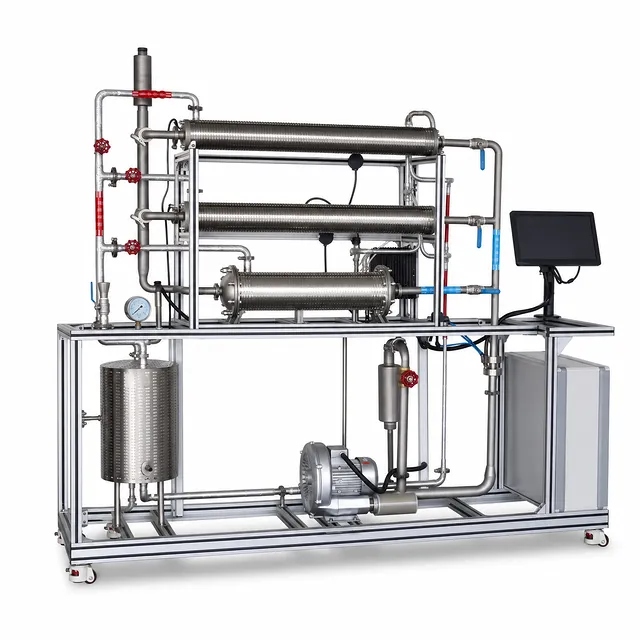
Educational Chemical Engineering Pilot Plants
Comprehensive Heat Transfer Coefficient Determination Educational Unit Operations Pilot Plant
Item Number : LPK-BHTC
Price varies based on specs and customizations
- Smooth Tube Exchanger
- Stainless steel outer shell with high-conductivity smooth red copper inner tube
- Threaded Tube Exchanger
- Stainless steel outer shell with internally threaded red copper inner tube for boundary layer disruption
- Shell-and-Tube Exchanger
- Industrial-geometry multi-pass shell-and-tube configuration with stainless steel shell

Shipping:
Contact us to get shipping details Enjoy On-time Dispatch Guarantee.
Why Choose Us
Easy ordering process, quality products, and dedicated support for your business success.
Introduction
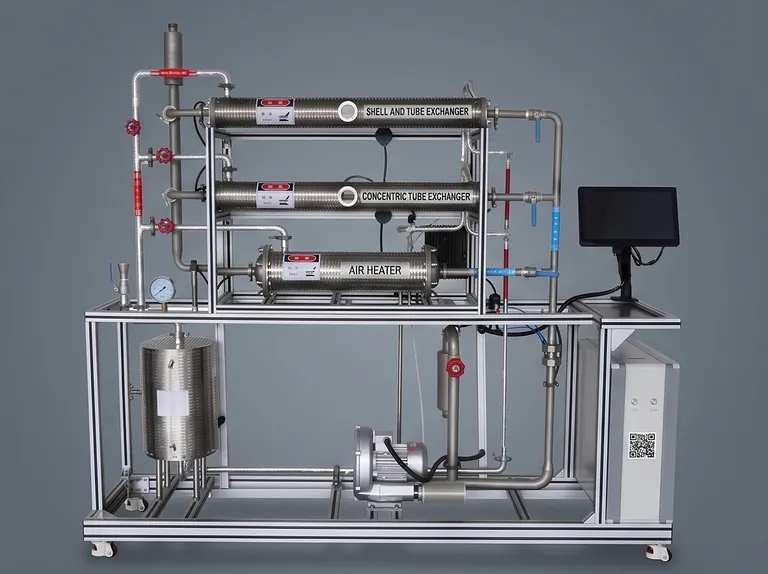
The Comprehensive Heat Transfer Coefficient Determination Educational Unit Operations Pilot Plant is an advanced, industrial-grade laboratory training system designed to bridge academic heat transfer theory with practical engineering applications. This pilot plant allows undergraduate students in engineering disciplines to perform quantitative analyses of convective heat transfer, explore methods for heat transfer enhancement, and evaluate the thermal performance of different exchanger configurations (including double-pipe and shell-and-tube designs). Equipped with precise instrumentation and digital data acquisition, the system simplifies the demonstration of complex thermal phenomena, helping instructors deliver hands-on, curriculum-aligned lab sessions.
To ensure seamless integration into diverse academic laboratories, both the hardware configuration and the software interface of this pilot plant can be fully customized to meet specific institutional requirements, space limitations, and curriculum objectives.
Pedagogical Features and Advantages
This educational unit is engineered specifically for university-level instruction, focusing on clarity of measurement, ease of operation, and alignment with modern engineering accreditation standards:
- Accreditation-Aligned Curriculum Support: Designed to meet the stringent requirements of international engineering education accreditations, focusing on student-led data collection, error analysis, and empirical modeling.
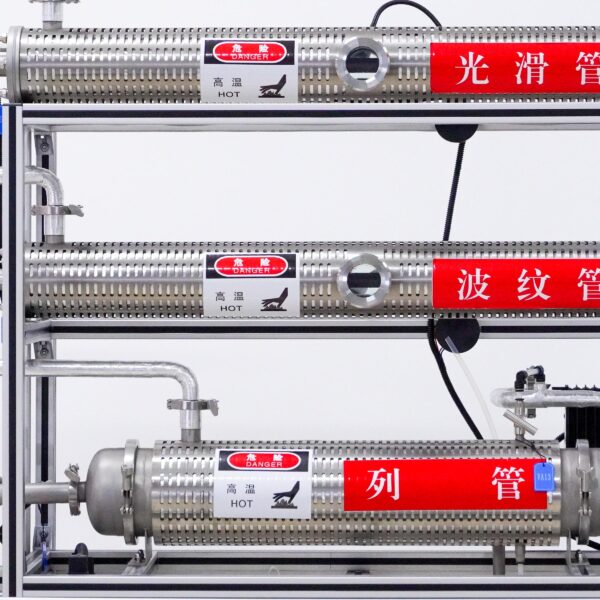
- Dual-Pipe Comparison (Enhanced vs. Standard Heat Transfer): Features side-by-side installations of a smooth copper tube and a threaded copper tube, allowing students to visually inspect and quantitatively verify the mechanisms of enhanced heat transfer.
- Versatile Configuration Evaluation: Enables the direct evaluation of convective heat transfer inside tubes, external steam condensation, and multi-pass shell-and-tube performance within a single, integrated station.
- Empirical Modeling Practice: Provides highly repeatable flow and temperature data, enabling students to perform linear regression analysis to determine the dimensionless constants ($A$ and $m$) in the Nusselt equation correlation ($Nu = A \cdot Re^m \cdot Pr^{0.4}$).
- Robust Safety Systems: Includes critical safety features such as a physical safety liquid seal on the steam generator, digital pressure sensors, and audible/visual high-pressure alarms, safeguarding student operators during active steam cycles.
Detail & Parts
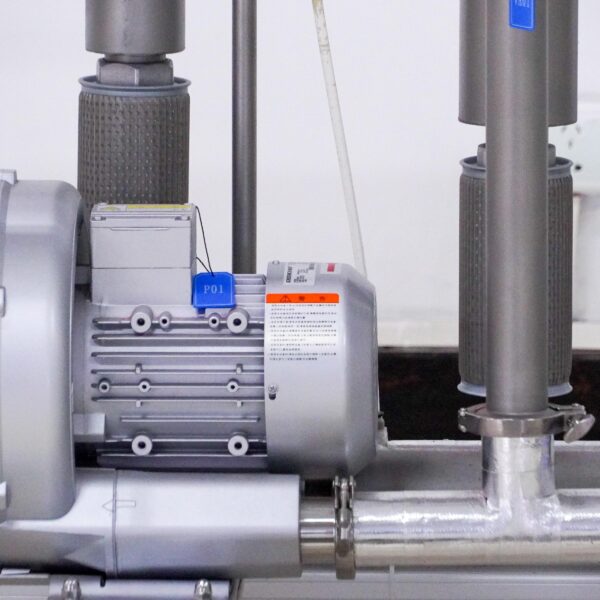
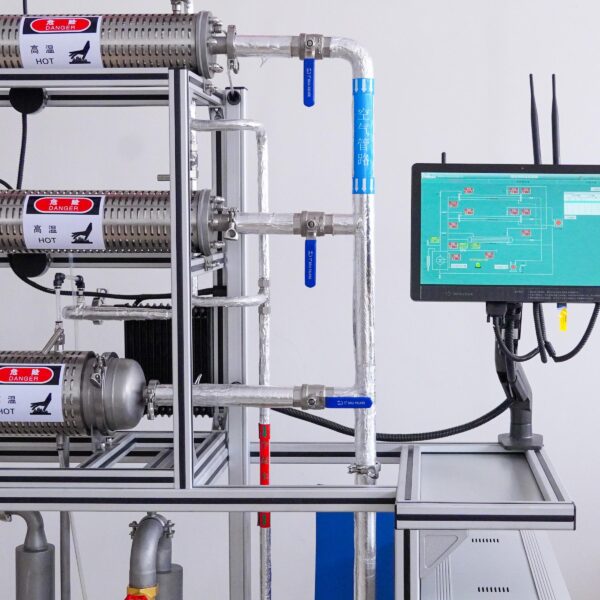
Technical Specifications
The system is constructed with industrial-standard materials, optimized for durability and visibility in an educational environment:
| Specification Parameter | Detail Description |
|---|---|
| Structure Frame | High-grade aluminum alloy framework with locking industrial casters for mobility and stability. |
| Footprint Dimensions | $\le$ 2200 mm (L) × 580 mm (W) × 1800 mm (H). |
| Smooth Tube Exchanger | Stainless steel outer shell with a high-conductivity smooth red copper inner tube. |
| Threaded Tube Exchanger | Stainless steel outer shell with an internally threaded red copper inner tube for turbulent boundary layer disruption. |
| Shell-and-Tube Exchanger | Industrial-geometry multi-pass shell-and-tube configuration with a stainless steel shell. |
| Steam Generation Unit | Automated electric steam boiler equipped with pressure sensors, safety liquid seal, and automatic pressure release. |
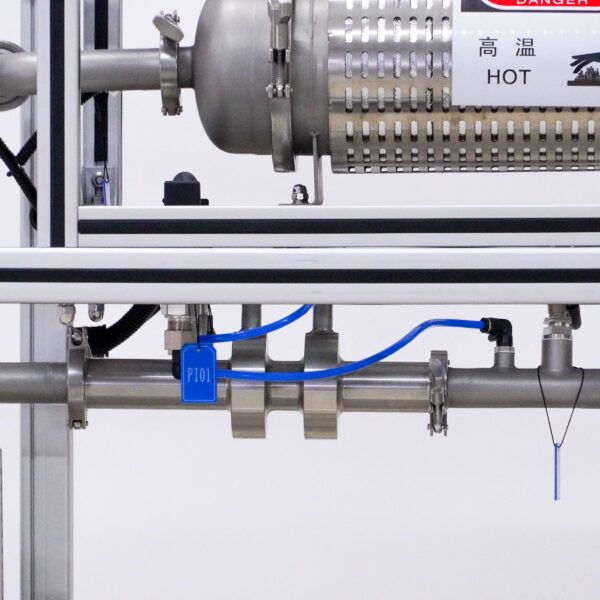
| Data Acquisition | Digital temperature transmitters, turbine flowmeters, and pressure sensors linked to a centralized control panel. |
Experimental Modules and Curriculum Mapping
This pilot plant is designed to directly correspond with the core practical modules taught in chemical, environmental, and food engineering programs. The table below outlines how the plant’s experimental capabilities map to the key terminology and chapters found in widely adopted engineering textbooks.
| Experimental Module | Targeted Engineering Fields | Core Concepts & Classic Textbook Alignment |
|---|---|---|
| Convective Heat Transfer Correlation | Chemical Engineering, Mechanical Engineering | Determination of $Nu = A \cdot Re^m \cdot Pr^{0.4}$ correlation parameters; evaluation of Reynolds number ($Re$) and Prandtl number ($Pr$) effects on Nusselt number ($Nu$) as covered in Unit Operations of Chemical Engineering. |
| Enhanced Heat Transfer Evaluation | Chemical Engineering, Food Engineering | Comparative study of heat transfer coefficients ($\alpha_i$) in smooth versus threaded tubes; boundary layer interruption and pressure drop trade-offs as discussed in Transport Processes and Unit Operations. |
| Steam Condensation Analysis | Environmental Engineering, Thermal Engineering | Measurement of external steam condensation film-heat transfer coefficients ($\alpha_o$) and overall thermal resistance, directly referencing heat transfer topics in Unit Operations of Chemical Engineering. |
| Shell-and-Tube Performance Testing | Chemical Engineering, Process Design | Calculation of overall heat transfer coefficient ($K_o$) and Logarithmic Mean Temperature Difference (LMTD) correction factors; practical evaluation of industrial exchanger geometries as outlined in Chemical Engineering Design. |
Hardware and Software Customization
Recognizing that every engineering department operates under unique curriculum structures and space constraints, LABPARK offers comprehensive customization options for this pilot plant.
We can modify the physical hardware configuration—such as the dimensions of the frame, materials of the heat exchanging tubes, or the inclusion of auxiliary sensors—to align with specific laboratory spaces or localized safety codes. Concurrently, the data acquisition and control software can be tailored to match your department's preferred pedagogical approach, ranging from manual instrumentation readouts for foundational learning to fully automated SCADA systems for advanced process control studies.
About LABPARK
LABPARK has been dedicated to serving the global higher education sector for over 20 years, focusing on the design, development, and manufacture of advanced educational laboratory equipment. Our product portfolio serves six key academic domains: chemistry, chemical engineering, biology, food engineering, pharmaceuticals, and environmental engineering.
Driven by continuous technological innovation, LABPARK holds 209 technical patents and has established successful partnerships with more than 289 universities and colleges worldwide. All products are manufactured and tested in our state-of-the-art 49,000 square meter production and R&D base, ensuring that every piece of educational equipment delivered meets the highest standards of safety, durability, and pedagogical utility.
Trusted by Industry Leaders
REQUEST A QUOTE
Our professional team will reply to you within one business day. Please feel free to contact us!
Related Products
Solid Spherical Heat Transfer Coefficient Determination Educational Chemical Engineering Pilot Plant
This educational chemical engineering pilot plant enables students to determine convective heat transfer coefficients and observe transient thermal behavior of solid spheres under natural convection, forced convection, fixed beds, and fluidized bed regimes.
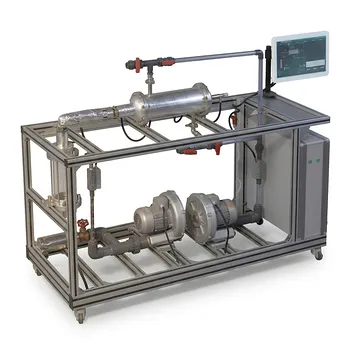
Shell and Tube Heat Exchanger Heat Transfer Coefficient Determination Educational Pilot Plant
LABPARK's shell and tube heat exchanger pilot plant enables students to investigate heat transfer coefficients, LMTD, co-current vs counter-current flow, bridging theory and industrial practice. Customizable for chemical, mechanical, environmental engineering curricula. Ideal for unit operations and process engineering labs.
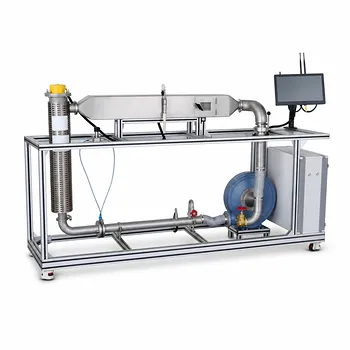
Circulating Wind Tunnel Drying and Convective Heat Transfer Coefficient Determination Educational Pilot Plant
This educational pilot plant enables engineering students to study convective drying, air-water vapor systems, and heat transfer by determining drying curves, drying rate curves, and convective heat transfer coefficients under variable conditions.

Three-Tube Heat Transfer Educational Pilot Plant for Unit Operations Training
Three-tube heat transfer pilot plant for studying convective heat transfer enhancement and condensation. Allows comparison of smooth, corrugated, turbulent tubes, verifying empirical correlations. Ideal for chemical engineering education with safety and closed-loop steam recovery.
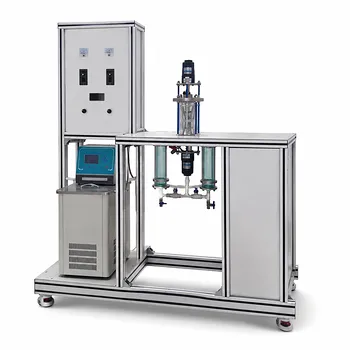
Liquid-Liquid Mass Transfer Coefficient Determination Educational Pilot Plant
This bench-scale educational pilot plant for liquid-liquid mass transfer coefficient determination offers precise control of phase boundary, temperature, and agitation, enabling hands-on study of transport phenomena and unit operations in chemical engineering labs for teaching.

Comprehensive Multi-Modal Heat Transfer Unit Operations Pilot Plant for Engineering Training
Comprehensive multi-modal heat transfer unit operations pilot plant for engineering training. Features four heat exchanger types, multi-media switching, and three operating modes. Hands-on experience in safety, optimization, and process control. Industrial-grade design with real-time data acquisition for chemical engineering labs.

Dual Mode Heat Transfer Pilot Plant for Unit Operations Training
Engineering-scale dual-mode heat transfer pilot plant for hands-on unit operations training in chemical engineering. Features real and simulated modes, multiple heat exchanger types, comprehensive coefficient determination, and advanced process control with data acquisition for engineering students and researchers.
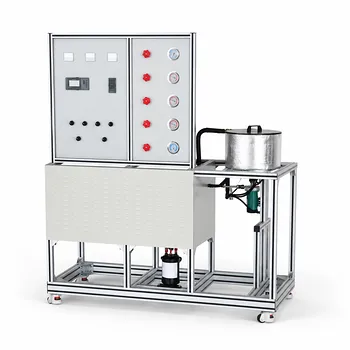
Educational Compression Refrigeration Performance Determination Unit Operations Pilot Plant
This educational pilot plant for compression refrigeration performance determination offers dual COP evaluation, regenerative cycle comparison, and calorimeter calibration. Customizable for curriculum integration, it features environmentally conscious design. Supports thermodynamic mapping on pressure-enthalpy diagrams and synchronous monitoring with centralized instrumentation.
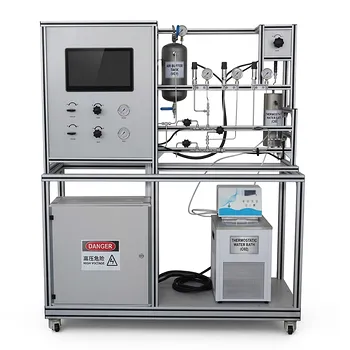
Throttling Effect Determination Educational Unit Operations Pilot Plant
Investigate the Joule-Thomson throttling effect with this educational unit operations pilot plant. Designed for engineering students, it enables hands-on comparative analysis of adiabatic gas expansion using precise process control, interactive digital interface, and eco-friendly operation, ensuring safe repeatable thermodynamic experiments.
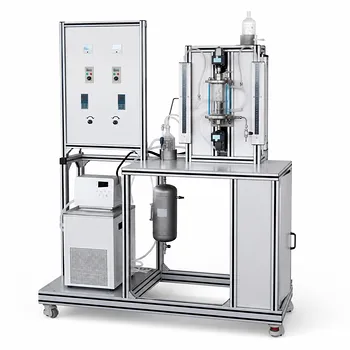
Dual-Drive Stirred Gas-Liquid Mass Transfer Coefficient Determination Pilot Plant
Pilot plant for determination of gas-liquid mass transfer coefficients with independent dual-drive agitation. Isolate gas and liquid film resistances via two-film theory control of speeds, flow rates, temperature. Borosilicate vessel provides visual access. Customizable for chemical, environmental, food, pharmaceutical engineering.

Absorption and Desorption Educational Unit Operations Pilot Plant
Dual packed column absorption and desorption pilot plant for chemical engineering education, offering real-time mass transfer coefficient measurement, durable mobile frame, industrial touch-screen interface, and customizable design for varied laboratory curricula, enabling hands-on study of gas absorption and stripping.
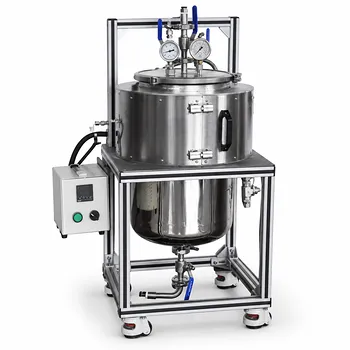
Hot Filtration Educational Unit Operations Pilot Plant Laboratory System
This integrated laboratory bench-scale hot filtration pilot plant enables students to study solid-liquid separation under thermal conditions, featuring a stainless steel vessel, removable heating jacket, and multi-layer filter plates for unit operations education, ideal for chemical engineering laboratory curriculum.

Tubular Reactor Flow Characteristics Determination Educational Unit Operations Pilot Plant
Educational pilot plant for investigating tubular reactor flow characteristics and residence time distribution Features adjustable recycle for plug flow and backmixing studies industrial touchscreen interface and real-time data acquisition Ideal for chemical engineering unit operations laboratory training and education
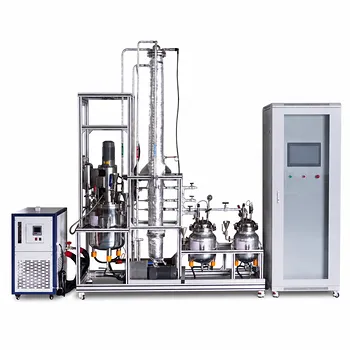
Carbon Material Thermal Pretreatment Multiphase Separation Educational Pilot Plant
Educational pilot plant for carbon material thermal pretreatment and multiphase separation. Features jacketed agitated reactor, separation column, and modern controls for hands-on unit operations training in heat transfer, fluid flow, and process safety with industrial-grade materials and wireless data acquisition.

Educational Unit Operations Pilot Plant for Intraparticle Diffusion Effective Factor Measurement
Designed for chemical engineering university labs, this pilot plant allows hands-on determination of catalyst particle intraparticle diffusion effective factors and gas-solid reaction kinetics using a fixed-bed tubular reactor with industrial touchscreen control, bridging theory and practical reactor design.
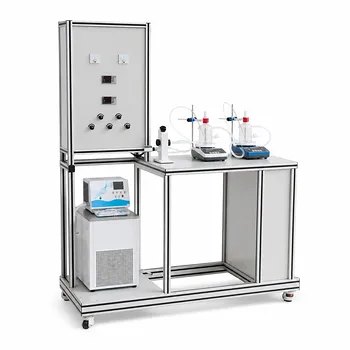
Ternary Liquid-Liquid Equilibrium Educational Pilot Plant
An integrated laboratory training system for engineering students to determine ternary liquid-liquid equilibrium data, construct phase diagrams, and gain hands-on experience with industrial instrumentation, including Abbe refractometer and magnetic stirrers, for precise data acquisition and curriculum-aligned experiments.

High-Gravity Emulsification and Mass Transfer Educational Pilot Plant
This integrated educational pilot plant utilizes rotating packed bed technology to demonstrate high-gravity emulsification and mass transfer, providing engineering students with hands-on experience in process intensification and unit operations through a modular, customizable design with digital monitoring.
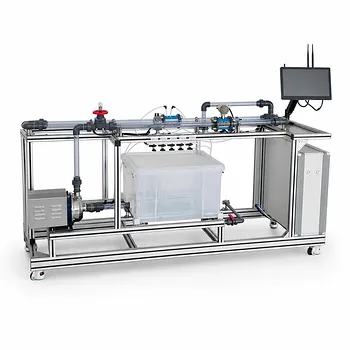
Orifice and Venturi Flowmeter Calibration Educational Pilot Plant for Fluid Mechanics Laboratory
Enhance fluid dynamics education with the Orifice and Venturi Flowmeter Calibration Educational Unit Operations Pilot Plant, featuring transparent orifice and Venturi meters, industrial sensors, touchscreen interface for real-time data analysis and automatic coefficient calculations in engineering student laboratories.
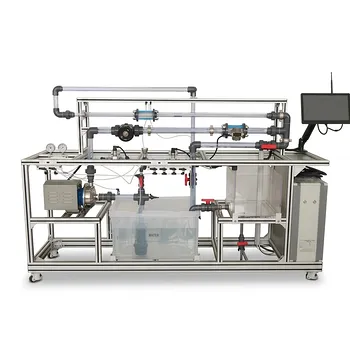
Centrifugal Pump Performance and Orifice Flowmeter Calibration Educational Pilot Plant
This versatile educational pilot plant enables engineering students to conduct centrifugal pump performance tests, orifice flowmeter calibration, and fluid mechanics experiments using a transparent flow loop, industrial HMI, and 3D virtual simulation for a comprehensive hands-on learning experience.

Multi-Functional Special Distillation Educational Pilot Plant
Versatile multi-functional special distillation pilot plant for chemical engineering education. Supports continuous, vacuum, azeotropic, reactive, extractive distillation. Transparent glass columns enable real-time visual observation of hydrodynamics and separation processes.
Related Articles
The Intuition You Can’t Simulate: Why the Best Bioprocess Education Still Lives on a Thin-Layer Plate
Before engineers trust a $500,000 bioreactor, they must trust their own hands. How thin-layer chromatography (TLC) builds the tacit knowledge that separates trained operators from true process engineers—and why LABPARK pilot plants preserve this irreplaceable skill.
The Electric Ghost in Your Bioreactor: How Optical pH Sensors Are Ending a 50-Year Maintenance Ritual
Optical FRET-based pH and pCO₂ sensors eliminate ground-loop noise, slash response times to milliseconds, and survive repeated autoclaving—a step change for bioprocess pilot plants tired of nursing glass electrodes.

The Invisible Constraint: How First-Principles dCO₂ Modeling Turns Your Pilot Plant into a Predictive Engine
Learn how a first-principles dCO2 mass transfer model de-risks bioprocess scale-up. Validate with pilot plant data to predict manufacturing CO2 profiles, size spargers, and design control loops—eliminating costly full-scale trials.