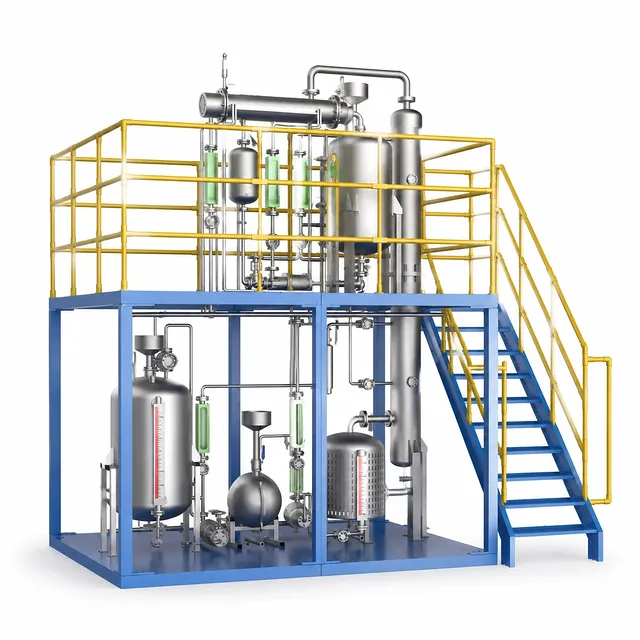
Vocational Chemical Engineering Pilot Plants
Dual-Mode Rectification Pilot Plant for Practical Training Unit Operations
Item Number : LPK-SMTJL
Price varies based on specs and customizations
- Operating Modes
- Dual-mode: Real-Material (active process) & Simulated-Material (model-driven with water/air)
- Column Type
- Sieve-plate column with single-pass downcomer and integrated sight glasses
- Control System
- PC-based SCADA software with real-time data acquisition, parameter adjustment, and safety interlocks

Shipping:
Contact us to get shipping details Enjoy On-time Dispatch Guarantee.
Why Choose Us
Easy ordering process, quality products, and dedicated support for your business success.
Introduction
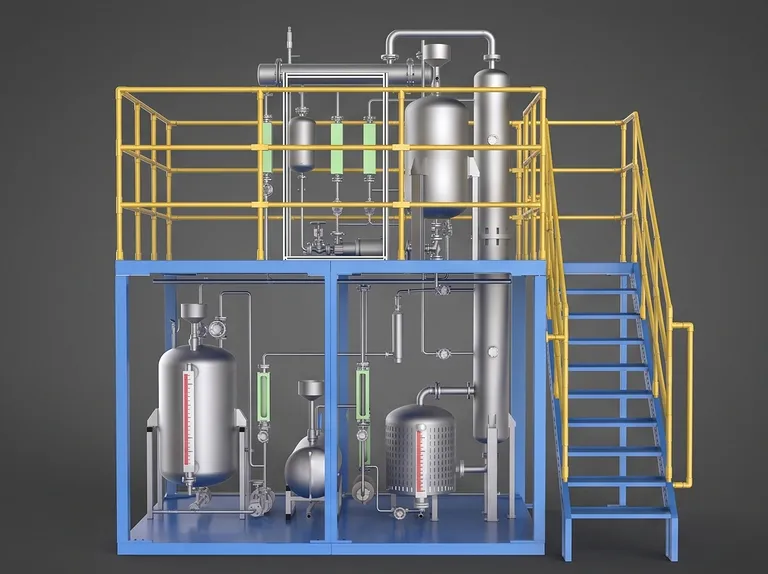
The Dual-Mode Rectification Practical Training Unit Operations Pilot Plant is an industrial-scale, two-tier laboratory system designed specifically for chemical engineering and process technology departments in higher education. This pilot plant features a sieve-plate distillation column equipped with visual sight glasses, allowing students to directly observe gas-liquid mass transfer and hydrodynamic phenomena. Integrating a unique dual-mode control system, the unit can operate either in "Real-Material Mode" using actual chemical mixtures with physical sensors and heaters, or in "Simulated-Material Mode" using safe fluids like water or air combined with mathematical models that respond to physical valve manipulations. This dual approach offers universities a flexible, safe, and highly pedagogical tool for teaching mass transfer and separation processes.
To ensure seamless integration with diverse laboratory spaces and syllabus requirements, this pilot plant supports extensive hardware and software customization. Both the physical layout—including column dimensions, material selection, and platform footprints—and the digital control interfaces can be modified to align with the specific training objectives of your institution.
Key Pedagogical Functions and Advantages
- Dual-Operating Modes:
- Real-Material Mode: The upper computer SCADA software collects real-time data from physical sensors and controls active components like feed pumps and electrical heaters for authentic process operation.
- Simulated-Material Mode: Allows safe operations using water or air. The system registers physical valve actions and uses integrated mathematical models to simulate corresponding process changes on the control software, enhancing safety while teaching start-up and shutdown procedures.
- Mass Transfer and Efficiency Studies: Supports the determination of overall column and individual plate efficiencies under total or partial reflux conditions. Convenient sampling ports are distributed across all tanks and column stages.
- Visual Hydrodynamic Observation: Built-in sight glasses along the column wall enable students to observe real-world tray behaviors, including bubbling, weeping, and entrainment.
- Variable Feed and Reflux Control: Features adjustable pre-heating systems to analyze the impact of different thermal feed states on separation, alongside manual and automated control of reflux ratios.
- Environmentally Friendly and Cost-Effective: Includes a fluid recycling loop that reduces chemical consumption and minimizes waste generation during repeated training sessions.
- Industrial-Grade Safety Frame: Built on a heavy-duty, two-story steel structure with a 1.2-meter safety handrail, anti-slip checkered steel plates, and an integrated safety ladder, giving students authentic experience in navigating industrial process plants.
Technical Specifications
| Parameter | Specification |
|---|---|
| Column Type | Sieve-plate column with single-pass downcomer and integrated sight glasses |
| Operating Modes | Dual-mode: Real-Material (active process) & Simulated-Material (model-driven with water/air) |
| Structure Layout | Two-tier industrial steel platform with yellow guardrails (1.2m height) and safety staircase |
| Platform Decking | 3mm carbon steel non-slip checkered plate |
| Control System | PC-based SCADA software with real-time data acquisition, parameter adjustment, and safety interlocks |
| Key Instrumentation | Flowmeters (rotameters), temperature transmitters, pressure sensors, and liquid level gauges |
| Auxiliary Equipment | Feed pre-heater, reboiler, overhead condenser, reflux divider, distillate and bottoms collection vessels |
| Overall Dimensions | Standard footprint of 3930 mm × 2560 mm × 3900 mm (customizable to laboratory ceiling heights) |
Curriculum Integration and Textbook Alignment
This pilot plant is designed to bridge theoretical principles taught in lectures with physical engineering practice. It supports laboratory modules across several majors, including Chemical Engineering, Environmental Engineering, Food Engineering, and Biotechnology.
The experimental capabilities of the unit align directly with core principles found in standard university textbooks, facilitating a cohesive learning environment where students can easily cross-reference their practical observations with academic literature:
| Textbook Reference | Relevant Unit Operations & Theoretical Concepts |
|---|---|
| Unit Operations of Chemical Engineering | Fractional distillation, McCabe-Thiele method for calculating theoretical stages, column tray efficiency, reflux ratio effects, and plate column hydrodynamics (weeping, flooding, and loading). |
| Transport Processes and Separation Process Principles (formerly Transport Processes and Unit Operations) | Vapor-liquid equilibrium (VLE), multicomponent mass transfer, continuous rectification, and heat/mass balances over distillation columns and condensers. |
| Chemical Engineering Design | Pilot-scale process design, instrumentation and control loops, equipment scaling, and process safety standards within pilot plant operations. |
By utilizing this pilot plant, professors can easily demonstrate the physical reality behind the equations and diagrams found in these foundational texts, helping students develop a intuitive understanding of process engineering.
Hardware and Software Customization
To accommodate the specific constraints of different university laboratories, we offer tailored adjustments for both hardware and software. Hardware modifications include adjustments to the platform size, staircase orientation, column height, number of sieve trays, and metallurgy selection (such as stainless steel grades). On the software side, the control interface, data-logging parameters, and mathematical simulation models can be customized to match your curriculum's focus, ensuring the equipment fits into your existing laboratory infrastructure.
About LABPARK
LABPARK has been dedicated to serving higher education institutions worldwide for over 20 years. We specialize in developing and manufacturing advanced teaching equipment and pilot plants, with a strong focus on six major fields: Chemistry, Chemical Engineering, Biology, Food, Pharmacy, and Environmental Engineering.
Driven by innovation and engineering excellence, our company holds 209 technical patents and has established successful partnerships with over 289 universities and colleges globally. Our state-of-the-art production and R&D base spans 49,000 square meters, ensuring that all our equipment is manufactured to rigorous industrial standards to provide students with safe, reliable, and highly educational training platforms.
Trusted by Industry Leaders
REQUEST A QUOTE
Our professional team will reply to you within one business day. Please feel free to contact us!
Related Products

Dual-Mode Gas Absorption and Desorption Unit Operations Training Pilot Plant
Industrial-scale pilot plant for gas absorption and desorption training in chemical engineering. Features dual-mode operation with real and simulated materials, transparent columns for flow visualization, and customizable design. Supports independent or combined loops for hands-on unit operations experiments.

Dual Mode Heat Transfer Pilot Plant for Unit Operations Training
Engineering-scale dual-mode heat transfer pilot plant for hands-on unit operations training in chemical engineering. Features real and simulated modes, multiple heat exchanger types, comprehensive coefficient determination, and advanced process control with data acquisition for engineering students and researchers.

Comprehensive Multi-Modal Heat Transfer Unit Operations Pilot Plant for Engineering Training
Comprehensive multi-modal heat transfer unit operations pilot plant for engineering training. Features four heat exchanger types, multi-media switching, and three operating modes. Hands-on experience in safety, optimization, and process control. Industrial-grade design with real-time data acquisition for chemical engineering labs.

Absorption and Desorption Educational Unit Operations Pilot Plant
Dual packed column absorption and desorption pilot plant for chemical engineering education, offering real-time mass transfer coefficient measurement, durable mobile frame, industrial touch-screen interface, and customizable design for varied laboratory curricula, enabling hands-on study of gas absorption and stripping.

Multi-Modal Distillation Unit Operations Training Pilot Plant
Multi-modal distillation pilot plant for practical unit operations training in chemical engineering education. Features real, analog, and semi-physical simulation modes, industrial construction, customizable for university labs. Hands-on fractionation columns, SCADA control, safety systems. Includes sight glasses, sampling ports, closed-loop recycling.

Rising and Falling Film Evaporation Educational Unit Operations Pilot Plant
Hands-on educational pilot plant for studying rising and falling film evaporation, flow regimes, and heat transfer. Customizable for university labs with industrial instrumentation and data acquisition. Enables comparative evaluation of evaporation modes and energy efficiency.

Multi-Functional Special Distillation Educational Pilot Plant
Versatile multi-functional special distillation pilot plant for chemical engineering education. Supports continuous, vacuum, azeotropic, reactive, extractive distillation. Transparent glass columns enable real-time visual observation of hydrodynamics and separation processes.

Multi Functional Catalytic Reaction and Reactor Evaluation Educational Unit Operations Pilot Plant
Bench-scale educational pilot plant for catalytic reaction and reactor evaluation, integrating fixed bed, fluidized bed, and stirred tank reactors. Students compare reactor designs, evaluate catalysts, and study reaction kinetics and hydrodynamics. Perfect for unit operations labs in chemical engineering curricula.
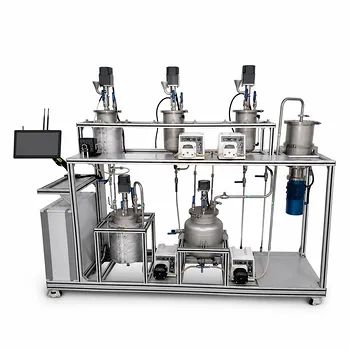
High-Gravity Emulsification and Mass Transfer Educational Pilot Plant
This integrated educational pilot plant utilizes rotating packed bed technology to demonstrate high-gravity emulsification and mass transfer, providing engineering students with hands-on experience in process intensification and unit operations through a modular, customizable design with digital monitoring.
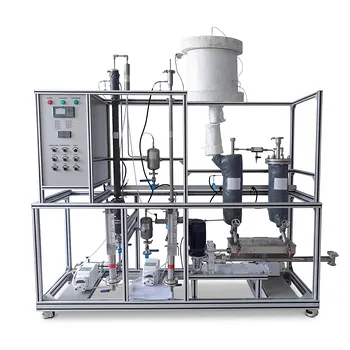
Steam Methane Reforming Hydrogen Production and Purification Educational Pilot Plant
This bench-scale educational pilot plant combines steam methane reforming with hydrogen purification, offering safe, hands-on unit operations training for university engineering laboratories. Its customizable design and high-precision monitoring enable real-time study of catalysis, phase separation, and process dynamics.

Multi-Reactor Educational Pilot Plant for Reaction Engineering Unit Operations
Integrated bench-scale educational pilot plant for chemical engineering teaching featuring fixed bed fluidized bed and stirred tank reactors with web-based digital twin controls and safety interlocks for hands-on unit operations and reaction engineering comparative studies in one compact system.

Residence Time Distribution and Reactor Flow Characteristics Determination Educational Pilot Plant
This versatile educational pilot plant is designed for comprehensive study of residence time distribution and reactor flow characteristics, featuring multiple CSTRs in series, a tubular reactor, variable recycle loop, and automated real-time data acquisition, perfect for hands-on chemical engineering education.

Fixed-Bed Chemical Reaction and Gas Dust Tar Removal Unit Operations Pilot Plant
Integrated educational pilot plant for studying catalytic gas-solid reactions and downstream gas purification. Features dual fixed-bed reactor, three-stage heating, and touchscreen control for hands-on engineering training. Ideal for chemical and environmental engineering curricula.

Multi Pump Fluid Transport Process Piping Unit Operations Training Pilot Plant
Industrial-scale multi-pump pilot plant for unit operations training in fluid transport and process piping, featuring real-material and semi-physical simulation modes, comprehensive pump and flowmeter calibration, and safety-enhanced two-tier platform, bridging academic theory and industrial practice for chemical engineering education.

Natural Product Extraction Unit Operations Training Pilot Plant
Integrated natural product extraction pilot plant for chemical engineering training bridges theory and industrial practice with modular extraction and evaporation/concentration units, hybrid touchscreen and manual control, realistic process simulation, and self-contained softened water and vacuum utilities.

Continuous Batch Extractive Distillation Educational Pilot Plant
Versatile pilot plant for continuous, batch, and extractive distillation training. High-borosilicate glass column for visualizing hydraulics, 15.6-inch touchscreen with data logging, precise reflux ratio control 1-99, and durable corrosion-resistant frame. Ideal for chemical engineering education and process research.

Electrolyte Distillation Purification and Formulation Educational Pilot Plant
Integrated bench-to-pilot scale educational pilot plant for electrolyte distillation, purification, and formulation with borosilicate glass construction, PLC automation, touchscreen HMI, and advanced industrial safety features for hands-on chemical process training, ideal for chemical engineering and materials science curricula.

Ethyl Acetate Synthesis Unit Operations Pilot Plant for Practical Training
Modular and customizable pilot plant for ethyl acetate synthesis practical training. Integrates esterification reaction, liquid-liquid extraction, neutralization, and sieve-plate distillation unit operations. Bridging theory and real-world industrial processes. Designed for university chemical engineering labs

Ion Exchange Water Purification Educational Pilot Plant for Engineering Unit Operations
This bench-scale ion exchange pilot plant trains engineering students in water purification. Dual transparent columns simulate industrial softening and demineralization. Students observe fluid dynamics, perform resin regeneration, and analyze breakthrough curves. The corrosion-resistant frame ensures durability in unit operations experiments.

Green Anhydrous Ethanol Refining Practical Training Pilot Plant
Advanced integrated pilot plant for university labs demonstrating extractive distillation to produce high-purity absolute ethanol from crude feedstock, featuring multi-column continuous operation, closed-loop solvent recycling, and customizable controls for hands-on engineering education, ideal for chemical engineering training and research.
Related Articles
The Invisible Constraint: How First-Principles dCO₂ Modeling Turns Your Pilot Plant into a Predictive Engine
Learn how a first-principles dCO2 mass transfer model de-risks bioprocess scale-up. Validate with pilot plant data to predict manufacturing CO2 profiles, size spargers, and design control loops—eliminating costly full-scale trials.
The Lever and the Leverage: Why a Pilot Plant Creates Engineers Who Build, Not Just Calculate
Catalytic reforming isn't a recipe; it's a war of trade-offs. Here’s how a pilot plant transforms abstract catalysis theory into the visceral, systems-thinking intuition that defines a great chemical engineer.
The Brown Cloud and the Engineer’s Mind: Why Pilot Plants Don’t Just Dilute Danger, They Unmake It
Scaling toxic gas management beyond the fume hood is a leap from blind containment to engineered neutralization. Explore the mass-transfer psychology behind gas absorption columns.