The Hidden Failure Mode That Dogma Misses
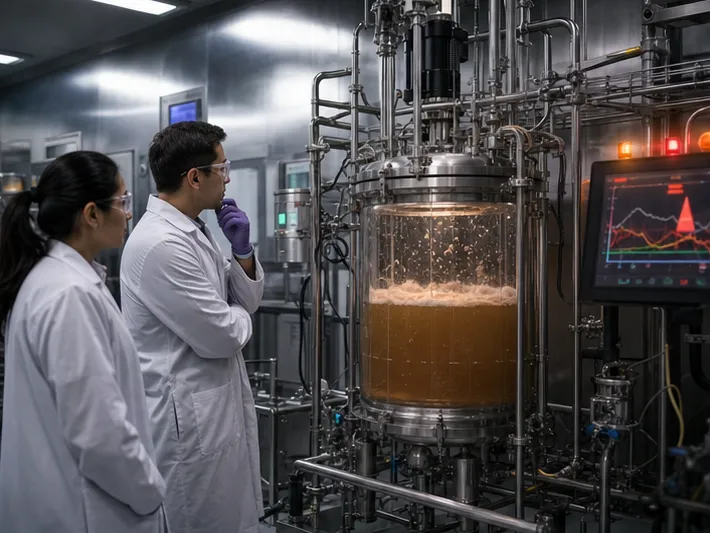
Bioreactor failures tend to be blamed on contamination, agitator seizure, or a wandering pH probe. These are the visible emergencies. The quiet killer—dissolved carbon dioxide—accumulates in plain sight and leaves no immediate trace. No alarm shrieks. The vessel does not shake. But the cells stop growing, product titers flatten, and the monoclonal antibody that reaches the patient emerges with a subtly wrong glycan profile.
The modelling of dissolved CO₂ (dCO₂) mass transfer addresses a problem that feels almost psychological in nature: we ignore what we cannot sense directly. Morgan Housel once described risk as what’s left after you’ve thought of everything. In a high-density CHO or HEK293 culture, dCO₂ is exactly that. The trainee who understands its dynamics moves from reacting to crises to designing predictability into a process.
Why dCO₂ Is a Parameter, Not a Byproduct
The Cellular Toll
Excess dCO₂ inhibits growth, suppresses protein productivity, and alters glycosylation patterns that determine therapeutic safety. The cell does not need a toxic insult; it just needs a microenvironment turned hostile by waste. At large scale, hydrostatic pressure at the bottom of a 10,000-litre tank forces CO₂ into solution far beyond what small-scale flasks ever see. Scale-up becomes a silent lottery.
The pH Sting of Over‑Stripping
The relationship is bidirectional. Aggressive sparging strips CO₂ fast—sometimes too fast. Since CO₂ sits at the centre of the bicarbonate buffer system, sudden removal pushes pH upward, forcing controller-driven base additions that further stress the cells. The operator may think they are solving an accumulation problem while actually triggering a pH oscillation. The titration curve becomes a mirror of the operator’s anxiety.
The First‑Principles Lens: Making the Invisible Measurable
Three Sources, One Dynamic Equilibrium
A useful dCO₂ model tracks three inputs:
- Cellular respiration – CO₂ generated in proportion to viable cell density (VCD).
- Lactate production and base addition – These shift the carbonate equilibrium, releasing more dissolved gas.
- Carbonate dissociation – The medium’s own chemistry contributes a baseline load.
Summing these sources paints a real‑time picture of carbon dioxide evolution rate (CER). The model does not just predict a number; it reconstructs the cell’s entire respiratory story from sparse online signals.
The kLa Bridge Between Biology and Hardware
Gas‑liquid mass transfer is encoded in the volumetric mass transfer coefficient, kLa. For CO₂, kLa translates sparger design, impeller geometry, and gas flow rate into a stripping efficiency. A student who understands that kLa for CO₂ differs from kLa for oxygen has already learned the most humbling lesson in bioprocessing: every hardware decision is a hidden biological bet.
The Variables Students Touch
In a well‑designed training plant, VCD, lactate, pH, and off‑gas data flow into the model continuously. The screen connects a rising lactate concentration to a surge in dCO₂, and the student grasps that metabolic control is not a separate discipline—it is the same discipline, just viewed from a different angle.
The Pilot‑Scale Validation Gap
Theoretical equations deserve doubt until they are confronted with real broth. Historical datasets from pilot plants offer a rare gift: the chance to tune the respiratory quotient, adjust empirical kLa correlations, and see where first‑principles prediction breaks. This is not a simulation exercise—it is a forensic examination of how a physical bioreactor actually behaves when gas bubbles and cells meet.
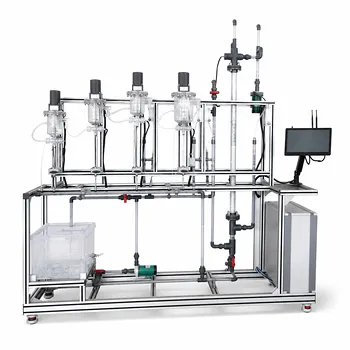
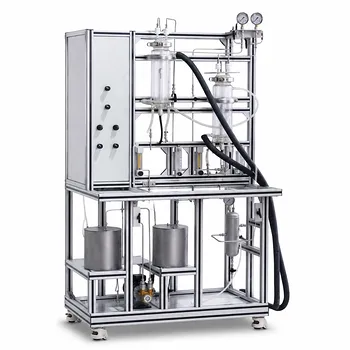
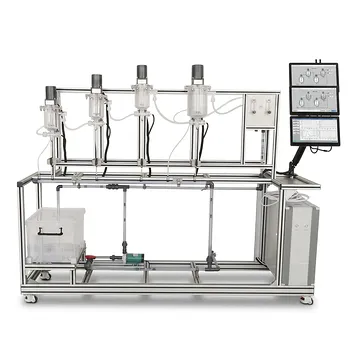
This is where a hands‑on unit operations pilot plant becomes irreplaceable. A university lab equipped with a bioprocess pilot plant that mirrors industrial reality lets students perform the iterative model‑validation loop themselves. They are not validating against a textbook; they are validating against a sensor’s 4–20 mA signal and a harvest titer measured at the end of the run. The experience imprints a mental model that a lecture alone cannot build.
The Trade‑Off That Defines Engineering Judgment
No control strategy is free of consequence:
- High stripping rates curb dCO₂ but risk pH instability, foam generation, and shear damage.
- Low gas flows protect cell viability but allow dissolved CO₂ to drift into inhibitory territory.
- kLa for oxygen and kLa for CO₂ are not independent. Optimising one may silently compromise the other.
Recognising these trade‑offs requires operating within a real system, where the cost of a poor decision is not a lowered grade but a failed batch. That is exactly the psychological pressure a pilot plant simulates—without the industrial financial penalty.
A Framework for Your Scale‑Up Goal
| Focus Area | Model Leverage Point | What You Gain |
|---|---|---|
| Cell culture performance | VCD‑to‑CER relationship | A safe dCO₂ operating window that preserves growth and glycosylation quality |
| Bioreactor design | kLa correlations from pilot data | Right‑sized spargers and mass flow controllers for target production scale |
| Automation and control | Online soft‑sensor mass balance | Proactive adjustments before dCO₂ reaches a harmful level |
From Hidden Risk to a Design‑Driven Variable
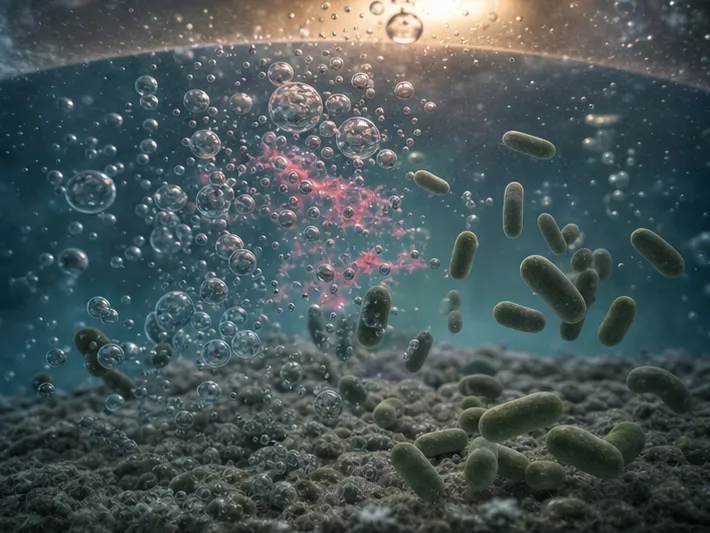
Mastering dCO₂ mass transfer modelling changes the way an engineer looks at any bioreactor. The vessel ceases to be a black box and becomes a transparent system where gas, liquid, and metabolism are always in conversation. That transparency is not a gift—it is earned through repetitive, hands‑on exposure to the very machines that will one day fill medicine cabinets.
LABPARK designs and manufactures customizable pilot‑scale unit operations plants for bioprocess, chemical engineering, and environmental training. Their systems give universities, research institutes, and enterprises the platform to teach exactly this kind of invisible‑variable engineering. When students can manipulate sparge rates, measure real‑time dCO₂, and validate their own models against actual batch data, the theory becomes muscle memory and the risk becomes a lever.
To see the invisible and equip your team with the judgment that only real systems can teach, explore LABPARK’s training pilot plants. Contact Our Experts
Related Products
- Bio-fermentation Ethanol Production Practical Training Unit Operations Pilot Plant
- Tubular Reactor Flow Characteristics Determination Educational Unit Operations Pilot Plant
- Residence Time Distribution and Reactor Flow Characteristics Determination Educational Pilot Plant
- Educational Unit Operations Pilot Plant for Intraparticle Diffusion Effective Factor Measurement
- Photocatalytic Membrane Separation and Degradation Unit Operations Pilot Plant