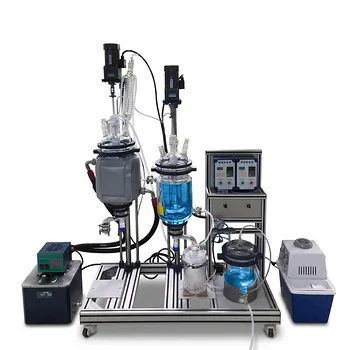
To stabilize your pilot-scale crystallization and prevent a cloud of unwanted fine crystals, you must reduce the contact energy within the vessel and strictly control supersaturation. The root cause of secondary nucleation in a stirred tank is almost always mechanical collision and fluid shear. You can tame this by manipulating four core operational levers: lowering agitation intensity, smoothing the supersaturation profile, thermally dissolving existing fines, and eliminating rogue seed particles from your feed.
While you can make several mechanical adjustments, the central operational philosophy is to keep the system deep within the metastable zone. Your adjustments must prioritize a gentle mixing environment and a slow, precise generation of supersaturation to promote pure crystal growth over indiscriminate nucleation.
Dismantling the Mechanism of Contact Nucleation
Before adjusting dials, you must visualize the enemy. In a pilot unit, the dominant source of new nuclei isn't spontaneous birth from the liquid, but the violent destruction of existing crystals.
The Energy-Crystal Size Relationship
Secondary nucleation in stirred vessels is primarily contact nucleation. This is the micro-attrition caused by crystal-impeller, crystal-vessel wall, and crystal-crystal collisions. Higher agitation speeds inject greater collision energy into the slurry. This energy directly increases the rate at which microscopic fragments are chipped off parent crystals, creating a self-perpetuating storm of fines.
Why the Metastable Zone Is Your Safe Harbor
You cannot eliminate secondary nucleation if you operate outside the metastable zone. If your cooling generates supersaturation faster than the crystal surface can consume it via growth, you push the solution into the labile zone. In this state, even a minor collision triggers a catastrophic cascade. Staying within the metastable zone ensures the mother liquor is thermodynamically incapable of supporting spontaneous nucleation, allowing you to isolate and solve the mechanical sources.
Four Operational Adjustments to Suppress Fine Generation
Based on the core mechanisms, you must transform your pilot plant’s operation from a high-energy milling environment into a gentle growth chamber.
1. Reduce Specific Power Input via Agitation
Your impeller is often the main culprit. The operational goal is to keep crystals suspended—nothing more.
- Slash the Rotation Speed: Reduce the RPM to the absolute minimum required for off-bottom suspension. Every incremental reduction in tip speed protects the fragile crystal edges.
- Switch to Softer Impeller Materials: A simple material substitution can drastically change the outcome. Replace a stainless steel impeller with a PTFE-coated or entirely PTFE impeller. The softer surface absorbs impact energy that would otherwise transfer to the crystal lattice, significantly lowering the nucleation rate from metal-shattered fragments.
2. Control Supersaturation with a Slow Thermal Trajectory
A thin, steady driving force for growth prevents the system from becoming shock-sensitive.
- Program a Slow Cooling Ramp: Instead of linear cooling, use a cubic cooling profile or finite difference modeling. Start with an ultra-slow rate (e.g., 0.1°C/min) when the surface area of the crystal slurry is low. The rate can increase later as total surface area grows to consume the supersaturation.
- Avoid Temperature Overshoots: Rapid cooling generates a high localized supersaturation peak at the cooling jacket surface. This instantaneous high driving force is a trigger for massive nucleation events. Tight PID loop tuning on your jacket inlet temperature is non-negotiable.
3. Implement a Fines Dissolution Loop
You cannot physically stop all microscopic breakage, but you can remove the debris selectively before it grows.
- Thermal Destruction Strategy: This adjustment exploits the temperature-solubility curve. Install an external circulation loop with an in-line heater to raise the slurry temperature slightly to dissolve the smallest crystals.
- Operational Logic: The fines—with their high surface area-to-volume ratio—dissolve entirely in the heated zone, while the larger product crystals only partially dissolve. This returns clear, slightly under-saturated solution back to the vessel, effectively converting fine crystal mass into reusable supersaturation for growth on larger crystals.
4. Pre-Treat the Feed to Eliminate External Seeds
Unwanted nucleation often starts before the solute ever enters the crystallizer.
- Pre-Heat the Feed Solution: You must dissolve any residual crystalline dust that might be present in the transfer lines or raw feedstock. Heating the solution well above the saturation temperature of the raw material removes these ghost nuclei.
- In-line Polish Filtration: Immediately before the solution enters the crystallizer, pass it through a micron-rated filter (e.g., 0.5-1 micron). This physically captures any extraneous foreign particles or undissolved seed crystals that would serve as template surfaces for heterogonous nucleation.
Understanding the Trade-offs
These adjustments are powerful but introduce constraints. Objectively, you cannot optimize all parameters without facing a trade-off.
- Mixing vs. Growth: Reducing agitation too aggressively risks crystal settling. If a crystal bed forms on the vessel bottom, you compromise heat transfer uniformity and create a localized high-supersaturation zone, which can paradoxically trigger worse nucleation. The sweet spot provides a homogeneous suspension without tip-speed-induced impact damage.
- Fines Loop Cost vs. Batch Time: A fines dissolution loop smooths the size distribution, but heating a slipstream consumes energy and slightly prolongs the overall batch cycle. You are trading thermodynamic efficiency for a narrower crystal size distribution.
- Filtering vs. Flow: Adding a micron-rated feed filter protects purity but can cause a pressure drop and restrict flow, potentially affecting residence time distribution if not sized properly for the feed pump head pressure.
Making the Right Choice for Your Research Goal
Your primary operational lever should align with the specific problem you observe in the pilot plant’s sight glass or particle size analyzer.
- If your primary focus is eliminating the "snow globe" effect (near-total breakage): Swap the stainless steel impeller for a PTFE-coated one and drop the RPM by 15-20% immediately; this tackles the contact energy source directly.
- If your primary focus is eradicating a persistent fine crystal shoulder in the PSD: Activate or install the fines dissolution loop to thermally digest the problematic particle fraction after it forms.
- If your primary focus is preventing an initial burst of nucleation at the cooling onset: Verify your feed clarity and temperature; implement pre-heating to eliminate seed history and reduce the initial cooling rate to the absolute minimum.
- If your primary focus is validating a scale-up protocol: Monitor the desupersaturation rate in real-time (via ATR-FTIR or conductivity). Adjust the cooling rate dynamically to ensure the consumption of supersaturation via growth exactly matches your generation rate, preventing accumulation.
By shifting your perspective from merely hitting a temperature setpoint to actively managing the energy and supersaturation balance, you transform the pilot plant from a nucleation generator into a predictable growth instrument.
Summary Table:
| Operational Adjustment | Mechanism | Primary Benefit |
|---|---|---|
| Reduce Agitation & Use PTFE | Minimizes mechanical impact energy | Prevents contact-induced crystal breakage |
| Slow Thermal Trajectory | Controls supersaturation rates | Keeps the system safely in the metastable zone |
| Fines Dissolution Loop | Thermally digests smallest crystals | Narrows and optimizes crystal size distribution |
| Feed Pre-Treatment | Filters and pre-heats feedstock | Eliminates external seed and dust templates |
Optimize Your Process Scale-Up with LABPARK
Achieving precise control over crystallization and chemical processes requires reliable, high-performance equipment. LABPARK provides premium Educational and Vocational Unit Operations Pilot Plants in chemical engineering, bioprocess & biotech, and environmental & water treatment.
We help universities, research institutes, and enterprises bridge the gap between theory and industrial practice with robust, highly controllable systems.
Ready to elevate your research or training capabilities? Contact our technical team today to discuss your custom pilot plant requirements!
Related Products
- Multi Functional Membrane Crystallization Educational Unit Operations Pilot Plant
- Potassium Salt Thermal Dissolution and Crystallization Separation Educational Unit Operations Pilot Plant
- Multi-Modal Distillation Unit Operations Training Pilot Plant
- Dual-Mode Rectification Pilot Plant for Practical Training Unit Operations
- Natural Product Extraction Unit Operations Training Pilot Plant
People Also Ask
- Why is precise temperature control critical in crystallization pilot plants? Key to Scale-Up Success
- What key factors should be considered when configuring a crystallization unit operations pilot plant?
- What are the benefits of integrating online PAT tools like ATR-FTIR into crystallization unit operations pilot plants?
- How to use crystallization pilot plant agitation speed to identify diffusion vs reaction growth?
- How can operators calculate the theoretical crystal yield in a vacuum or cooling crystallization pilot plant? Guide