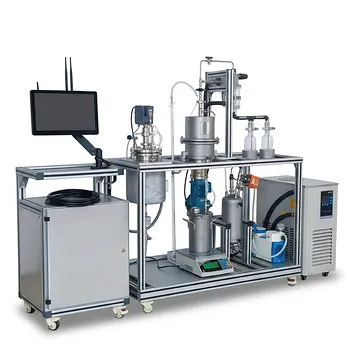
Real-time insight into what was once an invisible process – that is the core benefit. Integrating online Process Analytical Technology (PAT) tools like ATR-FTIR spectroscopy into crystallization pilot plants transforms a historically empirical unit operation into a data-rich, design-controlled process. You gain the ability to directly monitor supersaturation, construct solubility curves, and define the metastable zone limit as the crystallization runs. This immediate feedback enables active control loops that optimize crystal size distribution, prevent agglomeration, and provide hands-on training in modern quality-by-design principles.
Crystallization development has long suffered from blind trial-and-error. By inserting ATR-FTIR probes directly into pilot-plant crystallizers, you replace guesswork with real-time concentration data, allowing you to model, control, and teach crystallization as a rational design process rather than an art. The greatest value lies in moving from static off-line testing to dynamic, closed-loop control that ensures consistent product quality at the pilot scale.
The Core Benefits: From Trial-and-Error to Design-Controlled Crystallization
Real-Time Monitoring of the Hidden Solution Dynamics
Crystallization is exquisitely sensitive to supersaturation and temperature, yet solution concentration traditionally remained opaque until sampling. ATR-FTIR spectroscopy changes that by continuously measuring liquid-phase composition in situ.
Every infrared spectrum reveals the chemical fingerprint of the crystallizing species, translating directly into real-time solubility and supersaturation data. This lets you see exactly where you are within the metastable zone.
Enabling Active Feedback Control Loops
Simply logging data is not enough. The true power emerges when that information drives action. By feeding the real-time supersaturation signal to a process controller, you can automatically adjust cooling rates or antisolvent addition via heaters/chillers.
A primary loop can set a target cooling trajectory, while a secondary loop trims heater power to keep supersaturation precisely within a defined window. This prevents uncontrolled nucleation and lets you steer crystal growth actively.
Optimizing Crystal Size Distribution and Purity
When supersaturation is held at a controlled, low level, growth dominates over nucleation. The result is larger, more uniform crystals with fewer fines and less agglomeration.
Better still, controlled growth avoids solvent entrapment and often improves purity. Because the entire history of the crystallization is digitally recorded, you can correlate process conditions exactly with final crystal attributes.
Accelerating Learning and Industrial Readiness
Pilot plants serve a dual mission: process development and workforce training. PAT-enabled crystallizers turn both into structured, scientifically grounded exercises.
Students and researchers no longer just follow a recipe. They observe the solubility curve, set a control strategy, and witness the immediate impact on crystal properties—effectively compressing years of industrial experience into a single semester.
Building a Robust Analytical Strategy: ATR-FTIR Alone Is Not Enough
The Critical Role of Complementary PAT
ATR-FTIR gives you the solution concentration, but it says nothing about the solid phase. To fully characterize crystallization, you need orthogonal measurements like focused beam reflectance measurement (FBRM) or Raman spectroscopy.
FBRM tracks chord length distribution in real time, directly quantifying crystal size and population trends. Raman reveals polymorphic form and solid-state transformations that ATR-FTIR cannot see. Together, these tools provide a complete picture.
Orthogonal Validation: Preventing Measurement Artifacts
Any single analytical method can mislead. Comparing temporal concentration profiles from two independent techniques—for example, ATR-FTIR and reaction calorimetry—exposes errors from mass transfer, probe fouling, or unexpected phase changes.
This validation discipline ensures that what you model as crystallization kinetics is genuine crystal growth, not an artifact. In a pilot plant, this rigor builds confidence before scaling to production.
Understanding the Trade-offs and Implementation Challenges
The Cost and Complexity of Multi-Instrument Integration
A fully instrumented crystallization pilot plant is not a trivial investment. Multiple probes, signal processors, and engineering time for integration add significant upfront expense.
In some educational settings, starting with a single robust ATR-FTIR probe is the right balance, then adding FBRM as needs evolve. The key is to map your specific learning or development objectives against the required analytical fidelity.
The Need for Robust Calibration and Model Development
Real-time data does not automatically mean accurate data. ATR-FTIR chemometric models must be built against known standards under temperature and solvent conditions that mimic the real process.
Without careful calibration, the real-time concentration displayed on the screen can be off by a margin that undermines control. Investing in robust model development up front is essential, and retuning may be required for each new crystalline system.
Managing the Data and Control System Complexity
Closing the loop requires a control platform that can communicate with the PAT sensors. Integrating spectroscopy software with the plant’s distributed control system often demands custom engineering.
This complexity can overwhelm a pilot plant’s learning goals if not well scaffolded. The most successful implementations pair PAT deployment with deliberately simplified control exercises at first.
Applying PAT-Enabled Crystallization in Your Pilot Plant
Your path depends on whether your primary goal is education, process development, or quality assurance.
- If your primary focus is workforce training: Start with a single ATR-FTIR probe to teach solubility curve mapping and basic feedback control. The immediate visual feedback solidifies fundamental crystallization kinetics better than any textbook.
- If your primary focus is process development and scale-up: Invest in the full orthogonal suite—ATR-FTIR plus FBRM or Raman—and rigorously validate every concentration trend. This combination gives you the multivariable understanding needed to design robust, scalable cooling or antisolvent profiles.
- If your primary focus is demonstrating quality by design: Close the loop with model-predictive control that leverages real-time supersaturation and particle size data. Show stakeholders how continuously monitored CQAs enable real-time product release, aligning your pilot operation with modern regulatory expectations.
When you turn crystallization from a blind operation into a transparent, controlled science, you make the pilot plant a true engine of insight—and that insight is exactly what bridges the gap between laboratory curiosity and industrial reliability.
Summary Table:
| Key Benefit | Mechanism | Complementary PAT Tool |
|---|---|---|
| Real-Time Monitoring | Continuous liquid-phase composition measurement | ATR-FTIR Spectroscopy |
| Active Feedback Control | Automated heating/cooling adjustment via supersaturation loops | Reaction Calorimetry |
| Particle Size Optimization | Controls growth vs. nucleation to prevent agglomeration | FBRM (Chord Length) |
| Polymorph Identification | Detects solid-state transformations and phase changes | Raman Spectroscopy |
Bring Industrial-Grade Precision to Your Laboratory with LABPARK
Transition from empirical guesswork to data-driven process control. LABPARK designs and manufactures advanced Educational and Vocational Unit Operations Pilot Plants in chemical engineering, bioprocess & biotech, and environmental & water treatment.
We help universities, research institutes, and enterprises bridge the gap between classroom theory and industrial reality. By integrating modern PAT tools like ATR-FTIR into our pilot crystallization systems, we empower your students and researchers to master active feedback loops, optimize crystal quality, and accelerate process development.
Ready to upgrade your training or research capabilities? Contact LABPARK today to customize a pilot plant solution for your institution.
Related Products
- Multi Functional Membrane Crystallization Educational Unit Operations Pilot Plant
- Potassium Salt Thermal Dissolution and Crystallization Separation Educational Unit Operations Pilot Plant
- Multi-Modal Distillation Unit Operations Training Pilot Plant
- Multi-Reactor Educational Pilot Plant for Reaction Engineering Unit Operations
- Dual-Mode Rectification Pilot Plant for Practical Training Unit Operations
People Also Ask
- Control Crystallization Pilot Plant Secondary Nucleation: 4 Key Adjustments
- Why is precise temperature control critical in crystallization pilot plants? Key to Scale-Up Success
- What key factors should be considered when configuring a crystallization unit operations pilot plant?
- How to use crystallization pilot plant agitation speed to identify diffusion vs reaction growth?
- How can operators calculate the theoretical crystal yield in a vacuum or cooling crystallization pilot plant? Guide