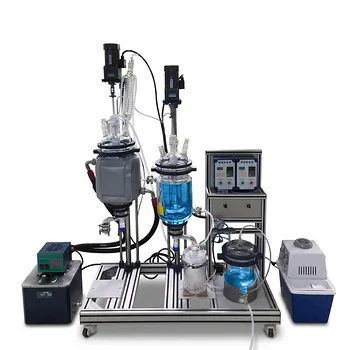
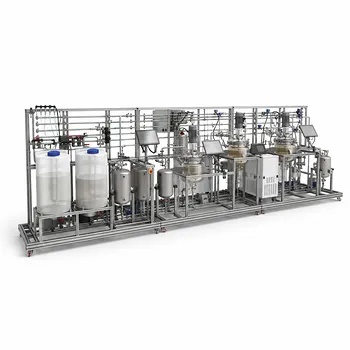
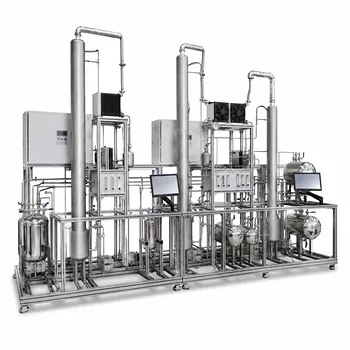
Configuring a crystallization pilot plant for solvent-based recrystallization demands a laser focus on temperature control, agitation precision, and solvent compatibility. Directly, you must engineer a system that safely handles flammable organic solvents like diisopropyl ether or acetonitrile, offers rapid and repeatable heating/cooling cycles to control supersaturation, and provides variable agitation to manipulate crystal size distribution. These core factors enable you to study thermodynamics, polymorphic outcomes, and the integrated downstream operations of filtration and drying under realistic industrial conditions.
The true key is understanding that every design choice—from the choice of solvent to the impeller speed and type of crystallizer—directly shapes the final crystal’s purity, size, and polymorphic form. A well-configured pilot plant is not just a scaled-down industrial unit; it is a flexible research instrument that must safely replicate full-scale temperature cycles while allowing systematic exploration of crystallization methods and polymorph control.
Temperature Control: The Heart of Recrystallization
Why Heating and Cooling Cycles Matter
Recrystallization relies on creating and relieving supersaturation through precise temperature swings. For compounds like Valsartan or Olanzapine, the solubility curve dictates that a small deviation in cooling rate can alter nucleation kinetics and final crystal size distribution.
Without robust temperature control, you cannot reliably study the thermodynamics of dissolution and crystal growth. In a pilot plant, the heating jacket or internal coil must respond uniformly to avoid localized hot spots that could degrade heat-sensitive molecules.
Designing for Precise Ramp Rates
Your pilot plant must support controlled linear heating and cooling, not just crude on/off cycles. A programmable PID loop with a direct temperature sensor in the crystallizer—not just in the jacket—is essential.
You also need sufficient heat transfer area, scaled down appropriately, to mimic the thermal time constants of industrial vessels. Undersized heat exchangers lead to sluggish responses that mask real crystallization behavior.
Agitation: Mastering Crystal Size Distribution
The Impact of Impeller Speed on Nucleation and Growth
Agitation intensity directly governs crystal size distribution. At low tip speeds, poor mixing causes wide particle size distributions, while excessive shear can fracture growing particles and induce excessive secondary nucleation.
For solvent-based systems like Valsartan in diisopropyl ether or Olanzapine in acetonitrile, precise speed control over a broad range (e.g., 50–400 RPM) allows you to probe the relationship between hydrodynamics and crystal properties.
Scaling Agitation from Lab to Pilot
In a pilot plant, always maintain geometric similarity of the impeller and baffle configuration to the intended production scale. A retreat-curve impeller or pitched-blade turbine is often preferred for its ability to suspend solids without excessive local shear.
You must also characterize the just-suspension speed (NJS) for each solvent-solute system, because insufficient solids suspension leads to agglomeration and anomalous crystal growth.
Solvent Compatibility and Safety: Non-Negotiable Design Requirements
Explosion-Proof Construction and Solvent-Resistant Seals
When working with diisopropyl ether (Valsartan) or acetonitrile (Olanzapine), the entire pilot plant must be rated for flammable atmospheres. This demands explosion-proof motors, intrinsically safe instrumentation, and proper electrical classification.
All wetted seals—on agitator shafts, valves, and pump internals—must resist swelling or degradation by the specific solvent class. PTFE, FFKM, or other perfluoroelastomer seals are common starting points, but compatibility charts should be checked for each solvent–temperature combination.
Containment and Ventilation for Volatile Organics
A closed, inertable system with a nitrogen purge prevents the formation of explosive vapor mixtures. Adequate ventilation and a vapor recovery or scrubbing line are essential not only for safety but also for studying evaporative crystallization without disturbing mass balances.
Solvent Selection Strategy: Taming Polymorphism and Yield
How Solvents Control Conformational Polymorphism
The solvent is never just a carrier; it actively stabilizes specific molecular conformations in solution. For a polymorphic compound like Olanzapine, the solvent environment feeds nucleation of certain crystal forms, making solvent selection the most powerful lever for polymorphic selectivity.
By rationally screening solvents that enrich the desired solution conformation, you can avoid unexpected phase transitions later in manufacturing or storage.
The Rational Selection Protocol at Pilot Scale
A pilot plant should support a rapid solvent screening workflow. Use small-scale crystallizers that can run multiple batches per day. Evaluate solubility, supersaturation width, and cooling-rate sensitivity for each candidate solvent.
Focus on solvents that provide a solubility >100 mg/g at elevated temperature and drop below 20 mg/g at the terminal cooling point, while also assessing antisolvent addition if cooling alone gives insufficient yield.
Crystallization Method Selection: Following the Solubility Curve
Cooling vs. Evaporative vs. Antisolvent
The shape of the solubility–temperature curve dictates the method. Cooling crystallization is ideal for Valsartan in diisopropyl ether, where solubility falls sharply with temperature. For solutes with a flat solubility curve, evaporative crystallization is needed to remove solvent and achieve supersaturation.
Antisolvent crystallization becomes mandatory when cooling cannot deliver enough yield at reasonable dilutions. A pilot plant must be modular enough to switch between these modes—by adding a condenser for evaporative runs or dosing lines for antisolvent addition.
Matching the Method to Compound Behavior
For Olanzapine from acetonitrile, cooling alone can yield acceptable crystals, but if you need to control the metastable form, you may incorporate a vacuum adiabatic cooling step. Your pilot plant’s vacuum system and solvent recovery tower then become essential components for integrated training.
Choosing the Right Crystallizer Hardware
Simple Tank Crystallizers for Initial Screening
A jacketed glass or metal vessel with an agitator serves as the most flexible starting point. It allows students and researchers to study batch cooling crystallization thermodynamics and basic nucleation phenomena without complexity.
Draft-Tube Baffle and Oslo Types for Uniform Cristals
When the research goal shifts to producing large, uniform crystals, a draft-tube baffle (DTB) or Oslo-type crystallizer becomes essential. These designs fluidize the crystal bed and circulate clear mother liquor, producing particles in the 600–1200 µm range.
In a pilot plant, installing a DTB unit with a controllable circulation rate lets you explore the relationship between magma density, supersaturation, and crystal size distribution.
Integrating Downstream Operations for a Complete Pilot Plant
A crystallization pilot plant built solely around the crystallizer misses the real industrial picture. You must include filtration and drying units to study how crystal habit, size, and residual solvent content affect downstream processing.
A seamless transfer of the slurry to a pressure nutsche filter or centrifuge, followed by a tray or fluid-bed dryer, closes the mass balance and exposes students to the realities of yield loss and agglomeration during drying.
Common Pitfalls and Trade-offs to Avoid
- Energy intensity vs. temperature uniformity: Direct utility injection (steam/brine) is cheaper, but a secondary fluid loop with a thermostat gives far better control over ramp rates.
- Flexibility vs. safety: Highly flexible modular plants increase the risk of misconfiguration. Pre-engineered solvent-specific skids are safer but limit the educational scope.
- Batch vs. continuous: Batch units are simpler to teach fundamentals, but a continuous mixed-suspension, mixed-product-removal (MSMPR) crystallizer better represents large-scale production dynamics.
- Scale-down of agitation: Perfect kinematic similarity is often unattainable. A compromise—maintaining equal power per mass—can produce scalable data but may alter shear conditions.
Making the Right Choice for Your Goal
The ideal configuration depends squarely on your primary objective. Use this guide to prioritize:
- If your primary focus is education: Choose a modular, bench-top skid with quick-change agitators, a jacketed tank, and simple safety interlocks. Prioritize visible glass construction so students can observe nucleation, while demonstrating both cooling and evaporative modes.
- If your primary focus is process development for a specific compound: Invest in a closed, explosion-proof, stainless-steel system with a DTB or Oslo crystallizer. Emphasize precise temperature profiling and integrated PAT tools (e.g., focused beam reflectance measurement) to track crystal size in real time.
- If your primary focus is polymorph screening: Forgo a single large crystallizer in favor of a multi-reactor array that can run parallel solvent screens. Rapid temperature cycling and inline Raman spectroscopy are worth the extra cost to capture form transitions.
- If your primary focus is solvent recovery and sustainability: Integrate a fractional distillation column directly downstream. This allows you to close the solvent loop and teach mass and energy balances alongside crystallization fundamentals.
By aligning the pilot plant’s capabilities with your core scientific question—not simply replicating industrial hardware—you create a system that becomes a genuine engine for insight, not just a scaled-down copy.
Summary Table:
| Key Factor | Critical Requirement | Impact on Crystallization |
|---|---|---|
| Temperature Control | Precise PID cooling/heating ramp rates | Controls supersaturation, nucleation, and thermodynamic growth. |
| Agitation Precision | Variable speed (50-400 RPM) & geometric similarity | Determines crystal size distribution (CSD) and prevents particle shear. |
| Solvent Safety | Explosion-proof construction & FFKM/PTFE seals | Ensures safe handling of volatile/flammable solvents like acetonitrile. |
| Hardware Choice | Jacketed tank, DTB, or Oslo-type crystallizers | Affects crystal uniformity, yield, and suitability for process scaling. |
Optimize Your Process Engineering Lab with LABPARK
Ready to configure a safe, precise, and high-performance crystallization pilot plant? LABPARK provides state-of-the-art Educational and Vocational Unit Operations Pilot Plants in chemical engineering, bioprocess & biotech, and environmental & water treatment.
We help universities, research institutes, and enterprises bridge the gap between laboratory research and industrial scale-up. Whether you need modular setups for student training or advanced, explosion-proof systems for complex API recrystallization studies, our engineering team is here to support you.
Contact LABPARK today to discuss your pilot plant requirements and request a customized quote!
Related Products
- Multi Functional Membrane Crystallization Educational Unit Operations Pilot Plant
- Potassium Salt Thermal Dissolution and Crystallization Separation Educational Unit Operations Pilot Plant
- Multi-Modal Distillation Unit Operations Training Pilot Plant
- Dual-Mode Rectification Pilot Plant for Practical Training Unit Operations
- Natural Product Extraction Unit Operations Training Pilot Plant
People Also Ask
- Control Crystallization Pilot Plant Secondary Nucleation: 4 Key Adjustments
- Why is precise temperature control critical in crystallization pilot plants? Key to Scale-Up Success
- What are the benefits of integrating online PAT tools like ATR-FTIR into crystallization unit operations pilot plants?
- How to use crystallization pilot plant agitation speed to identify diffusion vs reaction growth?
- How can operators calculate the theoretical crystal yield in a vacuum or cooling crystallization pilot plant? Guide