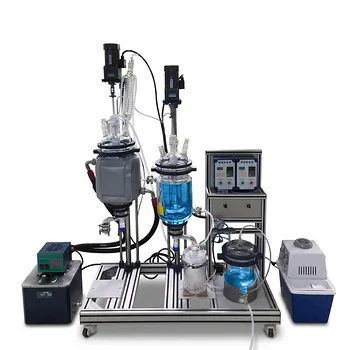
Calculating theoretical crystal yield is a fundamental mass-balance exercise that tells you exactly how much product to expect from your feed. For a simple cooling crystallization, the yield (G) is found by applying a solute balance with no solvent evaporation: G = F × (w_F - w_L) / (w_G - w_L), where F is feed mass flow, w_F is initial solute mass fraction, w_L is final mother liquor solute mass fraction, and w_G accounts for the crystal’s hydration state. In a vacuum crystallization pilot plant, the same solute balance applies, but you must also account for solvent evaporation (W), so the yield becomes G = [F × (w_F - w_L) + W × w_L] / (w_G - w_L). The evaporation rate W is then determined from a heat balance that equates the latent heat removed to the sensible plus crystallization heat.
Theoretical yield emerges from a solute mass balance adapted for hydrate content and solvent evaporation. Nail this, and you gain the power to predict output, size utilities, and debug pilot-plant performance before a single crystal forms.
Building the Solute Mass Balance
Every yield calculation starts with tracking the solute across the crystallizer. The total mass balance says what goes in must come out, and the solute balance isolates how that solute partitions into crystals versus mother liquor.
The Total and Solute Balance Framework
The total mass balance for a continuous or batch system is F = L + G + W. F is feed, L is mother liquor, G is crystal mass, and W is solvent vaporized (all in mass per time or total mass). For the solute, the balance is F × w_F = L × w_L + G × w_G.
Here w represents the solute mass fraction. For anhydrous crystals, w_G = 1.0; for hydrated crystals, w_G is the ratio of anhydrous molar mass to hydrated molar mass, reflecting that water tied up in the crystal lattice is not free water.
Why Mass Fractions Are Enough
Pilot-plant operators rarely work in mole units. Mass fractions (kg solute per kg solution) keep the math immediate and tie directly to solubility curves. They also make it obvious how much “free” water remains after accounting for hydration water. The equations work as long as you use consistent units.
Accounting for Crystal Hydration
If your target product is a hydrate, ignoring the lattice water will overestimate your yield and distort the solvent balance. The correction is built into w_G.
Defining w_G for Hydrated Crystals
For a hydrate like copper sulfate pentahydrate, the anhydrous molecular weight is 159.6 g/mol, the pentahydrate is 249.7 g/mol. Then w_G = 159.6 / 249.7 ≈ 0.639. This means only 63.9% of the mass you weigh as “crystals” is actually solute; the rest is bound water that must be subtracted from the mother liquor water.
Impact on the Yield Equation
When you plug w_G < 1 into G = F × (w_F - w_L) / (w_G - w_L), the denominator shrinks. This increases G compared to assuming anhydrous crystals, but it correctly reflects that you’re harvesting a heavier hydrated mass, including its lattice water.
Incorporating Solvent Evaporation in Vacuum Systems
Vacuum crystallization removes solvent to create supersaturation. That solvent vapor W appears in both the total balance and the solute balance, fundamentally altering the yield.
The Full Yield Equation with Evaporation
Solving the total and solute balances simultaneously yields the general expression:
G = [F × (w_F - w_L) + W × w_L] / (w_G - w_L)
The term W × w_L accounts for the solute that would have remained in the vaporized solvent; since that solvent is gone, the solute must already be accounted for in the crystal mass (or the mother liquor, if supersaturation persists). This equation is the workhorse for any evaporative or vacuum crystallizer.
How Evaporation Boosts Yield
The +W×w_L term directly adds to the numerator, increasing G. In other words, evaporating solvent forces more solute out of solution, driving the yield beyond what cooling alone could achieve. This is why vacuum units can deliver higher per-pass recoveries.
Determining the Evaporation Rate via Heat Balance
You can’t guess W; it’s governed by energy conservation. A proper heat balance ties evaporation to the cooling duty and the heat of crystallization.
The Heat Balance Equation
For a continuous crystallizer where heat loss to surroundings is negligible, the energy balance is:
Q + F × c_pF × t_1 = L × c_pL × t_2 + G × c_pG × t_2 + W × H
Q is the heat exchanged (negative when heat is removed), c_p values are specific heats, t_1 and t_2 are feed and discharge temperatures, and H is vapor enthalpy. For vacuum cooling crystallization, the system operates nearly adiabatically (Q ≈ 0), so the cooling is provided solely by evaporative latent heat.
Solving for W in a Vacuum Crystallizer
Setting Q = 0 and rearranging gives the critical relationship:
W × r_W = F × c_pF × (t_1 - t_2) + G × q_cr
Here r_W is the latent heat of vaporization, and q_cr is the heat of crystallization per mass of crystals. The temperature drop (t_1 – t_2) is your driving force. This equation tells you how much solvent must evaporate to absorb the sensible heat of cooling the feed plus the exothermic crystallization heat. Solve it simultaneously with the yield equation to get both W and G.
Iterative Solution in Practice
Because G appears in the heat balance and depends on W, you typically start with an estimated G, compute W, recalculate G, and iterate until convergence. Spreadsheet tools or simple pilot-plant software handle this instantly, but understanding the loop helps diagnose unreasonable results.
Simplifying for Cooling Crystallization
When there’s no evaporation (W = 0), the coupled equations collapse into a single direct calculation. This is the simplest form operators use for jacketed cooling vessels.
The yield equation becomes G = F × (w_F - w_L) / (w_G - w_L). Here the entire supersaturation comes from temperature-dependent solubility. You need accurate solubility data at the final temperature to set w_L. The heat balance still matters for sizing the coolant flow, but the yield itself is independent of energy calculations.
Understanding the Trade-offs and Pitfalls
Even with perfect math, real-world deviations can undercut your calculated yield. Recognizing these limits is essential.
Assumption of Equilibrium
The equations assume the mother liquor is exactly saturated at the discharge temperature. In practice, you may have residual supersaturation, meaning w_L is slightly higher than the equilibrium solubility and the real yield is lower. Fast cooling or poor mixing exaggerates this.
Neglected Heat Losses
For vacuum systems, assuming Q = 0 is convenient but never exact. Any heat leak into the vessel reduces the evaporation required, distorting the heat-balance W. Insulation and careful measurement of inlet/outlet temperatures help close the gap.
Hydration State Uncertainty
If the crystal form is not perfectly known—or if a mixture of anhydrate and hydrate can appear—w_G becomes a moving target. Always confirm the crystal phase with a microscopic or XRD check when yield mismatch occurs.
Measurement Errors in Concentration
Small errors in w_F or w_L propagate directly to G. Using an incorrectly calibrated refractometer or density meter can easily throw off the plant balance by several percent. Consistent sampling and analytical checks are mandatory.
How to Apply This to Your Pilot-Plant Operation
If your primary focus is designing a new process: Use the coupled yield-and-heat-balance equations to explore “what-if” scenarios for evaporation rates and feed concentrations, mapping out achievable yields across the design envelope.
If your primary focus is troubleshooting an underperforming crystallizer: Compare actual harvested mass to the theoretical G; a large negative deviation points to supersaturation persistence or hydrate mismatch, while a large positive deviation suggests over-evaporation or measurement error.
If your primary focus is scaling up from pilot to production: Verify that the mass balance and heat balance close within measurement uncertainty at pilot scale, then use the same w_F, w_L, and W/r_W ratios to predict performance at larger throughput, adjusting for heat‐transfer differences.
If your primary focus is educational demonstration: Walk students through the iterative solve and the impact of hydration, cementing the link between solubility data, energy constraints, and the material they can actually weigh.
Master the interplay between the solute balance, the hydrate factor, and the evaporation heat balance, and you transform crystallization yield from a rough guess into a precise, actionable number that guides every pilot‑plant decision.
Summary Table:
| Crystallization Type | Yield Formula | Key Considerations |
|---|---|---|
| Cooling Crystallization | $G = F \times \frac{w_F - w_L}{w_G - w_L}$ | Driven by temperature-dependent solubility; assumes zero solvent evaporation ($W=0$). |
| Vacuum Crystallization | $G = \frac{F \times (w_F - w_L) + W \times w_L}{w_G - w_L}$ | Requires solvent evaporation ($W$) to be solved iteratively via a coupled heat balance. |
Optimize Your Crystallization Processes with LABPARK
Are you looking to enhance your process development, training, or scaling capabilities? LABPARK provides premium Educational and Vocational Unit Operations Pilot Plants in chemical engineering, bioprocess & biotech, and environmental & water treatment.
Designed specifically for universities, research institutes, and enterprises, our pilot systems bridge the gap between theoretical calculations and real-world industrial operations.
Ready to elevate your laboratory or training facility? Contact LABPARK today to discuss your customized pilot plant requirements!
Related Products
- Multi Functional Membrane Crystallization Educational Unit Operations Pilot Plant
- Potassium Salt Thermal Dissolution and Crystallization Separation Educational Unit Operations Pilot Plant
- Dual-Mode Rectification Pilot Plant for Practical Training Unit Operations
- Polymerization Granulation and Pellet Processing Educational Unit Operations Pilot Plant
- Multi-Modal Distillation Unit Operations Training Pilot Plant
People Also Ask
- Control Crystallization Pilot Plant Secondary Nucleation: 4 Key Adjustments
- Why is precise temperature control critical in crystallization pilot plants? Key to Scale-Up Success
- What key factors should be considered when configuring a crystallization unit operations pilot plant?
- What are the benefits of integrating online PAT tools like ATR-FTIR into crystallization unit operations pilot plants?
- How to use crystallization pilot plant agitation speed to identify diffusion vs reaction growth?