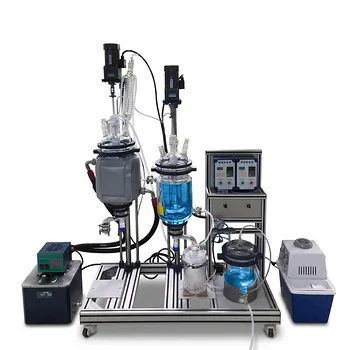
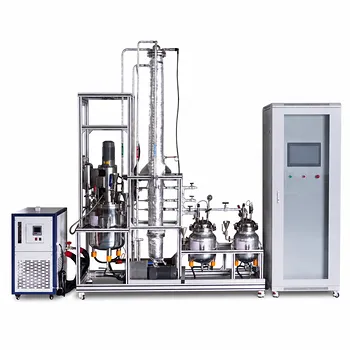
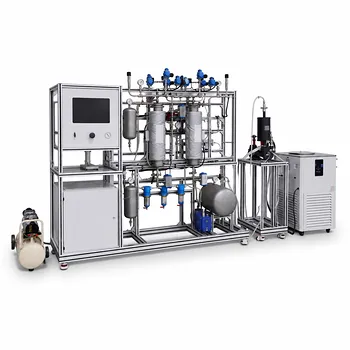
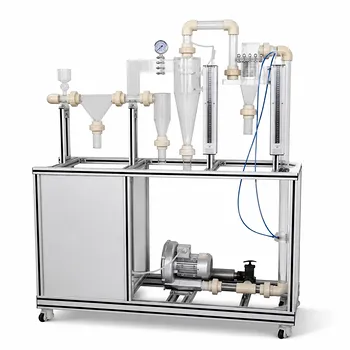
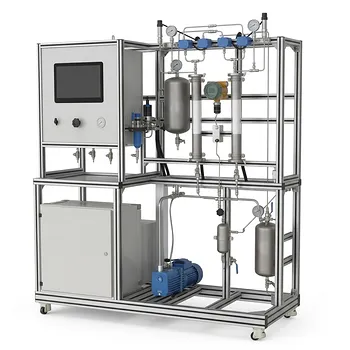
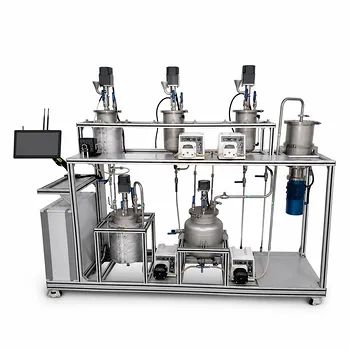
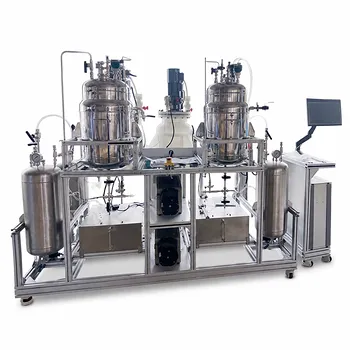
The core advantage is a shift from observing crystallization to controlling it. Manual beaker-based methods teach students the basic steps of crystallization—dissolve, heat, cool, filter. In contrast, educational pilot plants automate and instrument these unit operations, giving students hands-on experience with process control, data-driven optimization, and industrial-scale thinking. This transforms the lab from a recipe-following exercise into an engineering investigation.
Pilot plants convert crystallization from a qualitative, error-prone demonstration into a quantitative, controllable unit operation. Students no longer just see crystals form; they learn to engineer the crystallization process by manipulating parameters and analyzing results, directly bridging the gap between academic concepts and industrial practice.
From Recipe Followers to Process Engineers
The fundamental difference lies in what students are asked to do. Beaker methods are about execution: weigh, heat, wait, filter. Pilot plants are about exploration and control.
Manual Methods Reinforce Procedure, Not Understanding
In a traditional beaker setup, students follow steps and observe outcomes like crystal appearance. The process is passive—cooling rates are uncontrolled, agitation is manual, and filtration is simple gravity separation.
This approach teaches the existence of crystallization but not its dynamics. It’s a chemistry demonstration that rarely forces students to ask why yields vary or how to consistently produce a target crystal size.
Automation Turns Variables into Learning Levers
Educational pilot plants make process parameters visible and tunable. PLC-controlled cooling ramps allow students to program exact temperature profiles and see how cooling rate directly impacts supersaturation and nucleation.
Variable-speed agitation lets them study the effect of shear on crystal breakage and size distribution. Integrated filtration systems (plate-and-frame or vacuum) introduce industrial separation concepts like filtration resistance and cake compressibility. Every knob becomes a learning opportunity.
Quantitative Learning Through Data, Not Guesswork
The most impactful improvement is the transition from qualitative observation to quantitative analysis—a skill that defines professional chemical engineering.
Real-Time Data Closes the Theory-Practice Gap
Beaker experiments yield a final mass of crystals and perhaps a melting point. A pilot plant records and displays temperature profiles, agitation torque, and filtration pressure drops in real time. Students see their theoretical models of crystallization kinetics and material balances come alive on a screen.
They can generate crystal size distribution charts after each run and immediately link an operational decision—like a too-fast cooling ramp—to a high percentage of fines. This direct feedback loop is impossible with passive beaker cooling.
Learning to Optimize, Not Just Operate
With instrumented data, the lab shifts from “did it crystallize?” to “can I improve the yield and purity?” Students can run designed experiments, vary parameters, and use statistical methods to find optimum conditions.
This cultivates a mindset of process optimization, teaching them to treat yield, purity, and crystal size as controlled outputs rather than lucky results. It’s the same iterative improvement logic they’ll use in an industrial role.
Bridging Academic Theory and Industrial Reality
Industry doesn’t use beakers. It uses jacketed reactors, continuous centrifuges, and filter presses. Educational pilot plants shrink these down to a safe, manageable scale while preserving their core engineering challenges.
Introducing Unit Operation Complexity Safely
Manual methods mask important industrial phenomena. A gravity funnel never shows how filter cake resistance rises as solids accumulate or how vacuum can crack a cake. A beaker never demonstrates the importance of slurry handling pumps or containment for hazardous solvents.
Pilot plants introduce these complexities in a controlled setting. Students grapple with reality: a pump that cavitates, a filter that blinds, a temperature control that lags. That controlled failure is a powerful teacher.
Building Confidence for Career-Ready Skills
Graduates who have only used glassware often face a steep learning curve when they encounter their first commercial crystallization skid. Those trained on pilot plants arrive with vocabulary and problem-solving experience aligned with industry job roles.
They’ve calibrated a thermocouple, tuned a PID loop, and interpreted a filtration curve. This practical fluency makes them immediately more valuable to employers and reduces the onboarding burden for companies.
Understanding the Trade-offs
No educational tool is perfect. The shift to pilot plants carries costs that must be weighed against the learning benefits.
Higher Initial Investment and Maintenance
Pilot plants are expensive to purchase, install, and maintain. They require utilities, space, and technical support staff. While a beaker setup costs pennies, a single crystallization pilot plant can represent a significant capital line item.
Downtime due to sensor failure or pump wear can disrupt teaching schedules. Institutions must plan for sustained funding, not just an initial purchase.
Steeper Learning Curve for Students
The added complexity can overwhelm students if not properly scaffolded. Where a beaker requires 30 minutes of instructions, a pilot plant may demand several hours of training on safety, software, and operation.
If not designed carefully, the lab becomes a black-box exercise where students press buttons without understanding the underlying physics. The curriculum must integrate theory before they touch the equipment.
Less Focus on Fundamental Chemistry
By emphasizing control and data, pilot plants can obscure the beautiful chemistry of crystal nucleation and growth. Students might exit knowing how to hit a target particle size but have a weaker grasp of polymorph selection or molecular-level mechanisms.
A blended approach—using manual methods to introduce core concepts before scaling to pilot plant—often yields the best overall understanding.
Making the Right Choice for Your Learning Goals
The answer isn’t “pilot plants always better.” The right tool depends on what you want students to take away.
- If your primary focus is teaching fundamental chemistry concepts: Begin with manual beaker methods to observe crystal habits, supersaturation effects, and the influence of impurities. Use pilot plants later to show how those fundamentals scale.
- If your primary focus is developing process engineering skills: Adopt a pilot plant as the core lab. Let students design experiments, tune controllers, and analyze industrial-scale issues like filtration resistance and CSD.
- If your primary focus is resource-limited, broad exposure: Use pilot plants for a capstone project or a few senior-level sessions. Keep the majority of the curriculum on manual methods to keep costs manageable while still offering that transformative engineering experience.
- If your primary focus is preparing students for direct job placement: Integrate pilot plants early and often. Supplement with industrial-spec data analysis and troubleshooting exercises to simulate on-plant roles.
The most successful programs use manual and pilot-plant methods intentionally, not as replacements, but as complementary stages on a student’s journey from observer to engineer.
Summary Table:
| Feature | Manual Beaker Methods | Crystallization Pilot Plants |
|---|---|---|
| Control Type | Manual & passive cooling/agitation | PLC-automated process parameters |
| Data Collection | Qualitative (visual inspection only) | Real-time quantitative data & analysis |
| Learning Focus | Recipe execution & basic chemistry | Process optimization & engineering control |
| Industrial Relevance | Minimal (bench-scale glassware) | High (simulates industrial unit operations) |
Ready to elevate your engineering curriculum or research capabilities? LABPARK provides state-of-the-art Educational and Vocational Unit Operations Pilot Plants in chemical engineering, bioprocess & biotech, and environmental & water treatment. Designed specifically for universities, research institutes, and enterprises, our systems bridge the gap between classroom theory and industrial reality. Contact us today to find the perfect pilot plant solution for your lab!
Related Products
- Potassium Salt Thermal Dissolution and Crystallization Separation Educational Unit Operations Pilot Plant
- Multi Functional Membrane Crystallization Educational Unit Operations Pilot Plant
- Multifunctional Membrane Separation Educational Pilot Plant with Ultrafiltration, Nanofiltration, Reverse Osmosis
- Multi-Functional Membrane Separation Educational Pilot Plant for Unit Operations Lab
- Carbon Material Thermal Pretreatment Multiphase Separation Educational Pilot Plant
People Also Ask
- What are the benefits of integrating online PAT tools like ATR-FTIR into crystallization unit operations pilot plants?
- Why is precise temperature control critical in crystallization pilot plants? Key to Scale-Up Success
- Control Crystallization Pilot Plant Secondary Nucleation: 4 Key Adjustments
- What key factors should be considered when configuring a crystallization unit operations pilot plant?
- How can operators calculate the theoretical crystal yield in a vacuum or cooling crystallization pilot plant? Guide