The short answer is simple: you can’t trust a dry sieve with delicate resin beads.
Strong acid cation exchange resins, typically 0.4–0.6 mm beads, are highly prone to structural failure when they lose moisture. Drying causes the beads to decrepitate—they crack and shatter—generating a cloud of artificial fines that never existed in the operating column. The wet sieving method eliminates this by keeping the resin fully hydrated, ensuring the particle size analysis reflects only the true attrition damage from the process, not the testing procedure.
The core insight: Drying cation exchange resin before sieving creates the very problem you’re trying to measure. Wet sieving preserves the beads’ physical integrity, making it the only reliable way to quantify real operational fines.
The Fragile Nature of Ion Exchange Resins
Strong acid cation resins are not rigid glass beads. They are cross-linked polymer gels swollen with water. Their entire functional structure depends on staying wet.
Why Drying Destroys the Evidence
When these beads dry, they shrink unevenly as water leaves the polymer network. Internal stresses build rapidly and lead to sudden fracturing. This process, known as decrepitation, turns intact beads into fragments.
What you then capture on a dry sieve is a mix of genuine attrition fines and freshly shattered bead debris. The result is a gross overestimation of fines and a completely misleading particle size distribution.
The Mechanics of Decrepitation
A 0.5 mm gel bead contains a precise balance of polymer chains and water. Rapid moisture loss collapses this structure violently, similar to a dried-out sponge that crumbles when touched.
Even gentle oven drying at moderate temperatures can trigger this breakdown. The reference work highlights that strong acid cation resins specifically “tend to decrepitate or crack when dried,” making any dry analysis invalid from the start.
Why Accuracy Matters: Fines and Performance
You’re not measuring particle size for academic curiosity. You’re tracking attrition fines because they clog screens, increase pressure drop, and contaminate downstream processes.
Operational Attrition vs. Artificial Breakage
In a real ion exchange column, beads experience mechanical and osmotic stresses that slowly generate small fragments. These true fines are what an operator needs to monitor to predict maintenance and resin replacement.
Dry sieving conflates this signal with massive noise from drying-induced breakage. You lose the ability to distinguish a stable resin bed from one that is disintegrating under normal service.
The Cost of Misleading Data
Acting on false fines data can lead to premature resin backwashing, unnecessary chemical regenerations, or even a costly resin change-out.
Conversely, ignoring true fines because you assume the numbers are exaggerated can lead to bed plugging and unplanned shutdowns. Wet sieving gives you the ground truth you need to make confident decisions.
Understanding the Trade-offs
Wet sieving is the gold standard for cation exchange resins, but it’s not without practical compromises. Recognizing these will help you execute the method correctly and interpret results honestly.
The Practical Downsides of Wet Sieving
A wet analysis is more time-consuming than a quick dry shake. It requires a stack of sieves mounted on a sieve shaker with a continuous water spray system, plus careful collection and drying of the retained fractions afterward.
You also introduce a new variable: potential bead swelling if the wetting solution differs from the resin’s operating environment. However, this swelling effect is predictable and far smaller than the error from dry decrepitation.
Why Simplicity Isn’t Always Faster
A lab technician might argue that dry sieving is “good enough” for routine checks. But the cleanup from a misdiagnosed resin failure—troubleshooting, emergency media replacement, process downtime—dwarfs the extra 30 minutes of a wet test.
The speed of dry sieving is an illusion when its results lead you to chase ghosts.
Making the Right Choice for Your Goal
The decision between wet and dry methods hinges on what you need the data for. Use the following guide to align your technique with your true objective.
- If your primary focus is monitoring resin integrity and attrition: Always use the wet method. It’s the only way to isolate real operational fines from drying artifacts and see the true degradation trend.
- If your primary focus is a quick, qualitative check after an upset: A dry sieve can tell you if something catastrophic happened, but treat the absolute fines values with extreme skepticism. Any reading above 1-2% fines likely includes decrepitation debris.
- If your primary focus is validating a resin manufacturer’s specification: Insist on wet sieving data. A spec measured dry is meaningless for hydrated cation exchange resins and will not predict field performance.
Trust the hydration—what you see in water is what you get in your column.
Summary Table:
| Parameter | Wet Sieving | Dry Sieving |
|---|---|---|
| Resin State | Fully hydrated (natural state) | Oven-dried |
| Bead Integrity | Preserved (no damage) | Prone to cracking (decrepitation) |
| Fines Accuracy | Highly accurate (true attrition) | Poor (creates artificial fines) |
| Suitability | Recommended for quality analysis | Qualitative checks only (unreliable) |
Are you looking to equip your chemical engineering laboratory with industry-standard process systems? LABPARK provides state-of-the-art Educational and Vocational Unit Operations Pilot Plants in chemical engineering, bioprocess & biotech, and environmental & water treatment. Specifically designed for universities, research institutes, and enterprises, our systems ensure hands-on, accurate research and teaching environments. Contact us today to find the perfect pilot scale solutions for your institution!
Related Products
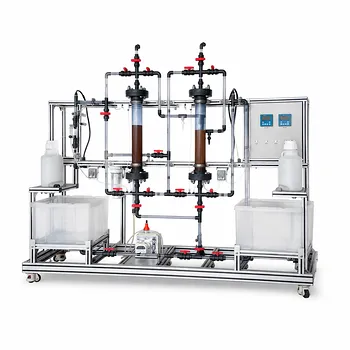
- Ion Exchange Water Purification Educational Pilot Plant for Engineering Unit Operations
- Constant Pressure Filtration Educational Unit Operations Pilot Plant
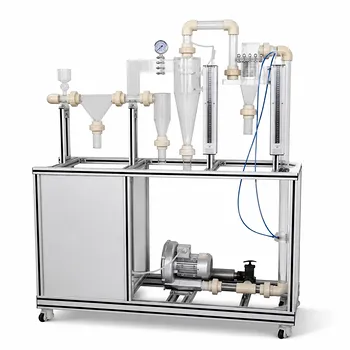
- Gas-Solid Heterogeneous Separation Demonstration Educational Unit Operations Pilot Plant
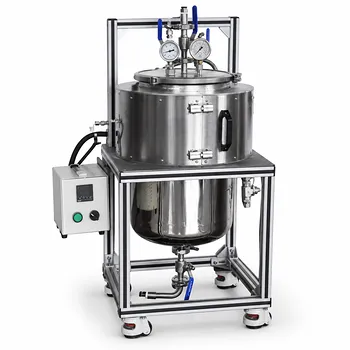
- Hot Filtration Educational Unit Operations Pilot Plant Laboratory System
- Dual-Mode Rectification Pilot Plant for Practical Training Unit Operations
People Also Ask
- How to Prevent Ion Exchange Channeling? Expert Solutions for Pilot Plants
- What operational precautions should lab operators take for resin volume changes and air pockets? Key Guide
- How does ion exchange work in water treatment pilot plants? Cost & process guide.
- How to use ion exchange pilot plants to verify alkalinity? A hands-on guide for engineering students.
- Why does iron degrade cation resin & how to demonstrate capacity recovery? Step-by-Step Lab Guide