The simple answer is vigilance and backwashing. You prevent channeling and trapped air pockets by never letting the liquid level inside the column drop below the top of the resin bed. If channeling does occur, you correct it by backwashing—passing water upward through the bed to break up tight packing, release trapped air, and realign the resin particles for uniform flow.
Channeling and air pockets destroy the uniform contact that makes ion exchange work. Prevention centers on a single non-negotiable rule: keep the resin completely submerged at all times. When the damage is done, a controlled upward flow of water (backwashing) is the only reliable fix to resettle the bed and restore full capacity.
Why Channeling and Air Pockets Occur—And Why They’re Catastrophic
Understanding the root cause helps you internalize the prevention rule. Channeling is not just a nuisance; it’s a direct attack on bed efficiency.
The Loss of Submergence Triggers Air Ingress
When the liquid level drops below the top of the resin bed, air rushes into the void spaces between the beads. A partially drained bed acts like a sponge with air-filled channels, not a flooded bed.
Once air is trapped, the incoming fluid takes the path of least resistance. It carves narrow, high-velocity streams through the bed, bypassing most of the resin. That’s channeling.
The Vicious Cycle of Short-Circuiting
Channeling creates direct short-circuits. The target ions simply never contact the majority of the exchange sites. You observe a sharp drop in exchange capacity and a misleadingly fast flow rate—because the fluid is only flowing through a tiny fraction of the column’s cross-section.
Prevention: The Non-Negotiable Liquid-Level Rule
Preventing channeling is far easier than correcting it after the bed has compacted and air has lodged. It all hinges on one operational discipline.
Always Keep the Resin Submerged
The cardinal rule is simple: never allow the liquid level to fall below the top of the resin bed. Even a momentary exposure during liquid transfer or a leak can introduce enough air to initiate channeling.
This applies during every phase—loading, rinsing, regeneration, and idle periods. Design control logic and level sensors to trigger alarms or automatically stop outflow before the liquid meniscus touches the resin.
Use Level Sensors and Operational Checklists
Pilot plants often lack the buffering volume of industrial columns. Train operators to continuously monitor sight glasses and use high-level/low-level cutoffs. Routine start-up checklists should explicitly confirm a flooded, air-free bed before any run.
The Hidden Factor: Resin Volume Swings During Acid and Water Cycles
Even when you keep the bed submerged, a different problem can mimic channeling and promote air entrapment if you’re not careful during regeneration.
Strong-Acid Cation Resins Shrink and Swell
During acid treatment (regeneration), strong-acid cation exchange resins undergo a significant volume contraction. When you subsequently rinse the column with water, the resin swells back rapidly, packing itself tight against the column walls.
This sudden, dense packing can compress residual air microbubbles into larger pockets and drastically slow the flow rate. While technically not channeling from a drained bed, the result is the same: uneven flow and reduced contact.
Preventing Swell-Induced Compaction Issues
To avoid this, introduce the water rinse gently. Don’t blast a tight bed immediately. Pre-wetting or a slow initial flow allows the swelling to propagate evenly without hydraulic bridging. Always ensure the column is vented at the top during filling to let displaced air escape before operation begins.
Correcting Channeling and Air Pockets: The Backwashing Solution
When prevention fails—or after a regen cycle creates a compacted mystery bed—backwashing is the definitive corrective action.
How Backwashing Works
Backwashing reverses the flow direction: clean water is pumped upward through the resin bed from the bottom distributor. This upward current lifts and separates the individual resin beads, releasing trapped air bubbles and flushing out any fines or debris.
Critically, the expansion and turbulence realign the particles, destroying the established flow imperfections. When you then slowly stop the flow and allow the bed to settle under gravity, it forms a freshly stratified bed with uniform porosity.
Step-by-Step Correction in a Pilot Column
- Stop the forward flow and ensure the column can vent.
- Introduce upward water flow slowly. Start at a low velocity to avoid pushing the entire bed out the top. Aim for a bed expansion of 30–50%.
- Observe the bed. You will see air bubbles purge and the resin fluidize.
- Sustain backwash until the effluent runs clear and you no longer see air being released.
- Settle the bed. Turn off the pump and let the bed settle gently. A final short forward rinse can fully pack the settled bed before switching to process fluid.
After a correct backwash, the flow resistance (pressure drop) should normalize and the column’s breakthrough capacity will recover.
Understanding the Trade-offs and Pitfalls
Backwashing is powerful, but it’s not a magic button. Applying it without thought can create new problems.
Resin Loss from Excessive Expansion
If the backwash flow rate is too high, the bed will expand past the column’s freeboard, and resin beads will wash out through the vent line. Pilot columns often have limited overhead space—calibrate your upflow velocity carefully based on the resin’s specific gravity and particle size.
Re‑Introducing Air During Drain‑Down
After backwashing, a common mistake is to drain the column from the bottom without first displacing the water with process fluid. As the bed drains, air again penetrates the settled resin. Always purge with process liquid before any drain-down.
Not Addressing the Root Cause of Contraction
If repeated, severe swelling cycles are crushing the bed, simply backwashing after every regen is a band-aid. The real fix may be to investigate whether your acid concentration or contact time is causing excessive osmotic shock. Using a more gradual elution protocol can reduce the severity of volume swings.
Making the Right Choice for Your Pilot Operation
The strategy you prioritize depends on whether you’re in a steady production window or a rigorous research campaign.
- If your primary focus is maintaining consistent mass transfer performance: Never break the liquid seal above the bed and install automated low-level cutoffs. One moment of exposure can invalidate a full day’s data.
- If your primary focus is navigating frequent regeneration cycles: Standardize a gentle backwash step after every acid-to-water transition. This dissolves compaction before it can mimic channeling.
- If your primary focus is maximizing resin lifespan: Minimize osmotic shock with slower concentration gradients during reagent changeover, reducing the need for aggressive backwashing and the risk of bead breakage.
- If your primary focus is troubleshooting an underperforming column: Backwash immediately as a diagnostic—if capacity returns, you’ve confirmed a channeling or air pocket issue. If not, you know to look for chemical fouling or equilibrium problems.
Respect the simple physics of a submerged, well-settled bed, and your pilot column will deliver the predictable, scalable data you depend on.
Summary Table:
| Issue | Primary Cause | Prevention Strategy | Corrective Action |
|---|---|---|---|
| Channeling & Air Pockets | Liquid level dropping below resin bed | Keep resin fully submerged; use level sensors & alarms | Perform upward backwash (30–50% expansion) to reset bed |
| Swell-Induced Compaction | Rapid swelling of resin during water rinse cycles | Introduce rinse flow slowly; ensure column top is vented | Backwash gently to release compaction and trapped air |
Optimize Your Chemical Engineering Lab with LABPARK
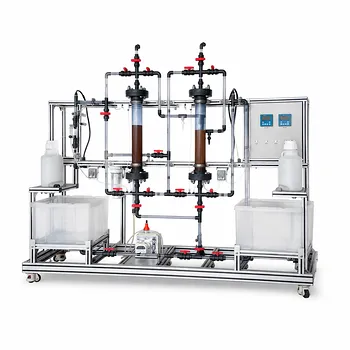
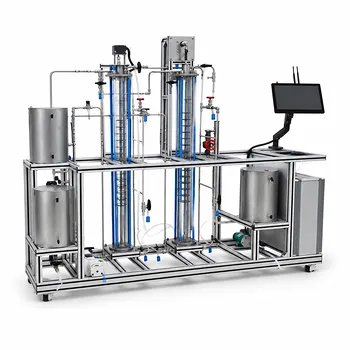
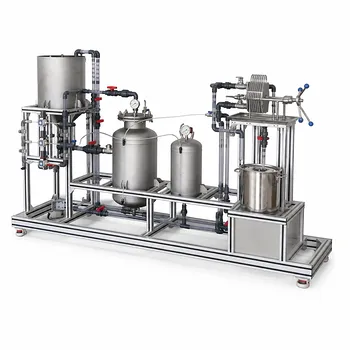
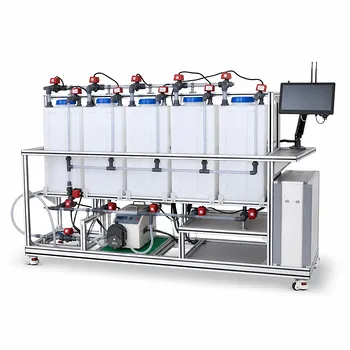
Achieving precise, repeatable data requires pilot plants designed for seamless operation. LABPARK provides advanced Educational and Vocational Unit Operations Pilot Plants in chemical engineering, bioprocess & biotech, and environmental & water treatment. Designed specifically for universities, research institutes, and enterprises, our systems help you master liquid-flow dynamics and eliminate operational issues like channeling.
Ready to elevate your research or training capabilities? Contact LABPARK today to discover our custom pilot plant solutions!
Related Products
- Ion Exchange Water Purification Educational Pilot Plant for Engineering Unit Operations
- Dual Mode Heat Transfer Pilot Plant for Unit Operations Training
- Comprehensive Liquid-Liquid Extraction Pilot Plant for Engineering Education
- Constant Pressure Filtration Educational Unit Operations Pilot Plant
- Educational Unit Operations Pilot Plant for Intraparticle Diffusion Effective Factor Measurement
People Also Ask
- What operational precautions should lab operators take for resin volume changes and air pockets? Key Guide
- How does ion exchange work in water treatment pilot plants? Cost & process guide.
- How to use ion exchange pilot plants to verify alkalinity? A hands-on guide for engineering students.
- Why does iron degrade cation resin & how to demonstrate capacity recovery? Step-by-Step Lab Guide
- How to perform preliminary cost estimations for pilot plant mixers, centrifuges, and compressors?