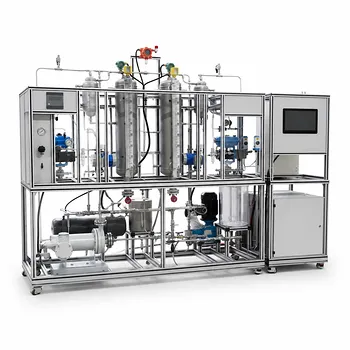
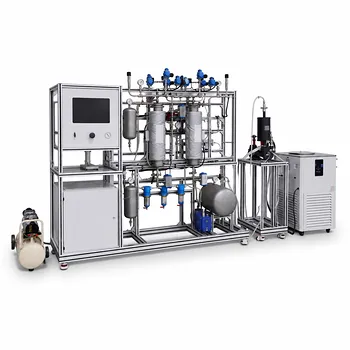
Producing ultra-pure demineralized water in a pilot plant depends on a precise, two-step chemical swap.
In these systems, cation exchange resins replace dissolved metallic cations (such as calcium, magnesium, and sodium) with hydrogen ions (H⁺), while anion exchange resins strip out negatively charged ions (chlorides, sulfates, bicarbonates) by substituting hydroxide ions (OH⁻). The H⁺ and OH⁻ then combine to form pure water, pushing the total dissolved solids (TDS) below 1 ppm. Operationally, the cost of producing demineralized water is typically about double the raw water cost, driven primarily by the expense of regeneration chemicals and the treatment of the spent regenerant waste.
Core Takeaway: Ion exchange demineralization is not a passive filter—it’s a reversible, stoichiometric reaction. A pilot plant’s true educational and design value lies in revealing the critical interplay between resin exhaustion, chemical regeneration, and the hard economics of waste disposal, not just in the final water purity.
How Ion Exchange Demineralization Works at the Pilot Scale
The Chemistry of Ion Swapping
The process relies on tiny, charged plastic beads. Strong-acid cation resins readily give up H⁺ ions in exchange for cations like Ca²⁺, Mg²⁺, and Na⁺. Strong-base anion resins do the same with OH⁻ for anions like Cl⁻, SO₄²⁻, and HCO₃⁻.
In a mixed-bed or multi-bed configuration, the two resin types work in series or together, gradually stripping the water of its ionic load until it is virtually mineral-free.
The Exhaustion Cycle in a Pilot Column
Inside the pilot plant, raw water flows downward through a packed resin column. The active exchange zone moves slowly through the bed as the topmost resin beads become saturated with contaminants.
Initially, the effluent shows near-zero conductivity. Over time, however, the resin’s capacity is consumed.
Monitoring Breakthrough and Resin Capacity
Breakthrough occurs when the first trace of undesirable ions escapes the column, signaling that the exchange zone has reached the bed’s outlet.
Pilot-scale operation makes it possible to chart breakthrough curves and calculate resin capacity in mmol/g or mmol/mL. These metrics are the foundation for sizing full-scale plants and predicting chemical consumption with precision.
Regeneration: The Economic and Environmental Turning Point
Chemical Regenerants and Their Role
Once breakthrough is detected, the pilot plant switches to regeneration mode. A strong acid (typically HCl or H₂SO₄) is passed through the cation bed to strip off the accumulated cations and re-load the resin with H⁺.
For the anion bed, a base like sodium hydroxide (NaOH) displaces the captured anions, restoring the OH⁻ groups. This chemical reversal is what makes ion exchange a cyclic, rather than a consumptive, process.
Wastewater and Disposal Challenges
Regeneration produces a concentrated stream of spent acid, base, and the removed salts. Disposing of or neutralizing this regenerant wastewater is a major operational cost—often rivaling the chemical purchase price itself.
Pilot plant studies teach that ignoring disposal logistics can erase any savings from optimized resin cycles, making wastewater management a central focus of water treatment training.
Understanding the Trade-offs
No single pilot plant design is perfect for every raw water source. High bicarbonate alkalinity, for instance, generates CO₂ that can load anion resins prematurely, requiring a degasifier. Phosphate interferences, notorious in boiler feedwater analysis, can also complicate demineralization if not addressed by careful column design.
The core economic trade-off is between capital cost and chemical consumption. A larger resin volume extends run times between regenerations but increases upfront investment. The real skill lies in balancing water purity, resin life, and the twofold cost of chemicals plus waste treatment—exactly what pilot-scale optimization teaches.
Making the Right Choice for Your Pilot Plant Goal
Every pilot plant objective points to a different operational emphasis. Anchor your decisions in what you need to learn or prove.
- If your primary focus is hands-on training: Operate a simple dual-bed column with frequent breakthrough runs to build intuition for stoichiometry, capacity curves, and the cost of negligence during regeneration.
- If your primary focus is process cost optimization: Use the pilot plant to systematically vary regenerant concentrations and flow rates, measuring the chemical cost per cubic meter of treated water until you hit the sweet spot between purity and expense.
- If your primary focus is scaling to a full industrial system: Extend pilot tests to include long-term resin fouling data and spent regenerant neutralization challenges—these factors, not the initial TDS, will dominate the life-cycle economics.
The ion exchange pilot plant is a compressed version of real-world trade-offs: purity is never free, but with rigorous piloting, the cost of that purity becomes completely transparent.
Summary Table:
| Process Stage | Key Mechanism / Reaction | Major Cost & Operational Drivers |
|---|---|---|
| Cation Exchange | Replaces metallic cations (Ca²⁺, Mg²⁺) with H⁺ | Requires strong acid regenerant (HCl/H₂SO₄) |
| Anion Exchange | Replaces anions (Cl⁻, SO₄²⁻) with OH⁻ | Requires strong base regenerant (NaOH) |
| Exhaustion Cycle | Active exchange zone saturates over time | Monitored by effluent conductivity/breakthrough |
| Regeneration & Waste | Recharges resins by reversing the reaction | Spent acid/base neutralization & disposal costs |
Accelerate Your Research and Training with LABPARK
LABPARK provides state-of-the-art Educational and Vocational Unit Operations Pilot Plants in chemical engineering, bioprocess & biotech, and environmental & water treatment. Tailored for universities, research institutes, and enterprises, our systems allow you to easily model breakthrough curves, optimize resin regeneration cycles, and analyze real-world cost trade-offs.
Take the next step in process education and industrial scaling—contact us today to request a quote!
Related Products
- Ion Exchange Water Purification Educational Pilot Plant for Engineering Unit Operations
- Comprehensive Liquid-Liquid Extraction Pilot Plant for Engineering Education
- Dual Mode Heat Transfer Pilot Plant for Unit Operations Training
- Electrochemical Water Treatment Educational Unit Operations Pilot Plant
- Constant Pressure Filtration Educational Unit Operations Pilot Plant
People Also Ask
- How to Prevent Ion Exchange Channeling? Expert Solutions for Pilot Plants
- What operational precautions should lab operators take for resin volume changes and air pockets? Key Guide
- How to use ion exchange pilot plants to verify alkalinity? A hands-on guide for engineering students.
- Why does iron degrade cation resin & how to demonstrate capacity recovery? Step-by-Step Lab Guide
- How to perform preliminary cost estimations for pilot plant mixers, centrifuges, and compressors?