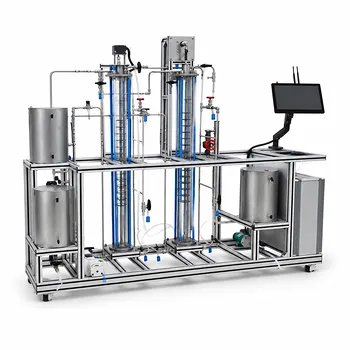
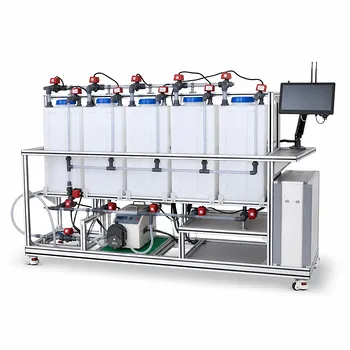
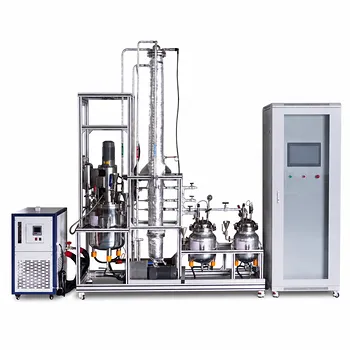
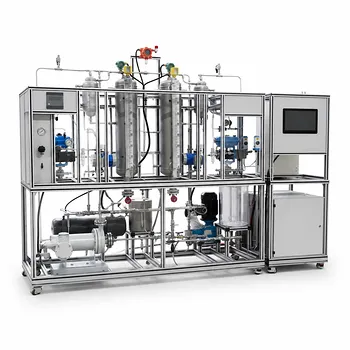
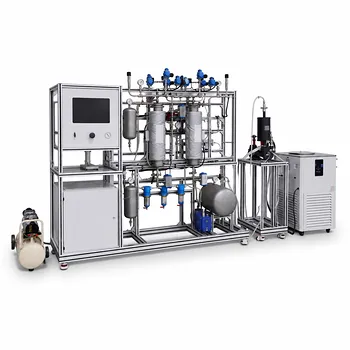
By running a water sample through a cation exchange column in the acid form and carefully titrating the effluent, chemical and environmental engineering students can directly measure total cation concentration and isolate the contributions of hydroxide and carbonate ions. This hands‑on method transforms abstract alkalinity equations into a concrete mass‑balance exercise. The pilot plant becomes a living validation tool that confirms whether P and M alkalinity readings truly match the underlying ion chemistry.
In an ion exchange pilot plant, swapping all cations for hydrogen ions and then titrating the resulting acidity gives an indisputable reference for total dissolved cations. Comparing this against standard alkalinity titrations allows students to verify the fundamental relationships between hydroxide, carbonate, and bicarbonate — and to spot real‑world imbalances that pure theory often misses.
The Pilot Plant as an Analytical Engine
The experiment’s centerpiece is a cation exchange column fully loaded in the hydrogen (H⁺) form. When you pass a raw water sample through this bed, every dissolved cation — Ca²⁺, Mg²⁺, Na⁺, and others — is replaced by an equivalent amount of H⁺.
The effluent therefore contains an acid equivalent to the total cation concentration of the original water. Titrating this acid with a standard sodium hydroxide solution gives a direct, stoichiometric answer in equivalents per million (epm).
Separating Hydroxide and Carbonate Ions
Raw water alkalinity is a mixture of OH⁻, CO₃²⁻, and HCO₃⁻. In the classic P (phenolphthalein) and M (methyl orange) titration, you obtain two endpoints that define these species algebraically.
The pilot plant adds a third, orthogonal measurement: total cation‑derived acidity. By also titrating a neutralised sample that has been pre‑treated to remove carbonate species, you can isolate the hydroxide and carbonate epm directly and compare them with the values calculated from P and M alkalinity.
Why This Verification Matters
Standard alkalinity titrations rely on the assumption that only hydroxide, carbonate, and bicarbonate contribute to buffering. In real industrial waters, weak organic acids or silicates can distort this picture.
The cation‑exchange‑derived acidity provides a hard, unbiased total cation count. When you subtract the alkalinity‑derived OH⁻ and CO₃²⁻ epm from that total, the remainder highlights any missing anions — a powerful troubleshooting insight that a textbook cannot teach.
Bridging Stoichiometry and Practical Alkalinity Analysis
P and M alkalinity measurements describe a water’s acid‑neutralising capacity, but they do not directly reveal individual cation concentrations. The ion exchange pilot plant closes that gap.
Calculating epm and Checking the Balance
- P alkalinity titrates down to pH 8.3, converting CO₃²⁻ to HCO₃⁻ and OH⁻ to H₂O.
- M alkalinity titrates down to pH 4.5, converting all buffering species to carbonic acid or water.
- From these two numbers, standard formulas give [OH⁻] and [CO₃²⁻] epm.
Now run the same water through the H⁺‑form cation exchanger. The titre of the effluent with NaOH directly yields total cation epm. In a pure carbonate‑hydroxide system, the relationship
( epm OH⁻ + 2 × epm CO₃²⁻ ) = total cation epm
must hold exactly. A mismatch immediately points to interference ions or measurement error.
Validating Titration Accuracy in One Experiment
Students often doubt whether their indicator endpoints are truly sharp. The pilot plant offers an independent checksum: if the acidity of the cation‑exchanged effluent equals the sum of the calculated cation loads from the P/M titration, the endpoint accuracy is confirmed.
This builds confidence in manual titration technique — exactly the skill needed for calibrating online pH sensors and configuring automated chemical dosing loops later in the curriculum.
Understanding the Trade‑Offs and Limitations
No educational tool is perfect. Using an ion exchange pilot plant to verify alkalinity relationships comes with practical nuances that are themselves valuable learning points.
Resin Condition Is Everything
A partially exhausted column will release residual cations, giving a falsely low acidity reading. Students must first fully regenerate the resin with a strong mineral acid and rinse until the effluent pH matches the feed water.
This step teaches the fundamentals of resin bed integrity and breakthrough curves — the same principles that govern industrial softeners and demineralisers.
Titration Artifacts and Carbon Dioxide Interference
Exposed effluents can absorb CO₂ from the air, creating an acidic bias. Swift handling and the use of a mixed indicator (like methyl red‑bromocresol green) help, but the experiment still demands careful technique.
If the pilot plant feed contains significant sulphate or chloride, the cation‑exchange effluent will contain the corresponding mineral acids. These titrate normally, so the method remains valid, but the strong‑acid anion concentration must be accounted for when reconciling the total ion balance.
When the System Is Not Purely Carbonate
The P/M‑to‑cation check works beautifully for simple boiler feed waters. For complex industrial waters containing sulphides, phosphates, or organic anions, the alkalinity titration relationships become muddy. In those cases, the ion exchange method still gives a reliable total cation figure, but the species‑specific verification becomes more interpretative.
Making the Right Choice for Your Learning Goal
How you use the pilot plant should mirror the objective you bring to the bench.
- If your primary focus is mastering water chemistry fundamentals: Design a clean synthetic water containing only hydroxide and carbonate. Use the ion exchange step to experimentally verify that the P/M‑derived OH⁻ and CO₃²⁻ epm exactly equal the total cation‑derived acidity — closing the theory‑practice loop.
- If your primary focus is preparing for an industrial operator role: Introduce realistic variations: raw water with hardness, sulphate, and silica. Practice resin regeneration, flow rate control, and titration speed to build the muscle memory needed for shift work in a power station or chemical plant.
- If your primary focus is research or troubleshooting skills: Deliberately spike the sample with a weak organic acid. Observe how the total cation epm remains unchanged while the P/M alkalinity calculation fails, then use the discrepancy to identify the interfering species — exactly the diagnostic approach used in process failure investigations.
The ion exchange pilot plant is much more than a black box for softening water; it is a precise, transparent instrument that lets you see stoichiometry in action and hold your textbook equations fully accountable.
Summary Table:
| Step | Action & Measurement | Educational & Practical Value |
|---|---|---|
| Cation Exchange | Pass water sample through $H^+$ resin and titrate effluent | Measures total cation concentration in equivalents per million (epm) |
| Alkalinity Titration | Perform standard P and M titration on sample | Calculates specific concentrations of $OH^-$ and $CO_3^{2-}$ ions |
| Stoichiometric Check | Compare total cations with sum of alkalinity species | Confirms titration accuracy and identifies interfering ions |
| Resin Regeneration | Flush column with mineral acid and rinse to neutral pH | Teaches resin breakthrough curves and bed capacity management |
Equip Your Lab with Industry-Grade Learning Tools
Bridge the gap between theoretical stoichiometry and practical process engineering. LABPARK provides premium Educational and Vocational Unit Operations Pilot Plants in chemical engineering, bioprocess & biotech, and environmental & water treatment. Designed specifically for universities, research institutes, and enterprises, our systems empower students to master real-world water treatment operations, resin regeneration, and chemical analysis.
Ready to elevate your engineering curriculum? Contact our experts today to customize your pilot plant setup.
Related Products
- Ion Exchange Water Purification Educational Pilot Plant for Engineering Unit Operations
- Comprehensive Liquid-Liquid Extraction Pilot Plant for Engineering Education
- Dual Mode Heat Transfer Pilot Plant for Unit Operations Training
- Electrochemical Water Treatment Educational Unit Operations Pilot Plant
- Constant Pressure Filtration Educational Unit Operations Pilot Plant
People Also Ask
- Why does iron degrade cation resin & how to demonstrate capacity recovery? Step-by-Step Lab Guide
- What are the key capacity differences & regeneration parameters in ion exchange columns? Scale Up Successfully
- How can foaming be managed during steam generation experiments in water treatment unit operations pilot plants? Tips
- What limits simultaneous Reynolds and Froude similarity? Master pilot plant scaling laws.
- Why Correct Sig Figs & Rounding Matter in Educational Pilot Plants: Ensure Data Accuracy