The single biggest lever in ion exchange pilot plants is not the column size—it’s the resin you choose and how you regenerate it. Synthetic polystyrene resins deliver an average exchange capacity of approximately 1,500 meq/L (32,000 gr CaCO₃/ft³), dwarfing phenolic resins (~640 meq/L), synthetic zeolites (~530 meq/L), and natural green sand (~160 meq/L). In a unit operations lab, that capacity directly controls how much water you can treat before the column exhausts and must be regenerated—typically with an excess of sodium chloride brine, where the concentration of the brine and the total salt consumption become the critical parameters you’re tuning to restore performance without wasting chemicals.
The heart of pilot-scale ion exchange boils down to this: higher intrinsic resin capacity provides a larger working window, but practical exchange capacity is a dynamic variable shaped by regenerant strength, dosage, flow rate, and the ionic properties of the species you’re removing. Mastering these knobs transforms a student exercise into a reliable scale‑up tool.
Comparing Resin Capacities: What the Numbers Mean for Your Pilot Column
The total exchange capacity is a resin’s theoretical “battery” for swapping target ions. In a pilot plant, however, you never access the full theoretical value—operating capacity is always lower due to kinetics, breakthrough points, and regeneration efficiency.
Synthetic Polystyrene Resins: The High‑Capacity Workhorse
With ~1,500 meq/L, gel‑type polystyrene resins hold the most charge per unit volume. For a given feed flow rate and contaminant concentration, this mass of active sites translates into a longer service cycle before breakthrough occurs. Pilot plant runs designed to strip hardness or metals can process significantly more bed volumes between regenerations, which reduces downtime and chemical usage per treated volume.
Phenolic, Zeolite, and Green Sand: Context‑Sensitive Alternatives
Phenolic resins (~640 meq/L) and synthetic zeolites (~530 meq/L) offer less raw capacity, but they can tolerate higher temperatures or stronger oxidizing environments that would wreck polystyrene beads. Natural green sand (~160 meq/L) barely registers on a capacity chart; it’s used in very low‑cost polishing applications where frequent backwashing is acceptable. In a pilot plant, choosing these materials isn’t about peak capacity—it’s about process compatibility when the feed stream is aggressive or when the experiment needs to mimic legacy industrial systems.
The Regeneration Equation: Brine Concentration, Dosage, and Flow
Once the resin bed is exhausted, the softening run ends and the bed must be converted back to its working ionic form. For sodium‑cycle softening, that means rinsing with an excess of sodium chloride solution.
Brine Concentration and Salt Consumption Drive Practical Capacity
The exchange capacity you actually realise in a pilot column is not a fixed resin property—it rises asymptotically with the concentration of brine and the total pounds of salt applied per cubic foot of resin. In the lab, a 10% brine solution applied at a high salt dosage (e.g., 15 lb NaCl/ft³) can push the operating capacity close to the resin’s ceiling. Cut the salt dosage or weaken the brine, and the same resin may deliver only 60–70% of its rated capacity. This is the central trade‑off students must optimise: more salt improves throughput per cycle but drives up chemical cost and waste brine volume.
Regenerant Flow Rate and Contact Time
Pilot columns also demand control of the regenerant flow rate. A slow, steady flow (typically 0.5–2 bed volumes per hour) gives the brine time to diffuse into the resin beads and exchange with the captured hardness ions. Rushing the regeneration reduces the effective capacity restoration and wastes regenerant. In advanced pilot trials, you’ll often recirculate a fixed volume of brine for a set period to maximise mass transfer while keeping total salt consumption constant.
Ionic Properties Influence Regeneration Efficiency
The ions you’re trying to strip off the resin dictate how aggressively you must regenerate. Small, highly charged ions (e.g., Fe³⁺, Mg²⁺) bind tightly to sulphonate groups because of their strong electrostatic pull. While they’re excellent at displacing sodium during service, they require more concentrated regenerant and longer contact time to be removed. Moreover, these same ions carry large hydration shells in solution, which increases their effective hydrated radius and slows their diffusion into the resin pores during both exhaustion and regeneration. A pilot plant engineer who ignores hydrated ionic radius will misjudge breakthrough times and under‑size regeneration steps, resulting in premature column failure.
Understanding the Trade‑offs in Pilot Plant Design
Every knob you turn in a pilot plant has a consequence. Objective decision‑making means exposing these tensions clearly.
Capacity Safety Margins vs. Column Size
Designing a column to operate at 80% of its theoretical breakthrough capacity is standard—it provides a buffer against flow fluctuations and temperature swings. Over‑designing this margin shrinks the useful bed volume per run and increases resin inventory cost. Under‑designing it risks ion leaking into the effluent before the scheduled regeneration, ruining a batch. Pilot data on actual breakthrough curves lets you dial in this margin with confidence.
Chemical Efficiency vs. Resin Longevity
Pushing regeneration to recover 95%+ of the resin’s capacity demands high salt dosages, which can slowly degrade the resin beads through osmotic shock—the rapid swelling‑and‑shrinking cycle between the exhausted and regenerated forms. A gentler regeneration protocol may leave a small residual capacity on the bed but extends the resin’s useful life. For a semester‑long experiment, the former gives better immediate numbers; for a commercial pilot, the latter often wins the long‑term economics.
Hydrated Radius, Pore Size, and Mass Transfer
Resins with larger pore structures can accommodate bulkier hydrated ions and benefit from faster diffusion kinetics, but they often have slightly lower bulk capacity. If your pilot plant targets removal of large, heavily hydrated metals, a macroporous resin might outperform a high‑capacity gel resin simply because the kinetic advantage outweighs the raw capacity deficit.
How to Apply This to Your Pilot Plant
The “right” configuration depends entirely on what you’re trying to prove or optimise. Use these goal‑oriented lenses to guide your choices.
- If your primary focus is maximising throughput per cycle: Start with a high‑capacity synthetic polystyrene gel resin and design the bed volume for an 80% breakthrough point. Use a concentrated brine (10–12% NaCl) at a generous salt dosage (15 lb/ft³) to push operating capacity near theoretical limits, then measure the actual treated volume before the effluent hardness rises above your target.
- If your primary focus is minimising chemical consumption and waste: Run a series of pilot trials to map the capacity‑vs‑salt‑dosage curve for your specific feed water. Identify the inflection point where adding more salt yields diminishing returns, and operate regeneration at that dosage. A lower brine concentration with a longer contact time often reduces total salt usage.
- If your primary focus is removal of a specific problematic ion (e.g., Mg²⁺, Fe³⁺): Analyse the ion’s effective ionic radius and hydration energy. Expect higher regenerant demand and slower stripping kinetics. In the pilot column, measure the effluent during regeneration to confirm the desorption profile, and adjust the brine soak time and flow rate to ensure complete removal without damaging the resin.
- If your primary focus is scaling up from a pilot to a full‑scale system: Use the pilot data to calculate the height equivalent to a theoretical plate (HETP) under your operating conditions. This directly informs the required column height for the full‑scale plant, and it ties your hands‑on regeneration experiments to a rigorous engineering design parameter.
A well‑designed ion exchange pilot plant isn’t just a demo—it’s a miniature mirror of the real world. Focus relentlessly on the real capacity your regeneration scheme delivers, and you’ll graduate from lab data to actionable engineering scale‑up.
Summary Table:
| Resin Type | Avg. Capacity (meq/L) | Key Features & Applications |
|---|---|---|
| Synthetic Polystyrene | ~1,500 | High capacity, standard workhorse; vulnerable to osmotic shock. |
| Phenolic Resins | ~640 | Moderate capacity; tolerates high temperatures & oxidizing environments. |
| Synthetic Zeolites | ~530 | Moderate capacity; ideal for aggressive feed streams. |
| Natural Green Sand | ~160 | Low capacity; cost-effective polishing, requires frequent backwashing. |
Elevate Your Chemical Engineering Lab with LABPARK Pilot Plants
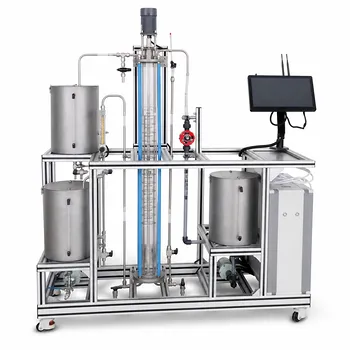
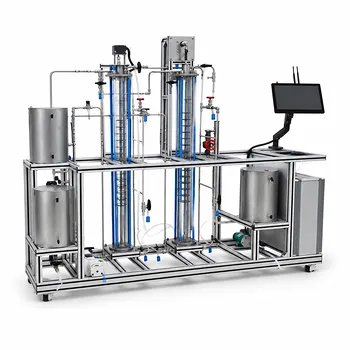
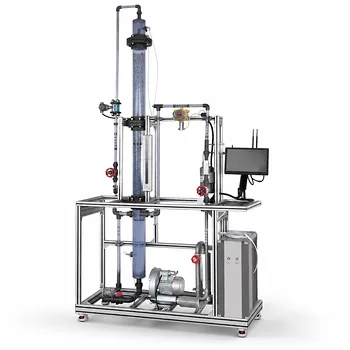
Are you looking to bridge the gap between classroom theory and industrial reality? LABPARK designs and supplies state-of-the-art Educational and Vocational Unit Operations Pilot Plants in chemical engineering, bioprocess & biotech, and environmental & water treatment for universities, research institutes, and enterprises.
Our pilot-scale systems allow students and researchers to:
- Master key parameters: Experiment with breakthrough curves, regenerant flow rates, and concentration adjustments.
- Experience real-world scale-up: Work with industry-grade resins, columns, and analytical instruments.
- Ensure safety and reliability: Utilize durable, education-optimized equipment designed for long-term academic use.
Ready to upgrade your laboratory training systems? Contact LABPARK today to discuss your specific curriculum or research needs!
Related Products
- Ion Exchange Water Purification Educational Pilot Plant for Engineering Unit Operations
- Educational Rotary Disc Liquid-Liquid Extraction Pilot Plant
- Absorption and Desorption Educational Unit Operations Pilot Plant
- Comprehensive Liquid-Liquid Extraction Pilot Plant for Engineering Education
- Packed Bed Absorption Educational Unit Operations Pilot Plant
People Also Ask
- How to Prevent Ion Exchange Channeling? Expert Solutions for Pilot Plants
- How does ion exchange work in water treatment pilot plants? Cost & process guide.
- What operational precautions should lab operators take for resin volume changes and air pockets? Key Guide
- How to use ion exchange pilot plants to verify alkalinity? A hands-on guide for engineering students.
- Why does iron degrade cation resin & how to demonstrate capacity recovery? Step-by-Step Lab Guide