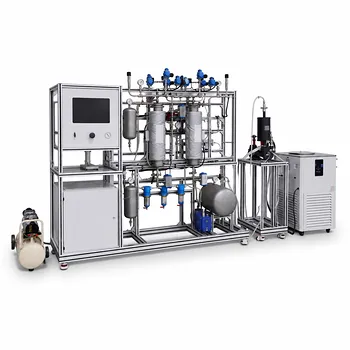
Pilot-scale ion exchange is a game where the resin bed itself is a dynamic, living participant. The two most disruptive operational variables are resin volume changes and air ingress. When you treat a strong-acid cation resin with acid, it shrinks; the subsequent water rinse causes dramatic swelling, which packs the bed and chokes flow. At the same time, if the liquid level ever falls below the top of the resin, air pockets and channeling appear instantly, scrambling your mass transfer and wrecking separation quality. You combat both with a single pro-active habit: religiously maintain a supernatant water layer and don’t hesitate to backwash.
Your ion exchange column is not a static pipe—it’s a breathing bed. Volume swings are chemically inevitable, and air is its greatest enemy. The core of operational safety is to keep the resin fully submerged at all times and to use upward water flow as a reset button whenever the bed packs or channels.
Why Resin Volume Changes Derail Your Pilot Run
Volume changes aren’t a nuisance—they’re an inherent property of the functional groups inside the beads. Ignoring them leads to pressure spikes, fractured beads, and non-representative breakthrough curves.
The Acid-Shrink, Water-Swell Cycle
Strong-acid cation resins contract in their acid form. When you regenerate with acid, the polymer matrix loses hydration and the beads physically shrink. As soon as you rinse with water, the ionic groups rehydrate and the resin swells significantly, sometimes by 10–15% of the bed volume. In a pilot column, this swelling translates directly into a tighter packing arrangement.
How a Packed Bed Strangles Flow
A tightly packed bed offers high resistance to liquid flow. What was an easy 3–4 mL/min during the acid cycle can become a trickle after the water rinse. Operators often misinterpret this as a blocked frit, but the real culprit is simply swollen beads that have eliminated the interstitial spaces. If you don’t act, you’ll start seeing erratic pressure drops and compromised residence time.
The Silent Killer—Air Pockets and Channeling
Air is an invisible workflow assassin. It doesn’t just reduce efficiency; it creates preferential flow paths that deceive your sampling and ruin mass balance calculations.
Never Let the Waterline Cross the Resin
The liquid level must never drop below the top of the resin bed. Even a momentary drain—caused by a siphon, a leaky valve, or a hasty sample draw—sucks air into the bed. As a practical rule, keep a 2 to 3 millimeter supernatant layer above the resin. This thin water cap acts as an air barrier and also signals at a glance that you’re still safe.
Channeling Destroys Separation Quality
Once air pockets form, liquid bypasses large portions of the bed. Channeling creates the illusion of a fast separation—because the fluid finds the path of least resistance—but your actual ion exchange capacity collapses. You’ll see skewed peak shapes, early breakthrough, and poor reproducibility between runs. If you observe the liquid level dropping, assume channeling has already started.
Backwashing: The Universal Reset
Backwashing is the single most powerful corrective action you have. It simultaneously loosens a swollen, packed bed and expels trapped air bubbles.
How to Fluff and Realign
Pass water upward through the column. The gentle upward flow lifts the resin beads, releasing compaction and allowing the particles to re-settle in a uniform, random packing. This fluffing action restores interstitial volume and wipes out pre-existing channels. After backwashing, allow the bed to settle freely with a few gentle taps to the column wall, then recirculate a small amount of feed to stabilize the flow.
When to Backwash, Not Just When It’s Clogged
Don’t wait for a complete flow stoppage. Backwash proactively: after every acid-water swell cycle, immediately after any liquid-level incident, and whenever you observe a rise in backpressure of 20% or more. A quick, 2–3 minute backwash is far cheaper than an entire aborted pilot run.
Understanding the Trade-offs and Common Pitfalls
Every intervention has a cost. Objectivity demands you know where backwashing and liquid-level management can backfire.
Over-Backwashing and Resin Loss
Excessive backwash flow rate or duration can fluidize the bed too aggressively and eject fines through the top of the column. You’ll slowly lose resin mass, altering your bed height and calibrated separation. Start with a low upward velocity—just enough to see the beads gently separate—and never let the bed expand more than 50% of its settled height.
The Trap of Inadequate Packing Before a Run
A bed that isn’t packed correctly from the start is a magnet for air pockets. Wet-load the resin as a slurry and gently tap the column wall during settling to dislodge interstitial bubbles. If you skip this step, even a perfect liquid-level protocol later will struggle to prevent persistent channeling, because microscopic air pockets will coalesce over time.
Sacrificing Residence Time for a “Fast” Rate
Operators sometimes crank up the flow to speed up screening, but ion exchange demands adequate contact time. In educational and pilot settings, a target of 3 to 4 drops per second (roughly 1–2 mL/min for a typical 1 cm ID column) ensures the liquid spends enough time with the resin to reach equilibrium. Chasing throughput at the expense of residence time only amplifies the impact of any existing channeling.
How to Build an Airtight Operational Protocol
These precautions synthesize into a few daily habits that ensure stable, interpretable pilot-plant data.
- If your primary focus is reliable throughput and avoiding downtime: Automate a liquid-level sensor or institute a strict visual check every 15 minutes to keep the supernatant water layer at 2–3 mm above the resin. Program a short, gentle backwash immediately after every regeneration rinse so the bed never transitions into a packed state.
- If your primary focus is high chromatographic resolution and reproducible breakthrough curves: Wet-pack the column with a slurry, tap out bubbles, and measure an initial pressure drop. Define a normal operating pressure range, and trigger a backwash the moment you cross the upper boundary. Never let the liquid level dip, and hold the flow rate steady at the 3–4 drops per second window.
Treat your resin bed as a sensitive hydraulic and chemical environment, and you’ll transform your pilot column from a source of frustration into a predictable, data-driven workhorse.
Summary Table:
| Operational Issue | Primary Cause | Key Precaution / Action |
|---|---|---|
| Resin Swelling & Compaction | Acid-to-water transition | Backwash proactively after regeneration; tap column walls to settle |
| Air Pockets & Channeling | Liquid level falling below resin | Maintain a 2–3 mm supernatant water layer above the bed |
| Resin Loss during Backwash | Excessive fluidization flow | Limit bed expansion to maximum 50% of settled height |
Need a robust, error-free setup for your laboratory? LABPARK provides premium Educational and Vocational Unit Operations Pilot Plants in chemical engineering, bioprocess & biotech, and environmental & water treatment. Designed specifically for universities, research institutes, and enterprises, our systems ensure precise control, safety, and reproducible data. Contact LABPARK today to find the perfect pilot plant solution for your research and training needs!
Related Products
- Ion Exchange Water Purification Educational Pilot Plant for Engineering Unit Operations
- Comprehensive Liquid-Liquid Extraction Pilot Plant for Engineering Education
- Dual Mode Heat Transfer Pilot Plant for Unit Operations Training
- Electrochemical Water Treatment Educational Unit Operations Pilot Plant
- Constant Pressure Filtration Educational Unit Operations Pilot Plant
People Also Ask
- How to Prevent Ion Exchange Channeling? Expert Solutions for Pilot Plants
- How does ion exchange work in water treatment pilot plants? Cost & process guide.
- How to use ion exchange pilot plants to verify alkalinity? A hands-on guide for engineering students.
- Why does iron degrade cation resin & how to demonstrate capacity recovery? Step-by-Step Lab Guide
- How to perform preliminary cost estimations for pilot plant mixers, centrifuges, and compressors?