Reducing ferric iron to ferrous iron dramatically improves ion exchange separation by eliminating the formation of uncharged complexes that evade resin capture. This simple valence shift turns a separation failure into a clean, single-pass success while simultaneously reducing acid consumption and simplifying downstream processing.
The core challenge isn't just about charge—it's about the chemical speciation that oxidation states dictate. When ferric iron (Fe³⁺) forms an uncharged phosphate complex, it becomes invisible to cation exchange resins. Reducing it to ferrous iron (Fe²⁺) prevents this complex, restores ionic charge, and lowers acid requirements, enabling complete separation in one step.
The Critical Role of Oxidation State in Ion Exchange
Ion exchange separations depend on charged species binding to resin functional groups. The metal's oxidation state directly controls its ionic charge and its tendency to form soluble complexes.
Any factor that neutralizes that charge—or locks the metal into a non-ionic species—will cause it to slip straight through the column, defeating the entire purpose of the unit operation.
How Ferric Iron Blocks Separation
In acidic phosphate streams, ferric iron (Fe³⁺) reacts with dihydrogen phosphate ions to form an un-ionized complex, Fe(H₂PO₄)₃. This complex carries no net charge.
Because it is uncharged, it cannot be adsorbed onto a cation exchange resin. It simply passes through the column alongside the target anion, resulting in incomplete separation and product contamination.
The Solution: Reduction to Ferrous Iron
By chemically reducing Fe³⁺ to ferrous iron (Fe²⁺), the un-ionized Fe(H₂PO₄)₃ complex never forms. Ferrous iron remains in an ionic state that is readily captured by the cation resin.
This simple pre-treatment step transforms a separation problem into a straightforward, highly efficient ion exchange process.
Broader Implications for Process Optimization
Beyond the immediate fix, manipulating the oxidation state unlocks multiple downstream benefits that compound into major cost and efficiency gains.
Impact on Acid Consumption and Elution
The lower charge of Fe²⁺ requires less acid to keep the ion in solution. This directly reduces chemical operating costs and waste generation.
Lower charge also simplifies the elution step—regenerating the resin becomes quicker and uses less regenerant, reducing cycle times and chemical volume.
Enabling Single-Pass Efficiency
With Fe³⁺ reduced prior to the column, the separation becomes fully achievable in a single pass. No recycling loops, no secondary polishing steps.
This drives higher throughput, lowers capital footprint, and makes the entire unit operation far simpler to control and scale.
Understanding the Trade-offs
Oxidation state control is powerful, but it's not a free move. You must weigh several practical factors.
- Chemical Cost and Handling: You're adding a reducing agent—sulfite, bisulfite, or others—which adds raw material cost and requires safe storage.
- Re-oxidation Risk: If dissolved oxygen or oxidizers enter the system, Fe²⁺ can revert to Fe³⁺, reactivating the complex and causing breakthrough.
- Process Complexity: The reduction step adds a new unit operation or at least a reagent dosing system, which must be carefully monitored and controlled.
These trade-offs are usually acceptable because the alternative is a failed separation, but they demand rigorous process engineering.
Making the Right Choice for Your Separation Goal
Your decision to adjust metal oxidation state depends on what matters most in your separation.
- If your primary focus is product purity: Reducing Fe³⁺ is non-negotiable—it eliminates the uncharged complex that would otherwise contaminate your output.
- If your primary focus is operating cost reduction: The lower acid and regenerant consumption from handling Fe²⁺ can yield significant savings over a campaign lifetime.
- If your primary focus is throughput and simplicity: Enabling single-pass separation reduces column size and eliminates complex recycle streams, making scale-up faster.
Oxidation state isn't just a chemical detail—it's a strategic lever that turns a failing ion exchange process into a reliable, efficient separation.
Summary Table:
| Parameter | Ferric Iron (Fe³⁺) | Ferrous Iron (Fe²⁺) |
|---|---|---|
| Dominant Species | Uncharged complex Fe(H₂PO₄)₃ | Free ionic state Fe²⁺ |
| Resin Affinity | None (evades capture) | High (captured by cation resin) |
| Acid & Eluent Need | High (to maintain solubility) | Lower (easier regeneration) |
| Process Efficiency | Poor; requires multi-pass loops | High; achieves single-pass separation |
Optimize Your Unit Operations with LABPARK
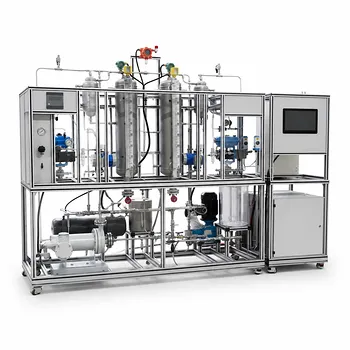
Are you looking to teach or research advanced separation techniques like ion exchange? LABPARK provides state-of-the-art Educational and Vocational Unit Operations Pilot Plants in chemical engineering, bioprocess & biotech, and environmental & water treatment.
Designed specifically for universities, research institutes, and enterprises, our pilot systems help students and researchers master critical process variables—such as oxidation state control, flow rates, and resin regeneration—in a safe, scalable environment.
Contact LABPARK today to discuss how our pilot plants can elevate your engineering curriculum or research program!
Related Products
- Ion Exchange Water Purification Educational Pilot Plant for Engineering Unit Operations
- Comprehensive Multi-Modal Heat Transfer Unit Operations Pilot Plant for Engineering Training
- Dual Mode Heat Transfer Pilot Plant for Unit Operations Training
- Multi-Reactor Educational Pilot Plant for Reaction Engineering Unit Operations
- Two-Dimensional Fluidization Hydrodynamics Educational Pilot Plant for Unit Operations Training
People Also Ask
- How to Prevent Ion Exchange Channeling? Expert Solutions for Pilot Plants
- What operational precautions should lab operators take for resin volume changes and air pockets? Key Guide
- How does ion exchange work in water treatment pilot plants? Cost & process guide.
- How to use ion exchange pilot plants to verify alkalinity? A hands-on guide for engineering students.
- Why does iron degrade cation resin & how to demonstrate capacity recovery? Step-by-Step Lab Guide