High-concentration gas absorption isn't just a faster process—it’s a fundamentally different one. The drift factor is critical in pilot plant analysis because it corrects for the significant bulk flow (drift) of the gas mixture toward the liquid interface, which arises when a large fraction of the solute is removed from a shrinking total gas stream. Neglecting this factor leads to underestimating the required packing height, a mistake that can derail scale-up from pilot data to industrial columns.
In a dilute system, the total gas flow is nearly constant and you can ignore bulk flow. But in high-concentration absorption, the solute's departure shrinks the total gas molar flow rate so much that the resulting convective drift enhances mass transfer. The drift factor—calculated via the logarithmic mean of the inert gas fraction ((1-y)_m)—quantifies this enhancement. Pilot plants with intermediate sampling ports are ideal for collecting the concentration profiles needed to validate drift‑corrected height equations and avoid costly design errors.
The Physics of High-Concentration Absorption
Why the Size of the Gas Stream Changes
In a typical gas absorption column, the solute moves from the gas phase into the liquid.
When the solute makes up a large portion of the incoming gas, removing a substantial amount of it causes the total molar flow rate ((V')) to drop significantly from bottom to top.
This is not a minor correction; it reshapes the entire concentration profile.
Bulk Flow Emerges as a Driving Force
The loss of solute mass creates a net convective current directed toward the interface.
This “drift” sweeps additional solute molecules along with it, adding a convective transport term on top of pure molecular diffusion.
The result is a mass transfer rate that is higher than what Fickian diffusion alone would predict.
How the Drift Factor Corrects the Design Equation
What the Drift Factor Actually Is
The drift factor is commonly expressed as the ratio (p / p_{Bm})—that is, the total pressure divided by the logarithmic mean partial pressure of the stagnant (inert) gas.
In terms of mole fractions, it appears as the logarithmic mean of the inert gas fraction, ((1-y)_m), placed in the denominator of the integration term for the number of transfer units.
This factor explicitly accounts for convective enhancement caused by the shrinking gas bulk.
From Dilute to Concentrated: When 1 Is Not Enough
When the solute concentration in the gas is very low, the inert partial pressure (p_{Bm}) is nearly equal to the total pressure (p).
The drift factor then approaches 1, making the bulk flow effect negligible—perfectly fine for teaching dilute systems.
In high-concentration service, however, (p_{Bm}) deviates from (p) enough that the factor grows well above 1, and ignoring it will systematically undercount the required column height.
Leveraging Pilot Plants to Validate the Drift Factor
Intermediary Sampling: The Key to Real Data
A high-quality pilot plant equipped with intermediate sampling ports along the column lets researchers pull gas samples at different heights.
These measurements produce an axial concentration profile that reveals the real rate of gas flow contraction.
Without such data, you cannot verify whether your drift‑corrected model matches reality.
Closing the Loop on Height Calculations
The packing height equation for high-concentration absorption integrates the molar flow rate and driving force, incorporating ((1-y)_m).
By comparing calculated height with actual packed height in a pilot run that achieves a target separation, you can validate the drift‑corrected method and quantify the error of assuming constant flow.
This empirical validation is the bridge between theoretical mass transfer and confident industrial design.
Understanding the Trade-offs
When the Drift Factor Matters Most
The criticality of the drift factor scales directly with the solute loading in the feed gas.
In applications like concentrated CO₂ removal or ammonia scrubbing, the drift factor can alter the predicted packing height by 20–40%.
If you ignore it, you will build a column that is too short and miss your outlet purity target.
The Commitment to Experimental Rigor
Including the drift factor requires accurate measurements of gas composition along the column, which adds experimental complexity.
You must also handle the fact that mass transfer coefficients may appear concentration‑dependent under these conditions, forcing you to separate the drift effect from other resistances.
However, the alternative—relying on dilute‑system equations—produces scale‑up errors that are far more expensive than the extra pilot effort.
Making the Right Choice for Your Pilot Plant Study
After understanding the physics, your protocol should be guided by the specific goal of the experiment.
- If your primary focus is designing a column for a concentrated feed: Always use the drift‑corrected height equation. Collect axial gas samples to confirm the effective ((1-y)_m) and never default to a constant flow assumption.
- If your primary focus is teaching fundamental principles: Begin with a dilute system so students can see the classic log‑mean driving force first, then introduce a high‑concentration run to isolate the drift factor’s effect and cement the concept.
- If your primary focus is comparing physical vs. chemical absorption under high loading: Note that the drift factor still applies to the physical mass transfer step. Run the physical absorption with and without the drift correction to demonstrate how bulk flow alters the apparent rate before you introduce the enhancement factor for chemical reaction.
- If your primary focus is validating a process simulation software: Use your pilot data to test whether the simulator’s mass transfer model correctly implements the drift factor. A mismatch between simulated and observed profiles often traces back to an incorrect or absent drift treatment.
By treating the drift factor as a non‑negotiable element in high‑concentration absorption experiments, you turn your pilot plant from a simple demonstration tool into a trusted source of scale‑up‑grade data.
Summary Table:
| Feature | Dilute Systems | High-Concentration Systems |
|---|---|---|
| Gas Molar Flow | Constant | Shrinks toward column top |
| Bulk Flow (Drift) | Negligible | High (adds convective transport) |
| Drift Factor ($p/p_{Bm}$) | Approx. 1 | Greater than 1 (must be calculated) |
| Scale-up Impact | None | Crucial (prevents column underdesign) |
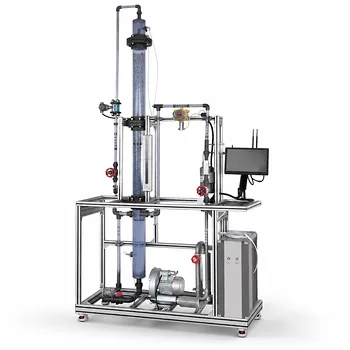
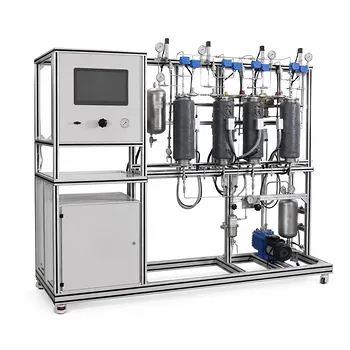
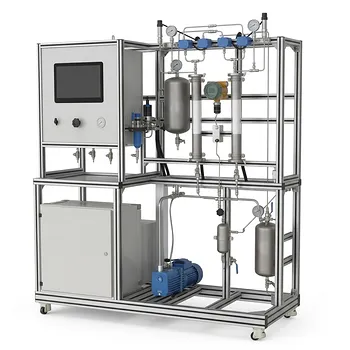
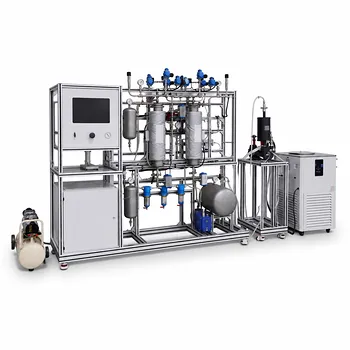
Need reliable mass transfer data for your academic or industrial research? LABPARK provides state-of-the-art Educational and Vocational Unit Operations Pilot Plants in chemical engineering, bioprocess & biotech, and environmental & water treatment for universities, research institutes, and enterprises. Ensure design accuracy, validate drift-corrected models, and prepare your students or engineers for real-world chemical processing. Contact our experts today to find the ideal pilot plant solution for your facility!
Related Products
- Carbon Dioxide Adsorption and Capture Educational Unit Operations Pilot Plant
- Carbon Dioxide Absorption and Desorption Educational Pilot Plant for Carbon Capture Studies
- Dual-Mode Gas Absorption and Desorption Unit Operations Training Pilot Plant
- Multi-Component Gas Pressure Swing Adsorption Pilot Plant for Unit Operations Education
- Absorption and Desorption Educational Unit Operations Pilot Plant
People Also Ask
- How does operating pressure influence the transition between absorption and desorption in a CO2 pilot plant?
- How do physical vs chemical adsorption impact pilot plant design? Key operational & regeneration strategies.
- How is moisture removal managed in an adsorption unit operations pilot plant? Dew Point Control Guide
- What are the key differences between PSA and TSA? Choosing the Right Adsorption Pilot Plant
- What unit operations are critical for CCUS training pilot plants? Build hands-on engineering expertise.