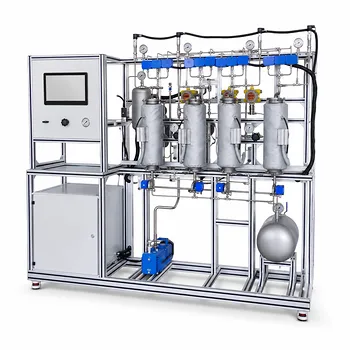
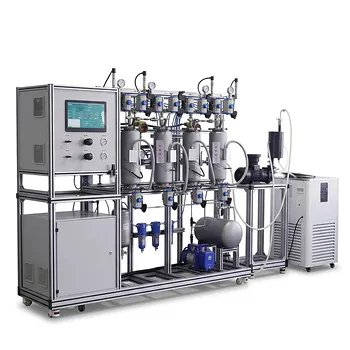
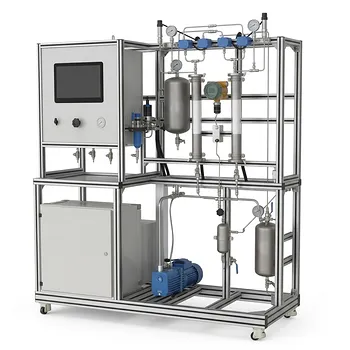
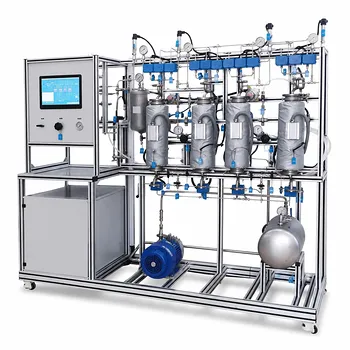
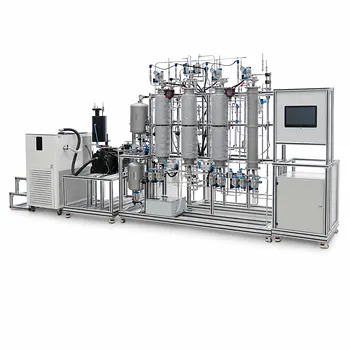
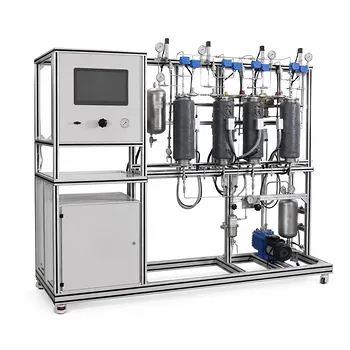
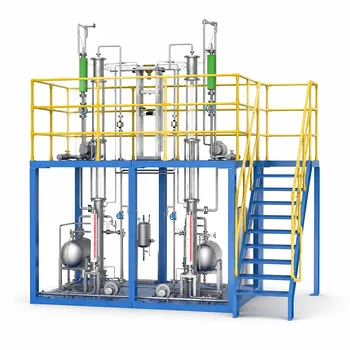
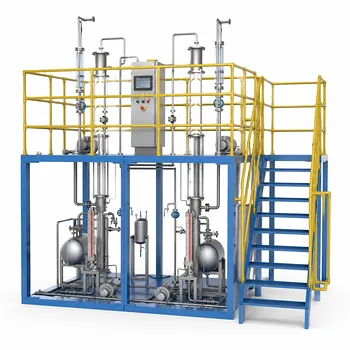
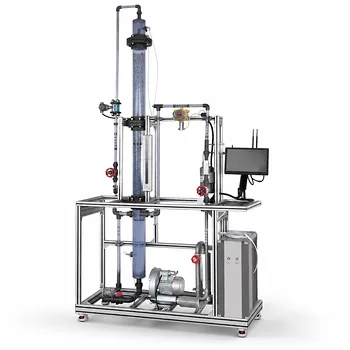
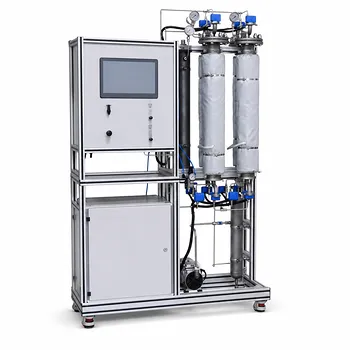
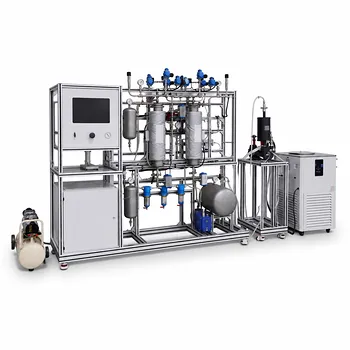
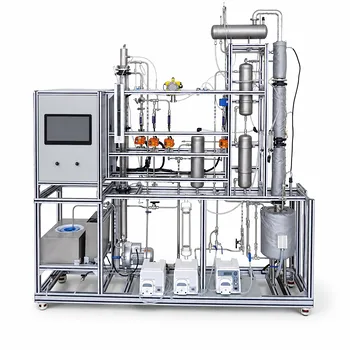
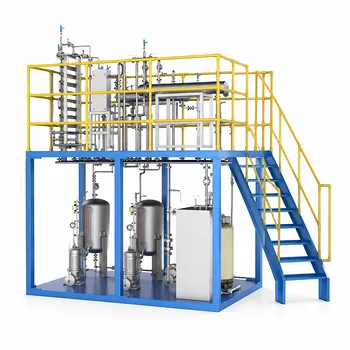
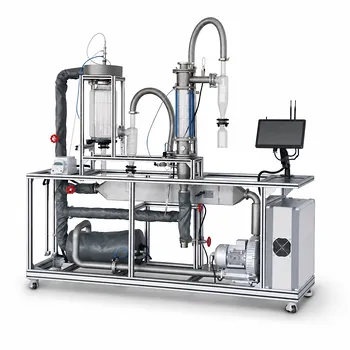
Moisture removal in an adsorption pilot plant is managed using a dual-bed design packed with 3A molecular sieve adsorbent, operating in alternating cycles of adsorption and thermal regeneration. This configuration allows a continuous dehydration process: one bed dries the incoming gas while the other undergoes high-temperature regeneration to drive off the captured water. The goal is to push moisture content below 1 µL/L (approximately 1 ppmv), which—critically—translates to a water dew point below -70°C. Without that level of dryness, water reacts with light hydrocarbons at low temperatures to form solid gas hydrates that can rapidly plug downstream equipment.
The core insight: In low-temperature separation processes, control of the water dew point is not just a quality specification—it is a fundamental safety and operability requirement. Failure to achieve an ultra‑low dew point leads to hydrate blockages, freezing, and catastrophic process shutdowns. The pilot plant validates both the dehydration performance and the regeneration strategy needed to sustain that performance at scale.
How the Adsorption Pilot Plant Removes Moisture
The Dual‑Bed Adsorption Principle
A standard unit operations pilot plant for gas dehydration uses two packed beds filled with 3A molecular sieve. These synthetic zeolites have precisely defined pore openings of 3 angstroms, which allow small water molecules (kinetic diameter ~2.65 Å) to enter while excluding methane, ethane, and larger molecules.
During the adsorption cycle, wet gas flows downward through the on‑line bed. Water molecules are physically trapped inside the zeolite’s micropores, and dry gas exits at the top. The bed continues in service until the moisture front approaches breakthrough.
Once the active bed reaches a preset breakthrough criterion, the process switches. The second bed takes over adsorption while the first enters thermal regeneration. Regeneration involves heating the bed (typically to 200–300°C) with a hot purge gas—often a slipstream of the dry product gas—to desorb the accumulated water. After cooling, the bed is ready for the next adsorption phase.
Why 3A Molecular Sieve Instead of Silica Gel or Alumina
Unlike silica gel or activated alumina, 3A molecular sieves maintain high water capacity even at very low partial pressures. They can achieve effluent moisture concentrations of less than 1 ppmv consistently. Other desiccants are more sensitive to temperature and co‑adsorption of hydrocarbons; they often cannot reach the dew points required for cryogenic processing.
In pilot‑plant training, students can directly compare drying curves and breakthrough times. The sieve’s steep mass‑transfer zone gives a sharp breakthrough, making it an ideal teaching tool for adsorption dynamics.
Why Controlling the Water Dew Point Is Non‑Negotiable
The Hydrate‑Formation Threat
Natural gas and light hydrocarbon streams almost always contain water vapor. When that gas is cooled to low temperatures—typical of cryogenic distillation columns, turbo‑expander plants, or liquefied natural gas (LNG) processes—water can combine with methane, ethane, or propane to form solid clathrate hydrates (e.g., CH₄·6H₂O). These ice‑like crystals grow rapidly and can:
- Completely block the narrow passages of brazed aluminum heat exchangers.
- Plug column trays, packing, and transfer lines.
- Erode compressor blades if freed suddenly.
A single hydrate plug in a cryogenic exchanger can force a plant shutdown, require costly defrosting, and potentially damage equipment beyond repair.
The Dew Point Defines the Safe Operating Window
The water dew point is the temperature at which water vapor begins to condense at a given pressure. If the process gas ever cools below its dew point, free water appears. Even if the gas temperature stays above the hydrate‑formation equilibrium curve, liquid water can still cause ice formation, corrosion, and two‑phase flow problems.
In a pilot plant that feeds a low‑temperature separation column (e.g., a demethanizer or a cryogenic distillation unit), the gas must be dried so that its water dew point is significantly lower than the coldest expected temperature in the process. Practically, that means aiming for a water dew point below -70°C, which corresponds to about 0.5–1 ppmv moisture.
Translating Moisture Content into Dew Point
In a unit operations lab, students often calculate the dew point using the saturation vapor pressure relationship. At a known system pressure ( p ), the water vapor partial pressure at the dew point ( t_d ) is:
[ p_{v,td} = \frac{H \cdot p}{0.622 + H} ]
where ( H ) is the absolute humidity (kg water/kg dry gas). Once ( p_{v,td} ) is found, the dew point temperature can be read from steam tables. This direct link between a measurable water content and a critical process temperature reinforces why even parts‑per‑million levels of moisture are dangerous: a mere 10 ppmv shift in moisture can move the dew point by tens of degrees.
Understanding the Trade‑offs
Energy Cost of Deep Dehydration
Achieving a -70°C dew point requires substantial thermal energy for regeneration. The hotter the regeneration and the lower the moisture content of the purge gas, the lower the final dew point. But this increases fuel or electricity consumption. Pilot plants help quantify this trade‑off by measuring regeneration gas demand and bed temperature profiles.
Adsorbent Aging and Breakthrough Risk
Over repeated cycles, molecular sieves lose capacity due to hydrothermal aging, fouling, or mechanical attrition. If the regeneration temperature is too low, residual water accumulates, and breakthrough happens earlier. Pilot‑plant studies reveal how declining adsorbent performance narrows the safe operating window and when sieve replacement becomes economically justified.
Dew‑Point Measurement Lag
In practice, online dew‑point analyzers can have a time lag. A sudden increase in inlet moisture (e.g., tower upset upstream) might not be caught immediately, allowing a hydrate‑forming excursion before the dryer can respond. Pilot‑plant experimentation teaches operators to set alarm thresholds and to cross‑check with manual moisture sampling, reducing the risk of undetected wet gas.
Making the Right Choice for Your Pilot‑Plant Goal
The specific approach to moisture management depends on what you are trying to learn or demonstrate. Use these guidelines to tailor your unit operations pilot plant.
- If your primary focus is cryogenic distillation or LNG processes: Set a strict target of <1 ppmv moisture and a water dew point below -70°C. Validate the dehydration unit’s capacity under worst‑case inlet moisture and temperature conditions to guarantee hydrate‑free operation downstream.
- If your primary focus is demonstrating adsorption fundamentals: Choose a standard 3A molecular sieve dual‑bed system. Document full breakthrough curves, mass‑transfer zones, and regeneration efficiency. Correlate moisture outlet with dew‑point calculations to teach the thermodynamic basis of gas dehydration.
- If your primary focus is protecting downstream catalysts or membranes: Recognize that even ppm levels of moisture can degrade some sorbents or poison catalysts. Design the pilot plant to test different guard‑bed configurations and evaluate the interplay between moisture, temperature, and adsorbent utilization.
- If your primary focus is energy optimization: Experiment with regeneration gas rates, heating cycles, and pressure‑swing options. Measure the energy per kilogram of removed water and identify the point of diminishing returns for deeper dew points.
Controlling the water dew point is the bridge between a well‑designed adsorption unit and a successful low‑temperature separation. Mastering that control in a pilot plant ensures that when the process scales up, hydration never becomes a bottleneck.
Summary Table:
| Parameter | Specification / Method | Critical Process Role |
|---|---|---|
| Adsorbent Type | 3A Molecular Sieve (3Å pore size) | Selective water adsorption; excludes hydrocarbons. |
| Target Moisture | < 1 ppmv (parts per million by volume) | Achieves the required ultra-low dew point. |
| Water Dew Point | Below -70°C | Prevents cryogenic freezing and hydrate formation. |
| Regeneration | Thermal Swing (200–300°C purge) | Restores adsorbent capacity for continuous operation. |
Optimize Your Engineering Lab with LABPARK Pilot Plants
Are you looking to bridge the gap between classroom theory and industrial reality? LABPARK provides high-quality Educational and Vocational Unit Operations Pilot Plants in chemical engineering, bioprocess & biotech, and environmental & water treatment.
Designed specifically for universities, research institutes, and enterprises, our advanced adsorption and separation pilot plants enable hands-on mastery of critical thermodynamic principles and process controls.
Ready to elevate your training and research capabilities? Contact LABPARK today to discuss your custom laboratory requirements!
Related Products
- Carbon Dioxide Adsorption and Capture Educational Unit Operations Pilot Plant
- Multi-Component Gas Pressure Swing Adsorption Pilot Plant for Unit Operations Education
- Pressure Swing Adsorption Educational Unit Operations Pilot Plant
- Carbon Dioxide Capture and Utilization Educational Pilot Plant for Unit Operations
- Educational Pressure Swing Adsorption Ethylene Capture Unit Operations Pilot Plant
People Also Ask
- How does operating pressure influence the transition between absorption and desorption in a CO2 pilot plant?
- How do physical vs chemical adsorption impact pilot plant design? Key operational & regeneration strategies.
- What are the key differences between PSA and TSA? Choosing the Right Adsorption Pilot Plant
- What unit operations are critical for CCUS training pilot plants? Build hands-on engineering expertise.
- How to demonstrate physical vs chemical absorption using a pilot plant? A practical lab guide.