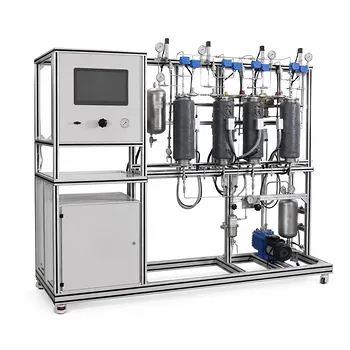
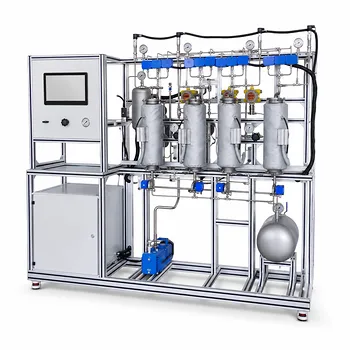
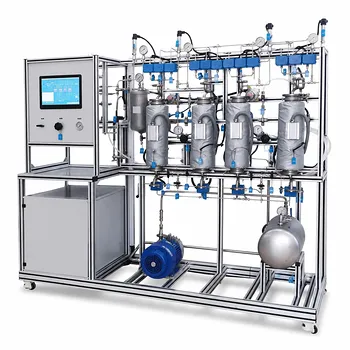
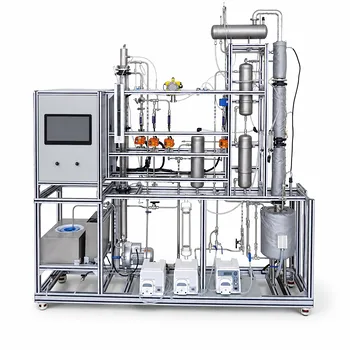
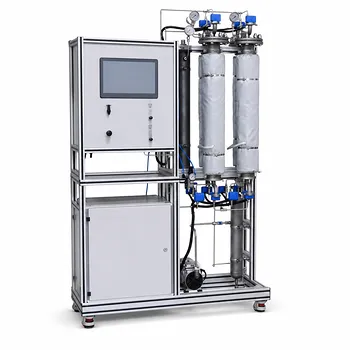
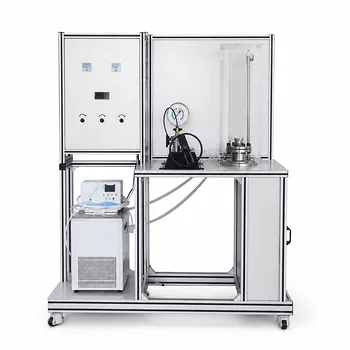
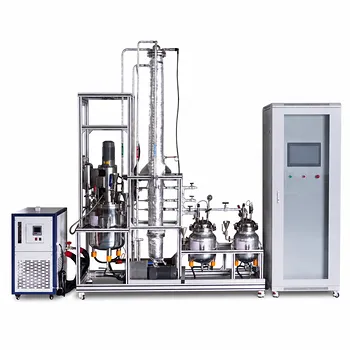
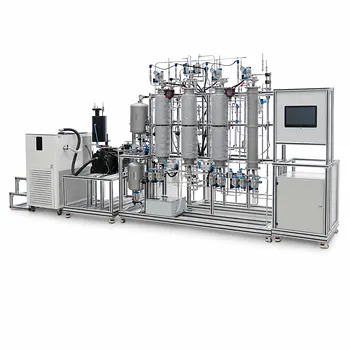
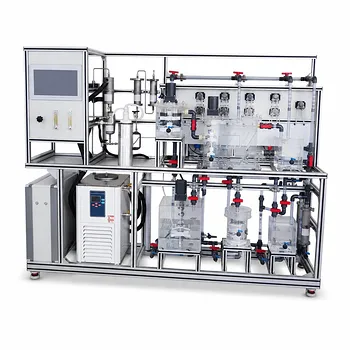
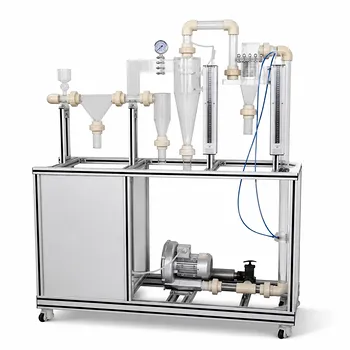
Gas absorption, solvent regeneration, and catalytic conversion are the three critical unit operations that form the backbone of an effective environmental and chemical pilot plant for carbon dioxide capture, utilization, and storage (CCUS) training. The absorption stage uses a packed column where a liquid solvent—typically an amine solution—removes CO₂ from a simulated flue gas stream. This is immediately followed by a desorber (stripping) column that uses thermal energy to release pure CO₂ and regenerate the solvent, while a downstream catalytic reactor demonstrates the conversion of captured CO₂ into value-added products like methanol.
Educational CCUS pilot plants must do more than simply demonstrate a process; they must be designed to reveal the fundamental engineering trade‑offs—mass transfer limitations, energy consumption, solvent stability, and material compatibility—that dictate the viability of industrial-scale carbon management.
The Core Trio: Unit Operations You Cannot Omit
Gas Absorption in a Packed Column
This is where the CO₂ separation magic begins. A packed column filled with structured or random packing maximizes the gas–liquid contact area, allowing the solvent to selectively absorb CO₂ from a simulated flue gas mixture.
For training purposes, the column should allow visual observation of hydrodynamic regimes (loading, flooding, weeping) so students can intuitively grasp mass transfer concepts. Operating with adjustable gas flow rates and liquid-to‑gas ratios lets users directly calculate overall mass transfer coefficients and study how solvent viscosity or channeling affects capture efficiency.
Thermal Solvent Regeneration (Desorber)
Capturing CO₂ is only half the story; the energy‑intensive regeneration step makes CCS economical or not. The desorber unit applies heat to strip the CO₂ from the rich solvent, recovering a high‑purity CO₂ stream and a lean solvent that is recycled back to the absorber.
In a training pilot plant, this unit is essential for exploring heat integration strategies, measuring regeneration energy (MJ/kg CO₂ captured), and evaluating solvent degradability over repeated absorption–desorption cycles. Students can investigate operating parameters such as reboiler temperature and pressure to visualize how they impact stripping efficiency and solvent stability.
Catalytic Conversion for CO₂ Utilization
Beyond storage, converting captured CO₂ into a product teaches the “U” in CCUS. A fixed‑bed catalytic reactor downstream of the desorber can demonstrate methanol synthesis or other reactions using the captured CO₂ and a hydrogen source.
This unit operation broadens the learning scope to heterogeneous catalysis, reaction kinetics, and reactor yield optimization. By varying temperature, pressure, and space velocity, trainees can connect capture purity to catalyst performance and understand the material integration challenges that define real‑world power‑to‑X processes.
Extending the Pilot Plant for Full‑Chain CCUS Training
Ancillary Storage and Compression Modules
While the absorption–desorption–reaction trio addresses the capture and utilization pillars, a truly comprehensive training platform may incorporate a CO₂ compression and simulated storage injection skid.
Even a simple high‑pressure vessel with pressure‑volume‑temperature (PVT) monitoring allows students to study the phase behavior and energy penalty of compressing CO₂ for pipeline transport or geological storage. This closes the gap between laboratory‑scale capture and field‑scale sequestration, making the pilot plant a miniature representation of the entire value chain.
Gas Pre‑treatment and Safety Systems
Real flue gas is rarely clean. Including particulate filters, mist eliminators, or a small adsorption scrubber upstream of the absorber teaches the importance of contaminant removal to protect solvents and catalysts.
From a safety standpoint, any unit handling pressurized gases and corrosive amines must incorporate certified pressure relief valves, burst discs, and corrosion‑resistant materials such as 316 stainless steel. Piping should comply with ASME B31.3, with all pressure vessels clearly tagged and protected by interlocks—this not only safeguards students but also ingrains the discipline of industrial safety culture.
Designing for Educational Impact
Balancing Process Fidelity with Observability
Transparent column sections (borosilicate glass) are invaluable for teaching two‑phase flow phenomena, but they limit pressure and temperature ranges. A well‑designed pilot plant compromises by putting the observation window on a low‑pressure line or using small‑diameter glass columns for the absorber while keeping the high‑temperature desorber in metal.
Real‑time data acquisition of temperatures, pressures, flow rates, and CO₂ concentration (via online infrared analyzers) must be integrated into a centralized control interface. This allows students to perform mass and energy balances instantly, testing hypotheses rather than waiting for manual sample analysis.
Operational Flexibility for a Modern Curriculum
The pilot plant’s value multiplies when it can run multiple solvent types—from traditional MEA to advanced formulations and ionic liquids. Quick-connect fittings and corrosion‑resistant wetted parts enable rapid solvent changeover, letting research groups benchmark novel materials under identical hydrodynamic conditions.
Adding capability for continuous automated control (PLC‑based) and the option to switch between manual and automatic operation helps students understand both fundamental process dynamics and modern distributed control system logic.
Understanding the Trade‑offs
Solvent Selection: Proven vs. Green Performance
Conventional amine scrubbing is well‑characterized and yields high capture rates, but it comes with corrosion, oxidative degradation, and a large regeneration energy demand. Eco‑friendly alternatives like ionic liquids or biphasic solvents can lower energy consumption and toxicity, but they are often more expensive and less documented.
In a training pilot plant, the cost and complexity of handling exotic solvents must be weighed against the research relevance they offer. Often, a modular design that starts with a robust amine system and allows future solvent swaps is the most prudent educational investment.
Energy Integration: Research vs. Simplification
Optimizing the heat integration between the hot lean solvent from the desorber and the cold rich solvent to the stripper introduces a layer of complexity. While this is crucial for an industrial‑fidelity plant, excessive heat recovery loops can overwhelm students if the goal is mastering fundamentals. A staged approach—first operating with simple heaters and coolers, then enabling a cross‑exchanger—builds understanding stepwise without sacrificing safety.
Catalyst Sensitivity in the Utilization Module
Methanol synthesis catalysts are highly sensitive to sulfur compounds, trace oxygen, and moisture. If the capture train does not deliver a sufficiently pure CO₂ stream, the catalyst will deactivate rapidly. A training plant must therefore either include realistic gas clean‑up stages or clearly separate the capture and utilization loops to prevent frustration. The trade‑off is between a perfectly integrated but finicky system and a decoupled but robust learning platform.
Making the Right Choice for Your Educational Goal
Choosing which unit operations to prioritize depends entirely on the learning outcomes you want to emphasize.
- If your primary focus is fundamental capture chemistry and mass transfer: Center the design on a high‑visibility packed‑bed absorber with a simple thermal regeneration loop. Keep the solvent side robust and easy to sample, and delay adding a utilization reactor until later.
- If your primary focus is energy‑efficient solvent screening and process intensification: Invest in a highly instrumented desorber with precise energy measurement and the ability to handle multiple novel solvents. Pair it with a flexible absorption column that can test different packing types.
- If your primary focus is full‑value‑chain CCUS or power‑to‑X integration: Include the catalytic conversion reactor and a compression/storage module from the outset. Ensure the CO₂ quality from the capture stage meets catalyst requirements, and plan the data architecture to trace carbon through every step.
In every case, a CCUS training pilot plant is an investment in experiential understanding—design the unit operations not just to work, but to teach.
Summary Table:
| Unit Operation | Primary Process Function | Key Educational & Training Value |
|---|---|---|
| Gas Absorption (Packed Column) | Absorbs $CO_2$ from flue gas using a solvent | Study mass transfer coefficients, hydrodynamics (flooding/loading), and gas-to-liquid ratios. |
| Solvent Regeneration (Desorber) | Strips $CO_2$ and recycles solvent using thermal energy | Evaluate heat integration, measure energy consumption ($MJ/kg\ CO_2$), and test solvent degradation. |
| Catalytic Conversion (Reactor) | Converts captured $CO_2$ into products (e.g., methanol) | Master heterogeneous catalysis, reactor kinetics, and power-to-X process integration. |
| Compression & Storage (Optional) | Compresses $CO_2$ for simulated geological storage | Explore PVT phase behavior, transport safety, and compression energy penalties. |
Bring Hands-On CCUS Training to Your Institution
Equip your students and researchers with the practical skills needed to tackle global carbon challenges. LABPARK designs and manufactures high-quality Educational and Vocational Unit Operations Pilot Plants in chemical engineering, bioprocess & biotech, and environmental & water treatment.
Our custom-built systems allow universities, research institutes, and enterprises to safely demonstrate complex chemical processes, analyze energy efficiency, and test new materials in real-world scenarios.
Ready to elevate your engineering lab? Contact us today to discuss your custom CCUS training requirements!
Related Products
- Bench Scale Carbon Dioxide Capture Educational Unit Operations Pilot Plant
- Carbon Dioxide Adsorption and Capture Educational Unit Operations Pilot Plant
- Carbon Dioxide Capture and Utilization Educational Pilot Plant for Unit Operations
- Carbon Dioxide Absorption and Desorption Educational Pilot Plant for Carbon Capture Studies
- Low Concentration Carbon Dioxide Capture Pressure Swing Adsorption Educational Pilot Plant
People Also Ask
- What are the differences between post- and pre-combustion carbon capture training pilot plants?
- How can pilot plants show tail gas vs flue gas CO2 capture differences? Key educational insights.
- How do temperature variations affect CO2 transport models in pilot plants? Model vs Reality
- How does operating pressure influence the transition between absorption and desorption in a CO2 pilot plant?
- What chemical reactions occur in NaOH acid gas removal? Master pilot plant principles.