Sodium chloride is the regenerant of choice for cation exchange resins in pilot plants for three compelling reasons: it is exceptionally cost-effective, safe to handle, and its high solubility prevents secondary fouling. The theoretical stoichiometric requirement is just 0.17 pounds of NaCl per 1,000 grains of hardness removed (expressed as calcium carbonate). This deceptively simple number is the chemical floor, but the real lesson of the pilot plant is how far real operations must deviate from it.
The pure stoichiometry of ion exchange demands only 0.17 lb of salt per kilograin of CaCO₃, but ion‑exchange equilibrium forces a massive excess. In practice, the optimum salt efficiency lands around 0.5 lb per kilograin—a three‑fold overshoot that elegantly captures the tension between chemical cost and resin capacity. Understanding why this is necessary transforms a routine lab step into a masterclass in process optimization.
Why Sodium Chloride Is the Regenerant of Choice
A Trifecta of Practical Advantages
Pilot‑plant environments, especially those used for education, impose unique constraints. NaCl satisfies them all without compromise.
Low cost and near‑universal availability make it the only economically viable candidate. Students can run multiple regeneration cycles without breaking a budget, and the supply chain is trivial.
Operator safety is a hard requirement. Unlike acidic regenerants (HCl, H₂SO₄) that pose burn and fume risks, dry salt and brine are benign. This allows trainees to focus on the process chemistry rather than on protective gear.
High solubility prevents operational headaches. The displaced cations—calcium and magnesium—form highly soluble chlorides. A poorly soluble by‑product would foul the resin bed and destroy capacity, turning a teaching tool into a maintenance nightmare.
The Low Molecular Weight Bonus
NaCl’s low formula weight (58.44 g/mol) means that a given mass delivers a large number of sodium ions. Every gram of salt packs more reactive power than a heavier regenerant, reducing the raw weight of chemical that must be stored, handled, and dosed. This directly supports the pilot plant’s goal of demonstrating efficiency principles with minimal ancillary burden.
The Stoichiometric Heart of Regeneration
The Ion‑Exchange Reaction in Numbers
Exhausted cation resin holds calcium and magnesium ions that must be swapped back for sodium. The core displacement, when expressed on an equivalent basis, follows a simple mass‑action equation.
To remove 1,000 grains of hardness (as CaCO₃)—the standard “kilograin” unit of the water treatment industry—the reaction requires approximately 0.17 lb of pure sodium chloride. This figure arises directly from the molecular weights and the divalent charge of the hardness ions.
Why the Number Matters in a Teaching Lab
The 0.17 lb/kilograin benchmark gives students a clean, calculable starting point. It shows that, in theory, very little salt is needed to chemically meet the exchange. The fact that reality demands far more becomes the central investigative challenge.
Why Practical Regeneration Demands a Large Excess
The Inescapable Law of Mass Action
Ion exchange is an equilibrium process. To push the reaction backward—forcing bound calcium and magnesium off the resin—the sodium ion concentration must be overwhelming. Le Chatelier’s principle requires a high‑ratio driving force.
In practice, this means using a brine solution at roughly 10% NaCl. At that concentration, the number of sodium ions per unit volume shatters the equilibrium, driving off multivalent cations that would otherwise cling stubbornly to the resin.
The Salt Efficiency Sweet Spot
There is a well‑mapped relationship between salt dosage and the recovery of exchange capacity.
- Too little salt (near the 0.17 lb/kg stoichiometric line) regenerates only a tiny fraction of the resin. The bed remains largely exhausted.
- Too much salt pushes capacity higher, but the incremental gain per pound of salt collapses. A classic diminishing‑returns curve emerges.
Industry‑wide, the optimum salt efficiency for synthetic cation resins hovers around 0.5 lb of NaCl per kilograin of hardness removed. This represents the point where the cost of the salt is roughly balanced against the value of the recovered capacity. In a pilot plant, students can experimentally reproduce this peak by plotting effluent hardness against salt dose.
Understanding the Trade‑offs
Capacity vs. Operating Cost
No fixed salt dose is universally correct. The choice is a deliberate trade‑off.
Higher salt doses (e.g., 1.0 lb/kg and above) maximize capacity per regeneration cycle. This can be attractive when resin is expensive or downtime for regeneration is limited, but the chemical cost per gallon of treated water climbs steeply.
Operating at the 0.5 lb/kg optimum minimizes the salt expense per kilogram of hardness removed. It leaves some unused resin capacity, but the overall cost of water produced usually reaches its lowest point here. Pilot plants that let students vary the dose and model the total cost curve cement this lesson permanently.
The Danger of Brine Channeling and Waste
Using a large excess of salt without proper flow distribution creates another pitfall. Brine can channel through the resin bed, leaving portions under‑regenerated while consuming extra salt. Good pilot‑plant design teaches that contact time, flow rate, and brine concentration are as important as the raw poundage of salt added.
Making the Right Choice for Your Pilot‑Plant Goal
The answer to “what salt dose should I use?” is never a single number—it depends entirely on what you intend to demonstrate.
- If your primary focus is mastering stoichiometric fundamentals: Start with the theoretical 0.17 lb/kilograin and use it to calculate the minimum salt needed. Then measure actual capacity to illustrate the chasm between theory and reality.
- If your primary focus is cost‑driven process optimization: Use the industry‑standard 0.5 lb/kilograin as your starting point, prepare a 10% brine solution, and run multiple cycles to map out the salt efficiency curve and the economic sweet spot.
- If your primary focus is exploring resin capacity limits: Test a wide range of salt doses (0.3 to 2.0 lb/kilograin) and plot incremental capacity versus salt expended. This vividly shows why chemical engineers cap regeneration far below the resin’s absolute maximum exchange capacity.
Sodium chloride wins in the pilot plant not because it is chemically exotic, but because it turns an abstract ion exchange equation into a tangible, measurable lesson in trade‑offs—and that is exactly what environmental water treatment education demands.
Summary Table:
| Parameter | Theoretical (Stoichiometric) | Practical (Optimal) | Key Operational Benefit |
|---|---|---|---|
| Salt Requirement | 0.17 lb / kilograin of CaCO₃ | ~0.5 lb / kilograin of CaCO₃ | Overcomes equilibrium limits via mass action |
| Brine Concentration | N/A | ~10% NaCl | Maximizes sodium ions to displace bound cations |
| Focus / Outcome | Academic stoichiometry baseline | Cost-to-capacity efficiency balance | Simulates real-world industrial plant economics |
Bring Hands-On Process Optimization to Your Facility
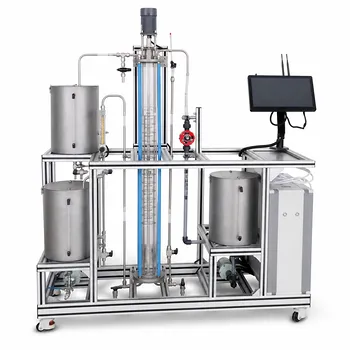
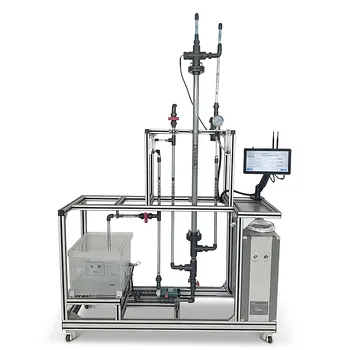
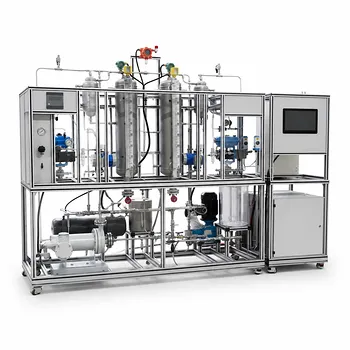
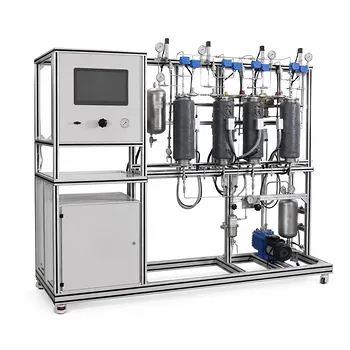
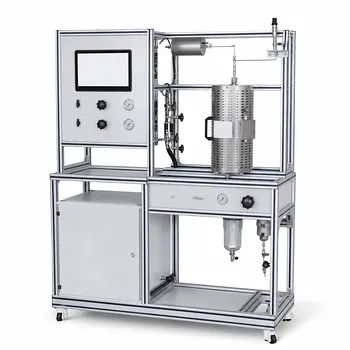
To master ion-exchange chemistry and process engineering, students and researchers need hands-on experience with industry-grade systems. LABPARK design and manufactures premium Educational and Vocational Unit Operations Pilot Plants in chemical engineering, bioprocess & biotech, and environmental & water treatment.
Specially tailored for universities, research institutes, and enterprises, our pilot plants bridge the gap between theoretical stoichiometry and practical process optimization.
Contact LABPARK today to discuss your laboratory training and research requirements!
Related Products
- Ion Exchange Water Purification Educational Pilot Plant for Engineering Unit Operations
- Educational Rotary Disc Liquid-Liquid Extraction Pilot Plant
- Constant Pressure Filtration Educational Unit Operations Pilot Plant
- Multi-Stage Stirred Tanks in Series Residence Time Distribution and Mixing Performance Determination Educational Pilot Plant
- Multi Functional Catalytic Reaction and Reactor Evaluation Educational Unit Operations Pilot Plant
People Also Ask
- How to Prevent Ion Exchange Channeling? Expert Solutions for Pilot Plants
- How does ion exchange work in water treatment pilot plants? Cost & process guide.
- What operational precautions should lab operators take for resin volume changes and air pockets? Key Guide
- How to use ion exchange pilot plants to verify alkalinity? A hands-on guide for engineering students.
- Why does iron degrade cation resin & how to demonstrate capacity recovery? Step-by-Step Lab Guide