Knowledge Chemical Engineering Education Why Compare Membrane-Reservoir Models with Pilot Plant Data? Ensure Successful Process Scale-Up
Author avatar

Tech Team · LABPARK

Updated 1 month ago

Why Compare Membrane-Reservoir Models with Pilot Plant Data? Ensure Successful Process Scale-Up


Validating theory against reality is not optional—it’s the moment your design either succeeds or fails. Comparing mathematical models of membrane-reservoir systems with experimental data from mass transfer pilot plants is essential because idealized equations assume perfect conditions—constant diffusion, no membrane swelling, no boundary layer resistance. A pilot plant exposes the model to real-world physics, revealing deviations that, if ignored, lead to failed scale-ups, off-spec product, and costly rework.

Mathematical models give you a map, but only pilot plant data shows you where the rocks are. This comparison uncovers the hidden mass transfer resistances and dynamic behaviors that no desk-based simulation can predict, turning a theoretical possibility into a reliable industrial process.

The Flaw in Perfect Assumptions

Every membrane-reservoir model rests on simplifications. These make the math solvable, but they also make the predictions fragile.

Where Models Drift from Reality

Most models assume a constant diffusion coefficient and a membrane that does not change dimensionally during operation. In a real pilot plant, you quickly see phenomena like concentration polarization—a buildup of solute at the membrane surface that throttles flux. Models that ignore this will over-predict performance dramatically.

The same gap appears with boundary layer resistance. A desk model might treat the liquid film next to the membrane as negligible. In a pilot unit, that stagnant layer can become the rate-limiting step, especially when surfactants or impurities alter the interfacial tension and reduce the effective mass transfer area. This is exactly why the supplementary reference warns that theoretical correlations for kLa fail without correction from pilot data.

The Unseen Variable: Time-Dependent Changes

A membrane that swells over hours or days changes its transport properties continuously. A static mathematical model can’t capture this evolution. Experimental data from a pilot plant reveals if and when that swelling occurs, letting you adjust the model’s parameters or, more importantly, your operating window to avoid catastrophic loss of selectivity.

Why Pilot Plants Are the Ultimate Truth-Teller

A mass transfer pilot plant isn’t just a larger beaker. It introduces fluid dynamics, residence time distributions, and mixing complexities that no benchtop cell can reproduce.

Exposing Hidden Resistances

In a membrane-reservoir system, the overall mass transfer coefficient (kL) is a composite of several resistances in series. A theoretical model might only account for the membrane itself. Pilot plant data, however, forces you to partition that resistance. You can measure if 70% of your pressure drop is in the liquid film, not the membrane. That insight redirects your engineering effort—maybe you need a spacer redesign, not a different polymer.

Scaling Up Without a Blindfold

The primary reference is clear: this comparison is a key step in process development. When you jump from a 10 cm² coupon to a 10 m² module, the physics don’t scale linearly. Flow maldistribution, channeling, and gradients in concentration or pressure emerge. By comparing your model predictions to a carefully designed pilot trial at an intermediate scale, you can quantify the scale-up factor and apply it to the industrial design with confidence.

Understanding the Trade-offs

Pilot plant trials are not free. They consume materials, operator time, and money. You must know when to lean on a model and when to run the experiment.

The Cost of Not Testing

The biggest mistake is treating the pilot plant as a confirmation exercise for a model you already believe. If you collect data only to validate what you want to see, you miss the signal. A harsh but honest pilot run that breaks your model is worth far more than a smooth one that tells you nothing new. The real cost is scaling up a flawed design.

Over-Correction and Model Blindness

On the flip side, discarding a model entirely in the face of pilot data can be just as dangerous. A model, even an imperfect one, provides a framework for troubleshooting. When pilot data deviates, the model tells you which assumption likely broke—was it a constant diffusion coefficient, or was it the boundary condition? This diagnostic power gets lost if you treat the process as a black box and only trust the pilot plant curve.

Making the Right Choice for Your Goal

Your approach to comparing models and pilot data should shift depending on what you’re trying to achieve. Use this guide to calibrate your effort:

  • If your primary focus is rapid scale-up for a new product: Run a pilot trial at the smallest scale that captures the key flow dynamics. Use the data to fit a simplified resistance model, then use that fitted model with skepticism for the next 10x jump. Never extrapolate blindly.
  • If your primary focus is troubleshooting an existing commercial system: Use the pilot plant to replicate the failure mode. Compare the data against an idealized model run under the same nominal conditions; the magnitude of the deviation will immediately point to the dominant fouling or mass transfer bottleneck.
  • If your primary focus is reducing development cost and material waste: Build a semi-empirical model early, but recognize it is a hypothesis. Design a minimum number of pilot plant runs specifically to test the model’s weakest assumptions—like the constancy of the diffusion coefficient over time—rather than running a full factorial experiment.

The model is your partner, not your prophet. Give it the final say only when the pilot plant’s data agrees. Any other path is a gamble your process cannot afford.

Summary Table:

Feature / Parameter Mathematical Models (Idealized) Pilot Plant Data (Real-world)
Diffusion Coefficient Assumed constant Variable (concentration polarization)
Boundary Layer Often neglected or simplified Introduces real film resistance
Membrane State Static (no dimensional change) Captures membrane swelling over time
Fluid Dynamics Ideal flow/mixing assumptions Exposes channeling & flow maldistribution
Primary Value Theoretical framework & design Quantitative scale-up validation

Bridge the Gap Between Theory and Reality with LABPARK

Don't let ideal mathematical equations compromise your process design. LABPARK provides state-of-the-art Educational and Vocational Unit Operations Pilot Plants in chemical engineering, bioprocess & biotech, and environmental & water treatment.

Designed specifically for universities, research institutes, and enterprises, our pilot systems empower you to validate theoretical models, expose hidden mass transfer resistances, and train the next generation of engineers with absolute confidence.

Ready to enhance your lab's research and training capabilities? Contact LABPARK today to find the perfect pilot plant solution for your needs!

Related Products

People Also Ask

Related Products

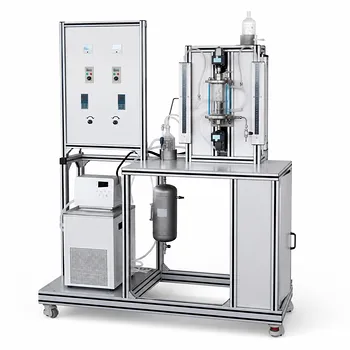
Dual-Drive Stirred Gas-Liquid Mass Transfer Coefficient Determination Pilot Plant

Dual-Drive Stirred Gas-Liquid Mass Transfer Coefficient Determination Pilot Plant

Pilot plant for determination of gas-liquid mass transfer coefficients with independent dual-drive agitation. Isolate gas and liquid film resistances via two-film theory control of speeds, flow rates, temperature. Borosilicate vessel provides visual access. Customizable for chemical, environmental, food, pharmaceutical engineering.

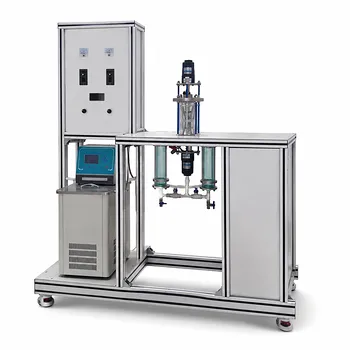
Liquid-Liquid Mass Transfer Coefficient Determination Educational Pilot Plant

Liquid-Liquid Mass Transfer Coefficient Determination Educational Pilot Plant

This bench-scale educational pilot plant for liquid-liquid mass transfer coefficient determination offers precise control of phase boundary, temperature, and agitation, enabling hands-on study of transport phenomena and unit operations in chemical engineering labs for teaching.

High-Gravity Emulsification and Mass Transfer Educational Pilot Plant

High-Gravity Emulsification and Mass Transfer Educational Pilot Plant

This integrated educational pilot plant utilizes rotating packed bed technology to demonstrate high-gravity emulsification and mass transfer, providing engineering students with hands-on experience in process intensification and unit operations through a modular, customizable design with digital monitoring.

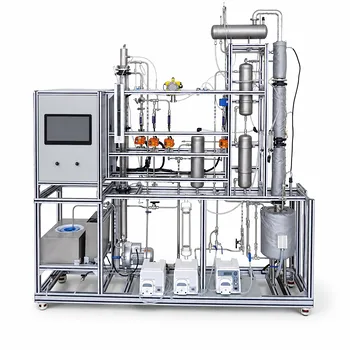
Absorption and Desorption Educational Unit Operations Pilot Plant

Absorption and Desorption Educational Unit Operations Pilot Plant

Dual packed column absorption and desorption pilot plant for chemical engineering education, offering real-time mass transfer coefficient measurement, durable mobile frame, industrial touch-screen interface, and customizable design for varied laboratory curricula, enabling hands-on study of gas absorption and stripping.

Multimodal Absorption and Desorption Pilot Plant for Unit Operations Training

Multimodal Absorption and Desorption Pilot Plant for Unit Operations Training

Multimodal absorption and desorption pilot plant for higher education labs. Bridges theory and industrial practice with transparent packed columns, three operational modes (real-material, simulated, semi-physical), and SCADA control. Students explore mass transfer, column hydraulics, and process control. Customizable.

Carbon Dioxide Absorption and Desorption Educational Pilot Plant for Carbon Capture Studies

Carbon Dioxide Absorption and Desorption Educational Pilot Plant for Carbon Capture Studies

Explore carbon dioxide absorption and desorption with this educational pilot plant. Transparent columns visualize mass transfer; electric heating simulates industrial solvent regeneration; touchscreen interface enables data monitoring. Ideal for chemical engineering, bridging theory and practice.

Dual-Mode Rectification Pilot Plant for Practical Training Unit Operations

Dual-Mode Rectification Pilot Plant for Practical Training Unit Operations

Industrial-scale dual-mode rectification pilot plant for chemical engineering practical training. Features real-material and simulated-material operation modes, sieve-plate column with sight glasses for visual observation of hydrodynamics, and customizable SCADA control for safe, hands-on learning of unit operations and mass transfer.

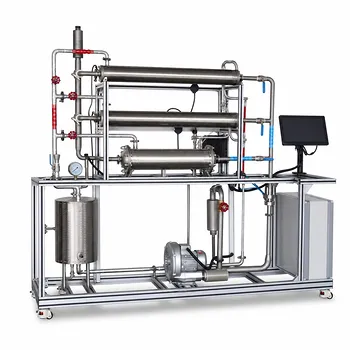
Three-Tube Heat Transfer Educational Pilot Plant for Unit Operations Training

Three-Tube Heat Transfer Educational Pilot Plant for Unit Operations Training

Three-tube heat transfer pilot plant for studying convective heat transfer enhancement and condensation. Allows comparison of smooth, corrugated, turbulent tubes, verifying empirical correlations. Ideal for chemical engineering education with safety and closed-loop steam recovery.

Comprehensive Multi-Modal Heat Transfer Unit Operations Pilot Plant for Engineering Training

Comprehensive Multi-Modal Heat Transfer Unit Operations Pilot Plant for Engineering Training

Comprehensive multi-modal heat transfer unit operations pilot plant for engineering training. Features four heat exchanger types, multi-media switching, and three operating modes. Hands-on experience in safety, optimization, and process control. Industrial-grade design with real-time data acquisition for chemical engineering labs.

Dual Mode Heat Transfer Pilot Plant for Unit Operations Training

Dual Mode Heat Transfer Pilot Plant for Unit Operations Training

Engineering-scale dual-mode heat transfer pilot plant for hands-on unit operations training in chemical engineering. Features real and simulated modes, multiple heat exchanger types, comprehensive coefficient determination, and advanced process control with data acquisition for engineering students and researchers.

Comprehensive Heat Transfer Coefficient Determination Educational Unit Operations Pilot Plant

Comprehensive Heat Transfer Coefficient Determination Educational Unit Operations Pilot Plant

Advanced industrial-grade educational pilot plant for comprehensive heat transfer coefficient determination. Enables quantitative convective heat transfer analysis, evaluates double-pipe and shell-and-tube exchanger configurations, and includes digital data acquisition. Customizable for engineering curriculum. Ideal for engineering unit operations labs.

Supercritical High-Gravity Flash Evaporation Educational Unit Operations Pilot Plant

Supercritical High-Gravity Flash Evaporation Educational Unit Operations Pilot Plant

Bench-scale integrated teaching system for advanced separation and mass transfer, combining supercritical high-gravity flash evaporation with heating, chemical reaction, and material collection, featuring modular design, Stainless Steel 316L construction, transparent visualization, touchscreen control, and safety systems for chemical engineering education.

Pressure Swing Adsorption Educational Unit Operations Pilot Plant

Pressure Swing Adsorption Educational Unit Operations Pilot Plant

Integrated bench-scale pressure swing adsorption pilot plant for hands-on teaching of gas-solid separation, mass transfer, and process optimization using nitrogen-oxygen model, featuring dual-column design, industrial touchscreen control, digital assessment suite, and customizable hardware and software configurations for educational laboratories.

Rising and Falling Film Evaporation Educational Unit Operations Pilot Plant

Rising and Falling Film Evaporation Educational Unit Operations Pilot Plant

Hands-on educational pilot plant for studying rising and falling film evaporation, flow regimes, and heat transfer. Customizable for university labs with industrial instrumentation and data acquisition. Enables comparative evaluation of evaporation modes and energy efficiency.

100L Continuous Loop Hydrogenation Educational Unit Operations Pilot Plant

100L Continuous Loop Hydrogenation Educational Unit Operations Pilot Plant

This 100L continuous loop hydrogenation pilot plant is designed for chemical engineering education, featuring 316 stainless steel construction, advanced gas-liquid mass transfer components, explosion-proof safety systems, and a 15.6-inch touchscreen with 5G connectivity, cloud data logging, bridging theory and industry.

Carbon Material Thermal Pretreatment Multiphase Separation Educational Pilot Plant

Carbon Material Thermal Pretreatment Multiphase Separation Educational Pilot Plant

Educational pilot plant for carbon material thermal pretreatment and multiphase separation. Features jacketed agitated reactor, separation column, and modern controls for hands-on unit operations training in heat transfer, fluid flow, and process safety with industrial-grade materials and wireless data acquisition.

Educational Unit Operations Pilot Plant for Intraparticle Diffusion Effective Factor Measurement

Educational Unit Operations Pilot Plant for Intraparticle Diffusion Effective Factor Measurement

Designed for chemical engineering university labs, this pilot plant allows hands-on determination of catalyst particle intraparticle diffusion effective factors and gas-solid reaction kinetics using a fixed-bed tubular reactor with industrial touchscreen control, bridging theory and practical reactor design.

Packed Bed Absorption Educational Unit Operations Pilot Plant

Packed Bed Absorption Educational Unit Operations Pilot Plant

Study gas-liquid absorption, pressure drop, flooding, and mass transfer coefficients with this pilot plant. Transparent packed column, industrial touchscreen, real-time sensor data, automated analysis. Investigate two-phase flow, loading points, column efficiency. Comprehensive data logging and assessment software included.

Natural Product Extraction Unit Operations Training Pilot Plant

Natural Product Extraction Unit Operations Training Pilot Plant

Integrated natural product extraction pilot plant for chemical engineering training bridges theory and industrial practice with modular extraction and evaporation/concentration units, hybrid touchscreen and manual control, realistic process simulation, and self-contained softened water and vacuum utilities.

Internal Circulation Gradient Free Catalytic Reaction Educational Pilot Plant

Internal Circulation Gradient Free Catalytic Reaction Educational Pilot Plant

Internal circulation gradient free catalytic reaction educational pilot plant for chemical engineering unit operations. Provides isothermal gradient free operation and hands on study of heterogeneous catalysis kinetics and mass transfer with precise control. Ideal for academic labs.


Leave Your Message