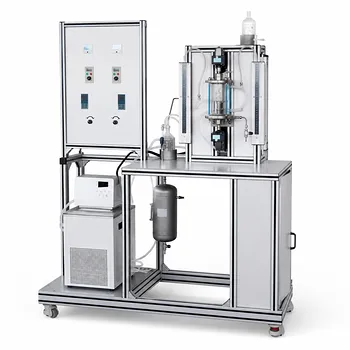
The mass transfer coefficient—$k_La$—is not just another scale-up parameter; it is the hidden governor that can make or break your catalytic hydrogenation process.
In a pilot plant, $k_La$ directly controls the dissolved hydrogen concentration reaching the catalyst surface. When the mass transfer rate is too low relative to the intrinsic reaction kinetics, the liquid phase becomes starved of hydrogen. This single shortfall shifts the rate-limiting step from chemistry to physics, making scale‑up predictions unreliable, triggering irreversible catalyst deactivation, and dramatically altering reaction selectivity—including the enantiomeric excess of asymmetric hydrogenations, which can plummet or even invert.
The core insight: A pilot plant’s $k_La$ defines the maximum hydrogen delivery rate to the catalyst. If it falls below the intrinsic kinetic demand, you enter a regime of hydrogen starvation where selectivity collapses, kinetics become unscalable, and the catalyst decays irreversibly. Thoroughly characterizing and matching $k_La$ across scales is the non‑negotiable foundation of a reproducible and safe hydrogenation process.
The Critical Role of $k_La$ in Catalytic Hydrogenation
What $k_La$ Actually Delivers
The volumetric mass transfer coefficient, $k_La$, is the product of the liquid‑film mass transfer coefficient ($k_L$) and the specific gas–liquid interfacial area ($a$).
It quantifies how fast gaseous hydrogen can cross the interface and dissolve into the liquid phase.
In a catalytic hydrogenation, dissolved hydrogen must then diffuse to the catalyst surface—so $k_La$ sets the ceiling on reactant availability.
The Regime Map: Kinetic vs. Mass Transfer Control
If $k_La$ is large relative to the consumption rate, the liquid remains saturated and the observed rate reflects true kinetics.
If $k_La$ is too low, the concentration at the catalyst drops below saturation—the reaction becomes mass‑transfer‑limited.
This boundary is the most critical diagnostic in pilot‑plant work, because it determines whether the data you collect can ever be scaled predictably.
How Insufficient $k_La$ Sabotages Selectivity
Enantioselectivity at Risk
Many catalytic hydrogenations—especially asymmetric ones—show a strong dependence on the effective dissolved hydrogen concentration.
Under starvation conditions, the desired pathway that requires high hydrogen coverage may slow down, while competing isomerization or over‑reduction routes become dominant.
The result can be a drastic drop in enantiomeric excess, or even a flip in the dominant enantiomer, destroying the product’s value.
Irreversible Catalyst Deactivation
When the catalyst surface is starved of hydrogen, reactive intermediates accumulate and can undergo side reactions that permanently poison the active sites.
This irreversible deactivation is not easily corrected by simply increasing $k_La$ later in production—it represents a true process robustness failure that can be diagnosed and prevented at the pilot scale.
Scale‑Up Hazards: When Lab Data Betrays You
Kinetics That Don’t Scale
A pilot reactor operating in a mass‑transfer‑limited regime will give the illusion of a much slower reaction than the true intrinsic kinetics.
If those “apparent” kinetics are used to design a larger reactor—where $k_La$ may naturally be higher—the full‑scale reaction can accelerate dangerously, outpacing heat removal and creating runaway risks.
The Heat Transfer Double Bind
When mass transfer limits the reaction, the heat generation rate ($Q_r$) becomes proportional to the mass transfer rate, not to intrinsic kinetics.
The scale‑up rule for constant temperature shifts from the typical homogeneous form to
$ \frac{UA}{k_La \cdot V} \cdot \Delta T_{LM} = \text{constant} $
A higher $k_La$ boosts the reaction rate and, with it, the demand on the cooling system’s $UA$.
If you scale up $k_La$ without a corresponding increase in cooling capacity, temperature spikes become inevitable.
Safety Margins Evaporate
A reactor that transitions from mass‑transfer‑limited to kinetics‑controlled across a scale change can experience an unexpected surge in gas consumption and heat release.
This mismatch can exceed the design pressure relief and cooling limits, turning a well‑behaved pilot reaction into a runaway scenario at production scale.
Understanding the Trade‑offs in Pilot Plant $k_La$ Characterization
The Temptation to Ignore Mass Transfer
It is often easier to run pilot hydrogenations at a single, convenient agitation speed and assume the reaction is kinetically controlled.
This shortcut comes at a cost: without experimental confirmation that $k_La$ is non‑limiting, the entire data set is potentially worthless for scale‑up.
Over‑Reliance on a Single Measurement
$k_La$ is a strong function of agitation rate, vessel geometry, fill level, solvent properties, and sparger design.
A value measured at one set of conditions does not translate to another.
Pilot plants must systematically map $k_La$ across the intended operating envelope—using decoupled, non‑reactive gas uptake tests or depressurization methods—to build a trustworthy scale‑up model.
The classic approach is to degas the solvent, pressurize with hydrogen (or a non‑reactive mimic), start agitation, and record the pressure decay. The $k_La$ is then extracted from a first‑order fit of the pressure‑time data.
Without this map, you are scaling blind.
Making the Right Choice for Your Hydrogenation Scale‑Up
When you use a pilot plant to prepare for production, your experimental design must explicitly confront mass transfer. Here is how to align your approach with your goals:
- If your primary focus is maintaining enantioselectivity or chemoselectivity: Run a series of hydrogenations at systematically increasing agitation speeds (or specific power inputs). The selectivity must plateau before you can claim it represents the intrinsic chemical behavior—only that plateau is safe to scale.
- If your primary focus is obtaining scale‑up‑ready kinetic parameters: First, deliberately lower agitation until you see mass transfer limitations; then operate well above that threshold to gather true kinetic data. Confirm with a non‑reactive $k_La$ measurement that you have at least a 2–3‑fold excess of delivery capacity over the maximal consumption rate.
- If your primary focus is sizing the cooling system for production: Determine the relationship between $k_La$ and agitation power in the pilot unit. Use the correlation $Q_r \propto k_La \cdot V$ to project heat load at the target $k_La$ for the full‑scale reactor, and ensure the plant’s $UA$ will accommodate that demand without unstabilizing temperature control.
Mastering $k_La$ at the pilot scale is not an academic exercise—it is the difference between a robust, predictable process and one that will lurch dangerously when scaled.
Summary Table:
| Process Regime / Scenario | Impact on Catalytic Hydrogenation | Key Pilot Plant Action Required |
|---|---|---|
| Kinetic Control (High $k_La$) | Liquid phase is saturated; reaction rate reflects true chemistry. | Target this regime to gather scalable, intrinsic kinetics data. |
| Hydrogen Starvation (Low $k_La$) | Selectivity collapses (ee% drops), and irreversible catalyst deactivation occurs. | Increase agitation or gas flow to ensure the system is not mass-transfer limited. |
| Scale-Up Mismatch | Unexpected reaction acceleration at scale; high risk of thermal runaway. | Systematically map $k_La$ using non-reactive gas uptake before scaling. |
| Heat Transfer Limits | Cooling demand ($UA$) surges alongside improved mass transfer. | Balance $k_La$ optimization with reactor heat removal capacity ($UA$). |
Optimize Your Scale-Up and Process Safety with LABPARK
Accurately mapping mass transfer coefficients like $k_La$ is crucial for turning laboratory chemistry into safe, viable production processes. LABPARK offers specialized Educational and Vocational Unit Operations Pilot Plants in chemical engineering, bioprocess & biotech, and environmental & water treatment.
Tailored for universities, research institutes, and enterprises, our pilot plants deliver the precise control, reliable data acquisition, and robust scaling models needed to bridge the gap between theory and industrial reality.
- Universities & Institutes: Equip your labs with industry-grade experimental setups for teaching and cutting-edge research.
- Enterprises: Minimize scale-up risks and optimize reactor design with highly reproducible pilot plant systems.
Ready to elevate your engineering capabilities? Contact LABPARK today to discuss your pilot plant requirements!
Related Products
- Dual-Drive Stirred Gas-Liquid Mass Transfer Coefficient Determination Pilot Plant
- Liquid-Liquid Mass Transfer Coefficient Determination Educational Pilot Plant
- Absorption and Desorption Educational Unit Operations Pilot Plant
- Carbon Dioxide Absorption and Desorption Educational Pilot Plant for Carbon Capture Studies
- Fixed-Bed Chemical Reaction and Gas Dust Tar Removal Unit Operations Pilot Plant
People Also Ask
- How does temperature affect mass transfer rates in chemical engineering educational pilot plants?
- How do pilot plants study gas solubility in polymer melts at high pressures? Key Mass Transfer Insights
- How does column packing affect absorption intensification, and how is it evaluated experimentally?
- Why Compare Membrane-Reservoir Models with Pilot Plant Data? Ensure Successful Process Scale-Up
- How does modeling gas solubility influence gas-liquid mass transfer design? Optimize Pilot Plant Aeration