Packing choice is the single most impactful design variable for intensifying absorption.
In a mass transfer pilot plant, the column packing directly governs the effective interfacial area and the overall mass transfer coefficient ($K_Ya$). High-performance packings—through their geometry and material—reduce mass transfer resistance and allow a significantly shorter column to achieve the same separation. Experimentally, this intensification is evaluated by measuring the height of an overall gas-phase transfer unit ($H_{OG}$) for different packings under identical operating conditions and comparing the resulting column heights required to reach a target removal.
Process intensification in absorption is about shrinking equipment size while maintaining or improving performance. In packed columns, the packing’s ability to create a large, well-wetted interfacial area and to promote turbulence directly increases $K_Ya$, which reduces the transfer unit height ($H_{OG}$). The primary experimental yardstick is therefore the $H_{OG}$ measurement, which quantifies how efficiently a specific packing uses vertical space to accomplish mass transfer.
Why Packing Defines Mass Transfer Performance
The Link Between Packing and $K_Ya$
At the heart of absorption intensification lies the volumetric mass transfer coefficient $K_Ya$, which combines the true mass transfer coefficient with the effective interfacial area per unit volume.
- A packing’s shape, surface texture, and material determine how much liquid film it can support and how much gas-liquid interface it creates.
- Greater effective area ($a$) directly boosts $K_Ya$, because a larger interface allows more molecules to cross the phase boundary per unit time.
- Enhanced turbulence—from ridges, perforations, or intricate geometries—also increases the film coefficients by thinning stagnant layers.
The result is that, for a given set of gas and liquid flow rates, a high-performance packing will deliver a notably smaller $H_{OG}$ than a simple, low-efficiency alternative.
Why $H_{OG}$ Is the Key Performance Metric
The height of a transfer unit $H_{OG}$ is defined as $H_{OG} = \frac{V/\Omega}{K_Y a}$, where $V/\Omega$ is the gas superficial velocity divided by the column cross-sectional area.
- $H_{OG}$ represents the column height required to achieve one transfer unit of separation—i.e., to change the gas-phase concentration by an amount equal to the average driving force.
- A packing that intensifies absorption shrinks $H_{OG}$: you need fewer meters to accomplish the same concentration change.
- In a pilot plant, you can directly measure $H_{OG}$ by running the column at steady state, sampling the inlet and outlet streams, and applying the design equation for a counter-current absorber.
Packing Material and the Critical Role of Wetting
The packing material is not a secondary detail; it determines the wetting efficiency and thus the effective area. This relationship is captured by the Onda correlation, which links the ratio of the packing’s critical surface tension ($\sigma_c$) to the liquid’s surface tension ($\sigma_L$) with the wetted fraction.
- Materials with a high critical surface tension, such as stainless steel ($\sigma_c \approx 75$ mN/m) or glass ($\approx 73$ mN/m), wet readily with aqueous solutions, maximizing the active interface.
- Plastics like polyethylene ($\sigma_c \approx 33$ mN/m) can suffer from poor wetting in water-based systems, leading to a smaller effective area and a higher $H_{OG}$.
- Surface treatment to increase $\sigma_c$ (e.g., hydrophilizing polypropylene) can close the performance gap, demonstrating that material chemistry is a lever for process intensification.
How to Experimentally Evaluate Packing Performance
The Core Measurement: $H_{OG}$ and $N_{OG}$
In a pilot-scale gas absorption column, the experimental evaluation follows a standard protocol that directly reveals the intensification effect.
- You first select a well-characterized system, such as the absorption of CO₂ from air into water or a dilute NaOH solution, ensuring reliable equilibrium data.
- For each packing candidate, you fix the gas and liquid flow rates to achieve a constant operating line and record inlet and outlet gas concentrations.
- From the concentration data and equilibrium relationship, you calculate the number of overall gas-phase transfer units, $N_{OG}$, using the standard logarithmic-mean driving force method.
- The measured packed bed height ($Z$) is then divided by $N_{OG}$ to yield the experimental $H_{OG}$: $H_{OG} = Z / N_{OG}$.
Direct comparison of $H_{OG}$ values for different packings under identical hydrodynamics quantifies the intensification. A packing that cuts $H_{OG}$ in half allows the column height to be halved while delivering identical absorption.
What the $H_{OG}$ Comparison Tells You
When you test a structured packing against random Raschig rings, you will typically observe a much smaller $H_{OG}$ for the structured design. This happens because:
- The structured packing’s larger geometric surface is mostly fully wetted.
- Its corrugated sheets promote more uniform liquid film flow and better gas-phase mixing.
- The random packing, by contrast, may have dead zones where liquid channeling reduces effective area and raises $H_{OG}$.
The physical column height required for a specified separation ($Z = H_{OG} \times N_{OG}$) becomes the straightforward visual tale of intensification: a shorter section of structured packing outperforms a much taller bed of random packing.
Including Pressure Drop and Other Practical Checks
While $H_{OG}$ is the primary intensification yardstick, a complete experimental evaluation must also account for energy consumption and operability.
- Pressure drop can become excessive with very small packing sizes or intricate geometries, increasing blower power costs. Measuring pressure drop per meter of packing at various gas loads helps define the economically optimal packing.
- Flooding limits must be determined. A packing that offers superb $H_{OG}$ may flood prematurely, limiting its practical throughput.
- Liquid distribution should be verified using wall fraction measurements or tracer tests; poor distribution undermines the packing’s theoretical performance.
These tests, run in a purpose-built pilot plant, provide the full picture of how packing choice influences both mass transfer intensification and overall process viability.
Understanding the Trade-offs
No single packing excels in every dimension. Recognizing the trade-offs is essential for a sound experimental design and for extracting the right engineering lesson.
- Smaller packing sizes boost surface area and reduce $H_G$ and $H_L$, but they also increase pressure drop and are more prone to fouling and liquid maldistribution.
- High-performance engineered packings (structured or complex random) can be expensive; their cost must be justified by the reduction in column height and associated structural savings.
- Material wetting advantage can backfire if the packing is too wettable by the dispersed phase in two-phase systems, promoting coalescence. For absorption, the priority is wetting by the liquid solvent, so high-$\sigma_c$ materials are generally favored—but for systems with low surface tension liquids, the difference may vanish.
- Packing size relative to column diameter must stay between 1/10 and 1/8 of the tower diameter to avoid wall-channeling effects that artificially lower apparent efficiency; this constrains the choice in pilot-scale columns with small diameters.
Making the Right Choice for Your Pilot or Research Goal
Based on what you need to demonstrate or optimize, the packing selection and evaluation strategy should shift.
- If your primary focus is demonstrating intensification fundamentals: Choose two packings with a large contrast in effective area and material wettability—such as a structured metal packing vs. a large polypropylene random packing. Measure $H_{OG}$ and plot bed height vs. removal efficiency to create a powerful visual argument for high-performance internals.
- If your primary focus is teaching material-science effects: Test materials of identical geometry but different $\sigma_c$ (e.g., glass vs. polypropylene Raschig rings). Have students calculate the Onda wetted area and compare predicted vs. measured $H_{OG}$, linking surface chemistry directly to column sizing.
- If your primary focus is optimizing a real industrial absorber: Run a campaign measuring $H_{OG}$ and pressure drop across a range of gas and liquid superficial velocities for candidate packings. Map out the trade-off space to identify the packing that gives the shortest column subject to pressure drop and flooding constraints.
- If your primary focus is scale-up from pilot to production: Ensure that the packing size-to-diameter ratio in the pilot matches the intended industrial ratio, and validate wetting behavior with the actual process fluid, not just the model system. A packing that looks ideal with pure water may underperform if the real liquid has a different surface tension.
Understanding how packing geometry and material chemistry translate into a measurable $H_{OG}$ gives you the power to design, scale, and troubleshoot absorption processes with confidence.
Summary Table:
| Packing Parameter | Impact on Intensification | Experimental Evaluation Metric |
|---|---|---|
| Geometry & Shape | Governs effective interfacial area ($a$) & turbulence | $H_{OG}$ (Height of Transfer Unit) |
| Material Chemistry | Determines wetting efficiency via surface tension | Wetted fraction & $H_{OG}$ comparison |
| Size & Void Fraction | Balances mass transfer rate against gas flow resistance | Pressure drop ($\Delta P$) & Flooding limits |
Optimize Your Chemical Engineering Lab with LABPARK
Are you looking to demonstrate mass transfer intensification and column packing dynamics in your curriculum or research? LABPARK provides high-quality Educational and Vocational Unit Operations Pilot Plants in chemical engineering, bioprocess & biotech, and environmental & water treatment.
Designed specifically for universities, research institutes, and enterprises, our pilot plants enable hands-on evaluation of $H_{OG}$, pressure drop, and absorption efficiency.
Why Partner with LABPARK?
- Industrial-Grade Standards: Equip your lab with robust, scale-up ready pilot columns.
- Comprehensive Learning: Accelerate research in gas absorption, VOC removal, and carbon capture.
- Tailored Solutions: Access custom configurations designed to meet your specific research and educational goals.
Ready to elevate your engineering programs? Contact our experts today to find the perfect pilot plant solution for your needs.
Related Products
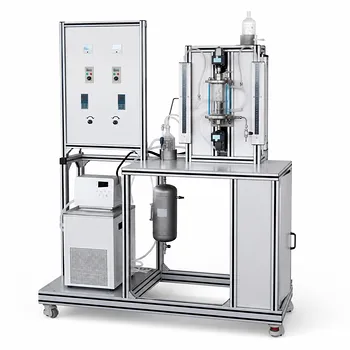
- Dual-Drive Stirred Gas-Liquid Mass Transfer Coefficient Determination Pilot Plant
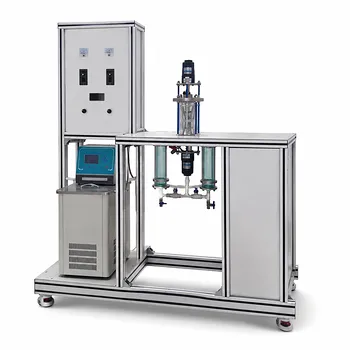
- Liquid-Liquid Mass Transfer Coefficient Determination Educational Pilot Plant
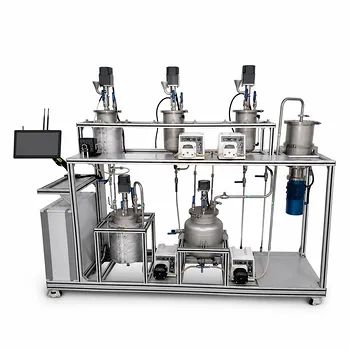
- High-Gravity Emulsification and Mass Transfer Educational Pilot Plant
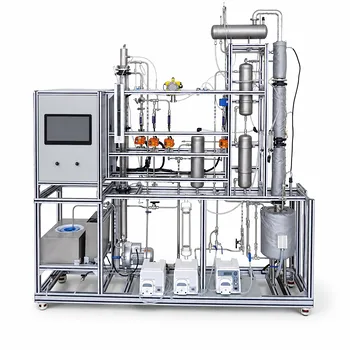
- Absorption and Desorption Educational Unit Operations Pilot Plant
- Multimodal Absorption and Desorption Pilot Plant for Unit Operations Training
People Also Ask
- Why Compare Membrane-Reservoir Models with Pilot Plant Data? Ensure Successful Process Scale-Up
- Why is pilot plant gas absorption lower than isothermal model predictions? Interfacial heating explained.
- Which interphase forces dominate gas dispersion in stirred reactors? Master Gas Holdup Models
- What key factors influence the rate of diffusion in liquids? Optimize Mass Transfer Pilot Plant Design
- What operational factors must be considered in viscous gas-liquid mass transfer? Pilot Plant Guide