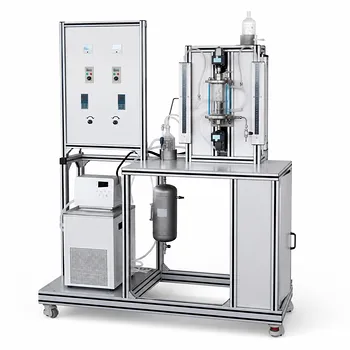
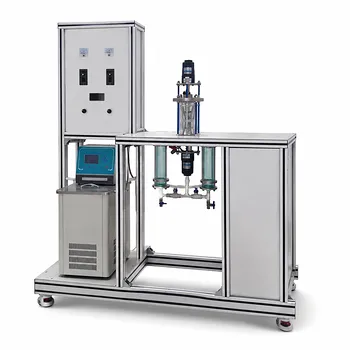
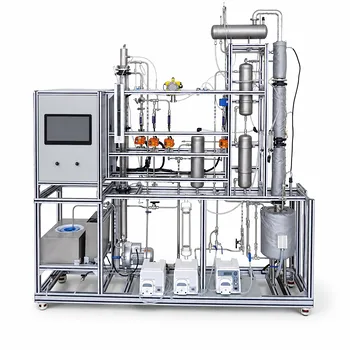
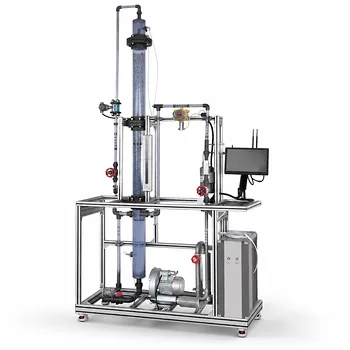
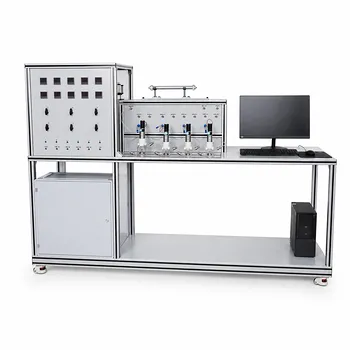
The simple answer is interfacial heating. Measured absorption rates in educational pilot plants often fall below isothermal model predictions because those models ignore the heat of absorption. When a gas dissolves and reacts, it releases heat right at the gas-liquid interface. This local temperature spike dramatically reduces the solute's solubility, which in turn throttles the mass transfer flux. What looks like a modeling failure is actually a powerful, real-world nonisothermal effect that pilot plants are uniquely equipped to reveal.
The core insight: Isothermal models assume a constant, uniform temperature—a simplification that breaks down the moment an exothermic absorption begins. The resulting interfacial temperature rise depresses gas solubility, creating a negative feedback loop that slows the very absorption you are trying to measure. In fast-reacting systems, this can cause overpredictions of 25% or more. The lower-than-expected rate is not a measurement error; it is the system telling you that energy and mass balances are profoundly coupled.
The Hidden Flaw in Isothermal Assumptions
When students first use a gas-liquid absorption pilot plant, they often reach for a textbook model that treats temperature as a constant. This is the trap.
Heat Release at the Interface
The act of absorption is rarely energy-neutral. In reactive absorption processes, the heat of reaction and dissolution is released precisely where the gas meets the liquid—the interface. In a small-scale educational column, this local heat can cause a noticeable temperature rise. The isothermal model, by design, ignores this term in the energy balance, leading to a systematically optimistic rate prediction.
Solubility's Sensitivity to Temperature
Henry's Law states that gas solubility in a liquid is strongly temperature-dependent. As interfacial temperature climbs, the equilibrium concentration of the dissolved gas at the surface plummets. The driving force for mass transfer—the concentration gradient between the interface and the bulk liquid—shrinks immediately. Your model expects a steep gradient; reality delivers a wilted one. The result is a flux that is lower than predicted, and you will see this discrepancy clearly in the column profile data you collect.
When Reaction Kinetics Amplify the Problem
The magnitude of the discrepancy is not random. It is a function of how fast the reaction is and how much heat it generates.
The Fast Reaction Regime and Why Mechanical Fixes Fail
In a fast chemical reaction regime, the enhancement factor (β) simplifies to a value dependent only on reaction kinetics and diffusion. Crucially, the absorption rate becomes independent of the physical liquid-film mass transfer coefficient (kʟ). This has a critical practical implication on a pilot plant: if you spot a lower-than-expected rate and try to fix it by spinning the rotor faster, agitating more, or thinning the liquid film, nothing will happen. The bottleneck is not physical mixing; it is the chemically depressed solubility at the hot interface. The only levers that matter in this regime are chemical—like increasing reactant concentration or, counterintuitively, controlling the temperature rise itself.
The Role of Contact Time and Solvent Evaporation
Nonisothermal effects are not just about a simple temperature step change. At longer contact times or higher reaction rates, secondary effects like solvent evaporation and gas-phase heating amplify the problem. The evaporative cooling at the interface might seem like it should help, but the net effect of taking heat into the gas phase and losing solvent mass further distorts the concentration gradients in ways isothermal models cannot capture. The result is a more severe drop in mass flux than a simple interfacial heating model might suggest on its own.
Quantifying the Discrepancy: Real-World Examples
This is not a subtle laboratory anomaly. It is a first-order effect that can derail a design if ignored.
Up to 25% Overprediction in Strong Reactions
In systems with strong chemical reactions—like the absorption of chlorine into toluene—neglecting gas-phase heat effects and solvent evaporation can cause a model to predict absorption fluxes that are 25% higher than what is experimentally observed. Think of that: a full quarter of your predicted mass transfer can be an illusion if you leave energy out of the picture. In an educational pilot plant, this large, reproducible error is the perfect teaching tool to move beyond idealized theory.
Using Pilot Plants to Validate Coupled Models
Educational pilot plants are not just for measuring the error; they are for fixing it. By measuring solute concentration at different column heights and applying rigorous mass and energy balances, you can validate coupled energy-and-mass transfer models like those based on penetration or film theory. The low experimental result you measured becomes the exact data point you need to fit a more advanced model, cementing your understanding of how heat transfer and mass transfer conspire.
Understanding the Trade-offs
Isothermal models are not ‘bad’; they are simply limited tools. Choosing to use one involves a conscious trade-off.
A purely isothermal model gives you simplicity and speed. It is excellent for teaching the foundational principles of operating and equilibrium lines. However, it comes at the cost of accuracy for any system with a substantial heat of absorption. The trade-off is stark: you can have a quick, directionally correct answer, or you can have a quantitatively correct answer that requires measuring interfacial temperature effects. The educational pilot plant exists at the intersection of this trade-off, giving you a controllable environment to quantify the price of simplicity.
Beyond temperature, another key variable—the absorption parameter (mGm/Lm)—governs the separation's efficiency but does not explain the nonisothermal rate shortfall. If your measured rate is low relative to an isothermal model, do not confuse the cause with an incorrectly set liquid-to-gas flow ratio. That ratio changes the driving force along the operating line; the interfacial temperature rise changes the equilibrium line itself, shifting the entire thermodynamic goalpost.
How to Apply This to Your Pilot Plant Experiments
Start by treating the lower-than-predicted rate as your most valuable data point. Your course of action depends entirely on your specific objective.
- If your primary goal is predictive accuracy: Abandon the isothermal model. Implement a coupled energy-and-mass balance model that incorporates interfacial temperature rise and, for volatile solvents, evaporation effects. Use your experimental concentration profiles to back-calculate the true interfacial temperature.
- If your primary focus is optimizing a reactive absorption process: Recognize when you are in the fast reaction regime (rate independent of physical (k_L)). Do not waste time trying to increase turbulence; instead, optimize chemical variables like reactant concentration or evaluate if a cooled solvent can pull heat away from the interface.
- If your primary objective is education or model validation: Use the discrepancy as the curriculum. Deliberately run the column with a system that has a high heat of absorption, measure the “isothermal error,” and then demonstrate how adding an energy balance collapses the data back onto a single, unified model.
The lower rate you measure is not a failure of your technique; it is the first clear signal that you are ready to move from simple models to the real, thermally-coupled world of industrial absorption.
Summary Table:
| Feature / Parameter | Isothermal Model Assumption | Real-World Pilot Plant Reality |
|---|---|---|
| Interfacial Temperature | Assumed constant & uniform | Rises due to exothermic reaction/dissolution |
| Gas Solubility (Henry's Law) | Assumed high & constant | Plummets due to local temperature spikes |
| Concentration Gradient | Steeper driving force | Wilted driving force, lower mass transfer flux |
| Prediction Accuracy | Overpredicts rates by up to 25% | Reflects true coupled mass & energy balances |
Elevate Chemical Engineering Education with LABPARK Pilot Plants
Bridging the gap between simplified textbook theory and real-world thermodynamics is critical for training future engineers. LABPARK provides state-of-the-art Educational and Vocational Unit Operations Pilot Plants in chemical engineering, bioprocess & biotech, and environmental & water treatment designed specifically for universities, research institutes, and enterprises.
Our advanced pilot plant systems enable students and researchers to visualize, measure, and validate coupled mass and energy transfer models under real-world conditions.
Ready to upgrade your laboratory? Contact LABPARK today to request a catalog or discuss your custom chemical engineering equipment requirements!
Related Products
- Dual-Drive Stirred Gas-Liquid Mass Transfer Coefficient Determination Pilot Plant
- Liquid-Liquid Mass Transfer Coefficient Determination Educational Pilot Plant
- Absorption and Desorption Educational Unit Operations Pilot Plant
- Carbon Dioxide Absorption and Desorption Educational Pilot Plant for Carbon Capture Studies
- Packed Bed Absorption Educational Unit Operations Pilot Plant
People Also Ask
- How does column packing affect absorption intensification, and how is it evaluated experimentally?
- Why Compare Membrane-Reservoir Models with Pilot Plant Data? Ensure Successful Process Scale-Up
- Which interphase forces dominate gas dispersion in stirred reactors? Master Gas Holdup Models
- What key factors influence the rate of diffusion in liquids? Optimize Mass Transfer Pilot Plant Design
- What operational factors must be considered in viscous gas-liquid mass transfer? Pilot Plant Guide