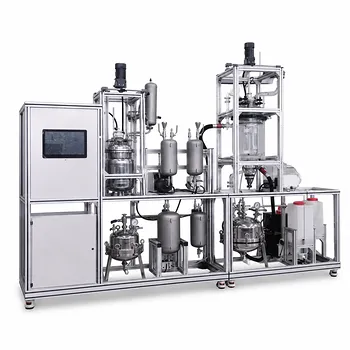
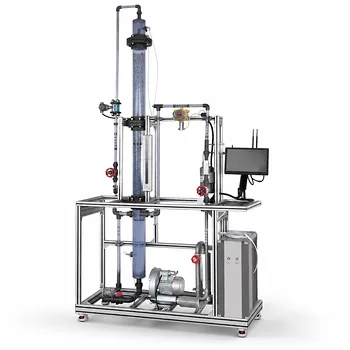
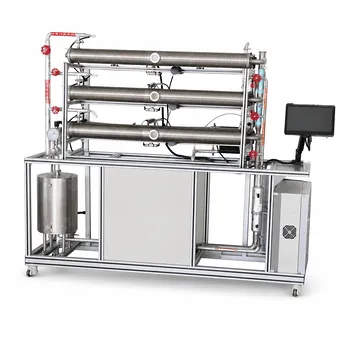
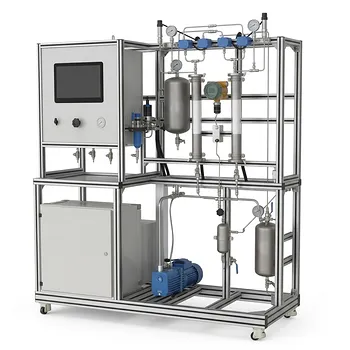
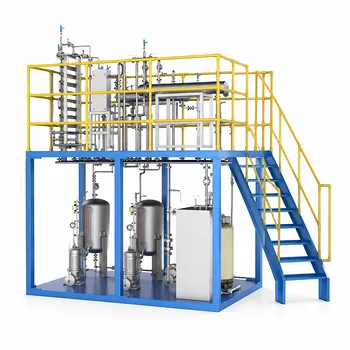
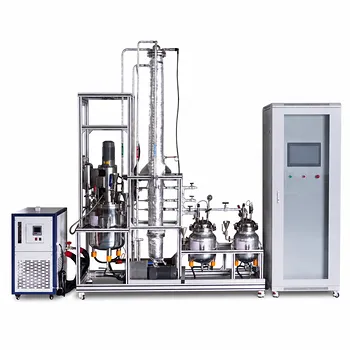
Diffusion in liquids isn’t a single phenomenon—it’s a delicate balance of four key forces. The rate at which molecules move through a liquid is influenced primarily by temperature, the concentration gradient, the fluid’s viscosity, and the size of the diffusing molecules. In a liquid-phase mass transfer pilot plant, these same factors dictate equipment design, from heat exchangers for thermal control to the choice of solvent and the geometry of mixing vessels.
While temperature, concentration gradient, viscosity, and molecular size set the theoretical limits of diffusion, pilot plant design succeeds by translating these properties into controllable operating variables—flow rates, agitation, temperature, and droplet size—that maximize the rate of mass transfer in a practical, scalable system.
The Fundamental Drivers of Liquid Diffusion
Understanding the “why” behind equipment decisions starts with the physics of molecules on the move. Fick’s first law governs the relationship, but four practical factors dominate pilot plant behavior.
Temperature: The Kinetic Accelerator
Higher temperatures inject more kinetic energy into molecules, speeding up their random motion. This directly increases the diffusion coefficient, making mass transfer happen faster. In a pilot plant, this means heat exchangers and jacketed vessels are not just accessories—they are primary control levers.
Concentration Gradient: The Driving Force
Diffusion rate is directly proportional to how steeply concentration changes with distance. A sharp gradient acts like a steep hill for molecules, driving them from high to low concentration more quickly. Pilot plant designs manipulate this by maintaining fresh feed streams and counter-current flows that constantly renew the driving force, preventing the gradient from flattening out as mass transfer proceeds.
Viscosity: The Molecular Brake
Thick, high-viscosity liquids put the brakes on molecular movement; the diffusion rate is inversely proportional to viscosity. When scaling up or selecting solvents, engineers must anticipate how viscosity changes with temperature and composition. A solvent that works at benchtop scale might become a mass transfer bottleneck at pilot scale if its viscosity is not managed through heating or careful formulation.
Molecular Size: The Inertia Factor
Heavier, larger molecules simply can’t move as fast under the same driving forces. This is why pilot plant studies for different solutes—say dissolved oxygen versus a large organic dye—yield vastly different mass transfer performance. The target molecule’s size must be considered when evaluating if a given contactor design can achieve the required extraction or absorption efficiency.
Translating Fundamentals into Pilot Plant Design
Knowing what accelerates diffusion is only half the battle. A liquid-phase pilot plant must be engineered to turn these physical facts into reliable performance data.
Controlling Temperature and Viscosity in Sync
Since raising temperature increases diffusion but also lowers viscosity—creating a compounding benefit—pilot plants often incorporate precise temperature control loops. The primary reference emphasizes managing these two factors together; in practice, this means integrating heating/cooling jackets, inline viscometers, and sometimes pre-heaters for feed streams to hit a target mass transfer coefficient.
Managing the Concentration Gradient through Flow
A steep gradient is the engine, but it will stall unless the bulk solution is constantly refreshed. This is where liquid flow rates and phase contacting patterns (co-current, counter-current, cross-flow) come in. By appropriately selecting flow configuration, a pilot plant sustains the maximum possible driving force along the entire active length of a column or contactor.
The Overlooked Role of Turbulence
In laminar flow, molecular diffusion is the only mechanism. But once flow turns turbulent, eddy diffusion can boost mass transfer rates by orders of magnitude. Many pilot plants—especially those with packed columns or stirred vessels—are deliberately operated in or near the turbulent regime. Varying impeller speed or gas/liquid flow rates allows researchers to observe the sharp jump in mass transfer coefficients and identify the minimum energy needed to break into turbulence.
Interfacial Area: The Multiplier of Mass Transfer
For any liquid-liquid or gas-liquid process, the rate of mass transfer is not just about how fast a molecule diffuses, but how much contact area is available. The overall rate depends on the specific interfacial area, which itself is a function of dispersed phase holdup and droplet size. Pilot plant designs influence this through nozzle choice, distributor plate design, and agitation intensity—all of which control the Sauter mean diameter of the droplets and thus the total area for transfer.
Equipment Design Parameters That Shape Diffusion
Beyond fundamentals, pilot plant hardware directly sets the performance envelope:
- Agitation rate and impeller type determine shear, turbulence, and droplet breakage.
- Baffles and vessel geometry prevent vortexing and improve bulk mixing.
- Liquid fill level and sub-surface sparging affect gas hold-up and bubble size in aerated systems. These operational details are the engineering translation of the diffusion equation, turning physical constants into controllable knobs.
Understanding the Trade-offs and Common Pitfalls
Perfect advice must include the costs and compromises. Design decisions never offer a free lunch.
- Temperature vs. Component Stability: Running hotter speeds diffusion but can degrade heat-sensitive compounds or increase unwanted side reactions. Pilot plant protocols must validate that thermal acceleration doesn’t compromise product quality.
- Turbulence vs. Energy Cost: While turbulence dramatically boosts mass transfer, the associated pressure drop and power consumption rise steeply. The optimal operating point balances the mass transfer coefficient against the energy bill.
- Small Droplets vs. Coalescence: Reducing droplet size increases interfacial area, but tiny droplets are prone to coalescence and can be difficult to separate afterward. Pilot plant tests must verify that the chosen droplet size remains stable in a realistic settler.
- High Concentration Gradients vs. Material Costs: Continuously flushing fresh solution adds operating expense. Designers must decide whether a higher gradient justifies the increased chemical consumption or if a taller column with a more moderate gradient is cheaper.
- Scale-up Oversimplification: A pilot plant that works perfectly at one scale can fail at a larger one if the fundamental controlling mechanism shifts—for example, from mass transfer limitation to heat transfer limitation. Always operate a pilot plant across a range of conditions, not just at a single “optimum” point, to map the design space.
Making the Right Choice for Your Pilot Plant Design
The same physical principles lead to different design priorities depending on your specific goal. Use these clear targets to guide your approach.
- If your primary focus is reproducible, scalable data: Fix temperature and viscosity as tightly as possible and systematically vary flow rates and agitation to map mass transfer coefficients across many regimes. This builds the robust correlation you’ll need for scale-up.
- If your primary focus is maximum extraction yield in a single unit: Invest in equipment that boosts interfacial area—high-quality distributors, optimized agitation, and turbulence promotion via baffles—while accepting higher energy use and a wider operating window.
- If your primary focus is low-energy, gentle processing (e.g., for fragile biomolecules): Keep the system laminar, accept a slower diffusion rate, and compensate by increasing residence time and using a taller column with a carefully maintained concentration gradient.
- If your primary focus is educational demonstration and phenomenological study: Include transparent sections, tracer injection ports, and variable-speed drives so that the transition from molecular to eddy diffusion can be directly visualized and measured, rather than optimizing for a specific throughput.
The best pilot plant is not the one that simply runs fast; it’s the one that gives you faithful, controllable insight into how the four fundamental drivers of diffusion will behave at full scale.
Summary Table:
| Factor | Impact on Diffusion | Pilot Plant Design Solution |
|---|---|---|
| Temperature | Higher temp increases molecular kinetic energy and diffusion rate | Heating/cooling jackets, pre-heaters, and control loops |
| Concentration Gradient | Steeper gradients drive faster molecular movement | Counter-current flow configurations and fresh feed streams |
| Viscosity | Higher viscosity slows molecular movement (inverse relationship) | Inline viscometers, temperature control, and solvent selection |
| Molecular Size | Larger, heavier molecules diffuse more slowly | Customized contactor geometries and optimized residence times |
| Turbulence & Shear | Promotes eddy diffusion, dramatically boosting transfer rates | Agitation rate control, impeller selection, and vessel baffles |
| Interfacial Area | Increases contact surface to multiply mass transfer rate | Precision nozzle designs, distributor plates, and bubble spargers |
Accelerate Your Mass Transfer Research with LABPARK
Translating liquid diffusion theory into controllable pilot-scale data requires highly precise, reliable equipment. LABPARK provides state-of-the-art Educational and Vocational Unit Operations Pilot Plants in chemical engineering, bioprocess & biotech, and environmental & water treatment to help universities, research institutes, and enterprises achieve their research and training goals.
Our custom-engineered pilot systems offer advanced control over temperature, flow rates, and agitation, ensuring you can accurately map mass transfer coefficients and scale up your processes with confidence.
Contact LABPARK today to discuss your project requirements and receive a detailed consultation!
Related Products
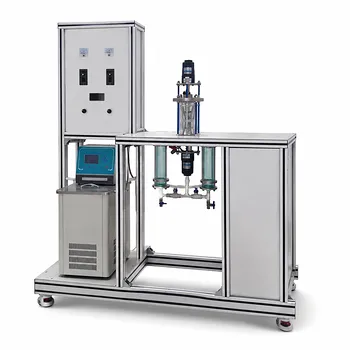
- Liquid-Liquid Mass Transfer Coefficient Determination Educational Pilot Plant
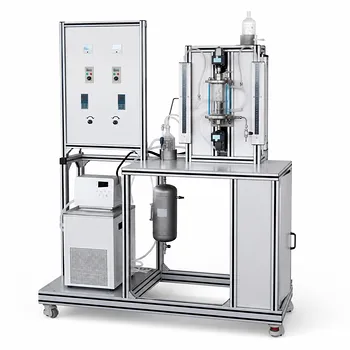
- Dual-Drive Stirred Gas-Liquid Mass Transfer Coefficient Determination Pilot Plant
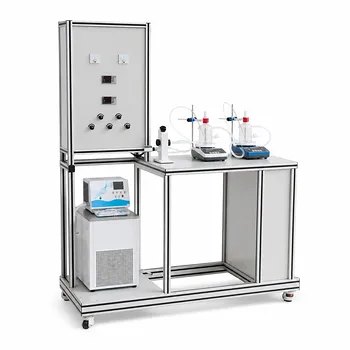
- Ternary Liquid-Liquid Equilibrium Educational Pilot Plant
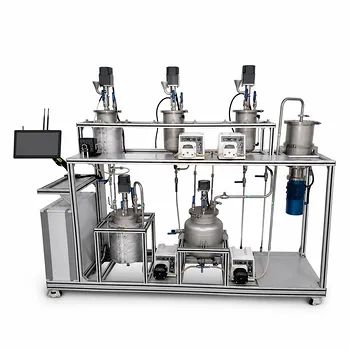
- High-Gravity Emulsification and Mass Transfer Educational Pilot Plant
- Comprehensive Liquid-Liquid Extraction Pilot Plant for Engineering Education
People Also Ask
- Why Compare Membrane-Reservoir Models with Pilot Plant Data? Ensure Successful Process Scale-Up
- How does column packing affect absorption intensification, and how is it evaluated experimentally?
- What are the limitations of the Wilke-Chang correlation? Avoid critical mass transfer errors.
- What is the role of the Sherwood number ($Sh$) in pilot plants? Master mass transfer scale-up
- Why is the calculation of gas and liquid diffusion coefficients critical? Unlock Accurate Pilot Plant Scale-Up