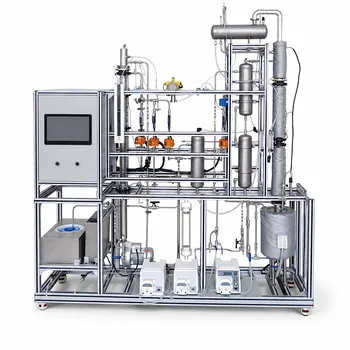
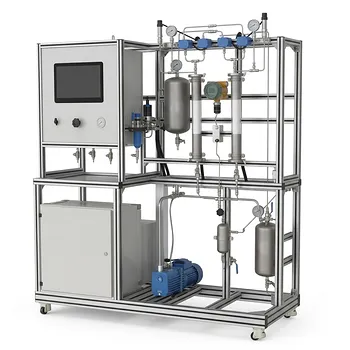
Whether you’re validating column performance or predicting scale‑up behavior, the mass transfer theory you choose fundamentally shapes how you interpret every data point from your pilot plant.
Film theory gives you a steady‑state, diffusion‑controlled picture—perfect for converting concentration profiles into film coefficients. Penetration theory, on the other hand, treats the interface as a constantly renewing boundary, linking mass transfer rates directly to turbulence and contact time. Both frameworks are applied to the same raw pilot‑plant measurements, but they yield different mechanistic insights and coefficient predictions.
Pilot plant experiments deliver rates and concentration data; mass transfer theories transform that data into the fundamental coefficients and models you need for equipment design. The film model excels at simplifying steady‑state absorption, while penetration theory captures the dynamic, unsteady‑state reality of turbulent columns. Knowing when to apply each—and when they diverge—is what turns empirical observations into reliable scale‑up.
Breaking Down the Two Theories
Film Theory: The Steady‑State Stagnant Layer Assumption
Film theory imagines two stagnant fluid films on either side of the gas‑liquid interface, with mass transfer occurring solely by molecular diffusion.
This steady‑state view is the classic workhorse for analyzing pilot‑plant columns operating under near‑equilibrium, low‑turbulence conditions.
Because the film is assumed stationary, the mass transfer coefficient k is directly proportional to the diffusion coefficient D.
In an educational or research pilot plant, you can calculate individual gas‑film and liquid‑film coefficients (k_g, k_L) directly from measured concentration gradients and bulk flow rates, using the straightforward film equations.
Penetration Theory: Unsteady‑State Contact and Surface Renewal
Penetration theory rejects the idea of a permanent stagnant film. Instead, it models the interface as a dynamic zone where fluid elements from the bulk liquid arrive, stay for a short exposure time, and then are replaced.
Mass transfer occurs via unsteady‑state diffusion into each element during its brief residence at the surface.
This framework is naturally suited to packed towers, bubble columns, and any pilot‑plant equipment with high turbulence or rapid surface renewal.
Under penetration theory, the mass transfer coefficient becomes proportional to the square root of the diffusion coefficient (√D), a relationship that often better matches experimental data when liquid‑side resistance dominates and turbulence is intense.
How Theories Transform Raw Pilot Plant Data
From Concentration Profiles to Mass Transfer Coefficients
Your pilot plant gives you inlet/outlet concentrations and flow rates. Film theory lets you back‑calculate individual film coefficients (k_g, k_L) and overall coefficients (K_G, K_L) using steady‑state material balances across the stagnant films.
Penetration theory, by contrast, forces you to estimate an exposure time or surface renewal rate—often derived from hydrodynamic measurements—and then compute a coefficient that reflects the unsteady diffusion process.
The difference in proportionality (D vs. √D) means that if you observe how the coefficient varies with solute diffusivity in a series of experiments, you can directly test which model describes your system more accurately.
Linking Flow Rates and Turbulence to Model Selection
In a gas‑absorption pilot plant, adjusting liquid and gas flow rates changes the thickness of the boundary film (in the film model) or the contact time (in the penetration model).
If you plot experimental mass transfer coefficients against flow rate, a simple film‑model interpretation would suggest a linear change in film thickness. But if turbulence visibly enhances transfer beyond that prediction, the penetration model’s exposure‑time dependence explains the extra gain through surface renewal.
This is how pilot‑plant data becomes the empirical bridge: you match the trend in your coefficients to the theory that captures the actual fluid dynamics.
When the Two Models Converge (and When They Diverge)
For many gas‑liquid systems with similar diffusivities and moderate turbulence, film and penetration theories give mass transfer coefficients that differ by only a few percent.
In such cases, the film model is preferred for its simplicity—perfect for teaching and quick process estimates.
The models diverge sharply when gas and liquid reactants have significantly different diffusivities or when complex reaction schemes are present.
Because penetration theory predicts k ∝ √D, it correctly accounts for the relative enhancement of fast‑diffusing species, whereas the film model’s linear dependence overestimates or underestimates one side of the resistance. In advanced research pilot‑plant studies, this distinction is critical for meaningful kinetic analysis.
Understanding the Trade‑offs and Pitfalls
The Danger of Blindly Applying Film Theory
Film theory’s assumption of a stagnant film is often inaccurate for highly turbulent packed towers or bubbling columns.
If you force your pilot‑plant data into a film‑model framework when the actual hydrodynamics are dynamic, you’ll extract film coefficients that are not truly representative of the underlying physics—leading to systematic errors in scale‑up.
The Complexity of Penetration Theory Parameters
Penetration theory shifts the difficulty to measuring or estimating the exposure time or surface renewal rate.
These parameters are not direct readouts from typical pilot‑plant instrumentation; they require supplementary hydrodynamic studies or empirical correlations, which can introduce their own uncertainty.
The sqrt(D) vs. D Discrepancy
The fundamental difference in diffusion‑coefficient dependence means that you cannot simply reuse coefficients calibrated from steady‑state experiments when the process becomes turbulence‑limited.
If your pilot plant involves varying temperatures or different solutes, the choice of theory directly alters the predicted impact on mass transfer rates. Recognizing this discrepancy is essential for correct data interpretation.
Making the Right Choice for Your Pilot Plant Analysis
Match your theoretical lens to the physical regime that dominates your pilot plant, not just to the easiest equation.
- If your primary focus is steady‑state, low‑turbulence liquid‑liquid or gas‑liquid contact (e.g., laminar‑film columns): Use film theory to extract straightforward film and overall coefficients from your concentration data.
- If your primary focus is highly turbulent packed towers, bubble columns, or any system with obvious surface renewal: Apply penetration theory to correctly link mass transfer rates to turbulence and short contact times, capturing the √D dependence.
- If you are dealing with solutes of widely different diffusivities or complex reactive absorption: Rely on penetration theory—its square‑root proportionality aligns more closely with experimental reality and avoids the mispredictions of a linear D dependence.
- If your goal is educational simplicity and the system shows only mild turbulence: Start with film theory to teach fundamentals, then use the pilot‑plant data to demonstrate where penetration theory becomes necessary.
The power of your pilot plant lies not just in the numbers it produces, but in your ability to frame those numbers with the right mass transfer theory—turning raw rates into a robust, scalable design.
Summary Table:
| Feature | Film Theory | Penetration Theory |
|---|---|---|
| Core Assumption | Stagnant fluid film, steady-state diffusion | Dynamic surface renewal, unsteady-state diffusion |
| k vs. D Relation | $k \propto D$ (Linear) | $k \propto \sqrt{D}$ (Square root) |
| Ideal Application | Low-turbulence, steady-state columns | High-turbulence packed or bubble columns |
| Key Parameters | Concentration profiles & bulk flow rates | Exposure time or surface renewal rate |
Optimize Your Unit Operations with LABPARK
Translating mass transfer theories into reliable experimental data requires high-precision equipment. LABPARK provides state-of-the-art Educational and Vocational Unit Operations Pilot Plants in chemical engineering, bioprocess & biotech, and environmental & water treatment for universities, research institutes, and enterprises. Our systems empower you to accurately validate column performance, teach fundamental principles, and predict scale-up behavior with confidence.
Ready to elevate your research and training capabilities? Contact us today to discover how LABPARK can customize the perfect pilot plant solution for your lab!
Related Products
- Liquid-Liquid Mass Transfer Coefficient Determination Educational Pilot Plant
- High-Gravity Emulsification and Mass Transfer Educational Pilot Plant
- Absorption and Desorption Educational Unit Operations Pilot Plant
- Dual-Mode Rectification Pilot Plant for Practical Training Unit Operations
- Multimodal Absorption and Desorption Pilot Plant for Unit Operations Training
People Also Ask
- How do pilot plants study gas solubility in polymer melts at high pressures? Key Mass Transfer Insights
- How does column packing affect absorption intensification, and how is it evaluated experimentally?
- Why Compare Membrane-Reservoir Models with Pilot Plant Data? Ensure Successful Process Scale-Up
- How does temperature affect mass transfer rates in chemical engineering educational pilot plants?
- What key factors influence the rate of diffusion in liquids? Optimize Mass Transfer Pilot Plant Design