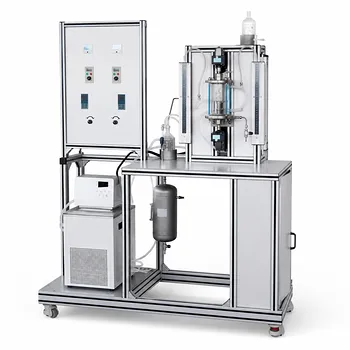
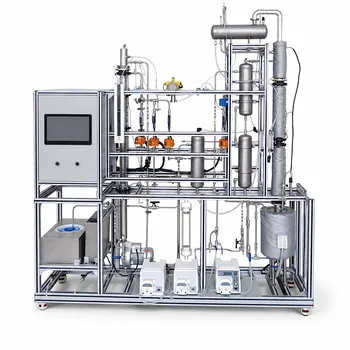
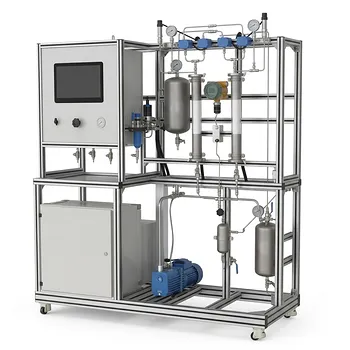
By simulating industrial high-pressure conditions in a controlled laboratory environment, multiphase unit operations pilot plants directly measure how much gas dissolves into a polymer melt at supercritical pressures. They combine heated, pressure-rated vessels with precise gas dosing to determine gas solubility coefficients, allowing researchers to quantify how pressure—rather than temperature—alters the melt’s phase behavior. This hands-on approach makes an otherwise invisible interfacial phenomenon tangible and safe for study.
The central value of a high-pressure multiphase pilot plant lies in its ability to use pressure as a tunable, non-destructive lever that enhances gas solubility in viscous polymer melts. While temperature changes can degrade the polymer, elevated pressure lets you probe solubility limits, map phase boundaries, and even drive molecular-weight-based fractionation—all while directly observing the mass transfer kinetics in real time.
Why Studying Gas Solubility in Polymer Melts Matters
Driving Industrial Processes from Foaming to Fractionation
For polymer foaming, the amount of gas dissolved directly determines cell nucleation density and final foam structure. In devolatilization, knowing solubility helps remove residual monomers or solvents efficiently. For fractionation, solubility differences at high pressure separate polymer chains by molecular weight without thermal degradation. All three depend on accurate, high-pressure solubility data.
The Challenge of a Viscous, Non-Ideal Matrix
Polymer melts are not simple liquids. Their high viscosity slows gas diffusion, and their complex thermodynamic behavior—often described by Flory–Huggins theory—causes swelling and non-linear solubility curves at elevated pressures. Theoretical predictions alone cannot capture these effects; experimental measurement is indispensable.
The Pilot Plant as a High-Pressure Laboratory
Replicating Supercritical Conditions with Precision
A multiphase pilot plant integrates a high-pressure gas dosing system (often for CO₂ or N₂) with a heated, stirred reactor that maintains the polymer in a molten state. Pressure vessels are designed to safely hold supercritical gases, while precise back-pressure regulators control the system pressure to within fractions of a bar. This setup recreates the exact conditions found in industrial extruders or autoclaves.
Controlled Gas Dosing and In-Situ Diagnostics
The plant meters a known mass of gas into the melt chamber. Once equilibrium is reached—sometimes after hours due to slow diffusion—analytical sensors (e.g., pressure decay monitors, gravimetric balances, or spectroscopic probes) quantify how much gas was absorbed. The result is a solubility coefficient (cm³ of gas per gram of polymer per unit pressure) that can be mapped across a pressure range.
Visualizing the Mass Transfer Process
In transparent, high-pressure view cells, students can physically observe the melt–gas interface. They watch a CO₂ bubble slowly shrink as gas molecules cross the phase boundary and diffuse into the polymer. This direct observation demystifies interphase mass transfer and shows why the liquid-side resistance—here, the polymer melt’s limited mobility—often controls the overall rate.
Pressure as a Gentle, Tunable Variable
Solubility Enhancement Without Thermal Degradation
Raising temperature can increase diffusion rates but often lowers gas solubility and risks polymer degradation. Increasing pressure, in contrast, directly boosts solubility by driving more gas molecules into the melt, following Henry’s law at low pressures and more complex sorption models at high pressures. This makes pressure a cleaner variable for studying phase boundaries or maximizing gas loading before foaming.
Retarding Crystallization to Simplify Phase Analysis
High hydrostatic pressure suppresses polymer crystallization kinetics. This retardation prevents the sudden solidification that would otherwise lock in an unknown gas distribution, making it easier to measure true equilibrium solubility in the amorphous melt. Consequently, students can map melting point shifts as a function of pressure and gas concentration without the ambiguity caused by rapid nucleation.
Understanding the Trade-Offs and Limitations
The Viscosity Barrier and Slow Equilibration
Elevated pressure increases the polymer melt’s viscosity, which dramatically slows gas diffusion. In a pilot plant, this means achieving true thermodynamic equilibrium can take many hours—sometimes a day or more. Shortcut measurements risk underestimating solubility, so careful experimental patience is mandatory.
Measurement Uncertainty in High-Pressure Melts
Because pressure depresses the crystallization rate, determining the exact melting point becomes uncertain. Small thermal fluctuations or shear from the stirrer can induce premature solidification, leading to a hysteresis in thermal analysis. Students must learn to reconcile these practical artifacts with the equilibrium phase diagrams taught in theory, a key educational outcome.
Safety and Cost of High-Pressure Operation
Working with supercritical gases demands rigorous pressure vessel design, burst disks, and extensive training. The capital and operational costs of a multiphase pilot plant are significant, and scale-up results may not translate linearly if the industrial process involves continuous flow rather than a batch autoclave. These constraints must be weighed against the unique data the plant provides.
Making the Right Choice for Your Study
Different research or educational goals will dictate which pilot plant features you prioritize:
- If your primary focus is polymer foaming: Select a plant with rapid gas dosing and a view cell that lets you observe bubble nucleation during controlled depressurization, directly linking solubility to foam morphology.
- If your primary focus is fractionation: Opt for a system that can recirculate supercritical fluid and collect multiple pressure-cut fractions, enabling you to separate polymer chains by molecular weight.
- If your primary focus is fundamental mass transfer: A plant with in-situ concentration sensors (like Raman or FTIR) and precise pressure decay capability will let you decouple solubility from diffusion coefficients, building a complete transport model.
- If your primary focus is teaching: A simplified, transparent autoclave with clear pressure and temperature readouts is most effective, letting students see gas dissolution firsthand and calculate solubility coefficients from a simple pressure drop.
A high-pressure multiphase pilot plant transforms gas solubility from an abstract thermodynamic number into a measurable, visual, and tunable property that you can safely control and apply to real polymer processing challenges.
Summary Table:
| Parameter / Challenge | Industrial Relevance | Pilot Plant Solution |
|---|---|---|
| High Viscosity | Retards diffusion & mass transfer | High-pressure stirred reactors for efficient mixing |
| Thermal Degradation | High temperatures damage polymer | Uses elevated pressure as a non-destructive solubility lever |
| Phase Behavior | Determines foam nucleation & structures | In-situ concentration sensors & transparent view cells |
| Slow Equilibration | Risks underestimating gas absorption | Precision gas dosing and long-term pressure control |
Advance Your Chemical Engineering & Mass Transfer Research with LABPARK
Bridge the gap between theoretical thermodynamics and hands-on industrial practice. LABPARK offers premium Educational and Vocational Unit Operations Pilot Plants specializing in chemical engineering, bioprocess & biotech, and environmental & water treatment.
Tailored for universities, research institutes, and enterprises, our state-of-the-art pilot plants enable safe, precise research into supercritical fluids, multiphase mass transfer, and polymer processing.
Ready to equip your laboratory with industry-leading pilot systems? Contact our experts today to discuss your project requirements!
Related Products
- Dual-Drive Stirred Gas-Liquid Mass Transfer Coefficient Determination Pilot Plant
- Liquid-Liquid Mass Transfer Coefficient Determination Educational Pilot Plant
- High-Gravity Emulsification and Mass Transfer Educational Pilot Plant
- Absorption and Desorption Educational Unit Operations Pilot Plant
- Multimodal Absorption and Desorption Pilot Plant for Unit Operations Training
People Also Ask
- How does temperature affect mass transfer rates in chemical engineering educational pilot plants?
- How does column packing affect absorption intensification, and how is it evaluated experimentally?
- Why Compare Membrane-Reservoir Models with Pilot Plant Data? Ensure Successful Process Scale-Up
- How does k_La affect hydrogenation scale-up? Critical insights for pilot reactors.
- How does modeling gas solubility influence gas-liquid mass transfer design? Optimize Pilot Plant Aeration