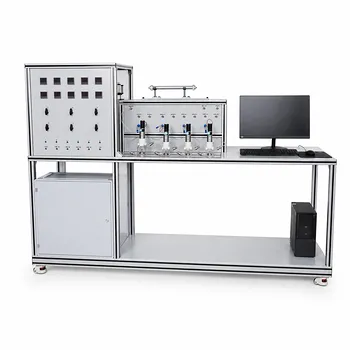
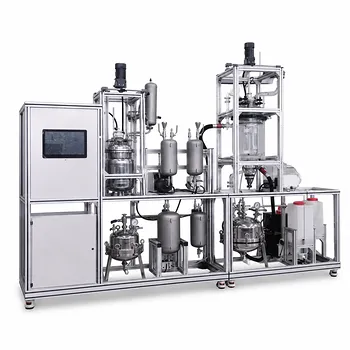
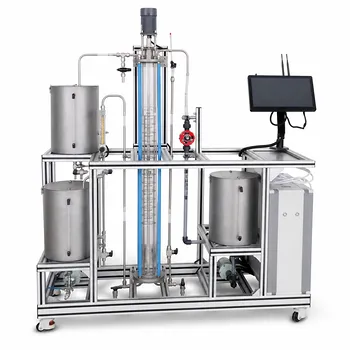
The key to teaching gas-liquid mass transfer in highly viscous or non-Newtonian media with a stirred-tank pilot plant lies in controlling and measuring a tight cluster of operational factors: mechanical power input, impeller selection, gas holdup, and the aeration strategy. When fluids become thick or exhibit non-Newtonian behavior, the energy barrier to break up gas bubbles skyrockets, and the liquid-phase resistance to oxygen transport becomes the dominant bottleneck. A pilot-scale rig lets students move beyond idealized textbook models and directly observe how these factors interact to cripple—or rescue—mass transfer efficiency in realistic, industrially relevant conditions.
Highly viscous and non-Newtonian fluids suppress gas-liquid mass transfer primarily by forming large, poorly dispersed bubbles that reduce interfacial area. The most effective teaching strategy is to have students systematically vary power input and impeller type to break this resistance, while measuring the resulting gas holdup and kLa — revealing the steep cost of mixing in non-ideal systems.
Understanding the Fluid Challenge
Why Viscosity Changes Everything
In low-viscosity fluids like water, agitation easily shears gas into a cloud of fine bubbles with a high surface area for mass transfer. As viscosity rises, the fluid’s internal friction resists this shearing action, leading to larger bubbles that quickly rise and coalesce.
For non-Newtonian fluids, the situation is more complex. Many fermentation broths or polymer solutions exhibit shear-thinning behavior, where viscosity drops near the impeller but remains high at the vessel wall. This creates zones of poor mixing and oxygen-starved pockets, even when the average power input seems sufficient.
The Surface Tension Factor
Surface tension works alongside viscosity to determine bubble size and stability. A high-surface-tension fluid resists bubble formation, requiring more energy to create new gas-liquid interfaces. In a teaching pilot plant, this means that simply reporting an agitation speed is meaningless without also characterizing the fluid’s physical properties—viscosity, surface tension, and density—so students can calculate meaningful dimensionless correlations.
Critical Operational Parameters
Mechanical Power Input: The Primary Lever
The power drawn by the agitator is the most direct operational control you have over mass transfer in viscous systems. Higher power input increases the shear rate and energy dissipation, which breaks larger bubbles into smaller ones and refreshes the liquid film around them.
However, students quickly discover that the relationship is not linear. In non-Newtonian media, the pump’s power number can shift dramatically as the apparent viscosity changes with shear rate. Teaching this requires learners to measure the torque or wattage directly, then correlate it back to the mass transfer coefficient (kLa) they measure experimentally.
Impeller Selection: The Geometry of Mixing
The choice of impeller is a make-or-break decision. Radial-flow impellers (like Rushton turbines) are workhorses for gas dispersion in low-viscosity broths, but they often create a cavity behind the blades in viscous fluids, severely reducing pumping capacity.
Impeller types suited for viscous regimes
Axial-flow impellers (pitched-blade turbines or marine propellers) and wide-blade hydrofoils (like the Lightnin A315 or Chemineer HE-3) are better at generating the bulk turnover needed to distribute gas throughout the tank. For highly viscous, non-Newtonian systems, close-clearance impellers such as helical ribbons or anchors may be necessary to wipe the vessel walls and prevent stagnant zones, though they are less efficient at gas dispersion. In a pilot plant, swapping these impellers and comparing kLa data teaches the profound impact of geometry on mixing quality.
Gas Holdup: The Usable Oxygen Inventory
Gas holdup—the volume fraction of gas held in the liquid—is the single best visual and quantitative indicator of a system’s aeration health. In viscous fluids, holdup drops as large bubbles rise immediately, leaving less gas in contact with the liquid at any moment.
Students should measure holdup directly (using volume expansion or pressure difference methods) and observe the change in bubble residence time. A low holdup in a seemingly well-stirred tank is a classic sign that the impeller is not handling the viscous load, a lesson that transfers directly to industrial troubleshooting.
Aeration Rate and Sparger Design
The gas flow rate must be balanced against the impeller’s ability to disperse it. Flooding—where the gas simply channels up the shaft without being distributed—occurs at much lower aeration rates in viscous media. The pilot plant should be equipped with a ring sparger below the impeller to produce initially small bubbles.
Students can explore the flooding limit by increasing gas flow until the power draw plummets, a demonstration that connects theory (the Froude and Flow numbers) to a dramatic visual event. Subsurface sparging with fine pores can help, but it also increases pressure drop and may require higher head space, which itself affects holdup measurements.
Baffles: Preventing Swirl at a Cost
Baffles are essential to convert tangential flow into the vertical mixing patterns needed for gas dispersion. However, in viscous systems, baffles can create dead zones behind them where thick fluid clings and limits mass transfer.
In educational experiments, running a non-Newtonian broth with and without baffles, while measuring local dissolved oxygen with multiple probes, highlights the trade-off between bulk mixing and local stagnation. The spatial distribution of oxygen often becomes more heterogeneous with baffles present, a nuance absent from low-viscosity “model” experiments.
Temperature and Fluid Conditioning
Temperature directly reduces viscosity for many fluids, making it a powerful operational variable to improve mass transfer. But for non-Newtonian solutions, heating can also alter the shear-thinning index, changing the entire mixing behavior. In pilot plant teaching, this is an opportunity to explore how industrial processes might pre-heat a feed stream not just for reaction kinetics, but also for improved oxygen transport. It also underscores the need to record temperature alongside all other data points, because kLa values are meaningless without stating the fluid’s exact thermal and rheological condition.
The Role of Pilot Plant Design
Why Scale Matters for Viscous Media
A pilot-scale stirred tank (5–50 L) bridges the gap between a beaker-scale shaker flask and a production fermenter. In viscous fluids, the power per unit volume (P/V) required to maintain a given kLa is scale-dependent, and wall effects become less dominant than in small bench-top rigs. This lets students see that their empirical correlations (like kLa = k(P/V)^a·vs^b) are not universal constants—the exponents shift with scale, a critical lesson for scale-up.
Observability and Measurement Access
The pilot plant must have transparent vessel sections and allow the insertion of multiple probes (dissolved oxygen, pH, temperature) at various positions. For non-Newtonian media, at least two dissolved oxygen probes—one near the impeller and one in a distant corner—are invaluable to reveal spatial gradients. Combined with a torque sensor on the agitator shaft and a rotameter on the gas line, the setup transforms into a hands-on learning environment where students can isolate each operational factor.
Understanding the Trade-offs
Power Efficiency vs. Mass Transfer Gain
There is a point of diminishing returns where pouring more power into a viscous fluid yields only a marginal increase in kLa, yet generates excessive heat and shear. This heat can denature sensitive biological products (like proteins in a mycelial fermentation) and increase cooling costs. In teaching, having students plot kLa versus specific power input reveals an economic trade-off curve—the engineering reality behind the "optimal operating point."
Shear Damage to Structure
In many non-Newtonian bioprocesses, the viscosity itself comes from delicate biological structures (fungal hyphae, polymer chains, or mammalian cells). High shear rates needed for gas dispersion can rip these structures apart, permanently reducing viscosity and sometimes killing the culture. The very act of improving oxygen transfer can destroy the product you’re trying to grow. Students learn that in such cases, other strategies—like oxygen enrichment of the gas stream or lower-temperature operation—must complement mixing.
Flooding and Weeping Instabilities
At fixed agitation speed, increasing gas flow will eventually flood the impeller, causing the power draw to drop and mass transfer to collapse. Conversely, reducing gas flow too much can cause weepage of liquid back into the sparger. These instabilities are much sharper in viscous media because the liquid phase has less inertia to dampen fluctuations. A pilot plant experiment that deliberately induces flooding and records the transient response teaches students to identify and avoid these dangerous operating boundaries.
How to Apply This to Your Teaching Lab
Depending on your educational module’s focus, you can emphasize different operational factors to drive home the core principles.
- If your primary focus is fundamental mass transfer phenomena: Require students to measure kLa at varying agitation speeds and gas flow rates while holding temperature constant, using a well-characterized viscous Newtonian fluid (e.g., a glycerol solution). They will build the empirical correlation and directly see the P/V dependency.
- If your primary focus is bioprocess engineering: Use a shear-thinning, non-Newtonian model fluid (like xanthan gum solution) and challenge students to map dissolved oxygen gradients across the tank with multiple probes. This reveals the pitfall of assuming a well-mixed liquid phase.
- If your primary focus is equipment design and scale-up: Have students swap between a Rushton turbine and an axial-flow hydrofoil in the same vessel, comparing flooding limits, holdup, and kLa under identical power inputs. This cements the lesson that impeller geometry is a critical design parameter, not an afterthought.
- If your primary focus is industrial troubleshooting: Run a ‘what-if’ scenario by incrementally increasing gas flow rate to the flooding point, showing the sudden loss of mixing and power draw. This teaches students to recognize early warning signs from torque and holdup data before catastrophic failure occurs.
By anchoring their learning in the tangible, often counter-intuitive behavior of viscous and non-Newtonian fluids, you transform a standard pilot plant exercise into a lasting lesson in the compromises that define real-world process engineering.
Summary Table:
| Operational Factor | Viscous/Non-Newtonian Challenge | Educational Experiment Focus |
|---|---|---|
| Power Input | Non-linear relationship; shifting apparent viscosity | Measure torque directly to correlate with mass transfer ($k_La$). |
| Impeller Design | Gas cavity formation; poor bulk turnover | Compare radial (Rushton) vs. axial-flow hydrofoils. |
| Gas Holdup | Rapid bubble coalescence; low residence time | Quantify via volume expansion or pressure difference. |
| Baffles | Stagnant zones behind baffles in thick fluids | Use multiple DO probes to map spatial oxygen gradients. |
Enhance Your Chemical Engineering & Biotech Labs with LABPARK
Are you looking to bridge the gap between textbook theory and industrial process realities? LABPARK provides state-of-the-art Educational and Vocational Unit Operations Pilot Plants in chemical engineering, bioprocess & biotech, and environmental & water treatment.
Designed specifically for universities, research institutes, and enterprises, our robust pilot plants enable hands-on training in gas-liquid mass transfer, mixing hydraulics, and system scale-up. Equip your students and researchers with the tools they need to master complex fluid behavior.
Contact us today to find the perfect pilot plant solution for your lab!
Related Products
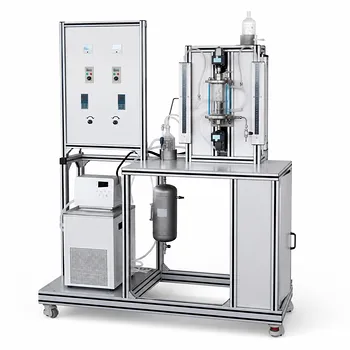
- Dual-Drive Stirred Gas-Liquid Mass Transfer Coefficient Determination Pilot Plant
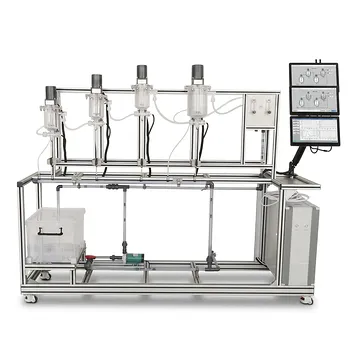
- Multi-Stage Stirred Tanks in Series Residence Time Distribution and Mixing Performance Determination Educational Pilot Plant
- Liquid-Liquid Mass Transfer Coefficient Determination Educational Pilot Plant
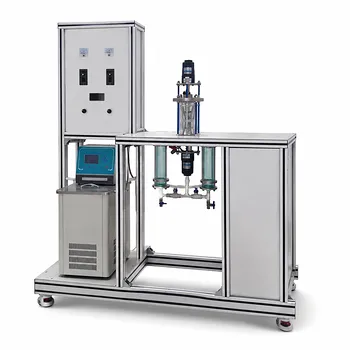
- Multi-Reactor Educational Pilot Plant for Reaction Engineering Unit Operations
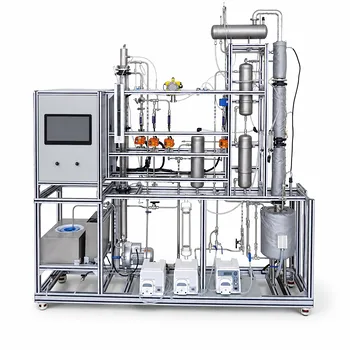
- Absorption and Desorption Educational Unit Operations Pilot Plant
People Also Ask
- How does column packing affect absorption intensification, and how is it evaluated experimentally?
- Why Compare Membrane-Reservoir Models with Pilot Plant Data? Ensure Successful Process Scale-Up
- Why is pilot plant gas absorption lower than isothermal model predictions? Interfacial heating explained.
- Which interphase forces dominate gas dispersion in stirred reactors? Master Gas Holdup Models
- What key factors influence the rate of diffusion in liquids? Optimize Mass Transfer Pilot Plant Design