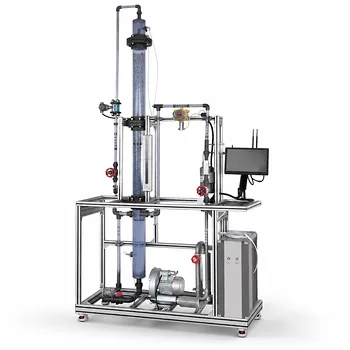
Surfactants render textbook mass transfer correlations unreliable. Even the most sophisticated theoretical models for the volumetric mass transfer coefficient (kLa) are built on idealized fluid behavior. When surface-active agents enter a system, they alter bubble size, interfacial rigidity, and the rate of molecular diffusion—each of which directly impacts the mass transfer coefficient. This is why pilot plant experiments are not a luxury but a necessity: they provide the empirical correction factors required to avoid catastrophic scale-up errors.
Theoretical mass transfer correlations are a starting point, but surfactants introduce complex interfacial effects that can make those predictions dangerously inaccurate. Pilot plant validation is the only reliable method to anchor your design in real-world physics, ensuring safe, efficient, and scalable operations.
The Fundamental Disconnect: Theoretical Models vs. Surfactant Reality
Standard mass transfer coefficient correlations assume a clean interface and predictable hydrodynamic behavior. Surfactants break those assumptions immediately.
How Surfactants Hijack the Interface
Surfactants accumulate at the gas‑liquid boundary, forming a molecular layer that can stiffen the interface. This reduces the internal circulation inside bubbles and increases the resistance to mass transfer. The result is a dramatic drop in the liquid‑side mass transfer coefficient (kl), a variable that pure‑component correlations like Wilke‑Chang do not capture.
The Cascade of Errors in Standard Correlations
The volumetric mass transfer coefficient (kLa) is the product of kl and the interfacial area a. Surfactants impact both terms simultaneously. They often generate smaller, more stable bubbles—which increases a—while simultaneously reducing kl due to the rigid interface. A correlation that fails to predict this coupled, counter‑acting behavior can be off by an order of magnitude, making the entire design basis unsafe.
Why a Pilot Plant Is Your Only Source of Trustworthy Data
A chemical engineering pilot plant lets you measure what models cannot guess. When surfactants are present, experimental data is not just an add‑on—it is the core of the design process.
Decoding the True Volumetric Mass Transfer Coefficient (kLa)
In the pilot plant, you can directly measure kLa under actual process conditions: real surfactant concentration, viscosity, temperature, and hydrodynamics. This measured value becomes the calibration target. You then back‑calculate the effective interfacial area and liquid‑side coefficient, creating an empirical model that reflects the true physics, not an idealized version of it.
Identifying the Controlling Resistance
The overall mass transfer coefficient K is defined by 1/K = 1/kg + 1/kl. In surfactant‑laden systems, the liquid‑side resistance (1/kl) often becomes dominant. By measuring K in your pilot plant and coupling it with known gas‑phase correlations, you can isolate the surfactant‑imposed barrier. This tells you whether to invest in finer bubble dispersions or in chemical means to break the interfacial film—a guidance no textbook correlation can provide.
Beyond Gas‑Liquid: A Universal Principle
The same logic extends to heterogeneous reactions, slurry hydrodynamics, and liquid‑liquid extraction. Any time a surface‑active contaminant or additive is present, theoretical diffusion coefficients and hold‑up correlations become speculative. Pilot plant data forces you to confront real‑world non‑idealities like dead zones, catalyst distribution, and temperature gradients that mass‑transfer‑limited processes are exquisitely sensitive to.
Understanding the Trade‑offs: Cost, Time, and Complexity
Running a pilot plant is expensive and time‑consuming. You must accept that trade‑off against the risk of designing purely on paper.
The Price of Certainty vs. The Cost of Failure
A pilot plant campaign adds months to a project and consumes raw materials and manpower. But a single scale‑up failure from a wrong mass transfer coefficient can cost millions and endanger lives. In safety‑critical sectors like water treatment or exothermic reactive systems, the pilot plant is a non‑negotiable insurance policy. The key is to use it surgically: validate the specific surfactant‑influenced parameters, not try to rewrite every equation from scratch.
Making the Right Choice for Your Scale‑Up Strategy
Your decision to invest in pilot‑plant validation for mass transfer coefficients should align with your primary goal.
- If your primary focus is safety and reliability: Use pilot plant data as the definitive design basis. Theoretical correlations serve only as a pre‑experimental screening tool.
- If your primary focus is accelerating time‑to‑market: Run targeted pilot trials that isolate the surfactant impact early. This prevents late‑stage redesigns and keeps your project timeline intact.
- If your primary focus is process optimization: Vary surfactant concentration, mixing intensity, and temperature in the pilot plant to build a robust empirical model. This will teach you far more than any published correlation.
- If your primary focus is education or fundamental understanding: Let students compare theoretical predictions against pilot‑plant measurements. The gap they observe is the most powerful lesson in the limitations of computational models.
A pilot plant doesn’t replace theory—it sharpens it. When surfactants are in play, that sharpening is the difference between a design that works on a flowsheet and one that works in the real world.
Summary Table:
| Parameter | Theoretical Predictions | Real-World Surfactant Impact | Pilot Plant Validation Benefit |
|---|---|---|---|
| Interface Dynamics | Mobile & clean boundary | Stiffened interface; rigid bubble behavior | Measures true liquid-side resistance (kl) |
| Interfacial Area (a) | Standard size distribution | Smaller, highly stable bubble generation | Captures coupled kl and a changes |
| Design Accuracy | High margin of error | Up to 10x deviation in kLa values | Delivers reliable empirical correction factors |
Ensure Safe & Accurate Scale-Up with LABPARK Pilot Plants
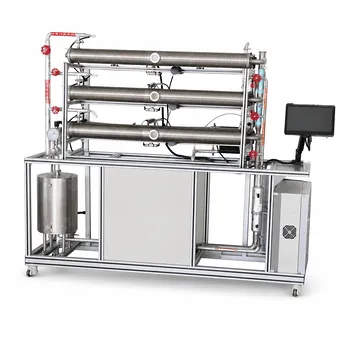
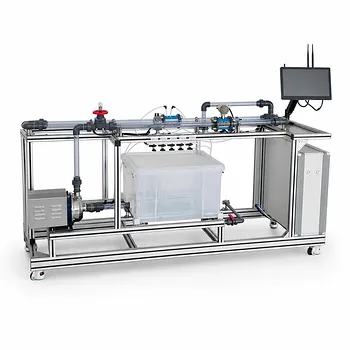
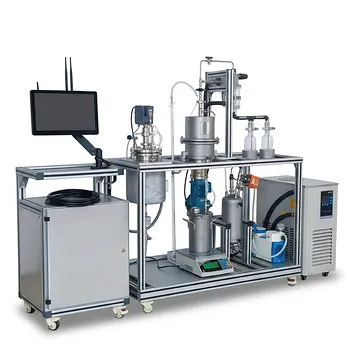
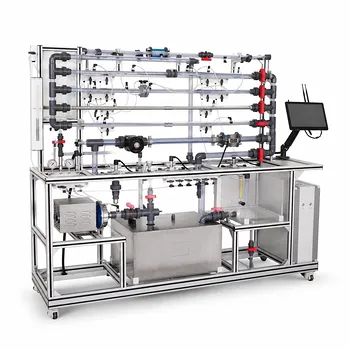
Don't let theoretical calculations compromise your process design. LABPARK provides state-of-the-art Educational and Vocational Unit Operations Pilot Plants in chemical engineering, bioprocess & biotech, and environmental & water treatment. Specifically engineered for universities, research institutes, and enterprises, our pilot plants deliver the precise empirical data you need to correct mass transfer coefficients and confidently scale up your operations.
Ready to validate your processes and eliminate scale-up risks? Contact our experts today to find the perfect pilot plant solution for your lab.
Related Products
- Dual-Drive Stirred Gas-Liquid Mass Transfer Coefficient Determination Pilot Plant
- Liquid-Liquid Mass Transfer Coefficient Determination Educational Pilot Plant
- Absorption and Desorption Educational Unit Operations Pilot Plant
- High-Gravity Emulsification and Mass Transfer Educational Pilot Plant
- Solid Spherical Heat Transfer Coefficient Determination Educational Chemical Engineering Pilot Plant
People Also Ask
- How does column packing affect absorption intensification, and how is it evaluated experimentally?
- Why Compare Membrane-Reservoir Models with Pilot Plant Data? Ensure Successful Process Scale-Up
- Why is pilot plant gas absorption lower than isothermal model predictions? Interfacial heating explained.
- Which interphase forces dominate gas dispersion in stirred reactors? Master Gas Holdup Models
- What key factors influence the rate of diffusion in liquids? Optimize Mass Transfer Pilot Plant Design