Knowledge Environmental and Water Treatment Education How is regeneration salt efficiency optimized for synthetic cation exchange resins? Pilot Plant Guide
Author avatar

Tech Team · LABPARK

Updated 2 months ago

How is regeneration salt efficiency optimized for synthetic cation exchange resins? Pilot Plant Guide


Salt efficiency in cation exchange regeneration isn’t about driving the resin to its absolute maximum capacity. It’s about finding the economic balance where each pound of salt strips the most hardness from the resin. In educational and vocational pilot plants, this is demonstrated by experimentally mapping the salt dosage against softening capacity. The clear optimum for synthetic cation exchange resins is achieved at a regenerant dose of approximately 0.5 lb NaCl per kilograin of CaCO₃ removed, delivered as a 10% sodium chloride brine solution.

Optimizing regeneration salt efficiency in a pilot plant means purposefully avoiding maximum resin capacity. Instead, you target the dosage that gives the highest hardness removal per pound of salt—typically 0.5 lb NaCl per kilograin of CaCO₃, applied as a 10% brine. This balance minimizes chemical cost while delivering reliable softening, a principle easily verified by plotting your own salt efficiency curves on a pilot-scale column.

The Principle of Regeneration Efficiency

Why More Salt Is Never Free

Regenerating a cation resin is a mass-action, equilibrium-driven process. Sodium ions must displace the calcium and magnesium held on the exhausted resin. Stoichiometrically, only about 0.17 lb of NaCl is required to remove 1,000 grains of equivalent CaCO₃.

However, because the resin prefers divalent hardness ions, you must supply a large excess of sodium to push the reaction backward. Increasing the salt dose does raise the resin’s exchange capacity, but the returns diminish sharply.

The Optimum Operating Point

The curve of “salt dose vs. softening capacity” has a knee. Below this knee, you waste regenerant; far above it, you waste money for a negligible capacity gain. For synthetic cation resins, the knee sits at 0.5 lb NaCl per kilograin of CaCO₃ removed. This is typically achieved with a brine concentration near 10% NaCl—the concentration that balances mass transfer, safety, and ease of handling in a pilot plant.

Executing a Regeneration Cycle in the Pilot Plant

Backwash: Preparing the Bed

The first step is a backwash at 5–6 gal/ft³/min. Water flows upward to expand the bed, release fines, remove surface debris, and reclassify the resin granules. A well-backwashed bed ensures even brine contact and prevents channeling.

Brining: Controlling Concentration and Flow

Brine introduction is the heart of salt efficiency. You introduce a 10% NaCl solution at a slow rate of 0.5–1 gal/ft³/min. This slow, laminar flow allows the concentrated brine to diffuse evenly into the resin pores. Varying the total pounds of salt delivered while keeping the concentration at 10% is how you systematically build a salt efficiency curve.

Slow Rinse: Displacing the Voids

Immediately after brining, a slow rinse at the same 0.5–1 gal/ft³/min pushes the brine plug through the column without dilution. This step accounts for the voids volume, which is typically 45–50% of the total resin bed volume. Skipping or shortening the slow rinse leaves high-salinity spent regenerant trapped in the column, wasting salt and interfering with the service run.

Fast Rinse: Polishing to 1 ppm

The final rinse ramps up to 1–1.5 gal/ft³/min to sweep out residual brine and hardness leakage. You continue until the effluent hardness drops below 1 ppm CaCO₃. This is your signal that the bed is clean, in its active sodium form, and ready for exhaustion.

Measuring and Optimizing Efficiency

The Capacity Formula in Practice

After regeneration, you run the exhaustion cycle and measure how many liters of hard water the column treats before breakthrough. Exchange capacity is calculated as:

(Liters of water consumed × Water hardness as ppm CaCO₃ × 437) ÷ (mL of resin in column)

The factor 437 converts the measurements into grains of CaCO₃ per cubic foot, allowing a direct comparison with your salt dose in pounds. You can then compute the real-world salt efficiency (lb NaCl/kilograin) for that specific regeneration recipe.

Plotting Your Own Salt Efficiency Curve

One of the most powerful lessons in a pilot plant comes from running multiple regeneration cycles—each at a slightly higher salt dose—while holding brine concentration, temperature, and flow rates constant. You plot salt dosage (lb/ft³ of resin) against the resulting capacity (kilograins/ft³). The highest point on the curve of “capacity per pound of salt” identifies your optimum salt efficiency. That’s why pilot-scale work is the gold standard for training operators: the trade-off becomes visible, not just theoretical.

Understanding the Trade-offs

Economic vs. Throughput Conflict

Targeting 0.5 lb NaCl/kilograin minimizes chemical cost per unit of hardness removed. But if your pilot plant’s goal is to maximize the volume of water softened between regenerations, you might intentionally operate at a higher salt dose—accepting a worse salt efficiency to gain a longer service cycle. The decision is always a balance of consumables cost against labor or downtime.

Common Operational Mistakes

  • Brine concentration drift: Using a brine far above or below 10% alters the chemical equilibrium and drops efficiency without warning.
  • Neglecting the slow rinse: Failing to account for the 45–50% voids volume wastes expensive salt and yields inconsistently regenerated beds.
  • Overlooking bed fouling: Iron floc, algae, or resin fines disrupt flow distribution, creating dead zones where salt contact is poor and apparent efficiency plummets.
  • Ignoring wastewater disposal: Higher salt efficiency means less salt in the waste stream, simplifying environmental compliance and disposal logistics.

Making the Right Choice for Your Pilot Plant’s Objective

Your pilot plant is a learning tool and a small-scale process optimizer. Here’s how to set your regeneration strategy based on what you most need to demonstrate or achieve:

  • If your primary focus is teaching process optimization: Run a series of cycles at increasing salt dosages, calculate capacity, and plot the salt efficiency curve to visually identify the 0.5 lb/kilograin optimum.
  • If your primary focus is minimizing consumable cost: Standardize on a 10% brine solution delivered at a total dose of 0.5 lb NaCl per kilograin of capacity—this is the proven economic sweet spot.
  • If your primary focus is maximizing water throughput per cycle: You can raise the salt dose to gain more treated water between regenerations, but understand you’ll be sacrificing the most efficient use of salt in favor of extended runtime.

Mastering salt efficiency isn’t about a single magic number—it’s about understanding the fundamental trade-off between chemical power and cost, and using your pilot plant to put that trade-off to work.

Summary Table:

Step Flow Rate (gal/ft³/min) Target / Key Parameter
1. Backwash 5–6 Expand bed, release fines, and prevent channeling
2. Brining 0.5–1 Deliver 10% NaCl brine solution to resin
3. Slow Rinse 0.5–1 Displace brine plug through 45–50% bed void volume
4. Fast Rinse 1–1.5 Sweep residual brine until effluent hardness is < 1 ppm CaCO₃

Elevate Your Water Treatment Training with LABPARK

Are you looking to bridge the gap between theory and practical application in water purification? LABPARK designs and manufactures premium Educational and Vocational Unit Operations Pilot Plants in chemical engineering, bioprocess & biotech, and environmental & water treatment.

Built specifically for universities, research institutes, and enterprises, our pilot plants enable students and operators to master critical processes like ion exchange, regeneration cycles, and salt efficiency optimization firsthand.

Contact LABPARK today to discuss your laboratory requirements and discover how our advanced training solutions can empower your students and researchers.

Related Products

People Also Ask

Related Products

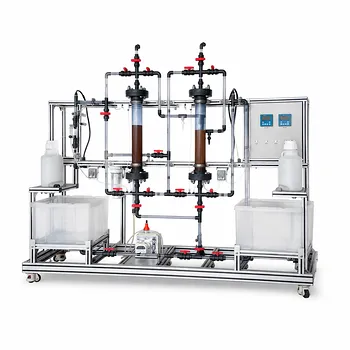
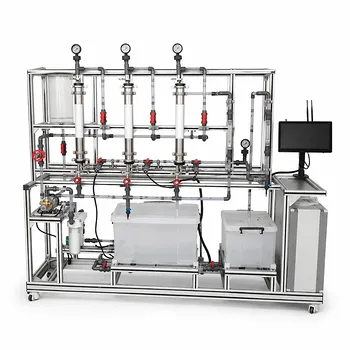
Ion Exchange Water Purification Educational Pilot Plant for Engineering Unit Operations

Ion Exchange Water Purification Educational Pilot Plant for Engineering Unit Operations

This bench-scale ion exchange pilot plant trains engineering students in water purification. Dual transparent columns simulate industrial softening and demineralization. Students observe fluid dynamics, perform resin regeneration, and analyze breakthrough curves. The corrosion-resistant frame ensures durability in unit operations experiments.

Educational Rotary Disc Liquid-Liquid Extraction Pilot Plant

Educational Rotary Disc Liquid-Liquid Extraction Pilot Plant

A transparent rotary disc column for educational liquid-liquid extraction experiments. This pilot plant enables students to study mass transfer, droplet dynamics, and flooding behavior, bridging theory and practice in chemical engineering unit operations education. Features variable-speed agitation and PLC control.

Electrolyte Distillation Purification and Formulation Educational Pilot Plant

Electrolyte Distillation Purification and Formulation Educational Pilot Plant

Integrated bench-to-pilot scale educational pilot plant for electrolyte distillation, purification, and formulation with borosilicate glass construction, PLC automation, touchscreen HMI, and advanced industrial safety features for hands-on chemical process training, ideal for chemical engineering and materials science curricula.

Photocatalytic Membrane Separation and Degradation Unit Operations Pilot Plant

Photocatalytic Membrane Separation and Degradation Unit Operations Pilot Plant

Bench-scale pilot plant integrating photocatalytic degradation with membrane separation for engineering education. Study advanced oxidation, microfiltration, and hybrid processes using industrial sensors. Features safety light-blocking curtain, low-noise compressor, and durable stainless-steel construction.

Constant Pressure Filtration Educational Unit Operations Pilot Plant

Constant Pressure Filtration Educational Unit Operations Pilot Plant

Hands-on educational pilot plant for constant pressure filtration. Classic plate and frame filter press allows students to study kinetics, determine specific cake resistance, perform cake washing and evaluate washing rates. Ideal for chemical engineering curriculum. Mobile, customizable, safety-compliant design.

Multi Functional Catalytic Reaction and Reactor Evaluation Educational Unit Operations Pilot Plant

Multi Functional Catalytic Reaction and Reactor Evaluation Educational Unit Operations Pilot Plant

Bench-scale educational pilot plant for catalytic reaction and reactor evaluation, integrating fixed bed, fluidized bed, and stirred tank reactors. Students compare reactor designs, evaluate catalysts, and study reaction kinetics and hydrodynamics. Perfect for unit operations labs in chemical engineering curricula.

Alkaline Membrane Water Electrolysis Educational Pilot Plant Unit Operations Training System

Alkaline Membrane Water Electrolysis Educational Pilot Plant Unit Operations Training System

Hands-on educational pilot plant for alkaline membrane water electrolysis hydrogen production, integrating unit operations training with industrial PLC control, real-time data logging, customizable design, durable 316L stainless steel construction, explosion-proof safety, and modern 5G connectivity for university laboratories.

Multi-Stage Stirred Tanks in Series Residence Time Distribution and Mixing Performance Determination Educational Pilot Plant

Multi-Stage Stirred Tanks in Series Residence Time Distribution and Mixing Performance Determination Educational Pilot Plant

Explore residence time distribution and mixing performance in series stirred tanks with this educational pilot plant. Real-time conductivity sensors, interactive 3D simulation, and industrial-grade PC for chemical engineering lab training. Customizable to curricula.

Residence Time Distribution and Reactor Flow Characteristics Determination Educational Pilot Plant

Residence Time Distribution and Reactor Flow Characteristics Determination Educational Pilot Plant

This versatile educational pilot plant is designed for comprehensive study of residence time distribution and reactor flow characteristics, featuring multiple CSTRs in series, a tubular reactor, variable recycle loop, and automated real-time data acquisition, perfect for hands-on chemical engineering education.

Multifunctional Membrane Separation Educational Pilot Plant with Ultrafiltration, Nanofiltration, Reverse Osmosis

Multifunctional Membrane Separation Educational Pilot Plant with Ultrafiltration, Nanofiltration, Reverse Osmosis

An integrated laboratory bench-scale membrane separation system for higher education engineering labs combining Ultrafiltration, Nanofiltration, and Reverse Osmosis processes. Features industrial PLC control with touch-screen HMI, transparent piping, and academic assessment software. Ideal for chemical and environmental engineering curricula.

Educational Compression Refrigeration Performance Determination Unit Operations Pilot Plant

Educational Compression Refrigeration Performance Determination Unit Operations Pilot Plant

This educational pilot plant for compression refrigeration performance determination offers dual COP evaluation, regenerative cycle comparison, and calorimeter calibration. Customizable for curriculum integration, it features environmentally conscious design. Supports thermodynamic mapping on pressure-enthalpy diagrams and synchronous monitoring with centralized instrumentation.

Potassium Salt Thermal Dissolution and Crystallization Separation Educational Unit Operations Pilot Plant

Potassium Salt Thermal Dissolution and Crystallization Separation Educational Unit Operations Pilot Plant

This educational pilot plant allows chemical engineering students to perform potassium salt thermal dissolution and cooling crystallization experiments, integrating solubility studies, supersaturation control, and solid-liquid separation in a safe, compact, and customizable laboratory system for hands-on unit operations learning.

Carbon Dioxide Absorption and Desorption Educational Pilot Plant for Carbon Capture Studies

Carbon Dioxide Absorption and Desorption Educational Pilot Plant for Carbon Capture Studies

Explore carbon dioxide absorption and desorption with this educational pilot plant. Transparent columns visualize mass transfer; electric heating simulates industrial solvent regeneration; touchscreen interface enables data monitoring. Ideal for chemical engineering, bridging theory and practice.

Carbon Dioxide Hydrogenation Methanol Synthesis Educational Unit Operations Pilot Plant

Carbon Dioxide Hydrogenation Methanol Synthesis Educational Unit Operations Pilot Plant

Pilot-scale educational system for carbon dioxide hydrogenation to methanol. Designed for unit operations teaching, it features a fixed-bed reactor, three-stage heating, dual mass flow controllers, and a 15.6-inch touchscreen with data acquisition. Perfect for chemical engineering and sustainable energy courses.

Multi-Functional Membrane Separation Educational Pilot Plant for Unit Operations Lab

Multi-Functional Membrane Separation Educational Pilot Plant for Unit Operations Lab

The Multi-functional Membrane Separation Educational Unit Operations Pilot Plant is an integrated bench-scale laboratory system designed for teaching undergraduate engineering education. It features Ultrafiltration, Nanofiltration, and Reverse Osmosis modules in a compact, mobile unit for practical hands-on learning.

General Purpose Cosmetics Production Unit Operations Training Pilot Plant

General Purpose Cosmetics Production Unit Operations Training Pilot Plant

Integrated pilot-scale cosmetics production training plant for chemical engineering education featuring utility supply emulsification blending and filtration modules with dual touchscreen manual control customizable mobile design ideal for practical hands-on unit operations and advanced process control learning.

Tubular Reactor Flow Characteristics Determination Educational Unit Operations Pilot Plant

Tubular Reactor Flow Characteristics Determination Educational Unit Operations Pilot Plant

Educational pilot plant for investigating tubular reactor flow characteristics and residence time distribution Features adjustable recycle for plug flow and backmixing studies industrial touchscreen interface and real-time data acquisition Ideal for chemical engineering unit operations laboratory training and education

Carbon Dioxide PVT Curve Determination Educational Unit Operations Pilot Plant

Carbon Dioxide PVT Curve Determination Educational Unit Operations Pilot Plant

Enable hands-on learning of thermodynamic principles with this carbon dioxide PVT curve determination pilot plant. Students visualize critical opalescence, phase transitions, and generate P-V isotherms across liquid, gas, and supercritical regions. Robust safety features, adaptable for university engineering labs.

Dual-Mode Rectification Pilot Plant for Practical Training Unit Operations

Dual-Mode Rectification Pilot Plant for Practical Training Unit Operations

Industrial-scale dual-mode rectification pilot plant for chemical engineering practical training. Features real-material and simulated-material operation modes, sieve-plate column with sight glasses for visual observation of hydrodynamics, and customizable SCADA control for safe, hands-on learning of unit operations and mass transfer.

Methanol Synthesis and Catalyst Performance Evaluation Educational Unit Operations Pilot Plant

Methanol Synthesis and Catalyst Performance Evaluation Educational Unit Operations Pilot Plant

Bench-scale methanol synthesis and catalyst evaluation educational pilot plant for chemical engineering labs to study catalytic kinetics, high-pressure operations, process control, and unit operations under realistic conditions with industrial safety features, precision gas delivery, data acquisition, and intelligent monitoring.


Leave Your Message