The short answer is that the simple goal of “keeping the heat in” evolves into a sophisticated study of energy management.
In basic calorimetry, you wrap a foam cup around a beaker to create a near-adiabatic environment. In chemical engineering unit operations, that same principle is scaled up and taught not as perfect insulation but as quantifying and optimizing heat flow. Students work with pilot-scale reactors equipped with vacuum jackets, industrial insulation, and heat exchangers to measure heat losses, calculate overall heat transfer coefficients, and evaluate a reactor’s thermal efficiency under real-world conditions.
The educational leap lies in shifting the student’s focus from preventing heat loss to predicting and managing it. The foam cup becomes a system of sensors, insulation, and active heat exchange—all designed to teach future engineers how to design energy-efficient chemical processes, not just run an ideal experiment.
From the Lab Bench to the Pilot Plant: A Shift in Mindset
The calorimeter in your chemistry class measured the heat of reaction by assuming the surroundings lost nothing. A pilot plant reactor cannot afford that fiction; it must control and measure exactly where every joule goes.
The Calorimeter’s Core Assumption: An Adiabatic World
A student calorimeter is deliberately simplified. Air gaps, plastic insulation, and a small scale make heat loss negligible enough to ignore. The lesson is clean thermodynamics. In chemical manufacturing, that flat assumption is dangerously expensive. Real reactors lose, gain, and recover heat continuously, and ignoring that reality leads to energy waste or runaway reactions.
Why Scaling Up Changes Everything
A ten-fold increase in vessel size gives a hundred-fold increase in surface area for heat loss. Insulation alone becomes less effective. You must now manage conduction, convection, and radiation simultaneously. The teaching objective pivots from a yes/no question—“Did we insulate it?”—to a systematic inquiry: “How fast is the heat escaping, where is it going, and can we use it productively?”
The Toolkit of Industrial-Scale Heat Management
Pilot plants replace the foam cup with a multilayered approach to thermal control. Each piece of equipment teaches a distinct unit operations concept.
Vacuum-Jacketed Reactors: The Evolution of the Foam Cup
The direct scale-up of the double-beaker is a vacuum-jacketed vessel. By evacuating the space between two walls, you eliminate conduction and convection through air. This mimics an ideal insulated laboratory system but on a process scale. Students see that industrial reactors often use this, especially in batch processes where heat must be held constant for reaction selectivity.
Beyond Insulation: Active Heat Exchange
Insulation only slows down loss; it doesn’t stop it forever. Industrial reactors integrate shell-and-tube or plate heat exchangers to remove or add heat deliberately. The lesson here is that minimizing loss is passive, but true energy efficiency requires active recovery. Students pump heating fluids through jackets or external exchangers and learn to maximize energy integration—for instance, using the hot product stream to pre-heat incoming reactants.
Instrumentation: Making the Invisible Visible
The foam cup has no sensors. The pilot plant overflows with them. Students install temperature probes at multiple points, flow meters, and power monitors. The core hands-on exercise becomes an energy balance: you measure energy in (electric heater, steam), energy out (product stream, cooling water), and declare any difference as “losses,” which then get the focus of improvement.
How This Is Taught in Unit Operations Labs
Modern chemical engineering curricula use these systems to embed practical thermodynamics in a way a textbook cannot replicate.
From Preventing Losses to Calculating Coefficients
The primary technical exercise is calculating the overall heat transfer coefficient (U). Students run a hot fluid through a reactor, track the temperature drop over time, and use Fourier’s law to back-calculate U. They quickly learn that U is not a fixed constant—it degrades with fouling, changes with agitation speed, and varies across the vessel wall. This demystifies a term they may have treated as a simple lookup value in a design problem.
Simulating Real-World Energy-Saving Practices
Advanced labs then vary parameters to mimic industrial optimization. How does switching from a turbine impeller to a paddle affect heat transfer? What if the jacket water flow rate drops by 20%? Students collect data, plot energy efficiency curves, and confront the same trade-off a plant engineer faces: faster mixing can improve heat transfer but costs more electricity. The goal is to minimize total energy consumption, not just heat loss.
Understanding the Trade-Offs
Objective instruction means acknowledging that perfect heat conservation is never the right answer. There are always practical and economic limits that a good unit operations course must highlight.
The Cost of Precision
A vacuum-jacketed reactor with a computer-controlled heat exchanger is orders of magnitude more expensive than a simple stirred tank. Students must learn to ask: “How much heat loss is acceptable for this process?” For a commodity chemical, the payback on advanced insulation may never come. The lesson matures from “minimize” to “optimize for net present value.”
When Insulation Isn’t Enough
For highly exothermic reactions, insulation can be dangerous. It traps heat, leading to thermal runaway. Here, the teaching flips completely: you don’t minimize heat loss; you design an emergency cooling system to dump heat as fast as possible. Students run simulations with reaction calorimeters that deliberately lose heat at a controlled rate, learning to size relief systems.
Making the Right Choice for Your Learning Goal
Your approach to the lab should reflect what you aim to internalize, whether you’re a student or an instructor designing the curriculum.
- If your primary focus is mastering heat transfer fundamentals: Spend most of your time on the steady-state experiments. Methodically measure U-values under varying stirrer speeds and jacket temperatures until the relationship between fluid dynamics and thermal resistance becomes intuitive.
- If your primary focus is process design and energy integration: Zero in on the transient experiments and the energy balance spreadsheet. Practice identifying the “losses” term and proposing practical retrofits, like adding a heat exchanger on the effluent stream.
- If your primary focus is safety and scale-up: Run the exothermic reaction scenarios that push the system towards runaway. Use the data to calculate the maximum safe operating temperature and the minimum cooling duty required.
The transition from a foam cup to a pilot plant is not just about bigger equipment—it’s a complete re-engineering of how you think about energy, moving from an ideal world of perfect insulation to the real world of measured, managed, and deliberately exchanged heat.
Summary Table:
| Feature | Lab-Scale Calorimetry | Pilot-Scale Unit Operations |
|---|---|---|
| Primary Goal | Prevent and ignore heat loss | Quantify, manage, and optimize heat flow |
| Equipment Used | Foam cup, simple beaker | Vacuum-jacketed vessels, heat exchangers |
| Key Technical Metric | Temperature change (ideal adiabatic) | Heat transfer coefficient ($U$), energy balance |
| Process Control | Passive containment | Active utility flow, agitation, energy recovery |
Elevate Your Chemical Engineering Lab with LABPARK
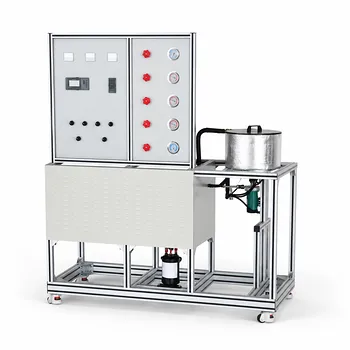
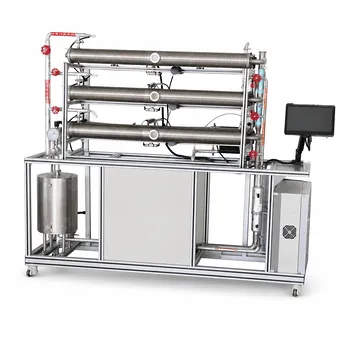
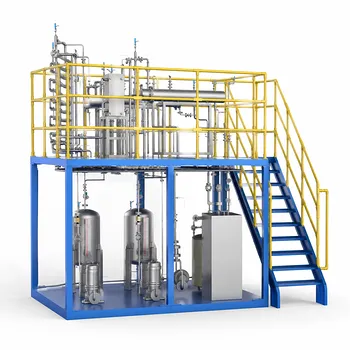
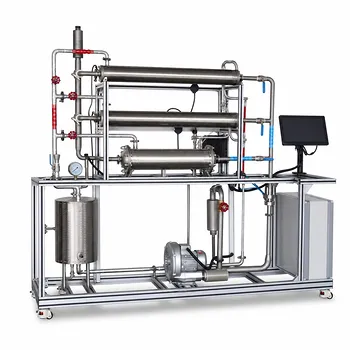
Transitioning from theoretical thermodynamics to practical industrial scale-up requires robust, high-fidelity equipment. LABPARK provides premium Educational and Vocational Unit Operations Pilot Plants in chemical engineering, bioprocess & biotech, and environmental & water treatment.
Whether you are designing a curriculum for a university, conducting applied research in an institute, or training personnel in an enterprise, our pilot plants empower students and engineers to master heat transfer coefficients, energy integration, and reactor dynamics on industrial-grade instrumentation.
Ready to upgrade your lab's training capabilities? Contact LABPARK today to explore our tailored pilot plant solutions!
Related Products
- Educational Compression Refrigeration Performance Determination Unit Operations Pilot Plant
- Multi-Reactor Educational Pilot Plant for Reaction Engineering Unit Operations
- Fixed-Bed Chemical Reaction and Gas Dust Tar Removal Unit Operations Pilot Plant
- Multi Functional Catalytic Reaction and Reactor Evaluation Educational Unit Operations Pilot Plant
- Tubular Reactor Flow Characteristics Determination Educational Unit Operations Pilot Plant
People Also Ask
- Why Switch Unit Operations Flow Configurations? Impact on Experimental Measurements
- Why is distinguishing between elastic and plastic deformation critical? Prevent tablet capping.
- How is unsteady-state flow analyzed & taught? Master Transient Systems in Unit Ops
- What are the differences between set-point, servo, and program control? Master unit operations training.
- How to use pilot plants to estimate gas compression costs? Master scale-up economics.