The ability to switch between co-current and counter-current flow transforms a unit operations pilot plant from a static demonstration into a dynamic investigative tool. This single design feature allows students and researchers to directly measure how flow direction dictates the temperature driving force, heat or mass transfer efficiency, and ultimately the performance of the process. By alternating between configurations and capturing real-time data from temperature sensors and flow meters, the pilot plant turns abstract thermodynamic equations into tangible, verifiable experimental evidence.
Co-/counter-current switching makes the logarithmic mean temperature difference (LMTD) a hands‑on measurement, not a textbook abstraction. It reveals that flow direction can dramatically alter efficiency – or, in the special case of condensing steam, leave it completely unchanged. This is the laboratory moment where theory meets measurement.
Why Flow Direction Dictates Transfer Performance
The direction in which two fluids or streams move relative to each other sets the thermal or concentration gradient that drives the separation or exchange. A training unit must be able to explore this fundamental relationship.
The Thermodynamic Driving Force
In any heat or mass exchanger, the rate of transfer is proportional to the average driving force. For heat exchangers, that is the logarithmic mean temperature difference (LMTD).
Under counter-current flow, the hot and cold streams travel in opposite directions. This maintains a large, relatively uniform temperature difference along the entire length, yielding a higher LMTD for the same inlet and outlet conditions. It is, thermodynamically, the most efficient configuration.
Co-current flow, where streams move in the same direction, creates a very large temperature difference only at the inlet. The driving force then decays sharply, resulting in a lower LMTD and a lower theoretical maximum heat transfer.
The Phase‑Change Anomaly
When one fluid undergoes a phase change – such as saturated steam condensing at a constant temperature – the rules change completely. Because the temperature of the condensing fluid does not vary along the exchanger, the LMTD for co-current and counter-current flow becomes identical.
This is a profound insight that no lecture can fully convey until a student toggles the valves on the pilot plant, watches the temperatures, and sees that the measured duty does not shift as expected. The switch makes this counter‑intuitive equality a real observation.
How Switching Configurations Reshapes Experimental Measurements
When a single unit can be reconfigured, the laboratory becomes a controlled comparison engine. The measurements stop being about finding a single number and start being about quantifying the difference that flow direction makes.
Real‑Time Verification of Temperature Profiles
With temperature sensors placed along the flow path, switching modes shows exactly how the temperature crossover potential differs. In a counter-current exchanger, the cold fluid outlet can be warmer than the hot fluid outlet – a thermodynamic possibility that co-current flow can never achieve. Students measure the actual outlet temperatures and verify the deviation from co‑current limits, reinforcing why counter‑current exchangers are smaller and more effective for a given duty.
Quantifying Performance Metrics
By simultaneously logging inlet/outlet temperatures and flow rates from the pilot plant’s instrumentation, users calculate:
- Actual heat duty for each configuration.
- Overall heat transfer coefficient, testing whether it remains constant or varies due to changes in fluid properties.
- LMTD directly from logged temperatures, then comparing the measured efficiency to the ideal maximum.
The ability to rapidly switch and remeasure under identical inlet conditions isolates flow direction as the sole variable, turning the experiment into a clean, high‑confidence comparison.
Observing Non‑Idealities
Real equipment rarely behaves like a textbook. Switching flow direction can reveal fouling asymmetries, flow maldistribution, or end‑effect losses that would stay hidden in a fixed‑direction setup. For instance, a sudden change in pressure drop when alternating flow can signal early channel blockage. These observations teach diagnostic skills that go far beyond routine efficiency checks.
Understanding the Trade‑offs of the Switchable Design
Adding the ability to switch requires additional piping, valves, and transitions. That introduces extra pressure drop, potential leak points, and a slightly more complex control scheme. The training unit is not an industrial‑optimized exchanger; it is an educational instrument where diagnostic flexibility is prioritized over raw efficiency.
It is also critical to remember that this feature is not universal across all unit operations. In drying pilot plants, co‑current flow may be chosen specifically to protect heat‑sensitive solids from high inlet temperatures, while counter‑current is needed to achieve very low final moisture content. In multi‑effect evaporators, co‑current (forward) feed simplifies liquid transfer by using pressure differences, while counter‑current feed keeps the concentrated liquid at a high temperature, maintaining a better heat transfer coefficient – but requires intermediate pumps. A switchable‑configuration training unit lets students map these design compromises directly onto their own experimental data.
Making the Right Choice for Your Educational Goal
The value of the switching feature depends on the core lesson you want the pilot plant to teach. Use it strategically.
- If your primary focus is teaching core heat transfer fundamentals: Prioritize a heat exchanger module with switchable flow and high‑accuracy resistance temperature detectors (RTDs) at multiple points. The LMTD comparison becomes the centerpiece of the lab.
- If you need to demonstrate product‑quality impacts (e.g., drying, thermal degradation): Ensure the dryer or evaporator module can be run in both co‑ and counter‑current modes. Students can then measure final moisture content, degradation products, or heat‑transfer coefficients and link them to the flow direction.
- If you want to challenge students with advanced dynamics and energy‑mass balances: A multi‑effect evaporator with switchable feed direction forces them to analyze pressure profiles, pumping requirements, and temperature‑concentration interactions across effects.
A pilot plant that lets you change the direction of flow does not just demonstrate a concept – it forces you to measure it from every angle, turning a passive observation into an active investigation of process principles.
Summary Table:
| Parameter | Co-Current Flow Configuration | Counter-Current Flow Configuration |
|---|---|---|
| Thermodynamic Driving Force (LMTD) | Lower (decays sharply along the length) | Higher (remains relatively uniform) |
| Heat Transfer Efficiency | Lower theoretical maximum | Highest efficiency configuration |
| Temperature Crossover | Impossible (cold outlet cannot exceed hot outlet) | Possible (cold outlet can be warmer than hot outlet) |
| Phase-Change (e.g., Saturated Steam) | Identical LMTD compared to counter-current | Identical LMTD compared to co-current |
Elevate Your Chemical Engineering Lab with LABPARK
Bridge the gap between thermodynamic theory and physical measurement. LABPARK designs and manufactures high-performance Educational and Vocational Unit Operations Pilot Plants for chemical engineering, bioprocess & biotech, and environmental & water treatment systems.
Our advanced training systems feature flexible co-current and counter-current switching, high-precision instrumentation, and real-time data logging, helping universities, research institutes, and enterprises deliver hands-on, industry-relevant training.
Ready to upgrade your lab's capabilities? Contact LABPARK today to discuss your training requirements.
Related Products
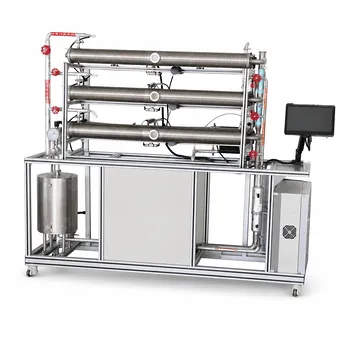
- Three-Tube Heat Transfer Educational Pilot Plant for Unit Operations Training
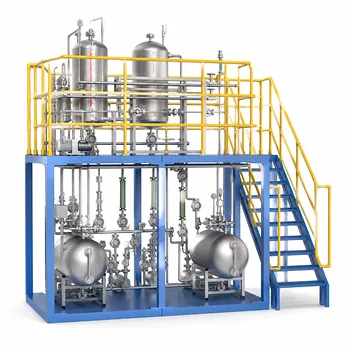
- Multi-Modal Distillation Unit Operations Training Pilot Plant
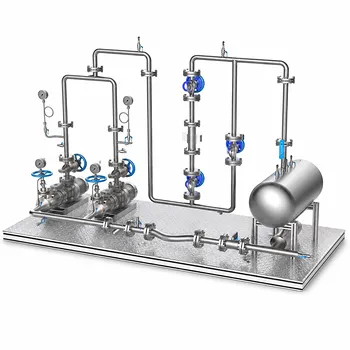
- Multi Pump Fluid Transport Process Piping Unit Operations Training Pilot Plant
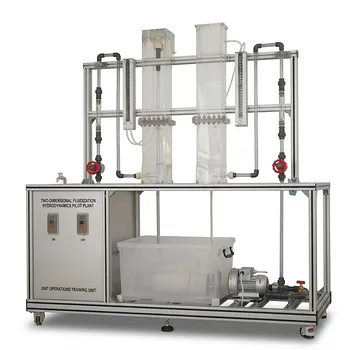
- Two-Dimensional Fluidization Hydrodynamics Educational Pilot Plant for Unit Operations Training
- Fluid Transport and Piping Dynamics Practical Training Unit Operations Pilot Plant
People Also Ask
- When is ε-NTU preferred over LMTD in pilot plants? Predict heat exchanger performance without iteration.
- Why is emissivity critical in heat transfer pilot plants? Bridge the Gap Between Theory & Industrial Design
- How can a heat transfer pilot plant demonstrate waste heat recovery? Learn to optimize industrial thermal systems.
- How does cascade control achieve superior disturbance rejection in heat transfer pilot plants?
- What engineering trade-offs must students analyze in a heat transfer pilot plant? Balance performance & cost.