If you can’t tell the difference between elastic and plastic deformation, you will never reliably solve tablet capping or lamination at scale. In a tablet compression pilot plant, distinguishing between these two behaviors lets you directly predict whether a formulation will form a robust, intact tablet or fracture under internal stress. Elastic deformation is the enemy of tablet strength because it stores energy that snaps bonds upon decompression, while plastic deformation is the permanent particle flattening that creates the bonding surface needed for durable tablets.
The core insight: A pilot plant exists to reveal how much of your total compaction energy goes into useless elastic recovery versus strength-building plastic flow. Without isolating these mechanisms, you’re just watching powder turn into broken tablets without knowing why—or how your equipment parameters must change to fix it.
The Fundamental Mechanics of Compaction
Understanding deformation behavior isn’t just academic; it’s the difference between a profitable batch and a rejected one. To operate a pilot press intelligently, you need to read what the powder is telling you during compression and ejection.
The Two Faces of Particle Response
Under the compressive load of the punches, every particle experiences a mix of elastic and plastic deformation. Elastic deformation is the immediate, reversible shape change—like a spring compressing. When the load is removed and the tablet leaves the die, those particles fight to return to their original shape, creating internal stresses that can crack the tablet.
Plastic deformation is the permanent, irreversible shape change that occurs when the yield strength of the material is exceeded. This is the mechanism that actually locks particles together. It creates broad, intimate contact areas where intermolecular forces can form strong bonds that survive decompression.
Why the Transient Rearrangement Matters
Before any real deformation begins, particles first go through a critical rearrangement phase. Small particles slide into the voids between larger ones, packing the powder bed more densely. This phase is entirely governed by particle morphology. Spherical particles flow and pack efficiently with minimal effort, requiring less subsequent deformation to achieve a solid compact.
Irregular, needle-shaped particles, on the other hand, create temporary mechanical interlocks during this packing stage. Those interlocks often rely on elastic flexing of the particle asperities. When the load comes off, those slender particle features spring back, undoing the interlock and creating stress concentration points that can nucleate cracks.
The Cost of Ignoring Deformation Behavior
If you treat all compaction as simply “squeezing powder hard enough,” you’ll inevitably face the two most stubborn tablet defects at pilot scale: capping and lamination.
Capping and Lamination as Elastic Failure Signatures
Capping is the separation of the tablet’s top or bottom crown from the band, while lamination is horizontal splitting within the tablet body. Both are classic indicators of excessive stored elastic energy. When the tablet is ejected and the axial load vanishes, particles with a high elastic component abruptly expand. This expansion is non-uniform—it’s fastest at the tablet’s edges and surfaces where the die wall constraint is first lost.
That differential strain creates a tensile stress wave that travels through the tablet. If the weak, newly formed bonds between particles can’t resist that stress, the structure fails, and a cap lifts off. A pilot plant makes these failures visible in slow motion, under controlled compression forces and punch speeds.
Why Hardness Measurements Alone Are Misleading
A hardness tester only tells you the tablet’s residual strength after ejection. It doesn’t tell you if you’re dangerously close to the fracture threshold because of high elastic recovery. Two tablets can have identical final hardness, but one may contain latent micro-cracks from elastic springback that will cause catastrophic failure during coating or packaging. Distinguishing deformation types lets you assess the tablet’s true structural integrity, not just its post-ejection survival.
Diagnosing and Mitigating Elastic Recovery in a Pilot Plant
The pilot press is your diagnostic tool. You can manipulate three key levers to shift the balance from elastic toward plastic deformation, and you can directly observe the results.
Managing Compression Force and Dwell Time
Increasing the main compression force can push more particles past their yield point into the plastic region. But brute force alone often fails for elastic materials because it also stores more elastic energy. The smarter pilot-plant adjustment is to increase dwell time—the duration the powder spends under maximum compression. This can be achieved by slowing the turret speed or using a pre-compression stage.
Extended dwell gives viscoelastic materials time to flow plastically, relaxing the stored elastic stresses before ejection. At pilot scale, you can quantify this by correlating punch speed changes with defect incidence, creating a process window that the primary reference rightly identifies as critical for ensuring mechanical strength.
Formulation as a Plasticity Engineer
The pilot plant lets you rapidly screen excipient blends that act as “plasticity donors.” Microcrystalline cellulose, for example, undergoes extensive plastic deformation and creates a dense, well-bonded matrix. By adding such materials, you absorb and redistribute the elastic energy from brittle or highly elastic active pharmaceutical ingredients (APIs).
The supplementary references highlight that particle shape directly influences the initial packing arrangement. This is your starting point. Pre-treatment unit operations like granulation can transform needle-like API crystals into more spherical, free-flowing agglomerates. This doesn’t just improve packing—it often reduces the high initial elastic deflection caused by slender particle fragments, lowering the total elastic recovery post-compression.
Understanding the Trade-offs
An objective advisor must highlight that pursuing plasticity at all costs introduces its own risks. Every formulation strategy has a downside that a pilot-plant operator must manage.
The Brittleness-Plasticity Paradox
Highly plastic materials bond beautifully, but they can also lead to tablet sticking. As the particle surface flows permanently under pressure, it can deform into the microscopic asperities of the punch face, creating a mechanical interlock that makes ejection difficult. You must distinguish this from insufficient lubrication to avoid adding the wrong fix.
Additionally, while spherical granules improve packing and reduce elastic springback, over-granulating can make particles so hard and resistant to further plastic deformation that you lose bonding capability entirely. The granules may pack perfectly but then fail to deform at all under pressure, resulting in a weak, friable tablet that abrades easily. The goal is not zero elasticity, but a careful balance where plastic deformation dominates enough to build a stable structure that can survive a small, controlled amount of elastic recovery.
Making the Right Choice for Your Goal
Use your pilot-plant experiments to pinpoint the deformation signature of your formulation and then match your equipment and parameters to that reality.
Here is how to apply this understanding based on your primary challenge:
- If your primary focus is eliminating capping defects: Decouple the compression event from the ejection stress. Start by lowering the turret speed to increase dwell time and allow plastic flow to relax internal elastic stresses. Pair this with a pre-compression force that provides a gentle de-aeration and packing stage to minimize air entrapment and its subsequent violent expansion.
- If your primary focus is scaling a fragile, elastic API: Shift your pilot-plant resources toward formulation design, not just higher compaction pressures. Screen high-plasticity binders that will coat the elastic API particles and absorb their springback. Use the pilot runs to validate that a pre-blend granulation step converts the API’s needle-like habit into more compactable agglomerates.
- If your primary focus is maximizing production speed: Accept that high speed shrinks dwell time, which favors elastic materials. You must proactively engineer your formulation to be insensitive to this. Use the pilot press at maximum speed to conduct a push test: identify the minimum amount of a highly plastic excipient needed to reach your hardness target at that speed without capping.
Your pilot plant is not just a smaller production machine; it is your microscope for observing the hidden duel between elastic recovery and permanent bonding that decides every tablet’s fate.
Summary Table:
| Deformation Type | Key Characteristic | Impact on Tablet Strength | Mitigation Strategy |
|---|---|---|---|
| Elastic | Reversible shape change (energy storage) | Causes internal stress, capping, and lamination | Increase dwell time; add plasticity donors |
| Plastic | Permanent, irreversible shape change | Creates intermolecular bonds and structural strength | Optimize compression force and granulation |
Scale Up Your Chemical & Pharmaceutical Engineering Workflows
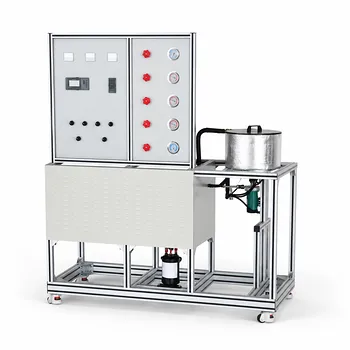
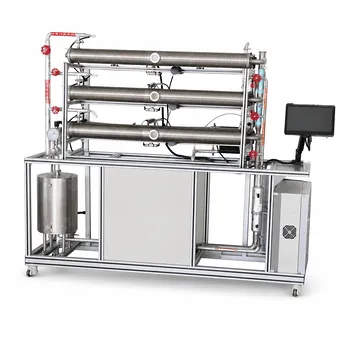
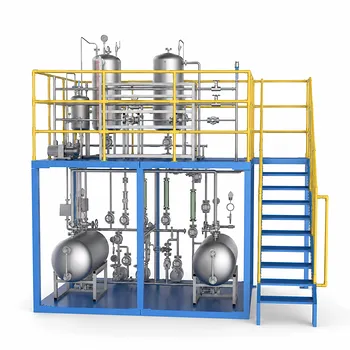
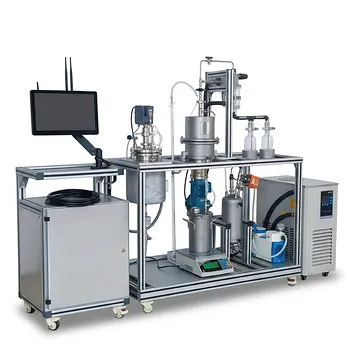
Are you looking to bridge the gap between laboratory theory and industrial-scale production? LABPARK provides state-of-the-art Educational and Vocational Unit Operations Pilot Plants in chemical engineering, bioprocess & biotech, and environmental & water treatment for universities, research institutes, and enterprises.
Our pilot scale equipment allows students and researchers to master crucial unit operations—from powder compression to advanced chemical processes.
Contact LABPARK today to request a quote or custom consultation!
Related Products
- Educational Compression Refrigeration Performance Determination Unit Operations Pilot Plant
- Constant Pressure Filtration Educational Unit Operations Pilot Plant
- Multimodal Absorption and Desorption Pilot Plant for Unit Operations Training
- Natural Product Extraction Unit Operations Training Pilot Plant
- Multi Functional Membrane Crystallization Educational Unit Operations Pilot Plant
People Also Ask
- Why Switch Unit Operations Flow Configurations? Impact on Experimental Measurements
- How is unsteady-state flow analyzed & taught? Master Transient Systems in Unit Ops
- What are the differences between set-point, servo, and program control? Master unit operations training.
- How to use pilot plants to estimate gas compression costs? Master scale-up economics.
- How do students monitor and control cycles of concentration to prevent scale in cooling tower pilot plants?