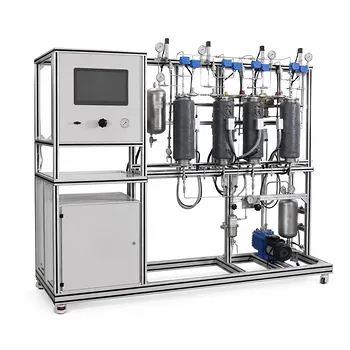
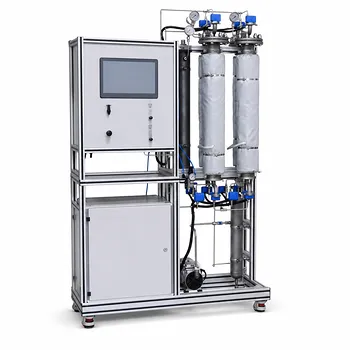
The answer lies in bridging the gap between idealized thermodynamic theory and chaotic physical reality. Activity coefficients for binary mixtures are the critical numerical translation factor that allows you to predict, with accuracy, how a real chemical mixture will behave inside a pilot-scale distillation column or extraction unit. By determining these coefficients, you move beyond guessing to precisely calculate the driving force for separation—enabling the design of columns with the correct number of stages, the optimization of energy-intensive reflux ratios, and the validation of why actual separation efficiency deviates from the ideal.
The core problem in pilot-plant operation is that molecules do not behave ideally. Activity coefficients are the quantitative measure of that non-ideality, making them the essential bridge for scaling up molecular thermodynamics into controlled, observable unit operations research.
Quantifying Real-World Phase Behavior
Before a drop of liquid is heated or mixed in a pilot plant, you need a reliable map of how components interact. Activity coefficients build this map for non-ideal systems.
The Limitation of Ideal Models
Ideal mixture assumptions, like Raoult’s Law, ignore intermolecular forces. In the real world, solutions contract or expand, and heat is released or absorbed upon mixing.
When you study a system like n-hexane and 2-propanone, the hydrogen bonding of the alcohol creates significant non-ideality. An ideal model fails completely here, leading to gross errors in predicting when a vapor phase will form and what its composition will be.
Linking Fugacity to Observables
Separation processes are governed by the isofugacity criterion. For vapor-liquid equilibrium (VLE), the fugacity of a component in the vapor phase must equal its fugacity in the liquid phase.
The liquid-phase fugacity is directly proportional to the activity coefficient. By analyzing how the ratio of these coefficients changes with mole fraction and temperature, you capture the exact molecular forces that determine relative volatility—the very phenomenon that makes separation possible.
Driving Distillation Column Design and Operation
A distillation column is a physical manifestation of VLE. Activity coefficients are the primary input that dictates its size and operational parameters.
Calculating the Height of Separation
The goal of a pilot-plant column is to achieve a specific purity. To do this, you must calculate the number of theoretical stages.
Using a thermodynamic framework like Wilson or NRTL to determine activity coefficients allows you to plot a precise equilibrium curve. This curve is then used in the McCabe-Thiele method to step off the required number of stages, giving you a non-negotiable target for column height and packing density.
Optimizing the Energy Input
The reflux ratio is the primary energy sink in distillation. Operating at too high a ratio wastes energy; too low fails to meet purity goals.
An accurate activity coefficient model lets you find the minimum reflux ratio precisely. This enables you to set the pilot plant’s operating reflux to a safe, cost-effective multiple—typically 1.2 to 1.5 times the minimum—directly impacting the heat duty of the reboiler.
Guiding Liquid-Liquid Extraction Strategies
When components are heat-sensitive or have close boiling points, extraction becomes the preferred unit operation. Here, the isoactivity relationship rules.
Predicting Partitioning and Solvent Selection
In extraction, a solute distributes between two liquid phases. Equilibrium is reached when the product of solute concentration and its activity coefficient is equal in both phases.
By predicting these coefficients, you calculate the partition coefficient (distribution ratio) . This essential metric instantly tells you if a particular solvent—be it toluene for a neutral organic or water for salts—will effectively pull the solute from the feed, guiding the very first step of pilot plant design.
Sizing the Contactor
Just as with distillation, the number of equilibrium stages defines the size of the mixer-settler or extraction column. The activity coefficients derived from models like NRTL or UNIQUAC feed directly into the material balance for a multi-stage counter-current operation.
This ensures that the pilot plant isn’t just a demonstration tool, but a scalable experiment that provides the partition data needed to specify industrial-scale contactors.
Understanding the Trade-offs
No determination of activity coefficients is free from complexity. Acknowledging the limitations is what transforms simulation data into trusted pilot-plant results.
Model Selection is a Minefield
The choice of thermodynamic framework is a high-stakes decision. Classic models like Margules or Van Laar often fail catastrophically for polar or associating mixtures, giving wildly inaccurate predictions.
Even powerful local-composition models like Wilson, NRTL, and UNIQUAC have distinct strengths and weaknesses. Selecting the wrong binary interaction parameters, or using a model that predicts false liquid-liquid splits, will render your pilot plant a validation of a simulation error, not a faithful scale-up tool.
The Danger of Azeotropy and Criticality
Determining activity coefficients reveals the existence of azeotropes—points where the liquid and vapor compositions are identical. At an azeotrope, the relative volatility locks to 1.0, and standard distillation hits a wall.
For a pilot-plant operator, this knowledge is a preemptive safety gauge. By understanding where the azeotropic locus meets the mixture’s critical conditions, you prevent sudden phase transitions or operational dead-zones, ensuring the experiment doesn't end in a non-converging batch or unsafe pressure build-up.
How to Apply This to Your Project
The value of a pilot plant lies in its ability to de-risk industrial scale-up. The depth of your activity coefficient analysis should match your specific research objective.
- If your primary focus is screening separation technologies: Use group contribution models like UNIFAC for a rapid, first-pass estimate of activity coefficients to flag potential azeotropes or difficult extractions before investing in a physical pilot run.
- If your primary focus is precise column or contactor design: Invest time in regressing experimental pilot-plant VLE data to refine binary interaction parameters (e.g., for NRTL or Wilson equations), ensuring your process simulation exactly mirrors the physical equipment’s performance.
- If your primary focus is process scale-up and debottlenecking: Use the hazard-free environment of the pilot plant to deliberately explore boundary conditions predicted by your activity coefficient model, such as flooding points or maximum feasible purity, to create a reliable performance envelope for the full-scale operation.
Empirical validation in a pilot plant turns the abstract mathematics of activity coefficients into the practical mechanics of separation, giving you the confidence to build industrial systems on a foundation of sound thermodynamic truth.
Summary Table:
| Unit Operation | Thermodynamic Challenge | Role of Activity Coefficients |
|---|---|---|
| Distillation | Non-ideal VLE & azeotropes | Dictates theoretical stage calculations & minimum reflux ratios |
| Extraction | Phase partitioning & solvent choice | Determines distribution ratio & guides contactor column sizing |
| Scale-up | Deviations from ideal models | Prevents simulation errors & defines safe operating envelopes |
Bridge the Gap Between Theory and Scale-Up with LABPARK
Ready to elevate your engineering research and training? LABPARK provides premium Educational and Vocational Unit Operations Pilot Plants in chemical engineering, bioprocess & biotech, and environmental & water treatment.
We empower universities, research institutes, and enterprises to physically validate thermodynamic models, de-risk scale-up, and train the next generation of engineers with hands-on, reliable systems.
Contact LABPARK today to discuss your custom pilot plant requirements!
Related Products
- Liquid-Liquid Mass Transfer Coefficient Determination Educational Pilot Plant
- Educational Compression Refrigeration Performance Determination Unit Operations Pilot Plant
- Ternary Liquid-Liquid Equilibrium Educational Pilot Plant
- Comprehensive Heat Transfer Coefficient Determination Educational Unit Operations Pilot Plant
- Binary System Vapor Liquid Equilibrium Data Determination Educational Unit Operations Pilot Plant
People Also Ask
- Why Compare Membrane-Reservoir Models with Pilot Plant Data? Ensure Successful Process Scale-Up
- How does column packing affect absorption intensification, and how is it evaluated experimentally?
- What are the limitations of the Wilke-Chang correlation? Avoid critical mass transfer errors.
- What is the role of the Sherwood number ($Sh$) in pilot plants? Master mass transfer scale-up
- Why is the calculation of gas and liquid diffusion coefficients critical? Unlock Accurate Pilot Plant Scale-Up