The efficiency of every distillation column and gas absorber in your pilot plant hinges on a single, often underestimated, molecular property: the diffusion coefficient. Calculating gas and liquid diffusion coefficients is critical because they define the fundamental speed limit of mass transfer in separation processes. Without them, you cannot accurately model concentration profiles, size equipment, or determine whether the gas film, liquid film, or both are throttling your column’s performance. These calculations transform raw pilot plant data into the scalable design parameters—like the height of a transfer unit (HTU) and the number of transfer units (NTU)—that validate industrial designs.
Far from being just a textbook exercise, calculating diffusion coefficients is the diagnostic key that unlocks your pilot plant’s data. They directly dictate the mass transfer coefficient (k) and the overall rate equation, enabling you to pinpoint the rate-limiting resistance and apply the correct scale-up correlations—even as flow regimes shift from trickle to pulse flow.
From Molecular Motion to Pilot Plant Performance
The Physics of Separation: Why Diffusion Matters
At its core, every mass transfer unit operation relies on molecules moving from one phase to another across a concentration gradient. The diffusion coefficient quantifies how fast that random molecular walk occurs. When mass transfer is the rate-limiting step—as it often is in gas absorption, distillation, and liquid-liquid extraction—this single parameter controls how quickly components can separate.
The primary methods for estimation, such as Fuller-Schettler-Giddings for gases and Wilke-Chang for liquids, translate fundamental properties like temperature, pressure, viscosity, and molar volume into a usable diffusion coefficient. These calculations allow you to predict how the process will behave at the pilot scale before you even run the equipment.
Connecting Coefficients to Column Design (HTU/NTU)
Once you have the diffusion coefficient, you can calculate the mass transfer coefficient (k or K). In an absorption column, for example, the overall gas-phase mass transfer coefficient relates directly to the height of a transfer unit (HTU). The formula is simple: HTU = (Gas flow rate) / (Overall mass transfer coefficient × Interfacial area).
By measuring inlet and outlet concentrations in your pilot plant, you determine the number of transfer units (NTU). Multiplying NTU by HTU gives the required packed height. So, if your diffusion coefficient is off, your calculated mass transfer coefficient is wrong, and your column design becomes a guess—invalidating the entire purpose of the pilot trial.
Decoding the Rate-Limiting Step
Identifying the Controlling Resistance
The overall mass transfer coefficient (K) acts as a chain of resistances: 1/K = 1/kg + 1/kl, where kg is the gas-phase coefficient and kl is the liquid-phase coefficient. The smaller coefficient dominates. Calculating liquid and gas diffusion coefficients tells you where the steepest resistance gradient lies. If your liquid-phase diffusion coefficient is exceptionally small (e.g., in viscous or complex solvents), then kl is low, and the liquid film controls the overall rate. That insight tells you to focus pilot plant trials on increasing liquid turbulence or interfacial area.
The Role of Flow Regimes and Hydrodynamics
Diffusion coefficients feed into volumetric mass transfer coefficients, which are highly sensitive to the flow regime—trickle, bubbly, pulse, or spray. For example, standard correlations for mass transfer coefficients can fail completely in the trickle flow regime. By calculating the base diffusion coefficient first, you can then use pilot plant data to map how the effective coefficient changes with gas and liquid velocities, helping you identify regime transitions and apply the correct mathematical model. Without that foundational calculation, you risk analyzing data with an invalid correlation.
Practical Calculation and Real-World Constraints
When Theory Meets Reality: Experimental Verification
Pilot plants exist to test theory. Comparing your calculated diffusion coefficients against experimentally measured mass transfer rates (from concentration differences and flow rates) reveals whether the real system follows the Wilke-Chang or Fuller-Schettler-Giddings prediction. This verification step is what teaches students and engineers the physical limitations of separation equipment—where edge effects, maldistribution, or non-idealities start to dominate.
The Limits of Computational Simulations
Even advanced CFD models and molecular simulations face challenges. Experimental diffusion data for methane at varying densities, for instance, show that while computer simulations using specific potentials can agree well with data, predicting transport coefficients in dense or complex states remains difficult. This is precisely why pilot plants are indispensable. By calculating and validating diffusion coefficients at the pilot scale, you build a reliable bridge between simulation and full-scale design, knowing when to trust the digital model and when the physical trial must lead.
Understanding the Trade-offs
Correlation-based methods are fast but imperfect. The Wilke-Chang correlation relies on a solvent “association factor”—a fudge factor that can introduce error. Viscosity, molar volume, and temperature-sensitivity further compound uncertainty. In gas-phase systems, the Fuller-Schettler-Giddings method ignores polar interactions that can be critical. Operating a pilot plant with only a rough estimate is still better than no estimate, but operators must recognize that a poorly chosen correlation can cascade into an incorrect pack height or flooding point calculation.
Moreover, knowing the diffusion coefficient alone doesn’t solve everything. A high diffusion coefficient is useless if interfacial area is lost due to maldistribution or if the wrong flow regime chokes performance. The coefficient quantifies the molecular potential; the pilot plant reveals the hydrodynamic reality. The criticality lies in combining both.
Making the Right Choice for Your Pilot Plant Goals
The role of diffusion coefficient calculation shifts depending on your primary objective. Tailor your focus accordingly.
- If your primary focus is accurate scale-up: Calculate gas and liquid diffusion coefficients to derive reliable mass transfer coefficients, then validate them against pilot-scale HTU/NTU data to create a design rule that scales confidently to production.
- If your primary focus is troubleshooting column performance: Use calculated diffusion coefficients to back-calculate individual phase resistances and identify whether gas-film or liquid-film control is the bottleneck; adjust packing, velocities, or temperature accordingly.
- If your primary focus is educational or research insight: Teach the calculation process to expose the direct link between molecular properties and macroscopic separation efficiency, using pilot plant experiments to demonstrate when idealized models break down.
- If your primary focus is model validation: Compare experimental diffusion measurements from your pilot plant with computational predictions to define the operating envelope where simulations can safely replace physical trials.
The diffusion coefficient is the silent, molecular-scale governor of every mass transfer pilot plant. Calculate it with rigor, and your pilot data transforms from a set of pressure gauges and flow readings into a predictive, scalable engineering tool.
Summary Table:
| Aspect | Primary Estimation Method | Impact on Pilot Plant Operations |
|---|---|---|
| Gas Diffusion | Fuller-Schettler-Giddings | Determines gas-phase resistance and gas-film HTU in absorption columns. |
| Liquid Diffusion | Wilke-Chang | Identifies liquid-phase resistance; critical for high-viscosity solvents. |
| Column Sizing (HTU/NTU) | Mass Transfer Correlations | Translates molecular diffusion rates into required physical packing height. |
| Flow Regimes | Hydrodynamic Mapping | Distinguishes molecular diffusion potential from bulk hydrodynamic limitations. |
Optimize Your Chemical Engineering Lab with LABPARK
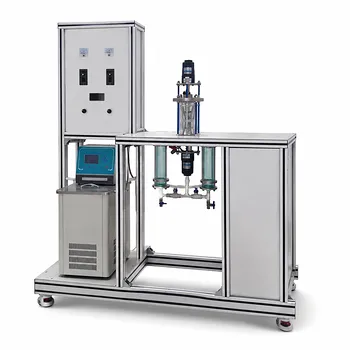
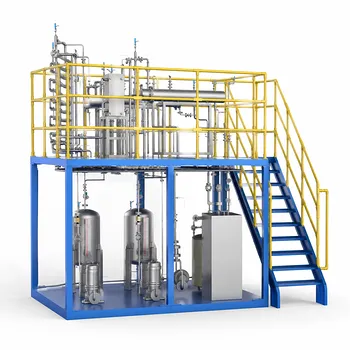
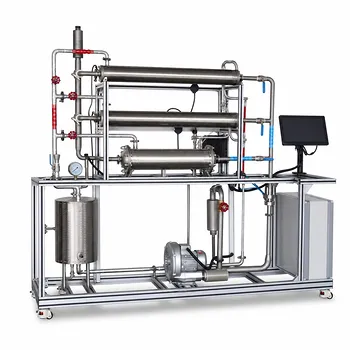
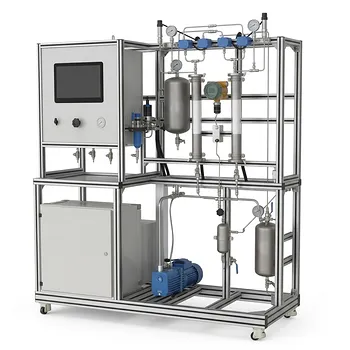
Are you looking to bridge the gap between theoretical calculations and real-world industrial practice? LABPARK provides state-of-the-art Educational and Vocational Unit Operations Pilot Plants in chemical engineering, bioprocess & biotech, and environmental & water treatment for universities, research institutes, and enterprises.
Our pilot-scale distillation, absorption, and extraction systems are engineered to help you accurately measure transport phenomena, validate thermodynamic models, and train the next generation of engineers.
Contact LABPARK today to find the perfect pilot plant solution for your lab!
Related Products
- Multimodal Absorption and Desorption Pilot Plant for Unit Operations Training
- Dual-Mode Rectification Pilot Plant for Practical Training Unit Operations
- Absorption and Desorption Educational Unit Operations Pilot Plant
- High-Gravity Emulsification and Mass Transfer Educational Pilot Plant
- Liquid-Liquid Mass Transfer Coefficient Determination Educational Pilot Plant
People Also Ask
- How do predictive thermodynamic models integrate into pilot plants? Bridging Theory and Practice
- Which cross-validation strategy should be selected for pilot plant time-series & batch data? Avoid Data Leakage
- Why Use Center Points in Process Analyzer Calibration? Key Benefits Explained
- How can process control schemes be configured to teach basic and advanced control?
- How does polyphosphate hydrolysis affect scale and corrosion in pilot plants? Essential Monitoring Guide