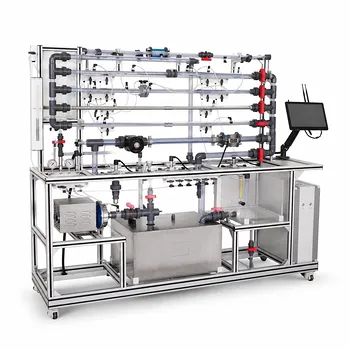
The secret to teaching process control isn’t software simulation alone—it’s the ability to touch, configure, and challenge a real physical system.
You can configure basic control strategies on a unit operations pilot plant by using pre-built PID algorithms for standard loops like flow, level, and cascade control. For advanced strategies, you write custom logic through graphical programming blocks or a dedicated control programming language, then compile, download, and test your own algorithms on live hardware.
A unit operations pilot plant is a configurable learning platform. It starts with standard configurations that teach core feedback, cascade, and feedforward principles, then scales to custom-coded advanced strategies (ratio, split-range, model-based) to develop true engineering judgment. The physical plant’s design rules, batch sequencing, and integrated Quality-by-Design demonstrations turn abstract theory into a visceral, high-impact learning experience.
Scaffolding Control Education: From Standard to Custom Loops
The Role of Standard Configurations in Basic Control
Most pilot plant software comes with a library of pre-built PID algorithms. Instructors can rapidly set up classic single-loop feedback control for flow, liquid level, or temperature without any programming.
This “click-configure-test” workflow lets students compare open-loop versus closed-loop behavior in minutes. They see steady-state offset, oscillation, and setpoint tracking on real pipes and vessels, which builds an intuitive feel for PID tuning far beyond a textbook.
Cascade control becomes tangible. For example, regulating reactor jacket temperature based on inner reactor temperature is just a matter of nesting two PID blocks—students directly observe how the secondary loop isolates the primary loop from utility-side disturbances.
Feedforward-feedback control is equally immediate. By linking a disturbance measurement (like feed flowrate) to a feedforward summer block before the feedback controller, the plant shows how corrective action starts before an error even appears. The pre-built structure handles the linear combination; the student provides the insight.
Customizing Strategies for Advanced Control Concepts
When the curriculum moves beyond standard structures, the pilot plant’s true flexibility emerges. Ratio control for precise chemical dosing or split-range control for heating/cooling is rarely a pre-built block—it must be created.
Users build these strategies inside integrated graphical programming environments. They drag and drop function blocks (multipliers, selectors, ramps) and wire them together, then compile the logic into real-time controller code. This teaches the step-by-step reasoning of industrial control design without low-level coding overhead.
For deeper algorithmic work, a dedicated control programming language (often IEC 61131-3 compliant) opens the door to custom PID variants, dead-time compensators, or model-predictive elements. Students write, download, and debug their code against a physical process—where a logic mistake can overshoot a real tank level, not just a simulation variable.
This dual path—graphical for rapid prototyping, text-based for deep customization—mirrors industry practice. It builds a skill set that transfers directly to plant-floor engineering.
The Physical Plant as a Teaching Tool: Design Rules and Integration
Fundamental Design Rules for Stable Control
A pilot plant’s hardware layout is a silent teacher. The single control valve rule on any process stream prevents students from creating competing loops that would mask their own control decisions.
Interface control is forced by design: wherever a gas‑liquid or liquid‑liquid boundary must be maintained, a level controller is present. Students don’t just learn the concept—they see the consequence of a poorly tuned level loop on downstream separation.
Valve placement reinforces hydraulics. A control valve on the pump discharge rather than the suction side protects the system; students measure pressure drops and cavitation risks to understand why.
These embedded design rules ensure that when a student configures a control loop, it operates in a physically coherent environment. The plant doesn’t let you cheat—it exposes why industrial practice evolved the way it did.
Incorporating Energy and Material Balance Studies
The overall material balance is set by a flow regulator or ratio flow controller on the main feed stream. This single-point control allows students to explore how disturbances propagate and how inventory control stabilizes the entire process.
A growing number of pilot plants feature interchangeable flow control methods: a traditional control valve versus a variable-frequency drive (VFD) on the pump. Students can run side-by-side experiments, measuring pressure drop, power consumption, and control responsiveness.
This turns an abstract economic trade-off into a concrete lab exercise. They’ll see that a VFD saves energy by avoiding frictional losses but may introduce different dynamic responses or electrical harmonics. The control scheme—where the PID output goes to a valve positioner or a VFD frequency setpoint—is simply reconfigured in the software, making the comparison seamless.
Beyond Continuous Control: Batch and Quality-by-Design
Implementing Batch Control with the S88 Standard
Many unit operations are inherently batch-oriented: startup, dosing, reaction, shutdown. Modern pilot plants align with IEC 61512 (ISA S88), introducing a structural hierarchy from recipes to equipment phases.
The control system combines continuous regulatory controllers (temperature, pressure) with discrete sequence logic managed by a Programmable Logic Controller (PLC). Students configure the recipe phases—e.g., opening an isolation valve, ramping a temperature setpoint, holding until a condition is met—and the PLC executes them.
This bridges the gap between continuous control theory and the reality that most high-value products are made in batches. Students learn how a single PID loop can serve multiple purposes under the command of a sequence, and how batch tracking for quality data ties directly to regulatory compliance.
Demonstrating Feedforward Control and Quality-by-Design (QbD)
Pilot plants can vividly demonstrate Quality by Design (QbD). The system is configured with flexible feedforward paths that accept raw material property inputs—like particle size or solvent purity—and adjust process setpoints automatically.
Students solve model equations (first-principles, empirical, or hybrid) that link raw material attributes to required process conditions. They see how, if the feed composition shifts, the control scheme changes a reaction temperature or crystallization cooling rate to keep the final quality on target.
This is not a simulation. Real-time spectral or physical sensors provide the feedforward signal; the control loop corrects in real time. It ingrains the principle that a fixed process recipe is fragile—a flexible, model-driven control scheme is robust.
Understanding the Trade-offs
A pilot plant’s flexibility is its greatest strength and its biggest pitfall. Too many configurable options can overwhelm a beginner, turning a simple flow-control exercise into a 30-minute clicking marathon. A carefully scaffolded curriculum is essential—start students on a “locked” configuration with only a few tuning parameters exposed, then progressively unlock complexity.
Real hardware introduces real friction. Sensors drift, valves stick, pumps cavitate. This is excellent for teaching process troubleshooting but can derail a tight class schedule. Plan buffer time for hardware hiccups; they are part of the lesson.
The control valve versus VFD comparison teaches energy efficiency but comes with a nuance: a VFD’s dynamic response can be slower or exhibit non-linearities at low speeds, complicating control tuning. The educational value is high, but the instructor must bridge theory and practical limitation.
Batch control complexity grows quickly. The sequence logic itself can become a programming project, potentially overshadowing the control tuning objectives. Use predefined phase templates early on, then let students edit them once the regulatory control concepts are solid.
Safety is a hard constraint. When students write custom code, a logic error can cascade. Pilot plants must have physical overrides (relief valves, hardwired e-stop) and software limits that are not student-configurable. This teaches industrial safety culture but also requires supervision.
Making the Right Choice for Your Educational Goal
Identify what you need students to walk away with, then match the plant’s configuration depth and hardware complexity.
- If your primary focus is introductory process control: Use the pre-built PID library and stick to standard single-loop and cascade demonstrations. Lock most software options and let students experience clear cause-and-effect on a simple, robust system.
- If your primary focus is advanced control engineering: Invest in a plant with full graphical and text-based programming capability. Have students design custom feedforward, ratio, and split-range schemes from scratch, then test them against real process disturbances.
- If your primary focus is batch manufacturing or pharma QbD: Select a plant that follows ISA S88 and supports flexible feedforward from quality sensors. Run exercises where students define recipes, sequence logic, and model-based corrective actions on the fly.
- If your primary focus is process optimization and energy management: Choose a system with interchangeable valve/VFD flow control. Design experiments that directly compare energy consumption, controllability, and overall economics, linking control decisions to operational cost.
A well-configured unit operations pilot plant does not just demonstrate control algorithms—it forces students to confront the physical, economic, and safety dimensions that make those algorithms meaningful.
Summary Table:
| Control Level | Configuration Method | Key Control Strategies | Educational Focus |
|---|---|---|---|
| Basic Control | Pre-built PID algorithm library | Flow, level, cascade, & feedforward | PID tuning, loop behavior, & tracking |
| Advanced Control | Graphical blocks & custom programming | Ratio, split-range, model-based, & batch S88 | Control logic design & system optimization |
Bring Industrial-Grade Process Control into Your Lab
Bridge the gap between control theory and physical reality with LABPARK. We provide cutting-edge Educational and Vocational Unit Operations Pilot Plants in chemical engineering, bioprocess & biotech, and environmental & water treatment, specifically designed for universities, research institutes, and enterprises.
Empower your students and researchers to configure, code, and test real-world control strategies on live physical systems. Contact LABPARK today to explore our customizable pilot plant solutions!
Related Products
- General Purpose Cosmetics Production Unit Operations Training Pilot Plant
- Multi-Reactor Educational Pilot Plant for Reaction Engineering Unit Operations
- Multi-Functional Drying Educational Unit Operations Pilot Plant
- Multimodal Absorption and Desorption Pilot Plant for Unit Operations Training
- Dual-Mode Rectification Pilot Plant for Practical Training Unit Operations
People Also Ask
- How do deviations in estimating latent heat impact pilot plant thermal systems? Avoid hardware mis-sizing.
- Why is the chemical plant startup schedule crucial? De-risk scale-up with pilot plants.
- When to transition from PID to adaptive control in pilot plants? Key process indicators.
- Why Compare Predicted and Experimental Excess Enthalpy? Key to Accurate Pilot Plant Scale-up
- How to study gasification in pilot plants? Compare exit gas composition & efficiency